Choosing the right subwoofer is crucial for achieving deep and powerful bass that enhances your audio experience, whether you’re enjoying music or watching films. A quality subwoofer can transform your sound system, delivering the thumping lows that make everything sound richer and more immersive. In this article, we’ll explore some of the best subwoofers available today, what to consider when selecting one, and tips for optimizing your setup for the ultimate listening experience.
Understanding Subwoofer Types
When diving into the world of subwoofers, it’s essential to understand the different types available, as each serves distinct purposes and environments.
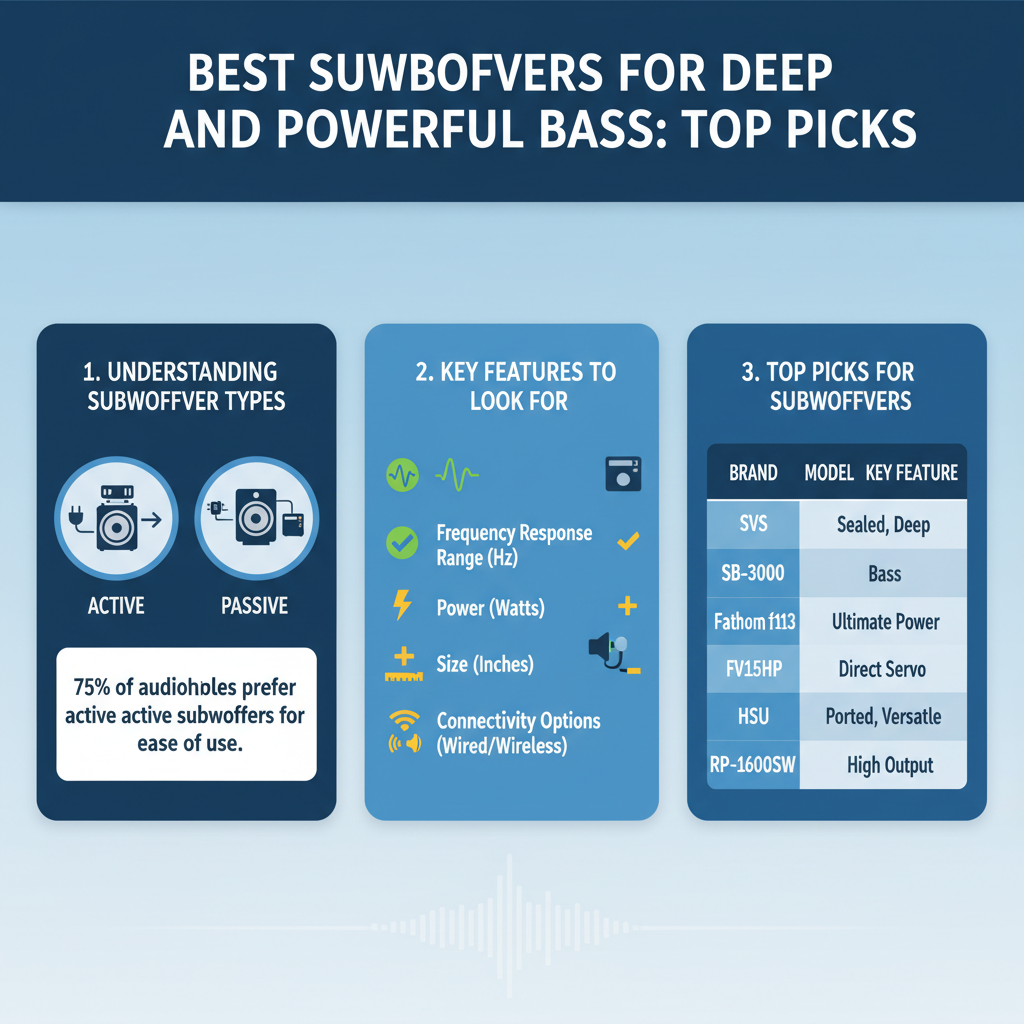
– Passive vs. Active: Passive subwoofers do not come with built-in amplifiers; instead, they require an external amplifier to power them. This can offer flexibility in terms of sound customization and system design but requires a bit more setup knowledge. Active subwoofers, on the other hand, come equipped with their own amplifiers, making them easier to install and use. For most home users, active subwoofers are often the go-to choice due to their convenience and simplicity.
– Ported vs. Sealed: Subwoofers also come in two primary designs: ported and sealed. Ported subwoofers feature a vent or port that allows air to escape, resulting in louder bass output at specific frequencies. This makes them ideal for those who love booming bass in music and movies. Sealed subwoofers, however, are enclosed and tend to produce tighter, more accurate sound without the booming effect. They excel in reproducing low frequencies cleanly, making them a favorite for audiophiles who value precision over volume.
Key Features to Look For

When shopping for a subwoofer, there are several critical features to consider to ensure you get the best performance for your needs.
– Power Handling: Understanding the power handling capabilities of a subwoofer is vital. Look for both RMS (Root Mean Square) and peak power ratings. RMS indicates the continuous power the subwoofer can handle without distortion, while peak power refers to the maximum level it can handle in short bursts. A good rule of thumb is to choose a subwoofer with an RMS rating that matches or exceeds your amplifier’s output for optimal performance.
– Frequency Response: The frequency response range of a subwoofer indicates its ability to reproduce low-end sounds. Generally, a subwoofer should ideally have a frequency response of around 20Hz to 200Hz for deep and powerful bass. The lower the frequency it can reach, the more depth it can add to your music and movies, especially for genres that utilize deep bass lines or sound effects.
Top Picks for Subwoofers
Here are our top picks for subwoofers that deliver deep and powerful bass, perfect for enhancing any audio experience.
– SVS SB-1000 Pro: This compact powerhouse is highly regarded for its impressive bass output, making it an excellent choice for both music and home theater environments. With advanced DSP controls and a frequency response down to 20Hz, the SB-1000 Pro offers versatility and incredible sound quality. Its small footprint allows for easy placement in various room sizes without compromising performance.
– Klipsch R-120SW: Known for its stylish design and strong performance, the Klipsch R-120SW is a fantastic option for home theaters. It features a 12-inch front-firing driver and a powerful built-in amplifier, delivering deep, punchy bass that can fill a room. Plus, its sleek appearance ensures it blends seamlessly with your home decor.
Setting Up Your Subwoofer
Proper setup can make all the difference in your subwoofer’s performance. Here are some tips to help you optimize your audio experience.
– Placement Tips: The placement of your subwoofer is key to achieving the best bass response. Ideally, you should position it in a corner or against a wall to reinforce the sound and create a fuller bass effect. However, it’s also important to experiment with different locations to find the best spot for your specific room acoustics. A technique called the “subwoofer crawl” involves placing the subwoofer in your listening position, then crawling around the room to find where the bass sounds best, allowing you to place the subwoofer in that ideal location.
– Calibration: Once your subwoofer is in place, calibrating it with your audio system is crucial for achieving the best sound quality. Most modern receivers come with automatic calibration systems that can help adjust levels and delay settings based on your room’s acoustics. However, fine-tuning manually can also yield excellent results, allowing you to adjust the crossover frequency and phase settings for a more cohesive sound.
Budget-Friendly Options
You don’t have to spend a fortune to get a great subwoofer. Here are some budget-friendly options that still deliver impressive performance.
– Polk Audio PSW10: This entry-level subwoofer is a favorite among many for its solid bass performance at an affordable price. With a 10-inch driver and a power output of 50 watts RMS, the PSW10 can fill a small to medium-sized room with satisfying low-end sound. It’s an excellent choice for those new to home audio without breaking the bank.
– Yamaha NS-SW050: Known for its compact design, the Yamaha NS-SW050 is perfect for smaller spaces. Despite its size, it offers efficient bass reproduction, making it a great choice for apartments or smaller rooms. With Yamaha’s exclusive Twisted Flare Port technology, this subwoofer minimizes port noise and distortion, ensuring clear and powerful bass.
Maintenance and Troubleshooting
Maintaining your subwoofer is important to ensure it continues to perform at its best. Here are some tips for upkeep and troubleshooting.
– Regular Checks: Periodically check the connections and settings of your subwoofer. Loose cables or incorrect settings can lead to poor performance or distortion. It’s a good practice to inspect the wiring and connections to ensure everything is secure and functioning properly.
– Common Issues: If you’re experiencing distortion or connectivity issues, first check your connections and ensure your subwoofer is powered on. Additionally, if you’re hearing rattling or buzzing sounds, it may indicate that the subwoofer is receiving too much power or is placed too close to a wall. Adjusting the volume or moving the subwoofer slightly can often resolve these issues.
User Reviews and Recommendations
Hearing from actual users can provide valuable insights into how subwoofers perform in real-world settings.
– Real Experiences: Many users rave about the clarity and depth provided by models like the SVS SB-1000 Pro, highlighting its ability to handle movie soundtracks and music with equal finesse. Others praise the Klipsch R-120SW for its stylish design and powerful output, making it a great conversation piece as well as a sound enhancer.
– Expert Opinions: Audio experts often recommend subwoofers based on their intended use, with the SVS SB-1000 Pro frequently appearing on lists for high-end home audio setups. For budget-conscious buyers, the Polk Audio PSW10 is commonly highlighted as an excellent entry-level option that balances performance and price effectively.
Summarizing the best subwoofers for deep and powerful bass, it’s clear that options range widely in features, pricing, and performance. Each of the subwoofers discussed offers unique benefits, whether you’re after high-end performance or a budget-friendly choice. By understanding the different types of subwoofers, their features, and how to set them up properly, you can elevate your audio experience and enjoy your favorite music and movies like never before. Explore your options and find the right subwoofer to enhance your sound system today!
Frequently Asked Questions
What should I look for when choosing the best subwoofers for deep and powerful bass?
When selecting a subwoofer for deep and powerful bass, consider key factors such as the subwoofer type (active vs. passive), size (typically measured in inches), power rating (watts), and frequency response range (lower frequencies for deeper bass). Additionally, review the enclosure type (sealed for tight bass, ported for louder bass) and connectivity options to ensure compatibility with your audio system. Features like adjustable crossover frequency and phase control can also enhance your bass experience.
How can I optimize my subwoofer for the best bass performance?
To optimize your subwoofer for the best bass performance, start by placing it in a suitable location in the room—typically in a corner or against a wall to enhance bass response. Adjust the settings on your subwoofer, including the crossover frequency and volume, to match your main speakers. Experiment with different positions and configurations, and consider using a room calibration system or an equalizer to fine-tune the sound for your specific space, ensuring you achieve deep, powerful bass without distortion.
Why do I need a subwoofer for deep bass in my home audio system?
A subwoofer is essential for deep bass because standard speakers often lack the capability to reproduce low-frequency sounds accurately. These low frequencies are crucial for genres like hip-hop, electronic, and cinematic soundtracks, providing a full-bodied audio experience. By adding a subwoofer to your home audio system, you enhance the overall sound quality, making it more immersive and enjoyable, particularly for bass-heavy content.
Which brands are known for producing the best subwoofers for deep bass?
Some of the most reputable brands known for producing high-quality subwoofers for deep bass include SVS, Klipsch, Polk Audio, and REL Acoustics. These brands offer a range of models that cater to different budgets and preferences, ensuring powerful bass performance and durability. Researching customer reviews and expert ratings can help you find the best subwoofer model from these brands that fits your specific needs.
What is the ideal size of a subwoofer for achieving powerful bass in a home theater?
The ideal size of a subwoofer for achieving powerful bass in a home theater typically ranges from 10 to 15 inches, depending on your room size and listening preferences. Larger subwoofers (12-15 inches) produce deeper and more impactful bass, suitable for larger spaces, while smaller models (8-10 inches) may perform well in compact rooms. Ultimately, consider the acoustics of your space and your listening habits to choose the right size that complements your home theater system.
References
- Subwoofer
- https://www.hifiengine.com/manuals/
- https://www.researchgate.net/publication/277272693_The_Influence_of_Bass_Frequency_on_Human_Perception
- https://www.sciencedirect.com/science/article/pii/S0360132311001360
- https://www.aarp.org/home-family/personal-technology/info-2020/best-soundbars.html
- https://www.npr.org/sections/health-shots/2020/07/15/891264166/how-sound-affects-our-brain-and-behavior
- https://www.psychologytoday.com/us/blog/the-optimistic-parent/201707/the-science-sound
- https://www.wired.com/story/soundscapes-creativity/