
Ray tracing significantly enhances video game graphics by simulating realistic lighting, shadows, and reflections, resulting in a more immersive gaming experience. This powerful technology allows developers to create visually stunning environments that feel alive and dynamic. In this article, you will learn how ray tracing works, its impact on visual fidelity, and the challenges it presents for game developers.
What is Ray Tracing?

Ray tracing is a rendering technique used in computer graphics to simulate the way light interacts with objects in a scene. At its core, ray tracing involves tracing rays of light as they travel through a virtual environment, calculating how they bounce off surfaces, refract through transparent materials, and cast shadows. This method allows for incredibly detailed and realistic lighting effects that closely mimic how we perceive light in the real world.
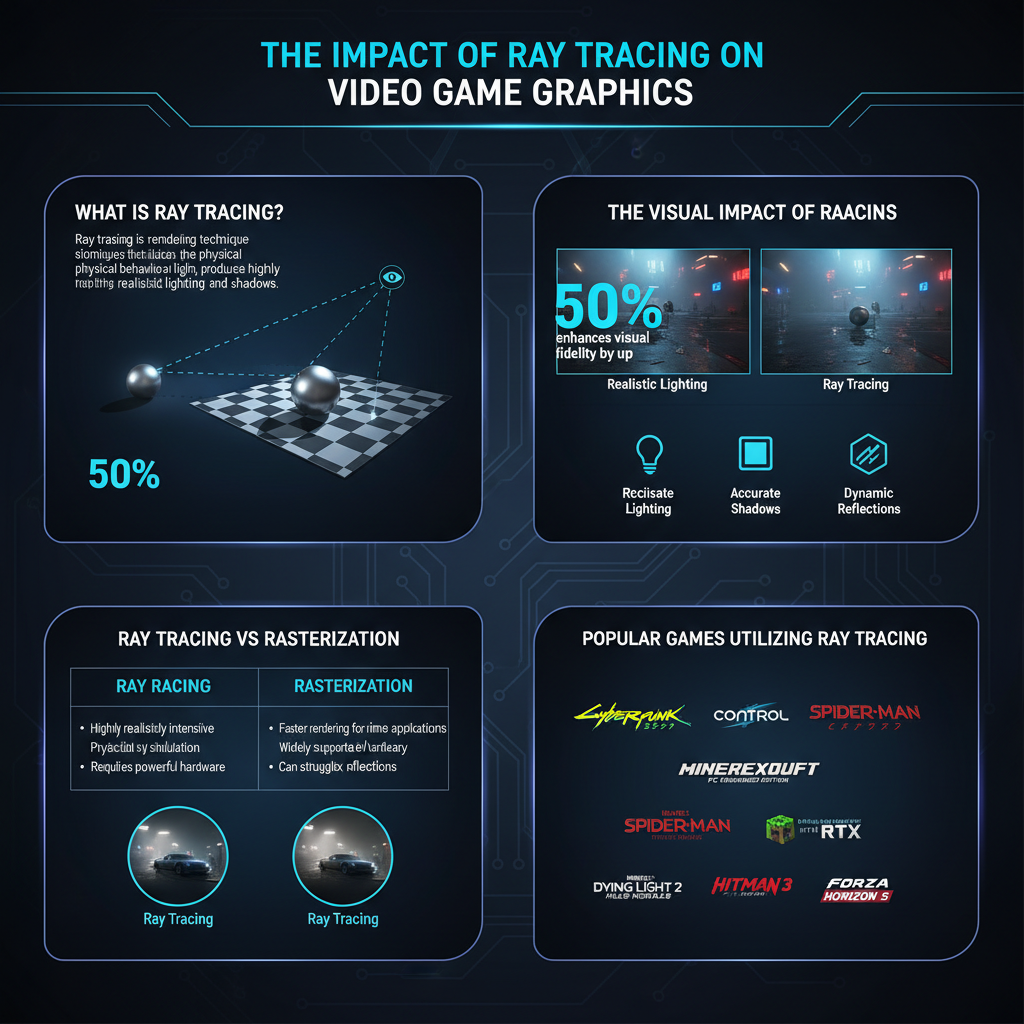
In contrast to traditional rasterization techniques, which rely on approximations to simulate lighting, ray tracing takes a more comprehensive approach. Rasterization works by converting 3D objects into 2D images, applying textures and lighting in a way that often sacrifices realism for speed. While rasterization is generally faster and has been the backbone of real-time rendering for decades, it can struggle to accurately depict complex light interactions, especially in dynamic environments. On the other hand, ray tracing excels in creating lifelike visuals, but at the cost of requiring more powerful hardware to achieve real-time performance.
The Visual Impact of Ray Tracing

One of the most significant benefits of ray tracing is its ability to enhance realism through accurate light behavior. In a ray-traced scene, light behaves as it does in reality: it can scatter, reflect, and refract, resulting in more believable environments. For example, when sunlight passes through a window and illuminates a room, the shadows cast by furniture can have subtle variations in darkness and color, creating depth and atmosphere that rasterized graphics may struggle to replicate.
Additionally, ray tracing dramatically improves shadow quality and depth perception. Shadows are no longer just flat, uniform shapes; they can exhibit soft edges, varying opacity, and intricate details that add to the overall depth of the scene. This enhancement allows players to perceive distances and spatial relationships more intuitively, contributing to a more immersive experience. As players navigate through a game world, they can enjoy a level of visual fidelity that was previously reserved for pre-rendered cutscenes or high-end CGI films.
Ray Tracing vs. Rasterization
When comparing ray tracing to rasterization, several key differences emerge in both rendering techniques and their outcomes. Rasterization is optimized for speed, which is why it has been the go-to method for real-time graphics in video games. It operates by breaking down 3D models into pixels, applying colors, and rendering the final image quickly. However, this method often leads to shortcuts that can compromise visual quality, particularly in areas involving complex light interactions.
Ray tracing, while offering superior visual fidelity, is much more compute-intensive. It processes each individual ray of light and calculates its interactions with various surfaces, which can lead to breathtaking visual results. However, this increased workload can result in longer render times and potentially lower frame rates, which is a significant consideration for game developers aiming to maintain smooth gameplay.
The performance implications of both methods are substantial, especially as the gaming industry pushes for higher resolutions and more intricate graphics. While ray tracing is becoming increasingly feasible with advancements in hardware, many games still utilize a hybrid approach, combining rasterization for base rendering while applying ray tracing selectively for specific effects, such as reflections and ambient occlusion.
Popular Games Utilizing Ray Tracing
Several games have effectively integrated ray tracing technology into their graphics engines, showcasing the stunning visual possibilities it offers. Titles such as “Cyberpunk 2077,” “Control,” and “Minecraft” have embraced ray tracing, transforming their visual aesthetics and enhancing immersion.
In “Cyberpunk 2077,” ray tracing is used to create realistic reflections that react dynamically to the environment. Players can see their surroundings mirrored in puddles and glass surfaces, adding a new layer of depth to the bustling Night City. Similarly, “Control” utilizes ray tracing to enhance its unique architectural environments, making shadows more dynamic and light interactions more engaging.
Even a game as whimsical as “Minecraft” has seen a significant transformation with ray tracing. The addition of ray tracing not only enhances the game’s blocky visuals but also introduces beautiful lighting effects that dramatically alter how players experience the game world. These examples illustrate how ray tracing can elevate visual storytelling, allowing players to connect with game environments on a deeper level.
Challenges and Limitations of Ray Tracing
Despite its impressive capabilities, ray tracing is not without its challenges. One of the most significant hurdles developers face is the technical complexity of implementing ray tracing in a game. The calculations involved in simulating realistic lighting and reflections demand a level of processing power that can strain even the most advanced gaming systems. This means that developers must carefully consider how to optimize performance while still delivering stunning visuals.
Performance considerations are also paramount, as ray tracing can significantly impact frame rates. Many gamers prioritize smooth gameplay over graphical fidelity, making it crucial for developers to find a balance between the two. This often leads to the use of various techniques, such as dynamic resolution scaling or hybrid rendering, to maintain performance while still benefiting from ray tracing’s advantages.
Additionally, hardware requirements can pose a barrier to entry for some gamers. While the latest graphics cards from manufacturers like NVIDIA and AMD have begun to support ray tracing, not all players have access to this cutting-edge technology. This disparity can create a divide in the gaming community, as some players experience the latest graphical advancements while others are left with older, less capable hardware.
The Future of Ray Tracing in Gaming
As the gaming industry evolves, ray tracing technology is set to play an increasingly vital role in shaping the future of video game graphics. Emerging trends suggest that we will continue to see advancements in real-time ray tracing capabilities, making it more accessible to developers and gamers alike. With the ongoing development of graphics cards and enhancements in game engines, the barriers to adopting ray tracing are steadily diminishing.
Predictions for the future indicate that we will see broader adoption of ray tracing in mainstream gaming, with more titles fully leveraging its potential. As hardware improves, even less powerful systems may be able to support ray tracing features, democratizing access to high-quality graphics. Furthermore, as developers become more familiar with integrating ray tracing into their workflows, we can expect to witness innovative applications and creative uses of lighting and shadows that will redefine the visual landscape of gaming.
In conclusion, the integration of ray tracing into video games marks a pivotal shift towards achieving photorealistic graphics. As we’ve explored, while ray tracing offers stunning visual enhancements, it also poses challenges that developers must navigate. Understanding the principles of ray tracing, its impact on visual fidelity, and the ongoing developments in this technology can enhance your appreciation for the graphics of modern games. Stay informed about the latest developments and consider trying out games that utilize ray tracing to experience the next level of graphical fidelity.
Frequently Asked Questions
What is ray tracing and how does it enhance video game graphics?
Ray tracing is a rendering technique that simulates the way light interacts with objects to create highly realistic images in video games. By tracing the path of rays of light as they bounce off surfaces, it produces effects like reflections, refractions, and shadows that are far more lifelike than traditional rasterization techniques. This results in enhanced visual fidelity, making environments appear more immersive and dynamic.
How does ray tracing affect gaming performance on different hardware?
Ray tracing is computationally intensive and can significantly impact gaming performance, especially on lower-end hardware. While modern graphics cards, like NVIDIA’s RTX series or AMD’s RDNA 2 architecture, are designed to handle ray tracing efficiently, players may experience lower frame rates if ray tracing is enabled without sufficient processing power. To enjoy ray tracing without sacrificing performance, gamers should ensure they have a compatible GPU and consider adjusting settings like resolution and ray tracing quality.
Why are developers implementing ray tracing in video games?
Developers are implementing ray tracing to elevate the visual quality of games and provide players with a more immersive experience. The technology allows for realistic lighting and shadow effects that enhance the overall aesthetics of a game, making it more engaging. As gaming hardware evolves, ray tracing has become a standard expectation, pushing developers to adopt this technology to remain competitive in the market.
Which popular video games currently utilize ray tracing technology?
Many popular video games have integrated ray tracing technology to enhance their graphics. Titles like “Cyberpunk 2077,” “Control,” “Minecraft,” and “Call of Duty: Modern Warfare” showcase the stunning visual improvements that ray tracing offers. As more games are released, the trend of adopting ray tracing continues, making it a key feature for gamers looking for cutting-edge graphics.
What are the best settings for optimizing ray tracing in video games?
To optimize ray tracing in video games, gamers should start by adjusting the quality settings based on their hardware capabilities. Lowering the ray tracing quality or resolution can help maintain smoother frame rates. Additionally, enabling features like DLSS (Deep Learning Super Sampling) can improve performance by rendering at a lower resolution and using AI to upscale visuals, allowing for a balance between stunning graphics and gameplay fluidity.
References
- Ray tracing
- https://www.nytimes.com/2020/11/10/technology/ray-tracing-video-games.html
- https://www.sciencedirect.com/science/article/pii/S1877050920301776
- GDC Vault – Awesome Video Game Data 2017
- https://www.bbc.com/news/technology-54513388
- https://www.researchgate.net/publication/332389517_Ray_tracing_for_real-time_rendering_in_video_games