

A global shutter captures an entire image at once, eliminating the distortion commonly caused by the rolling shutter effect found in many cameras. This technology is a game-changer for photographers and videographers alike, especially in scenarios involving fast motion. In this article, you will learn how global shutters work, the advantages they offer, and their impact on photography and videography.
Understanding the Rolling Shutter Effect

The rolling shutter effect occurs when a camera captures an image line-by-line, rather than in a single snapshot. This sequential method of exposure can lead to noticeable distortion, particularly when photographing or filming fast-moving subjects. For instance, if you’re shooting a sporting event where athletes are sprinting across the field, the camera might record different parts of the scene at slightly different times. As a result, the image can appear skewed or warped, with vertical lines bending and objects looking stretched.
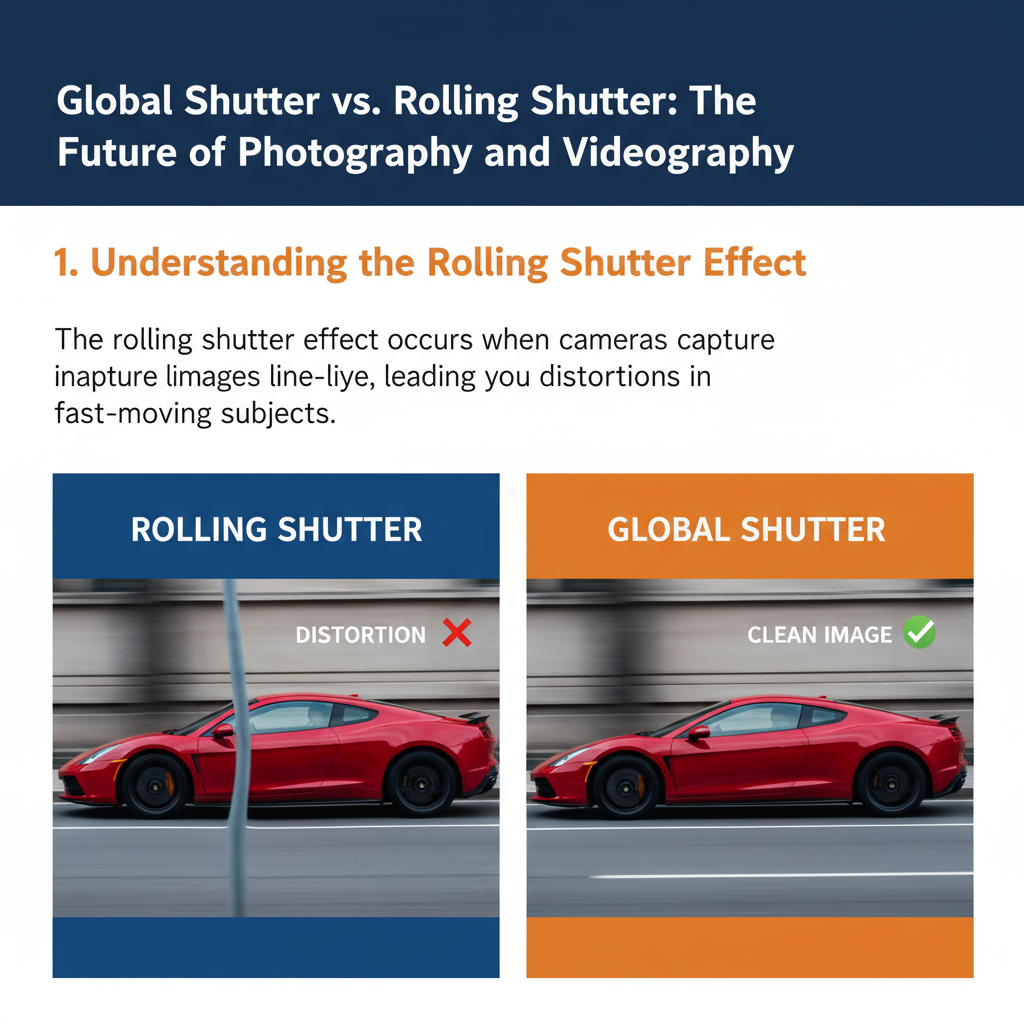
Common scenarios where the rolling shutter effect is particularly troublesome include sports photography, video recordings of rapid movements, and panning shots where the camera moves quickly to follow a subject. This distortion can detract from the overall quality of the image or video, making it less appealing and harder to comprehend. Understanding this effect is crucial for anyone serious about capturing high-quality visuals.

How a Global Shutter Works

A global shutter captures all pixels simultaneously, ensuring that every part of the image is exposed at the same time. This is in contrast to the rolling shutter, which exposes pixels sequentially. The technology behind global shutters relies on specialized sensor designs that allow for instantaneous readout of the entire sensor, effectively freezing the action without distortion.
In practice, when you press the shutter button, the sensor activates all its pixels at once, allowing for a complete capture of the scene before the shutter closes. This means that even if a subject is moving at high speed, it will be rendered accurately and without distortion. For example, in a high-speed chase scene in a movie, a global shutter would ensure that the cars maintain their shape and clarity throughout the frame, creating a more immersive viewing experience.
Advantages of Global Shutter Over Rolling Shutter
The primary advantage of global shutters is their ability to produce images with superior fidelity. Clearer images without the wobble or skewing associated with rolling shutters make a significant difference, especially in fast-paced environments. This is crucial for professionals in fields like action sports photography, live event coverage, and filmmaking, where accuracy and clarity are paramount.
Moreover, global shutters allow for the capture of high-speed motion without blurring or distortion, which can be a game-changer in scenarios like wildlife photography or capturing fast-moving objects. Filmmakers can achieve stunning slow-motion shots without worrying about artifacts created by rolling shutters. The result is not only aesthetically pleasing but also more truthful to the actual moment captured.
Limitations of Global Shutter Technology
Despite their advantages, global shutter sensors do come with certain limitations. One of the primary drawbacks is cost; global shutter sensors tend to be more expensive to produce than their rolling shutter counterparts. This can make cameras equipped with global shutters significantly pricier, which may not be feasible for all photographers or videographers, especially those just starting out.
Another limitation involves sensor size and design. Global shutters often face challenges related to size and light sensitivity, which can affect performance in low-light conditions. While advancements are being made to mitigate these issues, it’s essential for users to understand the trade-offs involved when selecting a camera with a global shutter.
Popular Cameras with Global Shutter
Several well-known camera models utilize global shutter technology. For instance, the Blackmagic Design URSA Mini Pro 12K and the Canon C700 FF are both renowned for their global shutter capabilities, making them favorites among professional filmmakers. These cameras excel in capturing high-speed action, allowing cinematographers to create breathtaking visuals without distortion.
In the realm of still photography, cameras like the Sony FX3 and the Panasonic Lumix GH5S are notable for their global shutter sensors. They are particularly well-suited for capturing fast-moving subjects, making them excellent choices for sports and wildlife photography. Utilizing cameras with global shutter technology can significantly enhance the quality of your work, ensuring that you capture every moment in its full glory.
Future of Global Shutter Technology
As technology continues to evolve, global shutter technology is also making strides forward. Innovations are being introduced that promise to address the current limitations, such as improving low-light performance and reducing production costs. Research into new sensor materials and designs is paving the way for more affordable and efficient global shutter options in the future.
Industry trends indicate a growing demand for global shutters not only in professional markets but also among consumer-grade cameras. With the increasing popularity of content creation across platforms like YouTube and social media, more enthusiasts are looking for cameras that can provide high-quality, distortion-free images. This demand is likely to drive further advancements and make global shutter technology more accessible to a broader audience.
The global shutter presents a significant advantage for capturing high-speed action without distortion. By understanding its functionality and benefits, photographers and videographers can make informed choices about their equipment. Consider exploring cameras with global shutter capabilities for your next project to ensure the highest quality images. Embracing this technology could be the key to elevating your visual storytelling and capturing moments as they truly are.
Frequently Asked Questions
What is a global shutter and how does it work?
A global shutter is a type of camera shutter that captures all pixels of an image sensor simultaneously, rather than sequentially. This means that when you take a photo or record a video, the entire frame is exposed at the same time, which helps prevent motion distortion and artifacts often associated with rolling shutter effects, especially during fast movements or when panning quickly.
How does a global shutter reduce the rolling shutter effect?
The rolling shutter effect occurs in cameras that capture images line by line, leading to distortions such as skewing or wobbling when capturing fast-moving objects. A global shutter eliminates this problem by ensuring that every pixel on the sensor is exposed at once, thus maintaining the integrity of the image even when there’s rapid motion. This results in cleaner, more accurate footage, making global shutters particularly favored in high-speed photography and videography.
Why is a global shutter important for video production?
A global shutter is crucial for video production because it allows for high-quality recordings of fast-moving subjects without the artifacts commonly seen in footage captured with rolling shutters. This is particularly important in genres such as sports, action films, or any scenario where motion is prevalent, as it ensures that the visual output remains sharp and true to life. Additionally, using a global shutter enhances the overall professionalism and visual appeal of the final product.
Which cameras are known for having global shutters?
Many professional and high-end cameras are equipped with global shutters, including models from brands like Blackmagic Design, RED, and some high-speed industrial cameras. Specific models, such as the Blackmagic URSA Mini Pro 12K and certain cinema cameras from Canon and Sony, provide global shutter functionality, making them ideal choices for filmmakers and photographers seeking to eliminate rolling shutter effects in their work.
What are the advantages and disadvantages of a global shutter compared to a rolling shutter?
The primary advantage of a global shutter is the elimination of rolling shutter artifacts, leading to clearer images during fast motion. However, global shutters can be more expensive to implement and may result in lower sensitivity to light compared to rolling shutters, particularly in low-light conditions. Additionally, global shutters can introduce some electronic noise, which might affect image quality. Understanding these pros and cons can help users make informed decisions based on their specific photography or videography needs.
References
- Rolling shutter
- https://www.cambridge.org/core/journals/journal-of-the-society-for-information-science-and-technology/article/abs/overview-of-rolling-shutter-and-global-shutter-in-digital-imaging/0F6E5D1B926B0E6D1D3C6DBE0AE5F5EA
- Learn Photography & Explore Our Articles | Nikon
- https://www.researchgate.net/publication/319742165_An_Analysis_of_The_Rolling_Shutter_Artifacts_in_Digital_Cameras
- https://www.sciencedirect.com/science/article/pii/S2405452615000134
