Understanding high-quality sound requires a grasp of the interplay between physics, technology, and human perception. At its core, high-quality sound is the result of well-formed sound waves, advanced audio equipment, and a listener’s personal experience. In this article, you’ll learn how sound waves interact with environments, the role of audio equipment, and the psychological factors that contribute to our enjoyment of music and audio.
The Basics of Sound Waves
Sound waves are essentially vibrations that travel through different mediums, such as air, water, or solid materials. These vibrations can be measured in two primary ways: frequency and amplitude. Frequency, measured in hertz (Hz), determines the pitch of the sound, while amplitude, measured in decibels (dB), dictates the volume. For instance, a low-frequency sound, like that of a bass drum, produces deep, resonant notes, while a high-frequency sound, such as a flute, creates sharper, more piercing pitches.
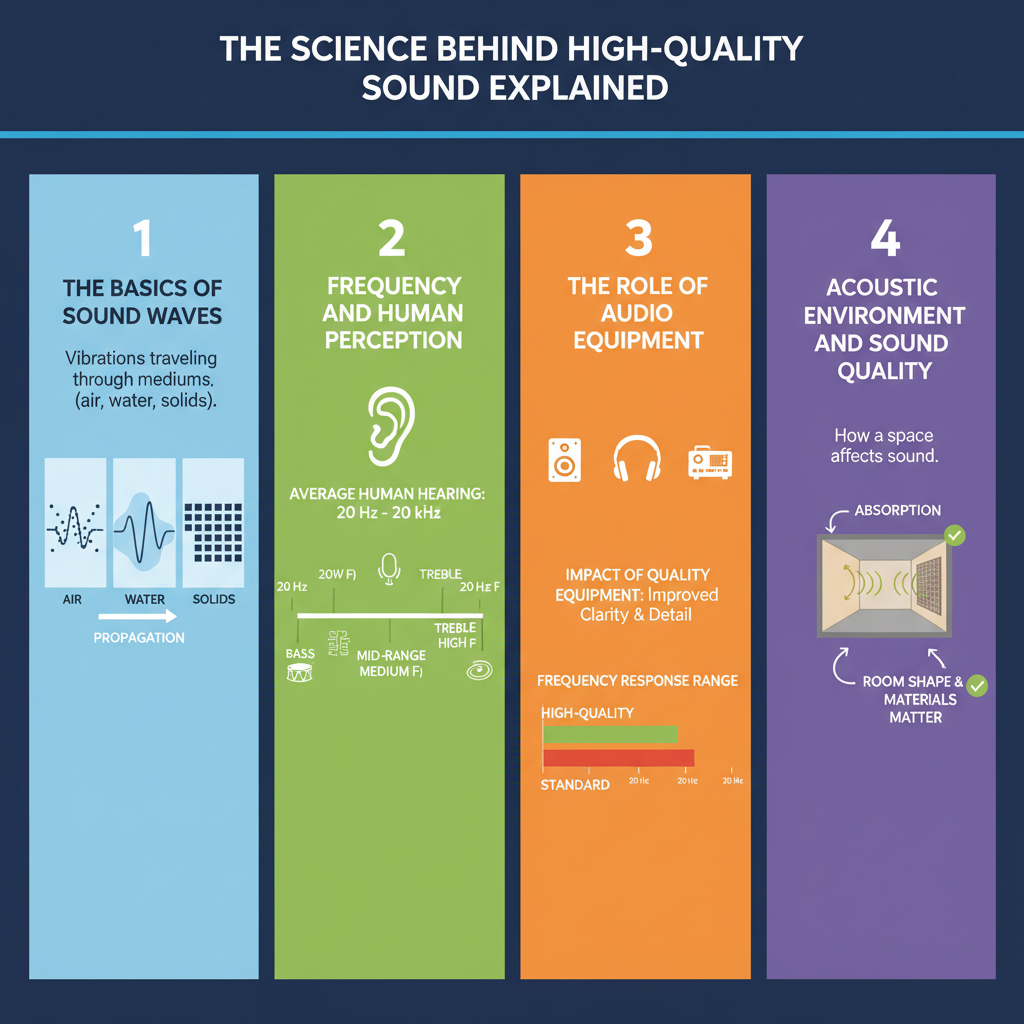
Interestingly, the speed of sound is not constant; it varies depending on the medium through which it travels. For example, sound travels faster in water (approximately 1,480 meters per second) than in air (about 343 meters per second at room temperature). This variance is important for understanding how sound behaves in different environments, which is a key factor in achieving high-quality audio experiences.
Frequency and Human Perception
Human hearing is quite remarkable and is typically capable of detecting sounds ranging from 20 Hz to 20 kHz. This range encompasses everything from the deep rumble of thunder to the high chirp of a bird. The auditory system, which includes the outer ear, middle ear, and inner ear, works together to process these frequencies. When we hear complex sounds, such as music, our brain interprets the combination of different frequencies, allowing us to enjoy melodies, harmonies, and rhythms.
Moreover, the perception of sound is also influenced by how our brain organizes auditory information. For example, we can distinguish between different instruments playing at the same time, thanks to a phenomenon known as auditory scene analysis. This ability highlights the importance of frequency and how it affects our overall enjoyment of sound. A well-mixed track, for instance, allows various frequencies to coexist harmoniously, creating a richer listening experience.
The Role of Audio Equipment
To experience high-quality sound, having the right audio equipment is essential. High-quality speakers and headphones are engineered to reproduce sound accurately without distortion. They use advanced materials and technologies, such as neodymium magnets and balanced armature drivers, to deliver clear, detailed sound across the frequency spectrum.
One crucial component in the audio chain is the Digital-to-Analog Converter (DAC). This device converts digital audio signals (like those from streaming services) into analog signals that speakers can understand. A high-quality DAC can significantly enhance sound clarity and detail, making it a worthwhile investment for anyone serious about their audio experience. Brands like Schiit and AudioQuest offer impressive DACs that cater to different budgets and needs.
Acoustic Environment and Sound Quality
The environment in which you listen to music plays a vital role in sound quality. The acoustics of a room can either enhance or detract from your listening experience. Factors such as room shape, size, materials, and furnishings all influence how sound waves interact with the space. For example, a room with hard surfaces like tile or glass can create echoes and reflections that muddle the sound, while a room with soft furnishings can help absorb those reflections, leading to clearer audio.
To improve your listening environment, consider implementing acoustic treatments. This can include adding rugs, curtains, or acoustic panels to help manage sound reflections. Additionally, placing speakers at an optimal height and distance from walls can further enhance sound clarity. Investing time in designing your audio space can make a remarkable difference in how you experience sound.
The Psychology of Listening
Listening to music is not just a physical experience; it’s also deeply psychological. Our emotional responses to music are influenced by various factors, including familiarity, cultural context, and personal experiences. For instance, a song that reminds you of a cherished memory can evoke powerful emotions, regardless of its technical quality.
Interestingly, studies have shown that high-quality sound can enhance mood and improve cognitive functions. Research indicates that listening to high-fidelity music can increase focus and boost memory retention. This is likely due to the brain’s ability to process complex sounds more efficiently in high-quality audio formats, leading to a more immersive listening experience. Engaging with music in high quality can transform it from mere background noise into a captivating journey.
Innovations in Sound Technology
The audio industry is continually evolving, with innovations that push the boundaries of sound quality. Technologies like surround sound and spatial audio create immersive listening experiences that make you feel as though you’re in the middle of a live performance. Companies like Dolby and DTS are at the forefront of developing advanced audio formats that enhance the spatial dimensions of sound.
Emerging technologies, such as high-resolution audio and lossless compression, aim to deliver even higher fidelity sound. High-resolution audio formats—like FLAC or DSD—preserve more detail than standard formats, offering a richer listening experience. Brands like Tidal and Qobuz provide access to these high-resolution libraries, allowing audiophiles to enjoy music as the artists intended.
Tips for Achieving High-Quality Sound
If you’re looking to elevate your listening experience, here are some practical tips:
1. Invest in Quality Audio Equipment: Start with high-quality speakers or headphones that suit your preferences. Brands like Sennheiser, Bose, and Klipsch offer a range of options to match various budgets.
2. Proper Setup: Ensure your audio equipment is set up correctly. Position speakers at ear level and maintain an optimal distance from walls to minimize unwanted reflections.
3. Experiment with Your Environment: Take time to assess your listening environment. Consider adding acoustic treatments or rearranging furniture to create a more conducive space for sound.
4. Explore High-Resolution Audio: Look for high-resolution audio files and services that offer lossless compression. This can significantly enhance your listening experience, especially for genres where nuance is key.
5. Pay Attention to Cables and Accessories: While not as critical as the main components, using quality cables and connectors can help prevent signal loss and maintain sound integrity.
By following these tips, you can create an environment that’s primed for enjoying high-quality sound.
High-quality sound is a blend of scientific principles and technological advancements that cater to our auditory preferences. By understanding the elements that contribute to sound quality—from the physics of sound waves to the psychology of listening—you can make informed choices about your audio experiences. Whether you’re a casual listener or an audiophile, there are always ways to improve your sound environment, leading to deeper enjoyment and appreciation of the music you love.
Frequently Asked Questions
What factors contribute to high-quality sound in audio equipment?
High-quality sound in audio equipment is influenced by several key factors, including frequency response, total harmonic distortion (THD), dynamic range, and the quality of components such as drivers and amplifiers. A wider frequency response allows for more accurate reproduction of sound, while lower THD ensures that the audio remains true to the original source without unwanted harmonics. Additionally, a greater dynamic range enhances the contrast between the quietest and loudest sounds, making audio more engaging and realistic.
How does the design of headphones impact sound quality?
The design of headphones significantly impacts sound quality through factors such as ear cup shape, driver size, and whether they are open-back or closed-back. Open-back headphones typically provide a more natural and spacious soundstage but may leak sound, while closed-back designs offer better isolation and more bass response. Additionally, larger drivers can produce deeper bass and fuller sound, making it essential to consider both the technical specifications and ergonomic design for optimal listening experiences.
Why do high-quality audio formats matter for sound clarity?
High-quality audio formats, such as FLAC and WAV, matter because they retain more detail and clarity compared to compressed formats like MP3. Lossy compression removes audio data to reduce file size, which can lead to a significant loss of sound quality and detail. By using lossless formats, listeners can experience the full depth and richness of the audio, ensuring that even the subtle nuances of music are preserved and enjoyed, ultimately enhancing the overall listening experience.
What is the best way to optimize my audio setup for high-quality sound?
To optimize your audio setup for high-quality sound, start by selecting high-fidelity audio sources and a compatible playback device. Invest in quality speakers or headphones, and make sure to position them correctly to achieve the best soundstage. Additionally, consider implementing acoustic treatments in your listening environment, such as sound-absorbing panels or diffusers, to minimize reflections and improve clarity. Finally, using high-quality cables and connectors can also help reduce signal loss and interference, further enhancing sound quality.
Which audio equipment is essential for achieving studio-quality sound at home?
To achieve studio-quality sound at home, essential audio equipment includes a digital audio interface, studio monitors, and a good pair of headphones. A digital audio interface allows for high-resolution audio recording and playback, while studio monitors provide accurate sound reproduction, essential for mixing and mastering. Additionally, investing in quality headphones for critical listening can help you catch details that might be missed by speakers alone, ensuring a well-rounded home audio setup for music production or casual listening.
References
- Sound quality
- https://www.sciencedirect.com/science/article/pii/S2213138816300083
- https://www.ncbi.nlm.nih.gov/pmc/articles/PMC6573761/
- https://www.acoustics.org/pressroom/httpdocs/35th/HighQualitySound.html
- https://www.itu.int/en/ITU-T/informals/groups/Pages/sound-quality.aspx
- https://www.psychologytoday.com/us/blog/the-science-sound/201206/the-science-sound
- https://www.acoustics.org/pressroom/httpdocs/35th/HighQualitySound.html