
Deepfake videos and AI-generated content are the products of sophisticated machine learning algorithms that craft media so lifelike, it can leave viewers questioning reality. This transformative technology utilizes neural networks trained on extensive datasets to create visuals and audio that can mimic real human expressions and voices. In this article, we will explore the underlying science, implications, and future prospects of deepfake technology, giving you a comprehensive understanding of this rapidly evolving field.
Understanding Deepfake Technology

At the heart of deepfake technology lie Generative Adversarial Networks (GANs), an innovative approach that has revolutionized the way machines create and learn from data. A GAN consists of two neural networks: the generator and the discriminator. The generator’s job is to produce new content, such as images or videos, while the discriminator evaluates this content against real-world examples. This adversarial process means that as the generator improves in its ability to create realistic content, the discriminator also becomes more adept at detecting fakes. It’s a continuous loop of improvement, resulting in increasingly convincing deepfake media.
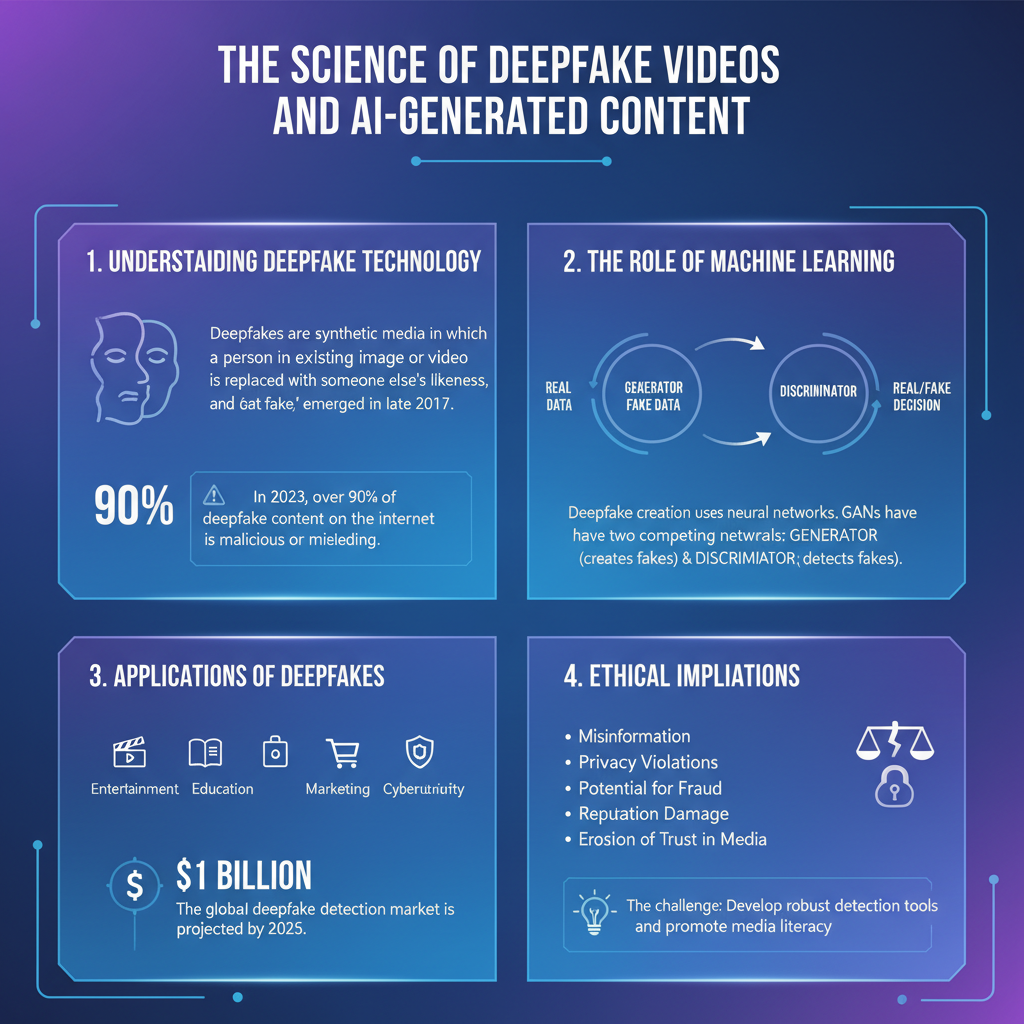
For example, when creating a deepfake video of a public figure, the generator analyzes thousands of images of that person, learning intricate details like their facial expressions and movements. The discriminator then assesses the generated video, pointing out inconsistencies, which allows the generator to refine its output until the video is nearly indistinguishable from reality. This fascinating interplay between the two networks is what allows deepfake technology to produce such strikingly realistic content.
The Role of Machine Learning

Machine learning plays a pivotal role in enhancing the capabilities of deepfake technology. By analyzing vast datasets of images and videos, machine learning algorithms can grasp complex patterns in human behavior, including facial expressions, gestures, and even voice intonation. This deep understanding is crucial for generating hyper-realistic media that resonates emotionally with viewers.
During the training phase, the model is fine-tuned to minimize discrepancies between the generated content and actual human behavior. For instance, if a deepfake video fails to accurately reflect the nuances of a person’s smile or speech, the algorithm will adjust until it achieves a closer match. This continuous learning process allows deepfakes to evolve quickly, making them not just a technological marvel but a serious contender in various media forms. As a result, we are witnessing a shift in how content is created, with AI becoming a co-creator alongside human artists.
Applications of Deepfakes
Deepfakes showcase a diverse range of applications, some of which are exciting and innovative, while others raise red flags. In the entertainment industry, filmmakers are using deepfake technology to create CGI characters that interact seamlessly with live-action footage. Imagine a beloved actor who has passed away appearing in a new movie, thanks to deepfake technology that revives their likeness and voice. Similarly, in gaming, developers are creating personalized avatars that respond to players’ movements and expressions, making for an immersive experience.
However, the dark side of deepfakes cannot be ignored. They are increasingly used in misinformation campaigns, where fake videos can distort public opinion or damage reputations. For instance, a deepfake might show a politician making controversial statements they never actually made, leading to widespread confusion and distrust. This duality highlights the need for responsible use and ethical considerations surrounding the deployment of such powerful technology.
Ethical Implications
The rise of deepfake technology introduces significant ethical dilemmas, particularly concerning consent and privacy. With the ability to create hyper-realistic representations of individuals without their permission, deepfakes can easily be used to exploit or harm people. The potential for misuse extends to generating non-consensual adult content, which is a violation of personal rights and dignity.
As society grapples with these challenges, discussions around legislation and regulation become increasingly vital. Policymakers, technologists, and ethicists must collaborate to establish guidelines that protect individuals from the potential harms of deepfakes while fostering creativity and innovation. This balance is crucial for navigating the complex landscape of AI-generated content responsibly.
Detecting Deepfakes
As the capabilities of deepfake technology advance, so too do the methods for detecting manipulated media. Researchers are developing sophisticated detection techniques that utilize AI models designed to identify subtle artifacts characteristic of deepfake algorithms. These artifacts can include unnatural blinking patterns, inconsistent lighting, or even audio mismatches that the human eye or ear might overlook.
Public awareness and education are equally important in combating the spread of deepfakes. By equipping individuals with the tools to recognize manipulated media, we can foster a more discerning audience. Resources such as online courses and workshops can help people develop critical thinking skills when consuming digital content, ensuring they are better prepared to navigate an increasingly synthetic media landscape.
Future of AI-Generated Content
Looking ahead, the future of deepfakes and AI-generated content is rife with both promise and challenges. As technology continues to evolve, researchers are striving to enhance the quality of generated content while simultaneously improving detection methods. This dual focus is essential for mitigating the risks associated with misuse while allowing creative applications to flourish.
Moreover, as deepfake technology becomes more accessible, we may see an explosion of user-generated content that leverages these tools for artistic expression, storytelling, and beyond. However, this democratization of technology will also necessitate ongoing discussions about ethical boundaries and the societal impact of AI-generated content.
The intersection of deepfake videos and AI-generated content presents a fascinating yet complex landscape. Understanding the science behind these technologies is crucial for navigating their implications and ensuring responsible use. As we look to the future, staying informed and engaged with developments in this field will empower us to harness its potential while mitigating risks. The key lies in balancing innovation with ethics, ensuring that as we explore the depths of artificial intelligence, we do so with a commitment to integrity and respect for one another.
Frequently Asked Questions
What are deepfake videos and how are they created?
Deepfake videos are synthetic media where a person’s likeness is convincingly replaced with someone else’s, often using artificial intelligence (AI) technologies. They are typically created using deep learning techniques, particularly Generative Adversarial Networks (GANs), which involve two neural networks—one generating the fake content and the other evaluating its authenticity. The process requires extensive datasets of the target’s images and videos to train the AI, allowing it to produce realistic and often indistinguishable content.
How can I identify a deepfake video?
Identifying a deepfake video can be challenging, but there are several key indicators to look for. Pay attention to unnatural facial expressions, inconsistent lighting, or mismatched audio that doesn’t sync with the movements of the person’s mouth. Additionally, specialized detection tools and software are being developed that leverage AI to spot deepfake characteristics, making it easier for viewers to discern authentic videos from manipulated content.
Why are deepfake videos considered a threat to society?
Deepfake videos pose significant threats to society, primarily due to their potential for misinformation and manipulation. They can be used to create misleading political propaganda, defame individuals, or incite social unrest, leading to a breakdown of trust in media and public figures. Furthermore, the technology can facilitate cyberbullying and other malicious actions, raising concerns about privacy and security in the digital age.
Which industries are most affected by deepfake technology?
Several industries are profoundly affected by deepfake technology, including entertainment, journalism, and law enforcement. In the entertainment sector, deepfakes can be used for innovative storytelling or character recreation, but they also raise ethical questions regarding consent and authenticity. Meanwhile, journalists face challenges in verifying the authenticity of video content, while law enforcement must contend with deepfakes used in cybercrime or fraud, necessitating new strategies for identification and response.
What are the best practices for mitigating the risks associated with deepfake content?
Mitigating the risks of deepfake content involves a combination of technological solutions and public awareness. Best practices include employing advanced detection tools to verify the authenticity of videos, educating the public about the existence and implications of deepfakes, and promoting media literacy to help individuals critically assess information sources. Additionally, policymakers and industry leaders should collaborate to establish regulations and ethical guidelines governing the use of AI-generated media to protect against misuse.
References
- Deepfake
- https://www.bbc.com/news/technology-51000703
- https://www.nytimes.com/2023/01/20/technology/deepfakes.html
- Optimizing Discrete Spaces via Expensive Evaluations: A Learning to Search Framework | Proceeding…
- https://www.ncbi.nlm.nih.gov/pmc/articles/PMC7414232/
- https://www.researchgate.net/publication/342530855_The_impact_of_deepfake_technology_on_society
- https://www.technologyreview.com/2020/01/14/844755/deepfakes-explained/
- Veterans Day Service at Arlington National Cemetery | Video | C-SPAN.org