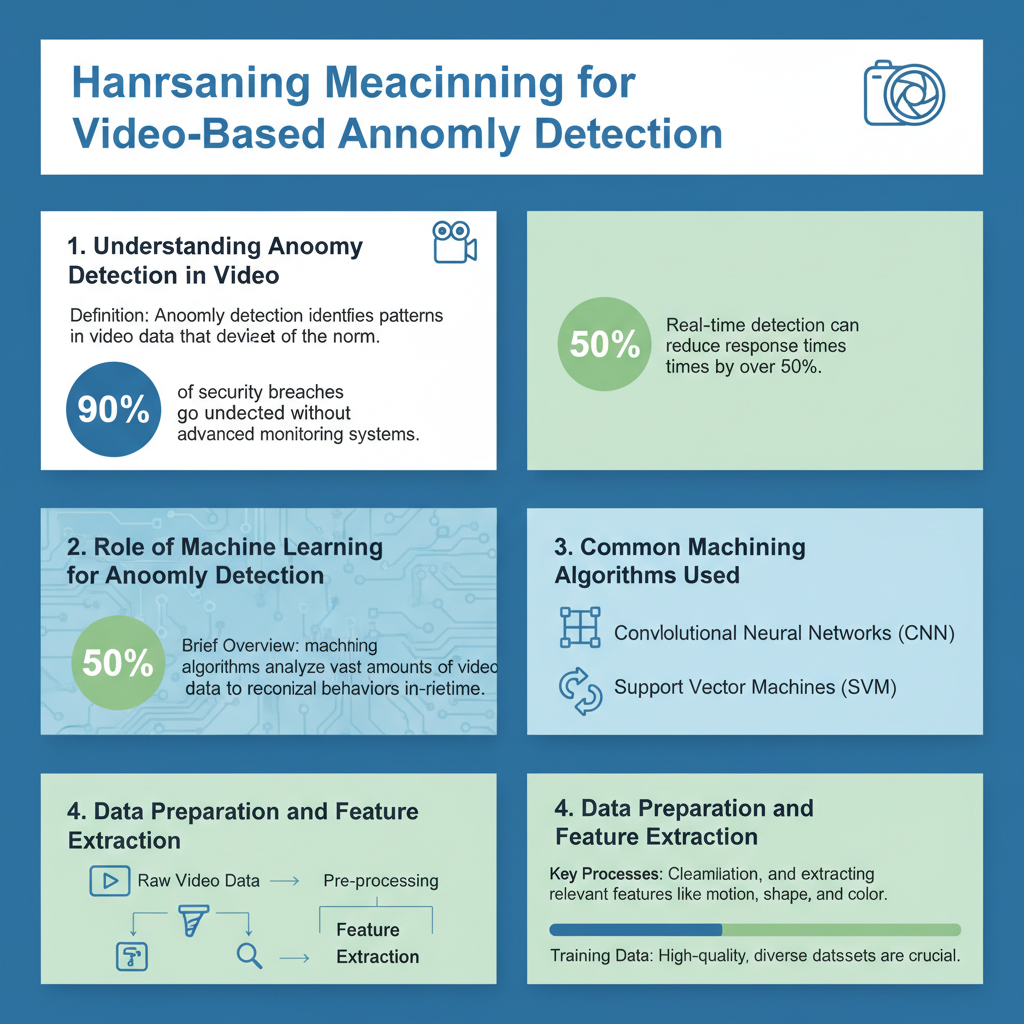
Machine learning is revolutionizing video-based anomaly detection by enabling systems to identify unusual patterns and behaviors in real-time. This technology is crucial for various applications, from security surveillance to quality control in manufacturing. By harnessing the power of algorithms and vast amounts of video data, organizations can detect anomalies quickly and efficiently, minimizing risks and enhancing safety. In this article, you’ll explore the mechanisms behind machine learning’s role in detecting anomalies in video data, the algorithms used, and the challenges faced in implementation.




Understanding Anomaly Detection in Video

Anomaly detection refers to the identification of patterns in data that do not conform to expected behavior. In video analysis, this means identifying events or behaviors that deviate significantly from the norm. The significance of anomaly detection lies in its ability to provide insights into potentially critical issues that could go unnoticed. For instance, in security surveillance, anomalies could include theft, vandalism, or unauthorized access. In manufacturing, anomalies might manifest as equipment malfunctions or safety breaches, such as workers not wearing protective gear. By detecting these anomalies in real-time, organizations can respond promptly, thereby mitigating risks and enhancing operational efficiency.
Role of Machine Learning in Anomaly Detection

Machine learning plays a pivotal role in anomaly detection by training algorithms to recognize patterns in video data. Unlike traditional methods that rely on predefined rules and manual programming, machine learning algorithms learn from data, continuously improving their accuracy over time. For example, a traditional approach might flag any movement in a restricted area as suspicious, whereas a machine learning model can differentiate between typical activity (like a delivery person) and genuine anomalies (like someone trying to breach security). This ability to learn and adapt makes machine learning a powerful tool for enhancing the effectiveness of anomaly detection systems.
Common Machine Learning Algorithms Used
Several machine learning algorithms are commonly used in video-based anomaly detection. Two of the most popular are Convolutional Neural Networks (CNNs) and Recurrent Neural Networks (RNNs). CNNs excel in processing visual data, making them ideal for tasks like identifying objects and events in video frames. RNNs, on the other hand, are well-suited for sequential data, allowing them to analyze frames over time to detect patterns and anomalies in motion.
In terms of learning techniques, both supervised and unsupervised learning play crucial roles in this context. Supervised learning involves training models on labeled datasets where anomalies are explicitly marked, which helps the system learn what to identify. In contrast, unsupervised learning allows the model to identify anomalies without prior labeling, enabling it to discover unexpected patterns in the data. This flexibility is essential for scenarios where anomalies are rare or hard to define, such as fraud detection in financial transactions.
Data Preparation and Feature Extraction
Effective anomaly detection relies heavily on data preparation and feature extraction. Data preprocessing involves cleaning and organizing video data to ensure that the algorithms can learn effectively. This step is crucial because raw video data can be noisy and contain irrelevant information that may hinder the detection process. Techniques such as normalization, resizing, and filtering help enhance the quality of the input data.
Feature extraction is another vital aspect of preparing video data for machine learning models. This involves identifying and isolating significant features or characteristics from the video frames that can help in distinguishing normal behavior from anomalies. For instance, motion vectors, changes in pixel intensity, and object trajectories can be extracted to provide the model with meaningful information. By focusing on these features, machine learning algorithms can improve their performance, leading to more accurate anomaly detection.
Real-World Applications of Video-Based Anomaly Detection
Video-based anomaly detection is making waves across various industries with numerous real-world applications. In security, for instance, surveillance systems equipped with machine learning capabilities can automatically alert personnel to suspicious activity, such as someone lingering too long in a restricted area. In healthcare, video monitoring systems can track patient movements to detect falls or unusual behavior, significantly improving patient safety. Retailers are also leveraging this technology to analyze customer behavior, identify shoplifting incidents, and optimize store layouts based on traffic patterns.
One case study that stands out is in the domain of public safety. Cities are implementing intelligent surveillance systems that use video-based anomaly detection to monitor public spaces for unusual activity, such as large crowds gathering unexpectedly. These systems can trigger alerts, allowing law enforcement to respond quickly to potential threats or emergencies, thereby enhancing community safety.
Challenges and Limitations
Despite the promising advancements in video-based anomaly detection, several challenges and limitations persist. One common issue is the occurrence of false positives—when the system flags normal behavior as an anomaly. This can lead to unnecessary investigations and erode trust in the system. Data privacy concerns also pose significant challenges, as increased surveillance may infringe on individuals’ rights and lead to public backlash.
To address these challenges, researchers are exploring various solutions. For instance, improving the algorithms to reduce false positives by incorporating contextual information can enhance accuracy. Additionally, developing ethical guidelines for data usage and privacy could help alleviate public concerns, ensuring that technologies are implemented responsibly.
Future Trends in Machine Learning for Anomaly Detection
The future of machine learning in anomaly detection looks bright, with several emerging technologies and methodologies on the horizon. One trend is the integration of advanced deep learning techniques, which may further enhance the accuracy and efficiency of anomaly detection systems. Additionally, the use of edge computing could enable real-time processing of video data, reducing latency and improving responsiveness.
Another exciting development is the potential for combining machine learning with other technologies, such as the Internet of Things (IoT). This integration could allow for smarter surveillance systems that not only analyze video data but also incorporate sensor data from various devices, providing a more comprehensive view of environments.
In summary, as these advancements unfold, they hold the promise of transforming video surveillance and analysis, leading to more sophisticated and effective anomaly detection solutions.
Machine learning is transforming video-based anomaly detection by providing more accurate and efficient methods for identifying unusual events. By understanding the algorithms, applications, and challenges discussed, you can better appreciate the impact of this technology on various industries. For further exploration, consider delving into specific algorithms or case studies to see how this technology is applied in real-world scenarios.
Frequently Asked Questions
What is video-based anomaly detection and how does machine learning enhance it?
Video-based anomaly detection refers to the process of identifying unusual or abnormal behaviors in video footage, which may indicate events such as theft, accidents, or other security threats. Machine learning enhances this process by automating the detection of anomalies through algorithms that learn from vast amounts of video data, recognizing patterns and deviations from normal behavior. This results in more accurate and efficient monitoring, reducing the need for constant human oversight.
How does machine learning identify anomalies in video data?
Machine learning identifies anomalies in video data by employing algorithms like convolutional neural networks (CNNs) and recurrent neural networks (RNNs) that analyze the visual and temporal features of the footage. These models are trained on labeled datasets, allowing them to learn what constitutes normal behavior in various contexts. Once trained, they can recognize deviations in real-time, significantly improving the accuracy of anomaly detection in complex scenarios.
Why is machine learning preferred over traditional methods for video-based anomaly detection?
Machine learning is preferred over traditional methods for video-based anomaly detection because it can handle large datasets and adapt to new data without manual intervention. Traditional methods often rely on predefined rules and thresholds, which can be inflexible and less effective in dynamic environments. Machine learning algorithms continuously learn and improve from new inputs, making them more robust and capable of detecting subtle or novel anomalies that may go unnoticed by rule-based systems.
What are the best practices for implementing machine learning in video-based anomaly detection?
The best practices for implementing machine learning in video-based anomaly detection include selecting a diverse training dataset that accurately represents the environment, utilizing advanced algorithms tailored for specific use cases, and continuously updating the model with new data to improve accuracy. Additionally, it’s crucial to integrate human oversight for false positives and negatives, ensuring that the system can adapt and refine itself based on real-world feedback for optimal performance.
Which industries benefit the most from machine learning in video-based anomaly detection?
Various industries benefit from machine learning in video-based anomaly detection, including security and surveillance, healthcare, transportation, and retail. In security, it helps prevent theft and monitor public safety; in healthcare, it can detect unusual patient behavior; in transportation, it monitors traffic patterns to enhance safety; and in retail, it analyzes customer behavior to reduce losses. The versatility of machine learning applications allows these sectors to increase efficiency and security through intelligent monitoring solutions.
References
- Anomaly detection
- https://www.sciencedirect.com/science/article/pii/S2352914821001571
- https://www.ncbi.nlm.nih.gov/pmc/articles/PMC7358227/
- https://www.ijcai.org/proceedings/2019/0149.pdf
- https://www.frontiersin.org/articles/10.3389/frai.2021.00010/full
- Design and Implementation of a Real Time Control System for a 2DOF Robot Based on Recurrent High …
- https://www.researchgate.net/publication/351457212_Machine_Learning_Approaches_for_Anomaly_Detection_in_Video_Surveillance
- https://www.ijcai.org/Proceedings/2017/0343.pdf