

The integration of AI in video-based sign language recognition is revolutionizing communication for the Deaf and hard-of-hearing communities. By utilizing sophisticated algorithms and machine learning technologies, AI enables the real-time translation of sign language, making it more accessible, effective, and inclusive. This article delves into the technology that powers AI-driven sign language recognition, its various applications, the challenges faced, and what the future holds for this exciting field.
Understanding AI and Sign Language Recognition

Artificial Intelligence (AI) refers to systems or machines that mimic human intelligence to perform tasks, and it is increasingly relevant in the realm of sign language recognition. Sign language, a visual form of communication, relies heavily on gestures, facial expressions, and body language to convey meaning. AI enhances sign language recognition by analyzing video data to identify these visual cues accurately.
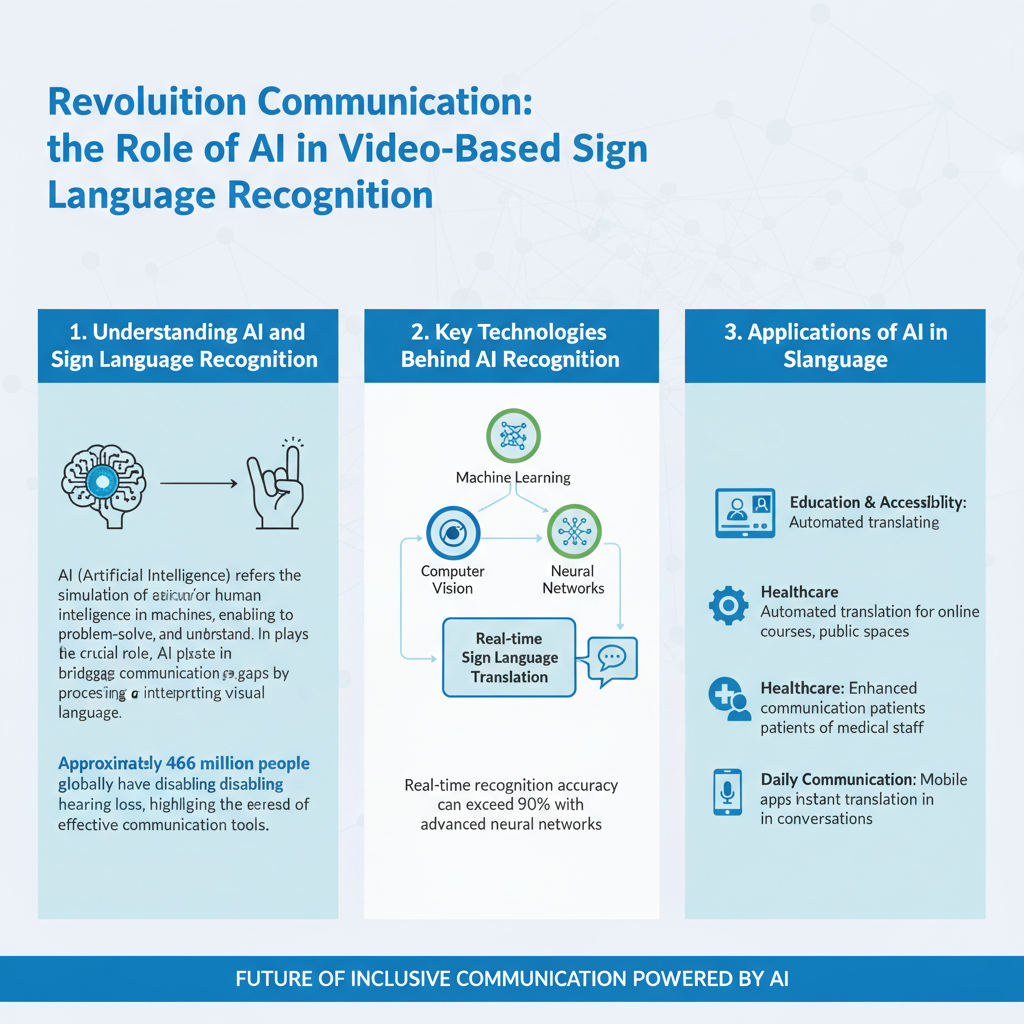
Video-based sign language recognition works through a series of steps. First, cameras capture video footage of a person signing. Advanced algorithms then analyze the video to detect gestures, movements, and expressions. This involves segmenting the video into frames and identifying key points that represent different signs. The AI system then matches these gestures against a database of known signs, translating them into text or spoken language. This process allows for real-time communication, bridging the gap between Deaf individuals and those who do not know sign language.
Key Technologies Behind AI Recognition

At the heart of AI-driven sign language recognition are machine learning algorithms, particularly those in the realm of deep learning. These algorithms learn from vast amounts of data, identifying patterns and nuances in sign language that would be difficult for a human to articulate. A popular architecture used in this context is convolutional neural networks (CNNs), which excel at processing visual data. CNNs can effectively analyze the sequence of hand movements and facial expressions that are critical for understanding sign language.
Computer vision also plays a pivotal role in interpreting visual signals from users. This technology allows AI systems to understand and process the visual information captured by cameras. By combining computer vision with machine learning, AI can achieve a higher level of accuracy in recognizing signs, even in diverse lighting conditions or various backgrounds. The continual improvement of these technologies is essential for enhancing the effectiveness of sign language recognition systems.
Applications of AI in Sign Language Recognition
The applications of AI in sign language recognition are both diverse and impactful. In education, AI-driven tools can enhance learning experiences for Deaf students by providing real-time captioning and translation of lectures and discussions. For instance, a classroom equipped with AI technology can translate a teacher’s spoken language into sign language, allowing Deaf students to participate fully.
Another significant application is in communication tools. Real-time translation applications are being developed that allow individuals to converse seamlessly, regardless of their preferred language. For example, platforms like Google Translate are exploring ways to incorporate sign language, enabling users to sign a phrase and receive an instant audio or text translation. This fosters better interactions in various settings, including workplaces, public services, and everyday conversations.
Challenges in Implementing AI for Sign Language
Despite its potential, implementing AI for sign language recognition comes with several challenges. One major obstacle is the variability in sign language across different regions and communities. Just as spoken languages differ, sign languages have their own regional dialects and variations. For instance, American Sign Language (ASL) is distinct from British Sign Language (BSL), and a system trained on one may not effectively recognize signs from another.
Additionally, creating extensive datasets to train AI models is crucial yet challenging. Sign language is rich in context and nuance, making it difficult to capture every possible sign in various environments and scenarios. The lack of comprehensive datasets can hinder the development of robust AI systems that can accurately recognize and interpret signs in real-time.
Future Prospects of AI in Sign Language Recognition
The future of AI in sign language recognition is promising, with numerous innovations on the horizon. One area of focus is improving the accuracy and speed of recognition systems. As computing power increases and algorithms become more sophisticated, we can expect AI to achieve near-human levels of interpretation. This could lead to more intuitive interfaces that not only recognize signs but also understand the context in which they are used.
Moreover, the broader societal impact of AI-driven sign language recognition could be transformative. Imagine a world where public services, such as healthcare and education, are fully accessible to Deaf individuals through AI translation tools. This would not only enhance communication but also promote inclusion and equality in society.
Ethical Considerations and Community Involvement
As we advance in AI technology, it is essential to consider the ethical implications and the importance of community involvement. Engaging the Deaf community in the development process is crucial to ensure that the technology meets their needs and expectations. Their insights can guide the design of user-friendly interfaces and help identify the most critical aspects of sign language that must be captured.
Additionally, ethical considerations surrounding data privacy and AI decision-making are paramount. Ensuring that AI systems respect users’ privacy and make unbiased interpretations is essential for fostering trust in these technologies. Transparent practices and collaboration with Deaf advocacy groups can help navigate these challenges effectively.
The integration of AI in video-based sign language recognition holds immense potential for enhancing communication accessibility. As technology evolves, it is crucial to address the challenges while ensuring ethical practices and community engagement. By continuing to explore AI’s role in bridging communication gaps, we can support initiatives that empower the Deaf and hard-of-hearing communities, fostering a more inclusive world for everyone.
Frequently Asked Questions
What is AI-based video sign language recognition and how does it work?
AI-based video sign language recognition leverages machine learning algorithms and computer vision to interpret and understand sign language from video inputs. The process involves capturing video frames, extracting key features from hand gestures, facial expressions, and body movements, and then translating these into text or spoken language. This technology is particularly beneficial for enhancing communication accessibility for the deaf and hard-of-hearing communities.
How can AI improve the accuracy of sign language recognition systems?
AI enhances the accuracy of sign language recognition systems through advanced techniques such as deep learning and neural networks, which can analyze vast amounts of sign language data to identify patterns and nuances. By training on diverse datasets that include various sign languages, dialects, and individual signing styles, AI systems become more adept at recognizing and interpreting signs accurately, even in real-time applications.
Why is AI video sign language recognition important for promoting inclusivity?
AI video sign language recognition is crucial for promoting inclusivity as it breaks down communication barriers between the hearing and deaf communities. By facilitating real-time translation of sign language into spoken or written language, AI technology enables better access to information, services, and social interactions, ultimately fostering a more inclusive society where everyone can participate equally.
What are the best use cases for AI in video-based sign language recognition?
The best use cases for AI in video-based sign language recognition include educational platforms that provide sign language learning resources, customer service applications that assist deaf clients, and video conferencing tools that offer real-time interpretation. Additionally, entertainment industries can utilize AI for creating inclusive content, ensuring that deaf audiences can enjoy films, shows, and events with appropriate sign language translation.
Which challenges does AI face in accurately recognizing sign language in videos?
AI faces several challenges in accurately recognizing sign language in videos, including variability in sign language dialects, different signing speeds, and the influence of environmental factors like lighting and background distractions. Additionally, the subtleties of facial expressions and body language, which are integral to conveying meaning in sign language, can be difficult for AI models to interpret correctly. Continuous improvement in AI algorithms and training data diversity is essential to overcoming these challenges.
References
- Sign language
- https://www.sciencedirect.com/science/article/pii/S1877050919311083
- https://www.ncbi.nlm.nih.gov/pmc/articles/PMC7126893/
- https://www.frontiersin.org/articles/10.3389/frai.2021.00013/full
- https://www.bbc.com/news/technology-49119462
- https://www.itu.int/en/ITU-T/focusgroups/ai4good/Pages/default.aspx
- https://www.microsoft.com/en-us/research/publication/deep-learning-for-sign-language-recognition/
- https://www.aclweb.org/anthology/2020.lrec-1.513.pdf
- https://www.jstor.org/stable/10.5325/jslang.2.1.0063