
Real-time object recognition in video games is significantly enhanced by AI, allowing for more immersive and dynamic gameplay experiences. This technology enables games to identify and interact with objects in real-time, improving player engagement and realism. In this article, we will explore how AI achieves this and the impact it has on the gaming industry.




Understanding Real-Time Object Recognition

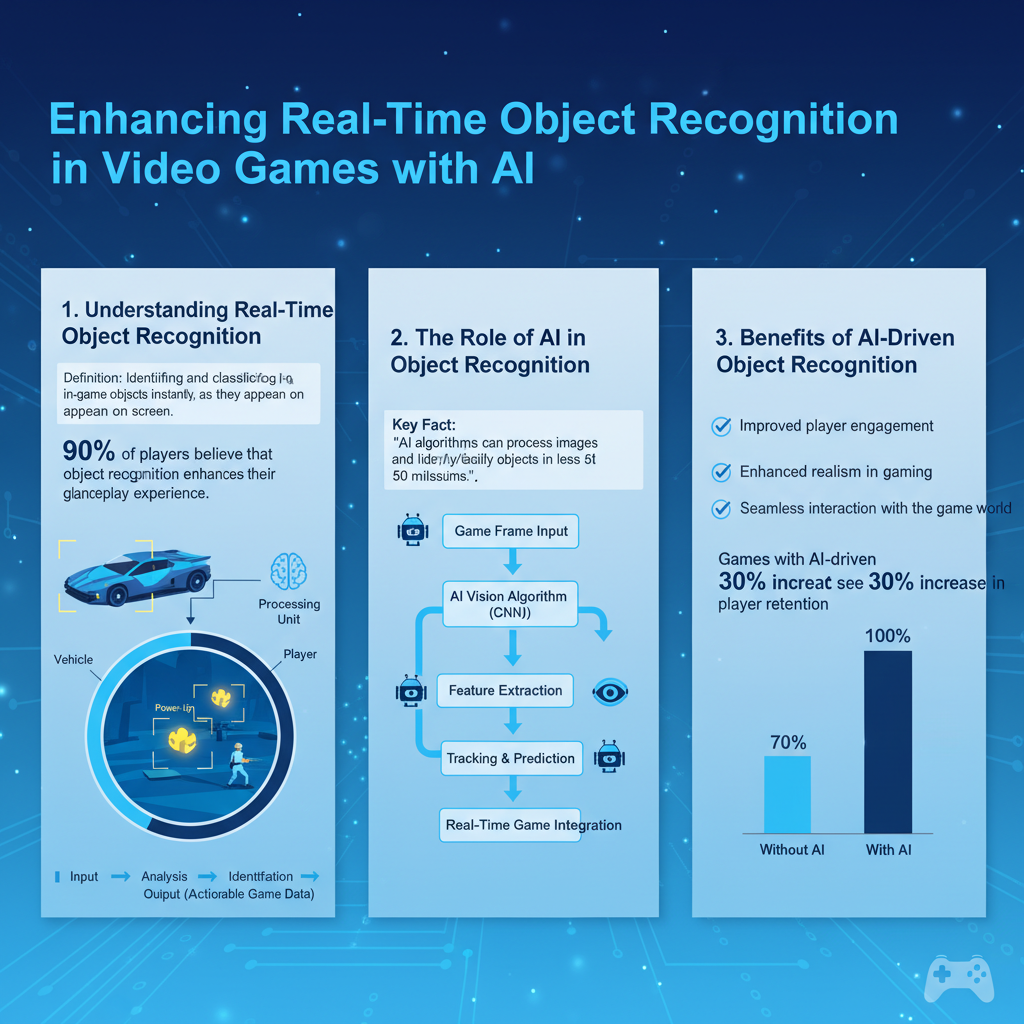
Real-time object recognition in gaming refers to the ability of a game to identify and process objects within a scene instantaneously as a player interacts with the environment. This technology is pivotal, enabling seamless interactions and enhancing the overall gaming experience. Speed and accuracy are crucial in this context; players expect immediate responses to their actions. For instance, if a player throws a grenade in a first-person shooter, the game needs to recognize the grenade’s trajectory and the objects it interacts with to create a realistic explosion and impact. Without fast and accurate recognition, the gameplay can feel sluggish or unresponsive, detracting from immersion.
The Role of AI in Object Recognition
AI plays a transformative role in object recognition through the use of machine learning algorithms. These algorithms are trained on vast datasets consisting of images and videos to learn how to identify various objects. For instance, a game might utilize thousands of images of cars from different angles and lighting conditions to teach the AI to recognize a car in various environments.
Neural networks, particularly convolutional neural networks (CNNs), are extensively used for image and object recognition. They mimic the way the human brain processes visual information, allowing games to detect and categorize objects with remarkable precision. As the AI processes more data, it becomes increasingly adept at recognizing objects even in complex scenes or under varying conditions, such as different lighting or obscured views. This ability not only enhances realism but also allows for more engaging gameplay mechanics, as players can interact with a dynamic world that responds intelligently to their actions.
Benefits of AI-Driven Object Recognition
The implementation of AI-driven object recognition brings numerous benefits to the gaming experience. Firstly, it enhances realism and immersion. When players see objects being recognized and interacted with in a manner that mimics real life, it builds a connection to the game world. For example, in games like “The Last of Us Part II,” the AI recognizes the environment’s elements, allowing players to engage with items like weapons or health packs seamlessly. This creates a sense of presence and involvement that significantly enhances the gaming experience.
Moreover, improved gameplay mechanics and dynamic interactions are direct outcomes of AI-enhanced object recognition. Games can now incorporate more complex interactions, allowing players to manipulate objects in intuitive ways. In “Breath of the Wild,” for instance, players can pick up, throw, or combine items based on the game’s real-time recognition of those objects. This not only encourages creativity but also makes each player’s experience unique, boosting replay value and engagement.
Challenges in Implementing AI for Object Recognition
While the benefits of AI in object recognition are clear, there are also significant challenges to consider. One of the primary hurdles lies in processing power and data requirements. Real-time recognition demands immense computational resources, which can strain hardware, particularly in resource-intensive games. Developers must find a balance between maintaining high graphic fidelity and ensuring smooth performance.
Another challenge is the complexity of the gaming environments themselves. Creating a game that can recognize and react to a multitude of objects in a dynamic world requires sophisticated algorithms and extensive training data. This means that developers must invest considerable time and resources into refining their AI systems to ensure that they can handle diverse scenarios without lag or inaccuracies.
Future Trends in AI and Object Recognition
Looking ahead, the future of AI and object recognition in gaming is bright and full of possibilities. Emerging technologies such as augmented reality (AR) and virtual reality (VR) are set to revolutionize how players interact with games. These platforms rely heavily on real-time object recognition to create immersive experiences. For instance, AR games like “Pokémon GO” blend real-world imagery with virtual elements, requiring advanced recognition capabilities to accurately identify and place Pokémon within the player’s environment.
Predictions for advancements in AI object recognition suggest that as hardware continues to improve and algorithms become more sophisticated, we can expect even more seamless integration of AI in gaming. This could lead to the development of games that adapt to players’ actions and preferences, creating personalized gaming experiences that evolve over time.
Case Studies of AI in Popular Video Games
Several popular video games have successfully implemented AI for object recognition, showcasing its potential. For example, “Resident Evil Village” employs AI to recognize and react to player actions in real-time, allowing for more strategic gameplay. The game’s enemies adapt their tactics based on player behavior, creating a challenging yet rewarding experience.
Another example is “Ghost of Tsushima,” where the AI recognizes various environmental elements, enhancing exploration and interaction. Players can engage with the world in meaningful ways, such as using the wind to guide them to objectives, all made possible through sophisticated object recognition.
Player feedback has been overwhelmingly positive regarding these features, with many expressing appreciation for the depth and realism that AI brings to their gaming experience. As developers continue to refine these technologies, we can expect even more innovative uses of AI in future titles.
The use of AI for real-time object recognition is revolutionizing the gaming landscape, leading to more engaging and interactive experiences for players. By understanding its benefits, challenges, and future potential, developers and gamers alike can appreciate the remarkable advancements in this field. Explore these innovations in your next gaming adventure!
Frequently Asked Questions
How does AI improve real-time object recognition in video games?
AI enhances real-time object recognition in video games through advanced machine learning algorithms and neural networks. These technologies enable the game engine to analyze visual data quickly, identifying and classifying objects in the environment with high accuracy. This capability not only leads to more immersive gameplay but also allows for dynamic interactions between players and the game world, making experiences feel more realistic and engaging.
What are the benefits of using AI for object recognition in gaming?
The benefits of AI in object recognition for gaming include improved graphics fidelity, enhanced gameplay mechanics, and personalized gaming experiences. AI can adapt to player actions and provide real-time feedback, making enemies more intelligent and environments more reactive. Furthermore, it allows developers to create intricate levels filled with interactive elements, enriching the player’s journey and sustaining their interest.
Why is real-time object recognition important in modern video games?
Real-time object recognition is crucial in modern video games as it significantly affects the overall user experience and gameplay dynamics. It allows for seamless integration of animated characters, environmental objects, and interactive elements, resulting in a more immersive and engaging environment. Without effective object recognition, games might feel static and unresponsive, diminishing player satisfaction and engagement.
Which AI technologies are used for object recognition in video games?
Various AI technologies are employed for object recognition in video games, including convolutional neural networks (CNNs), computer vision techniques, and deep learning algorithms. These technologies enable the analysis of visual data in real time, allowing games to recognize and react to objects dynamically. Additionally, advancements in hardware, such as GPUs, facilitate the processing power needed for these sophisticated AI models, further enhancing performance.
What challenges do developers face when implementing AI for object recognition in games?
Developers face several challenges when implementing AI for object recognition in games, including managing the computational load and ensuring real-time performance. High-quality object recognition requires significant processing power, which can strain system resources, particularly in complex scenes. Additionally, ensuring accuracy while minimizing latency is critical; developers must strike a balance between visual fidelity and gameplay responsiveness to maintain an enjoyable player experience.
References
- Outline of object recognition
- https://www.sciencedirect.com/science/article/pii/S0893608021002844
- https://www.nature.com/articles/s41598-018-22009-4
- https://www.bbc.com/news/technology-44566209
- https://www.technologyreview.com/2021/09/20/1035752/ai-gaming-object-recognition/
- https://www.microsoft.com/en-us/research/publication/deep-learning-for-object-recognition-in-video-games/
- https://www.kdnuggets.com/2021/06/ai-object-detection-video-games.html
- https://www.researchgate.net/publication/342425238_Real-Time_Object_Recognition_in_Video_Games_using_Deep_Learning