

The primary way AI detects fake videos and misinformation is through advanced algorithms that analyze visual and audio elements for inconsistencies. These technologies are designed to identify manipulated content by examining patterns, metadata, and even deepfake signatures. With the rise of misleading content online, understanding how AI tackles these challenges is more crucial than ever. In this article, you’ll discover how these AI systems work, their effectiveness, and the challenges they face in the fight against misinformation.
Understanding AI Detection Techniques

AI employs machine learning algorithms that can recognize anomalies in video content. These algorithms are trained on vast datasets containing both authentic and manipulated videos, allowing them to learn the subtle differences between the two. For instance, a model might analyze thousands of facial expressions and movements to understand what a genuine smile looks like. This training helps the AI spot inconsistencies—like unnatural eye movements or awkward speech patterns—that could indicate that a video has been manipulated.
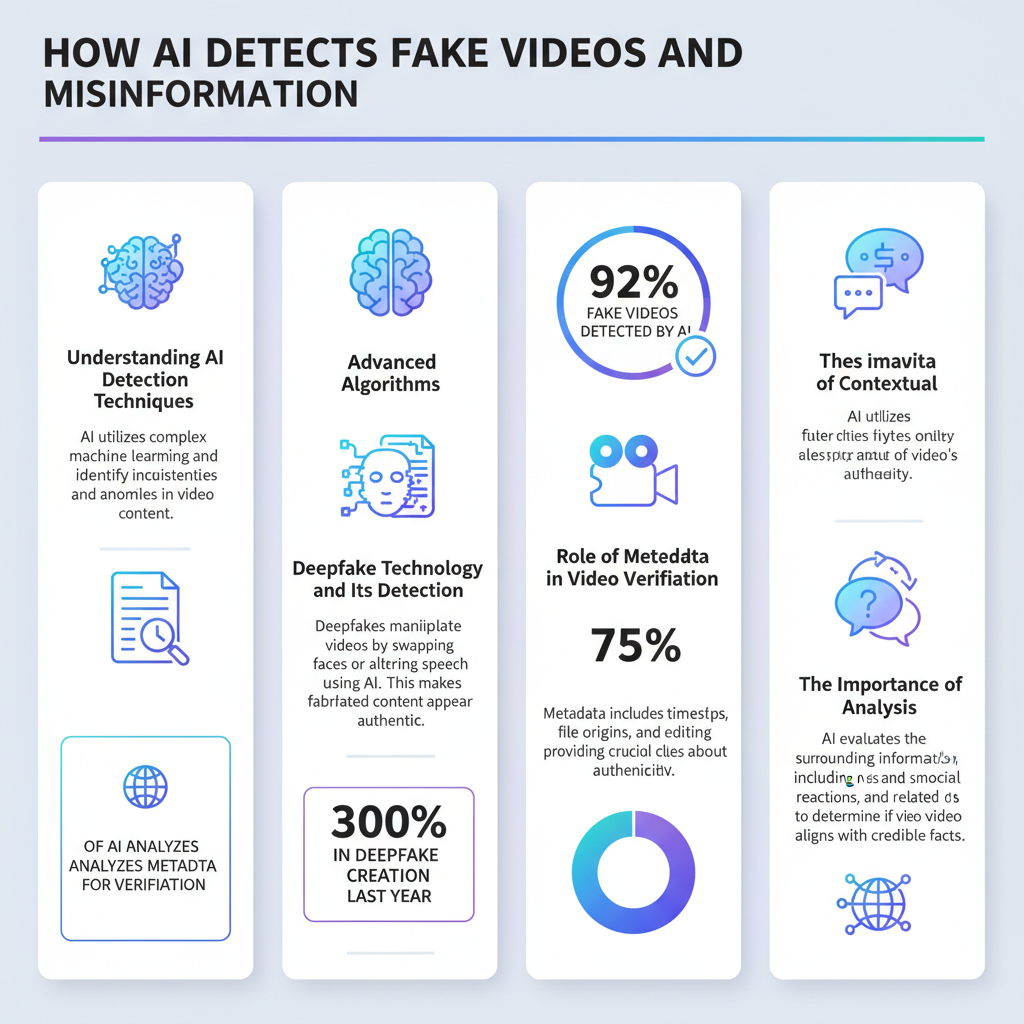
Techniques like facial recognition and voice analysis play a significant role in identifying alterations in authenticity. Facial recognition algorithms can compare facial features against a database, checking for any discrepancies that suggest modification. Similarly, voice analysis can detect variations in pitch, tone, and speed that might not align with the person’s usual speech patterns. By combining these techniques, AI can create a detailed profile of video content that helps identify whether it has been tampered with.
Deepfake Technology and Its Detection

Deepfakes use AI to create realistic fake videos, posing a significant threat to information credibility. These synthetic media pieces can convincingly mimic people’s appearances and voices, making it increasingly difficult for viewers to discern truth from fiction. For instance, a deepfake video might show a public figure saying something they never actually said, potentially influencing public opinion or inciting unrest.
Detection methods focus on identifying artifacts and inconsistencies typical of deepfake production. Common indicators include unnatural lighting, irregular facial movements, or inconsistent audio quality. Advanced AI systems can analyze these artifacts and flag videos that exhibit such anomalies for further investigation. Organizations and researchers are continually refining these detection techniques through the use of neural networks and other sophisticated methodologies, improving their efficacy in the ongoing battle against misinformation.
Role of Metadata in Video Verification
Metadata provides critical information about a video’s origin, including timestamps and camera details. This data is essential in assessing the credibility of a video. For example, if a video purporting to show a recent event has a timestamp from an earlier date, it raises immediate red flags about its authenticity.
AI tools can analyze metadata to spot discrepancies that may indicate manipulation. When a video is uploaded, its metadata can reveal if it has been altered, such as changes in the file size or format. Some AI systems can even assess the source of the upload, helping to trace videos back to their origin. This capability is particularly valuable in verifying news reports, where the timeline of events is crucial for accurate reporting.
The Importance of Contextual Analysis
AI systems assess the context in which videos are presented to determine their credibility. Understanding the narrative and source helps AI differentiate between genuine content and misinformation. For instance, a video shared on a reputable news platform may carry more weight than one posted on a social media account with a history of spreading conspiracies.
By analyzing surrounding content—such as accompanying text, hashtags, or the reputability of the uploader—AI can provide a more comprehensive evaluation of a video’s trustworthiness. This contextual analysis is vital in today’s media landscape, where misinformation can spread rapidly, often outpacing fact-checking efforts.
Challenges in AI Detection of Fake Videos
Rapidly evolving technology means AI must constantly adapt to new manipulation techniques. As creators of fake content become more sophisticated, the algorithms designed to detect these manipulations must also evolve. For example, the rise of more advanced deepfake techniques has made it increasingly challenging for traditional detection methods to keep pace.
Ethical considerations arise, particularly regarding privacy and the potential for misuse of detection technologies. There are concerns that AI tools could be used not only for identifying misinformation but also for surveillance and censorship, infringing on individual rights. Striking a balance between protecting the public from misinformation and respecting privacy is a complex issue that requires careful consideration from developers, policymakers, and society at large.
Case Studies of Successful AI Implementations
There have been several notable examples of AI successfully identifying fake videos and preventing misinformation spread. For instance, platforms like Facebook and Twitter have invested heavily in AI technologies to combat the proliferation of deepfakes and misleading content. They use AI algorithms to flag suspicious videos for review by human moderators, effectively reducing the visibility of false information.
Another example is the work done by the MIT Media Lab, which has developed tools that utilize AI to detect inconsistencies in videos. Their research has demonstrated that by analyzing subtle cues in footage, AI can significantly improve the accuracy of identifying manipulated content. Various organizations, including fact-checking groups, are leveraging these advancements to enhance public safety and trust in media.
Future of AI in Combating Misinformation
Predictions about advancements in detection capabilities and AI’s evolving role in media literacy paint a hopeful picture for the future. As technology continues to improve, we can expect AI systems to become more adept at recognizing nuanced signs of manipulation. Moreover, advancements in natural language processing will likely enhance the contextual analysis capabilities of AI, enabling it to better understand the subtleties of human communication.
The necessity for ongoing public awareness and education on recognizing misinformation cannot be overstated. As AI tools become more integrated into our digital lives, educating individuals about their capabilities and limitations will empower users to make informed decisions about the content they consume. Initiatives that promote media literacy could play a vital role in creating a more discerning public, capable of navigating the complexities of information in the digital age.
In summary, AI plays a crucial role in detecting fake videos and misinformation through various sophisticated techniques. From advanced algorithms analyzing visual and audio elements to contextual analysis and metadata verification, these tools are essential in the fight against misinformation. However, as technology evolves, so do the challenges, highlighting the importance of ethical considerations and public awareness. Staying informed about AI’s capabilities and limitations will empower individuals to better navigate the digital landscape. For further understanding, consider exploring additional resources on AI detection technologies or engaging with organizations focused on combating misinformation.
Frequently Asked Questions
How does AI detect fake videos and misinformation?
AI detects fake videos and misinformation through a combination of techniques, including deep learning algorithms, computer vision, and natural language processing. These technologies analyze video content for inconsistencies, such as mismatched audio and visuals, altered frames, and patterns typical of manipulation. Additionally, AI can cross-reference information from credible sources to verify claims made in videos, helping to identify potentially misleading content effectively.
What are the most common techniques used by AI to identify manipulated videos?
The most common techniques used by AI to identify manipulated videos include facial recognition, anomaly detection, and the analysis of metadata. Facial recognition algorithms can spot inconsistencies in a person’s appearance or expressions, while anomaly detection identifies unusual patterns in video frames that may indicate tampering. Furthermore, analyzing metadata, such as the time and location of a video’s creation, can provide context that helps determine whether the content is authentic.
Why is it important to use AI for detecting misinformation in videos?
Using AI for detecting misinformation in videos is crucial because the rapid spread of fake content can cause significant social and political harm. AI can process vast amounts of data quickly, enabling real-time detection and response to misleading content that might otherwise go unnoticed. This technology not only helps protect the integrity of information but also builds public trust by ensuring that audiences have access to accurate and reliable content.
Which platforms utilize AI to combat misinformation in videos?
Several major platforms utilize AI to combat misinformation in videos, including social media networks like Facebook, Twitter, and Instagram, as well as video-sharing sites like YouTube. These platforms employ AI-driven algorithms to flag potentially misleading content, provide context or warnings, and sometimes remove false videos altogether. By integrating AI technology, these platforms aim to create safer online environments and promote the sharing of verified information.
What are the limitations of AI in detecting fake videos and misinformation?
Despite advancements, AI still faces limitations in detecting fake videos and misinformation. One major challenge is the sophistication of deepfake technology, which can create highly realistic fake videos that are difficult for AI to distinguish from real footage. Additionally, AI systems can struggle with context, failing to understand nuances or cultural references that might change the meaning of a video. Lastly, the reliance on training data means that AI might not recognize new types of misinformation or manipulation techniques that emerge over time.
References
- Deepfake
- https://www.bbc.com/news/technology-51432249
- https://www.reuters.com/investigates/special-report/usa-fake-news-detection/
- https://www.nytimes.com/2021/01/12/technology/deepfakes-misinformation.html
- https://www.technologyreview.com/2020/02/11/844254/deepfakes-fake-news-ai/
- https://www.sciencedirect.com/science/article/pii/S1877050919317833
- Report Series: Committee on Astrobiology and Planetary Science: Review of the Planetary Science A…
- Daniel G. Bobrow: In Memoriam | AI Magazine