Creating choose-your-own-adventure video experiences is revolutionized by AI, enabling personalized storytelling based on viewer choices. This technology enhances engagement by adapting narratives dynamically, offering a more immersive experience than traditional linear storytelling. In this article, we’ll explore how AI achieves this transformation, the technology behind it, and its implications for the future of interactive media.
Understanding Choose-Your-Own-Adventure Concepts

Choose-your-own-adventure storytelling in video formats allows viewers to make decisions that influence the narrative direction and outcome of the story. Unlike traditional storytelling, where the narrative follows a fixed path, these interactive experiences grant users the power to shape their journey, providing a sense of agency that enhances emotional investment. This approach is particularly appealing in an age where audiences crave personalized content, as it allows them to explore various outcomes based on their choices. Engaging with a narrative in this way can lead to deeper connections with the characters and themes, making for a richer viewing experience.
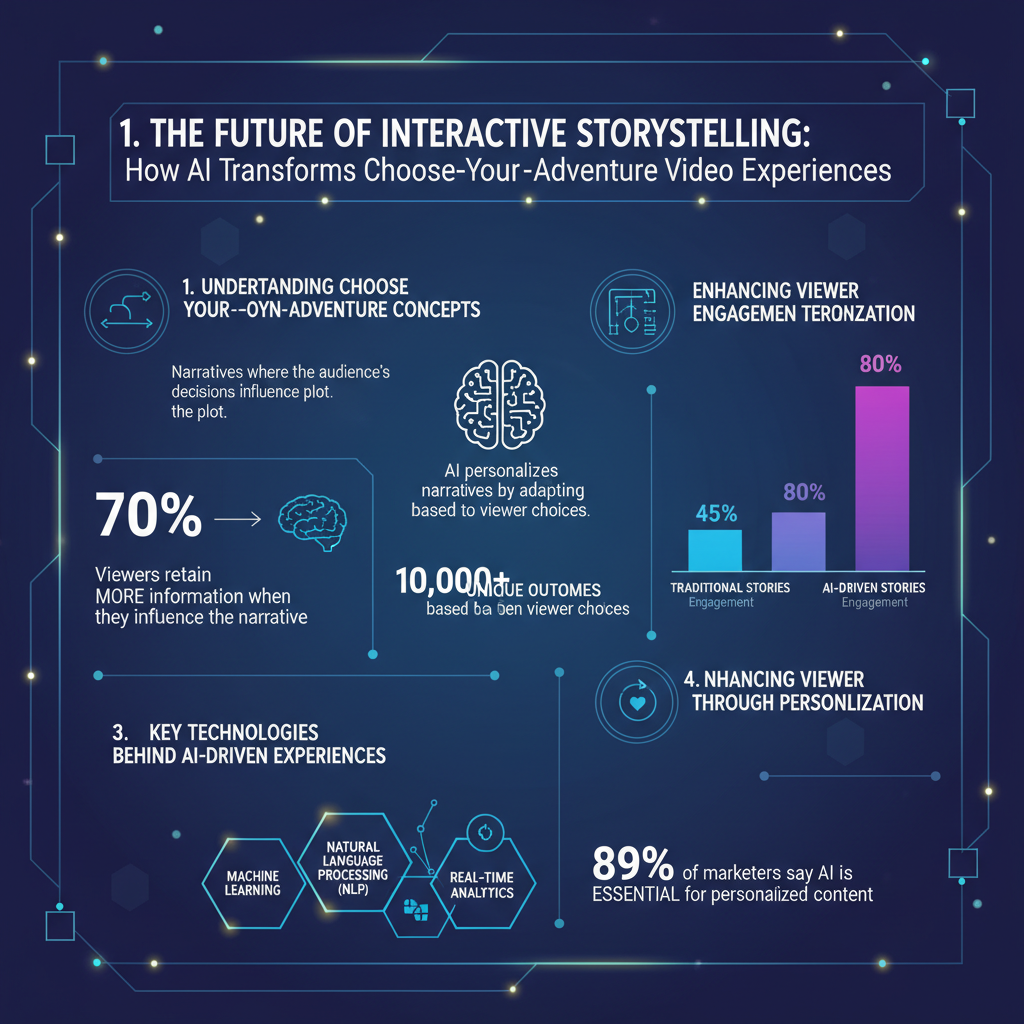
Role of AI in Interactive Storytelling

AI algorithms play a crucial role in interactive storytelling by analyzing viewer decisions in real-time to adapt the narrative. These algorithms can process vast amounts of data, identifying patterns in user choices that guide the story’s direction. For example, if a viewer consistently chooses a character with a rebellious streak, the AI can tailor the narrative to emphasize themes of defiance and independence, creating a more personalized experience.
Moreover, machine learning enhances character interactions and plot developments. By learning from previous viewer interactions, AI can generate dialogue that feels natural and responsive. This creates a more engaging experience, as characters can react in ways that align with user preferences and past choices. Such dynamic interactions elevate the storytelling experience, making it feel alive and responsive.
Key Technologies Behind AI-Driven Experiences
Two key technologies underpin AI-driven choose-your-own-adventure experiences: natural language processing (NLP) and procedural generation. NLP allows AI to understand and generate human-like dialogue, enabling characters to engage in meaningful conversations with viewers. This technology is particularly useful when viewers are given dialogue choices, allowing the narrative to flow seamlessly based on user input.
Procedural generation complements NLP by creating diverse story paths based on predetermined algorithms. This technology can generate unique scenarios, environments, or even entire storylines based on a few core inputs. For instance, in a fantasy adventure, the AI can create different quests or challenges based on the choices made by the viewer, ensuring no two experiences are the same. This capability not only enriches the narrative but also encourages multiple viewings as users explore different paths and outcomes.
Enhancing Viewer Engagement Through Personalization
Personalization is at the heart of viewer engagement in choose-your-own-adventure experiences. AI tailors content based on user preferences, behaviors, and even previous interactions, making each viewer’s journey unique. For example, streaming platforms like Netflix have begun experimenting with interactive storytelling, allowing viewers to choose different paths in shows like Black Mirror: Bandersnatch. By analyzing viewer choices, the platform can recommend similar interactive experiences or tailor future content to align with individual viewer tastes.
Emotional AI is another critical component in creating relatable characters. By analyzing viewer reactions and preferences, emotional AI can adjust character behaviors and dialogues to resonate more deeply with the audience. This leads to a more immersive experience, as viewers feel understood and connected to the characters and the unfolding story.
Challenges in Implementing AI for Interactive Videos
While the potential for AI in interactive storytelling is vast, several challenges must be addressed. One major hurdle is the technical complexity of real-time decision-making and content rendering. As viewers make choices, the system must be able to seamlessly process these decisions and adjust the narrative without lag or interruption, which can be a significant technical feat.
Balancing narrative coherence while offering multiple pathways is another challenge. Writers and developers must ensure that each branching storyline remains engaging and logical, avoiding confusion for the viewer. If a narrative becomes too convoluted or difficult to follow, it can detract from the overall experience, leading to frustration rather than enjoyment. Striking the right balance between complexity and clarity is key to successful interactive storytelling.
Future Trends in AI-Driven Interactive Media
The future of AI-driven interactive media holds exciting possibilities. With advancements in AI technology, we can anticipate more sophisticated storytelling techniques that will further enhance viewer engagement. For instance, the integration of AI with virtual reality (VR) and augmented reality (AR) could create fully immersive environments where viewers not only influence the story but also physically interact with the narrative in a three-dimensional space.
As AI continues to evolve, we may also see the development of more nuanced emotional responses from characters, allowing them to react authentically to viewers’ choices. This could lead to a more profound emotional connection, making stories more impactful. Furthermore, as AI learns from a broader range of viewer interactions, the narratives it generates could become increasingly complex and tailored to individual experiences, evolving beyond traditional storytelling constraints.
Case Studies of Successful AI Choose-Your-Own-Adventure Experiences
Several successful examples showcase the potential of AI in creating engaging choose-your-own-adventure experiences. One noteworthy case is the interactive film Black Mirror: Bandersnatch, which garnered attention for its unique storytelling approach. Viewers could make decisions that led to multiple endings, reflecting a variety of psychological themes and moral dilemmas. Audience reactions were overwhelmingly positive, with many viewers appreciating the depth and complexity of the narrative.
Another example is the video game Detroit: Become Human, which utilizes AI to create a branching narrative where player choices significantly influence outcomes. The game’s intricate decision trees and character arcs resulted in a highly engaging experience, with players often sharing their unique stories and choices across social media.
These case studies highlight not only the effectiveness of AI in enhancing viewer engagement but also the potential for creating compelling narratives that resonate with diverse audiences.
By leveraging AI, the future of choose-your-own-adventure video experiences promises to be more dynamic and engaging than ever before. It’s essential for creators to understand these technologies and their implications to stay ahead in the evolving landscape of interactive storytelling. Explore these advancements and consider how you can implement them in your projects for an enriched viewer experience. The journey into personalized narrative experiences is just beginning, and the possibilities are truly endless!
Frequently Asked Questions
How does AI enhance the storytelling experience in choose-your-own-adventure video games?
AI enhances storytelling in choose-your-own-adventure video games by analyzing player choices and adapting the narrative in real-time. This dynamic approach allows the game to offer personalized experiences, where the plot evolves based on decisions made by the player, creating a unique storyline for each gameplay. Advanced AI algorithms can incorporate natural language processing to understand player inputs better, providing more engaging and immersive narratives.
What are the benefits of using AI for creating interactive video content?
The benefits of using AI in creating interactive video content include increased engagement, personalized experiences, and efficient production. AI can automatically generate multiple story branches based on a single script, allowing creators to produce rich narratives without extensive manual labor. Moreover, AI tools can analyze viewer preferences, tailoring content to better suit their interests, which often leads to higher viewer retention and satisfaction.
Why should creators consider AI for developing choose-your-own-adventure experiences?
Creators should consider AI for developing choose-your-own-adventure experiences because it allows for scalable and adaptable storytelling that traditional methods may struggle to achieve. With AI, creators can quickly generate numerous narrative pathways, ensuring that content remains fresh and diverse. Additionally, AI can help identify popular choices among players, offering insights that can guide future content development and marketing strategies.
Which AI technologies are most effective for creating choose-your-own-adventure videos?
The most effective AI technologies for creating choose-your-own-adventure videos include machine learning, natural language processing, and procedural content generation. Machine learning algorithms help analyze player behavior to predict and adapt story outcomes, while natural language processing enables more interactive dialogue systems. Procedural content generation allows creators to automatically generate diverse scenarios based on player interactions, enhancing replayability and engagement.
How can developers implement AI in their choose-your-own-adventure video projects?
Developers can implement AI in their choose-your-own-adventure video projects by integrating AI frameworks and tools that support dynamic storytelling. This can involve using game engines like Unity or Unreal Engine, which offer AI plugins for decision-making and narrative adaptation. Additionally, developers should focus on creating a robust database of story elements and player choices, enabling the AI to generate coherent and compelling narratives based on user interactions.
References
- Interactive fiction
- https://www.theguardian.com/technology/2020/dec/30/how-ai-is-transforming-the-world-of-gaming
- https://www.sciencedirect.com/science/article/pii/S1877050921001767
- https://www.forbes.com/sites/bernardmarr/2020/05/25/the-role-of-artificial-intelligence-in-creating-interactive-video-games/
- https://www.techrepublic.com/article/how-ai-is-revolutionizing-video-games/
- https://www.bbc.com/future/article/20210323-how-ai-is-changing-the-way-we-play-video-games
- https://www.nature.com/articles/s41599-021-00716-0
- https://www.tandfonline.com/doi/full/10.1080/0144929X.2021.1923889