
Real-time rendering powered by artificial intelligence significantly enhances gaming graphics by producing more realistic environments and smoother animations. This technology allows games to dynamically adjust visuals based on the player’s actions and the game’s context, creating an immersive experience. In this article, we will explore how AI is revolutionizing graphics in gaming.
Understanding Real-Time Rendering
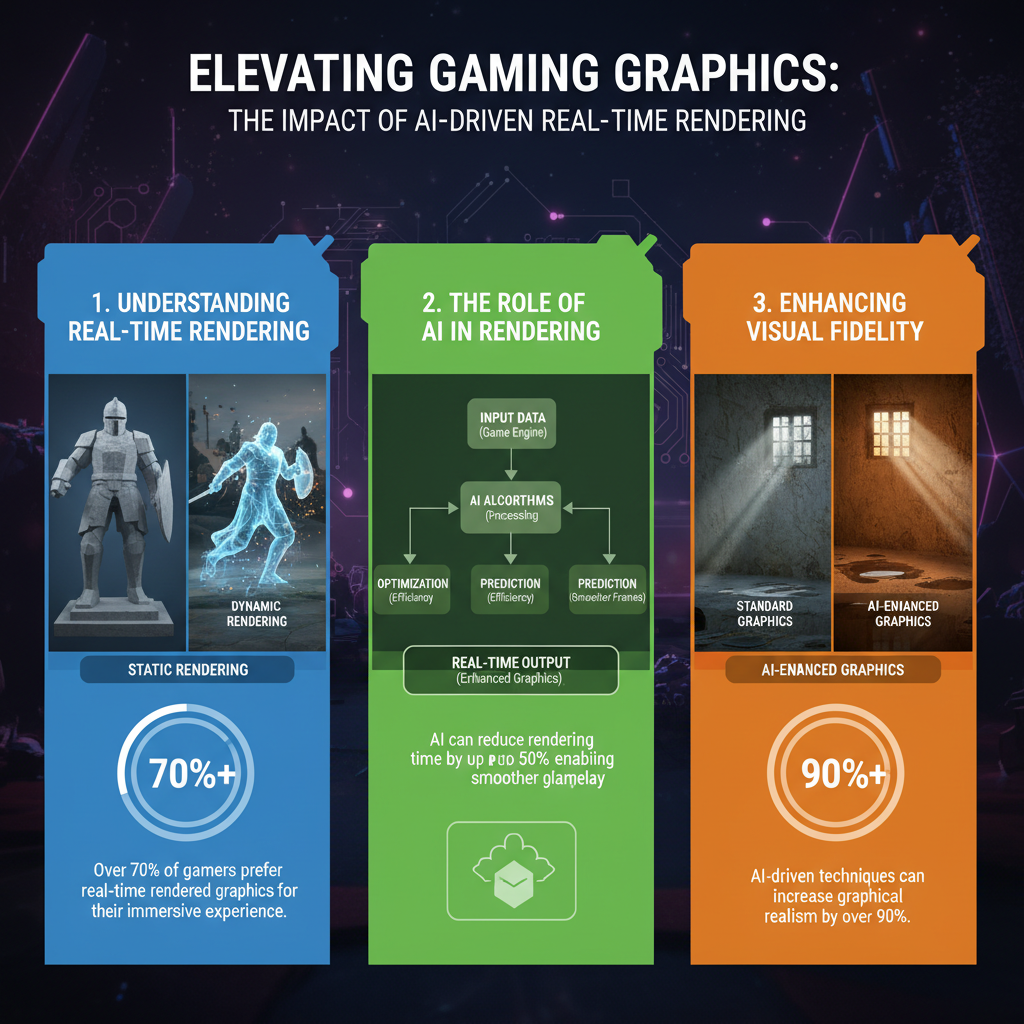
Real-time rendering is a crucial process in gaming that allows for the instantaneous creation of images from 3D models and environments, enabling smooth gameplay and realistic visuals. Unlike traditional rendering techniques, which often pre-render images in a static format, real-time rendering processes each frame on the fly, adapting to the player’s movements and actions in real-time. This capability is vital in gaming, where players expect a fluid and responsive experience. In traditional rendering, complex scenes may take hours to render, resulting in a lack of interactivity. In contrast, real-time rendering ensures that players can navigate through expansive worlds without noticeable delays, making it essential for modern gaming.
The Role of AI in Rendering

Artificial intelligence plays a transformative role in optimizing rendering processes, making them more efficient and visually appealing. AI algorithms can analyze vast amounts of data and make informed decisions about which elements of a scene to prioritize, significantly speeding up the rendering process. For instance, techniques like deep learning and neural networks can predict how light interacts with surfaces, reducing the need for extensive calculations that slow down rendering times.
Games like “Cyberpunk 2077” and “The Last of Us Part II” have showcased how AI can be harnessed for graphical enhancements. These games employ AI techniques to improve texture quality and manage lighting, leading to stunning visuals that capture players’ imaginations and draw them deeper into the gaming experience.
Enhancing Visual Fidelity
One of the standout features of AI in gaming is its ability to create high-fidelity textures and detailed environments that elevate visual quality. By utilizing machine learning algorithms, developers can enhance textures on-the-fly, allowing for richer detail even in expansive scenes. For example, AI can analyze a low-resolution texture and intelligently upscale it to a higher resolution while preserving essential details and reducing artifacts.
Moreover, AI’s capabilities extend to dynamic lighting and shadows, which are crucial in establishing the mood and atmosphere of a game. With techniques such as ray tracing, AI can simulate how light behaves in the real world, providing more realistic shadows and reflections. This dynamic adjustment based on the environment and the player’s position leads to a more engaging and immersive experience.
Performance Optimization
Performance optimization is a critical aspect of AI-driven rendering that enhances the gaming experience by reducing lag and improving frame rates. AI can analyze the performance of a game in real-time and make adjustments to ensure smoother gameplay. Techniques such as adaptive resolution allow the game to adjust the quality of the graphics based on the hardware’s current performance, ensuring players can enjoy a seamless experience without significant drops in frame rates.
Dynamic level of detail (LOD) management is another area where AI shines. By intelligently adjusting the complexity of 3D models based on their distance from the player, AI frees up resources, ensuring that the game runs smoothly without sacrificing visual quality. This means that players can explore beautiful, detailed worlds without being hindered by performance issues.
Real-Time Content Generation
The impact of AI extends beyond rendering; it also influences procedural content generation in games. AI algorithms can create expansive worlds and assets dynamically, allowing for unique experiences each time a player engages with the game. For instance, games like “No Man’s Sky” use AI to generate vast galaxies filled with diverse planets, creatures, and ecosystems, offering players endless exploration opportunities.
This procedural generation not only saves developers time and resources but also enriches the gaming experience by providing a diverse range of environments and challenges. With AI-generated content, players can encounter new landscapes and scenarios, enhancing replayability and keeping the gameplay fresh and exciting.
Future Trends in AI and Gaming Graphics
Looking ahead, the integration of AI in gaming graphics is expected to continue evolving, leading to even more sophisticated visual experiences. Future trends may include more advanced versions of neural networks that can accurately predict and render complex scenes, further blurring the lines between gaming and reality. We might also see AI-driven character animations that adapt to player behavior, making interactions feel more lifelike and engaging.
However, challenges remain. The reliance on AI for rendering raises concerns about the consistency of quality across different hardware configurations. Additionally, as AI becomes more integral to the gaming experience, developers must navigate ethical considerations regarding data usage and player privacy.
In conclusion, the ability of AI-powered real-time rendering to elevate gaming graphics is transforming the gaming landscape, offering players a more immersive and visually stunning experience. By understanding the technology behind these enhancements, gamers and developers alike can better appreciate the advancements in the industry. Embrace the future of gaming graphics and consider how these innovations can enhance your gaming adventures, as we look forward to even more exciting developments in the years to come.
Frequently Asked Questions
How does AI-powered real-time rendering improve graphics quality in video games?
AI-powered real-time rendering enhances graphics quality by using machine learning algorithms to predict and generate details that would typically require substantial computational resources. This technology allows for more complex textures, realistic lighting effects, and intricate animations without sacrificing performance. As a result, gamers experience smoother visuals and more immersive environments, making gameplay feel more lifelike.
What are the benefits of using AI in game graphics rendering?
The benefits of using AI in game graphics rendering include improved efficiency, enhanced realism, and the ability to create more dynamic environments. AI algorithms can optimize rendering processes, reducing the load on hardware and allowing for higher frame rates. Furthermore, AI can dynamically adjust graphical fidelity based on the player’s hardware capabilities, ensuring an optimal gaming experience for a wider audience.
Why is real-time rendering crucial for modern gaming experiences?
Real-time rendering is crucial for modern gaming experiences because it allows players to interact with dynamic environments in a seamless manner. Unlike pre-rendered graphics, real-time rendering processes images on-the-fly, enabling responsive gameplay where actions and visual feedback occur instantaneously. This immediacy is essential for maintaining immersion and enhancing player engagement, particularly in fast-paced genres like action or multiplayer games.
Which gaming engines utilize AI-powered real-time rendering technologies?
Several leading gaming engines, including Unreal Engine and Unity, utilize AI-powered real-time rendering technologies. These engines incorporate advanced features such as NVIDIA’s DLSS (Deep Learning Super Sampling) and ray tracing, which leverage AI to enhance visual fidelity and performance. Game developers increasingly adopt these technologies to push the boundaries of graphic realism and deliver stunning visuals that captivate players.
How can developers implement AI-powered rendering techniques in their games?
Developers can implement AI-powered rendering techniques by integrating existing frameworks and tools available in popular game engines, such as machine learning libraries and AI plugins. They should focus on optimizing asset creation, like using AI to generate textures or models, and employ techniques such as procedural generation for dynamic content. Additionally, leveraging AI for real-time analytics can help developers fine-tune performance and graphical settings based on player feedback and hardware capabilities.
References
- https://en.wikipedia.org/wiki/Real-time_rendering
- https://www.sciencedirect.com/science/article/pii/S0097849322000152
- https://www.nytimes.com/2020/09/25/technology/video-game-graphics.html
- https://www.bbc.com/news/technology-58720609
- https://www.nature.com/articles/s41599-022-01011-6
- https://www.wired.com/story/ai-video-game-graphics/
- news
- https://www.researchgate.net/publication/327344007_RealTime_Rendering_with_Artificial_Intelligence
- https://www.techradar.com/news/how-ai-could-change-the-way-video-games-are-made
- https://www.theguardian.com/games/2021/feb/08/ai-in-video-games-future-of-gaming