

The integration of AI technology significantly enhances the accuracy and efficiency of face recognition in surveillance videos. By leveraging advanced algorithms and machine learning capabilities, AI systems can quickly and reliably identify individuals, reducing false positives and improving security measures. This transformation not only bolsters the effectiveness of surveillance systems but also ensures a more robust approach to public safety. In this article, we will explore how AI transforms face recognition within the realm of surveillance, shedding light on its components, applications, and the challenges it faces.
Understanding Face Recognition Technology

Face recognition technology is a sophisticated system designed to identify or verify a person’s identity using their facial features. The core components of these systems include cameras, image processing software, and databases containing facial data. The process begins when a camera captures a video feed, which is then analyzed by the software to detect faces. The detected faces are converted into a mathematical representation that can be compared against a database of known faces.
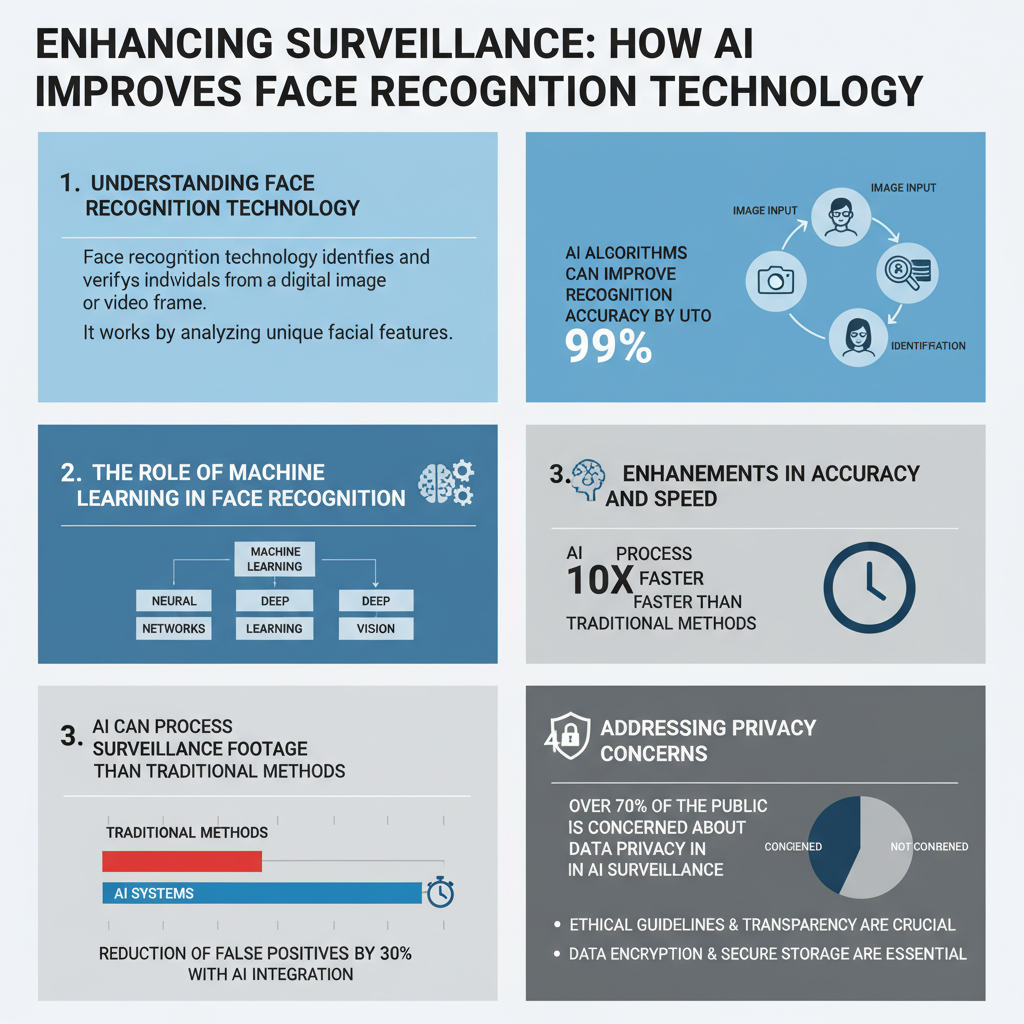
AI algorithms play a crucial role in processing visual data. Traditional systems relied heavily on simple pattern recognition, which often led to inaccuracies. In contrast, AI employs deep learning techniques, enabling the software to train on vast datasets. These datasets consist of diverse images under various conditions, allowing the algorithm to learn the subtle nuances of human faces. This ability to understand and interpret visual data enhances the reliability of face recognition in surveillance videos, making it a powerful tool for security applications.
The Role of Machine Learning in Face Recognition

Machine learning is at the heart of modern face recognition technologies. AI models are trained using large datasets that contain thousands, if not millions, of images of faces. This training process allows the algorithms to learn distinctive facial features and patterns, creating a comprehensive understanding of human identity.
One of the key advantages of machine learning is its capacity for continuous improvement. As AI systems encounter new images and scenarios, they can adapt and refine their recognition capabilities. This aspect of continuous learning is essential for maintaining high accuracy rates, especially in dynamic environments where lighting, angles, and even the appearance of individuals can change. For instance, a system that learns from real-time data can improve its recognition rates in crowded places like airports or shopping malls, where traditional methods may struggle.
Enhancements in Accuracy and Speed
When comparing traditional face recognition methods to AI-enhanced techniques, the differences in accuracy and speed are striking. Traditional systems often relied on static algorithms that could not adapt or improve over time. In contrast, AI-driven technologies utilize neural networks that can analyze multiple facial features simultaneously, leading to quicker and more accurate identification.
A notable case study involves the use of AI in law enforcement. In 2018, the New York Police Department implemented an AI-based facial recognition system, which reportedly improved identification rates by up to 30% compared to previous systems. This significant enhancement not only aids in solving crimes more efficiently but also helps to identify individuals in real-time, thereby improving public safety.
Addressing Privacy Concerns
While the capabilities of AI in surveillance are impressive, they also raise important ethical and privacy concerns. The potential for misuse of face recognition technology, such as unauthorized surveillance or discrimination, has sparked debates around its implementation. Many advocate for strict regulations to govern the use of AI in public spaces, ensuring that individuals’ rights are protected.
Regulations like the General Data Protection Regulation (GDPR) in Europe and similar initiatives worldwide aim to establish guidelines for responsible AI use. These guidelines often include provisions for transparency, data protection, and the right for individuals to opt-out of surveillance. Engaging with these ethical considerations is crucial for stakeholders to balance security needs with respect for individual privacy.
Future Trends in AI and Surveillance
The future of AI in surveillance is poised for exciting advancements, with emerging technologies like 3D facial recognition gaining traction. Unlike traditional 2D recognition, 3D techniques analyze the shape and contours of a face, making it harder for individuals to spoof the system with images or masks. This added layer of security could significantly enhance the effectiveness of surveillance systems.
Moreover, advancements in edge computing are expected to further shape the future of AI in surveillance. With edge devices processing data on-site, real-time analysis can occur without the need for constant internet connectivity, enabling quicker responses to security threats. As these technologies evolve, we can anticipate a more integrated and sophisticated approach to public safety and security.
Practical Applications of AI Face Recognition
AI face recognition technology is being adopted across various industries, showcasing its versatility and effectiveness. In retail, for example, stores are using facial recognition to identify repeat customers and enhance personalized shopping experiences. By analyzing customer behavior, businesses can tailor marketing strategies and improve customer service.
Public safety is another critical area benefiting from AI face recognition. Law enforcement agencies are increasingly using these systems to identify suspects in real-time during investigations. Cities like San Francisco, however, are also grappling with the implications of such technologies, leading to discussions about their appropriate use in public spaces. These practical applications highlight the balance between leveraging innovation and ensuring ethical practices.
Challenges in AI Face Recognition
Despite its benefits, AI face recognition faces several challenges that must be addressed to improve its reliability. One significant issue is the potential for bias in AI systems. If the training data is not diverse, the algorithm may perform poorly on faces that do not match the majority demographic, leading to inaccuracies and unfair treatment.
To overcome these challenges, developers must prioritize the creation of inclusive datasets that represent a wide range of ethnicities, ages, and genders. Additionally, ongoing testing and validation of AI systems are essential to ensure they function effectively across diverse populations. By implementing these strategies, the reliability of AI face recognition can be significantly enhanced.
The advancements in AI are revolutionizing face recognition in surveillance videos, making systems smarter and more efficient. By understanding the technology, its applications, and the challenges it faces, stakeholders can better navigate the future of security and privacy. Engaging with these developments by following the latest news and advancements in AI technology will empower individuals and organizations alike to make informed decisions in this rapidly evolving landscape.
Frequently Asked Questions
How does AI improve the accuracy of face recognition in surveillance video?
AI enhances the accuracy of face recognition in surveillance video through advanced algorithms that utilize deep learning techniques. These algorithms can analyze facial features in real-time, distinguishing between subtle differences in appearance, such as lighting conditions and varying angles. By training on vast datasets, AI can continuously improve its recognition precision, reducing false positives and enhancing the reliability of security systems.
What are the key benefits of using AI-driven face recognition in security surveillance?
The key benefits of AI-driven face recognition in security surveillance include increased efficiency in identifying potential threats, faster response times, and improved accuracy in tracking individuals across multiple cameras. AI systems can process and analyze large volumes of video data almost instantaneously, enabling security personnel to focus on real-time decision-making rather than manual monitoring. This technological advancement not only enhances safety but also optimizes resource management.
Why is AI-based face recognition becoming essential in modern surveillance systems?
AI-based face recognition is becoming essential in modern surveillance systems due to its ability to provide enhanced security and operational efficiency. As crime rates evolve and security needs become more complex, traditional surveillance methods can fall short. AI-powered solutions offer a proactive approach by not only recognizing faces but also predicting potentially suspicious behavior, thereby allowing for preemptive actions and improved public safety measures.
Which industries benefit the most from AI-enhanced face recognition technology in surveillance?
Several industries benefit significantly from AI-enhanced face recognition technology in surveillance, including retail, law enforcement, transportation, and banking. In retail, businesses use this technology to analyze customer behavior and enhance security. Law enforcement agencies rely on accurate identification for criminal investigations, while transportation sectors utilize it for monitoring passengers and ensuring safety. Additionally, banks implement face recognition for fraud prevention and secure transactions.
What challenges does AI face in the development of face recognition for surveillance applications?
AI faces several challenges in the development of face recognition for surveillance applications, including privacy concerns, biases in algorithm training, and varying environmental conditions that can affect accuracy. Ensuring compliance with privacy regulations while maintaining public safety is a complex balance. Moreover, if training datasets lack diversity, the AI may exhibit biases, leading to inaccuracies in recognition for certain demographics. Addressing these challenges is crucial for the responsible implementation of AI in surveillance.
References
- Facial recognition system
- https://www.nist.gov/news-events/news/2020/12/face-recognition-technology-improving-accuracy
- https://www.bbc.com/news/technology-54250969
- https://www.sciencedirect.com/science/article/pii/S0031320321000135
- https://www.ncbi.nlm.nih.gov/pmc/articles/PMC7394543/
- https://www.aaai.org/ojs/index.php/AAAI/article/view/18914
- https://www.theguardian.com/technology/2020/jan/14/facial-recognition-technology-uses-and-abuses
- https://www.cio.com/article/3192308/how-ai-is-transforming-face-recognition.html