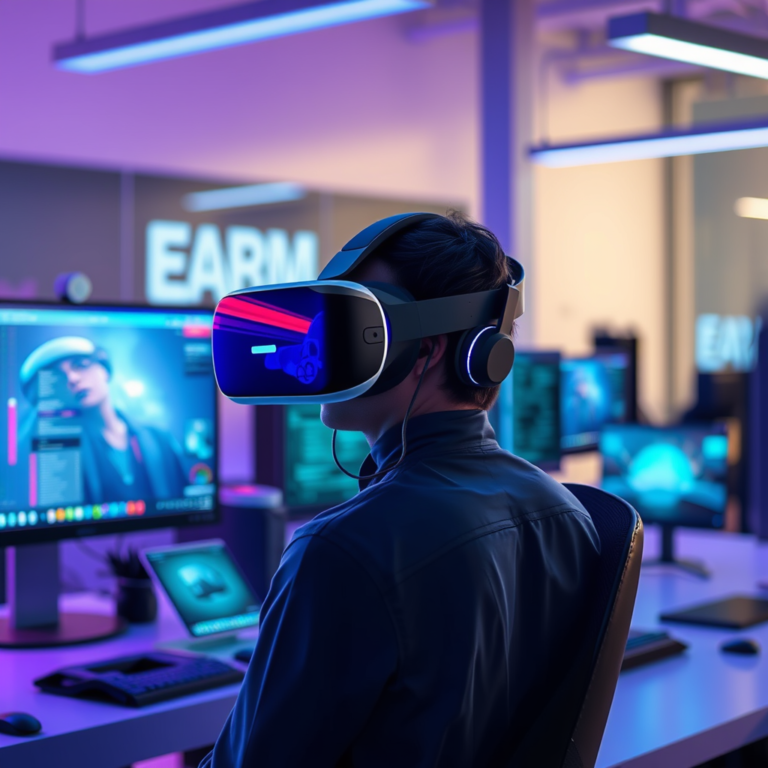
The future of ultra-wide 3D displays in metaverse applications is indeed bright, as they promise to significantly enhance immersive experiences by offering expansive visual fields and improved depth perception. As technology continues to advance, these displays are becoming essential for how users engage with virtual environments, leading to more captivating and lifelike interactions. In this article, we’ll delve into the current state of ultra-wide 3D displays, explore recent technological advancements, highlight key applications within the metaverse, discuss how they improve user experience, address the challenges facing these displays, and predict future trends on the horizon.
The Current State of Ultra-Wide 3D Displays

Ultra-wide 3D displays have emerged as a game-changer in the world of visual technology, boasting specifications that push the boundaries of traditional displays. Currently, many ultra-wide monitors feature a 21:9 or even 32:9 aspect ratio, providing vast horizontal space that enhances viewing experiences, particularly in gaming and professional settings. For instance, displays like the Samsung Odyssey G9 offer a staggering 2400R curvature and a resolution of 5120 x 1440, allowing users to immerse themselves in stunning visuals.
When comparing ultra-wide displays with traditional 2D and standard 3D formats, the differences are striking. Traditional displays typically provide a limited field of view, which can hinder immersion, especially in dynamic and interactive environments. In contrast, ultra-wide 3D displays enable users to see more of the virtual world at once, facilitating a more natural and engaging experience. As a result, users can better track movements and interactions within the metaverse, making these displays an invaluable asset for gamers, educators, and professionals alike.
Advancements in Display Technology

The evolution of display technology has been nothing short of remarkable, with innovations such as OLED and MicroLED leading the charge. OLED (Organic Light Emitting Diodes) displays are known for their vibrant colors and deep blacks, making them ideal for creating immersive visual experiences in the metaverse. MicroLED technology, on the other hand, offers improved brightness and energy efficiency, opening up new possibilities for ultra-wide displays without sacrificing performance.
Moreover, advancements in refresh rates and resolutions are also enhancing the user experience. Current displays now reach refresh rates of 240Hz or more, which are crucial for reducing motion blur and providing smooth visuals, particularly during fast-paced gaming scenarios. With resolutions improving to 8K and beyond, the level of detail available in virtual environments is reaching unprecedented heights, allowing for more realistic and engaging interactions.
Key Applications in the Metaverse
Ultra-wide 3D displays have a wide range of applications within the metaverse. In gaming, these displays allow for a more immersive experience, enabling players to see peripheral actions and details they may miss on a standard display. Titles like “Microsoft Flight Simulator” and “Cyberpunk 2077” leverage these expansive screens to draw players deeper into their richly crafted worlds.
In professional simulations, ultra-wide displays are becoming increasingly important. Industries like architecture, engineering, and medicine utilize these displays for training purposes, enabling users to visualize complex data and simulations in real-time. The ability to analyze 3D models and environments on a larger scale significantly enhances learning and collaboration.
Furthermore, social interactions within the metaverse are also enriched by ultra-wide displays. Virtual meeting spaces can be designed to accommodate multiple participants, creating a more natural and engaging environment for conversations and collaborations. The expansive field of view allows users to feel as though they are truly sharing a space, which is crucial for building relationships in a virtual setting.
Enhancing User Experience
The key to the success of ultra-wide 3D displays lies in their ability to improve immersion and user engagement. By providing a wider field of view and enhanced depth perception, these displays allow users to feel as if they are part of the virtual environment rather than merely observing it. This level of immersion can lead to heightened emotional and cognitive responses, making experiences more memorable and impactful.
For example, studies have shown that users engaged in virtual reality experiences report increased levels of presence when using ultra-wide displays. This heightened sense of presence can result in greater satisfaction and a stronger connection to the content being experienced. Additionally, ultra-wide displays can facilitate a more intuitive interaction with virtual objects, as users can perceive depth and spatial relationships more accurately, leading to a more natural interaction with the environment.
Challenges Ahead
Despite their many advantages, the widespread adoption of ultra-wide 3D displays in the metaverse faces several challenges. One of the primary hurdles is cost—high-quality ultra-wide displays can be expensive, which may limit accessibility for some users. Manufacturers need to find ways to produce these displays at a lower cost to make them more available to a broader audience.
Another challenge is user comfort. Many users experience motion sickness and eye strain when engaging with immersive content for extended periods. As display technology evolves, manufacturers must prioritize ergonomics and comfort, ensuring that users can enjoy extended sessions without discomfort. Solutions might include features like adjustable refresh rates, enhanced anti-glare coatings, and adaptive brightness settings to reduce eye strain.
Future Trends to Watch
Looking ahead, several trends are poised to shape the future of ultra-wide 3D displays in metaverse applications. The integration of artificial intelligence (AI) is one of the most exciting possibilities. AI could enable displays to adapt to individual user preferences, automatically adjusting settings based on user behavior and environmental conditions, thus enhancing overall comfort and experience.
Additionally, the potential for augmented reality (AR) overlays in conjunction with ultra-wide displays is immense. Imagine being able to superimpose virtual elements onto your real-world view, all while enjoying the expansive field of an ultra-wide display. This could open new avenues for creative expression, education, and collaboration, further blurring the lines between the physical and virtual worlds.
The evolution of ultra-wide 3D displays holds immense potential for transforming metaverse experiences. As technology continues to advance, these displays will enable more realistic and engaging interactions, paving the way for broader applications. By staying informed about these advancements, users can consider how they can enhance their own experiences in the metaverse, whether for gaming, education, or social interaction. The future is bright, and ultra-wide 3D displays are set to be at the forefront of this exciting journey.
Frequently Asked Questions
What are the key benefits of using ultra-wide 3D displays in metaverse applications?
Ultra-wide 3D displays enhance immersion in metaverse environments by providing a broader field of view, allowing users to experience virtual worlds more naturally. This expansive view facilitates better spatial awareness and interaction, making activities like gaming, virtual meetings, and educational experiences more engaging. Moreover, the stereoscopic depth offered by 3D displays can reduce eye strain and improve user comfort during extended sessions, making them a valuable asset for both casual users and professionals.
How do ultra-wide 3D displays improve user experience in virtual reality (VR) settings?
Ultra-wide 3D displays significantly improve the user experience in VR settings by creating a more realistic and immersive environment. With a wider aspect ratio, users can see more of their surroundings, which enhances the sense of presence and realism. Additionally, ultra-wide displays can better accommodate multi-user experiences, allowing for collaborative environments where participants interact seamlessly, thereby enriching social interactions within the metaverse.
Why should businesses invest in ultra-wide 3D displays for metaverse applications?
Businesses should consider investing in ultra-wide 3D displays for metaverse applications because they can boost productivity and innovation. These displays enable more effective presentations, design reviews, and collaborative projects, fostering creativity and teamwork. Furthermore, as the metaverse continues to gain traction, having advanced technology can set businesses apart from competitors, making them more appealing to clients and employees alike.
What features should I look for when selecting an ultra-wide 3D display for metaverse use?
When selecting an ultra-wide 3D display for metaverse applications, prioritize features such as resolution (look for at least 4K), refresh rate (at least 120Hz is ideal for smooth visuals), and compatibility with VR headsets or software. Additionally, consider the display’s color accuracy and brightness, as these factors significantly impact visual quality. Features like adjustable stands and connectivity options (HDMI, DisplayPort) are also crucial for maximizing usability and comfort.
Which industries are likely to benefit most from ultra-wide 3D displays in the metaverse?
Industries such as gaming, architecture, education, and healthcare are expected to benefit significantly from ultra-wide 3D displays in the metaverse. In gaming, enhanced graphics and immersive environments can elevate user engagement. Architects can utilize these displays for realistic 3D modeling and virtual walkthroughs, while educators can create interactive learning experiences. In healthcare, ultra-wide displays can facilitate detailed visualizations of medical data and simulations, improving training and patient outcomes.
References
- 3D display
- https://www.sciencedirect.com/science/article/pii/S1877050919310567
- https://www.nature.com/articles/s41598-021-96129-5
- https://www.bbc.com/future/article/20211005-what-is-the-metaverse-and-why-does-it-matter
- https://www.techrepublic.com/article/the-future-of-the-metaverse-and-its-potential-impact-on-business/
- https://www.nytimes.com/2021/10/28/technology/metaverse-facebook.html
- https://www.reuters.com/technology/metaverse-future-what-you-need-know-2021-10-28/
- https://www.itu.int/en/ITU-T/focusgroups/metaverse/Pages/default.aspx
- https://www.wired.com/story/the-metaverse-what-it-is-and-what-it-means/
- https://www.itu.int/en/ITU-T/focusgroups/metaverse/Pages/default.aspx