Streaming protocols are the backbone of media delivery over the internet, allowing for the seamless transmission of audio and video content. They ensure that users enjoy smooth playback, regardless of their network conditions. In this article, we’ll dive into the world of streaming protocols, focusing on HLS, DASH, and RTMP—three widely-used standards that cater to different needs in the realm of online media.
What is a Streaming Protocol?

Streaming protocols are sets of rules and conventions that dictate how audio and video data is transmitted over the internet. They enable real-time data transfer, allowing users to access content without having to wait for an entire file to download. Essentially, streaming protocols break media files into smaller chunks, which can be sent over the network and reassembled for playback almost instantaneously. This is particularly important for live streaming events, where latency and smooth delivery are crucial for viewer engagement. By employing streaming protocols, content providers can ensure a better user experience, even in variable network conditions.
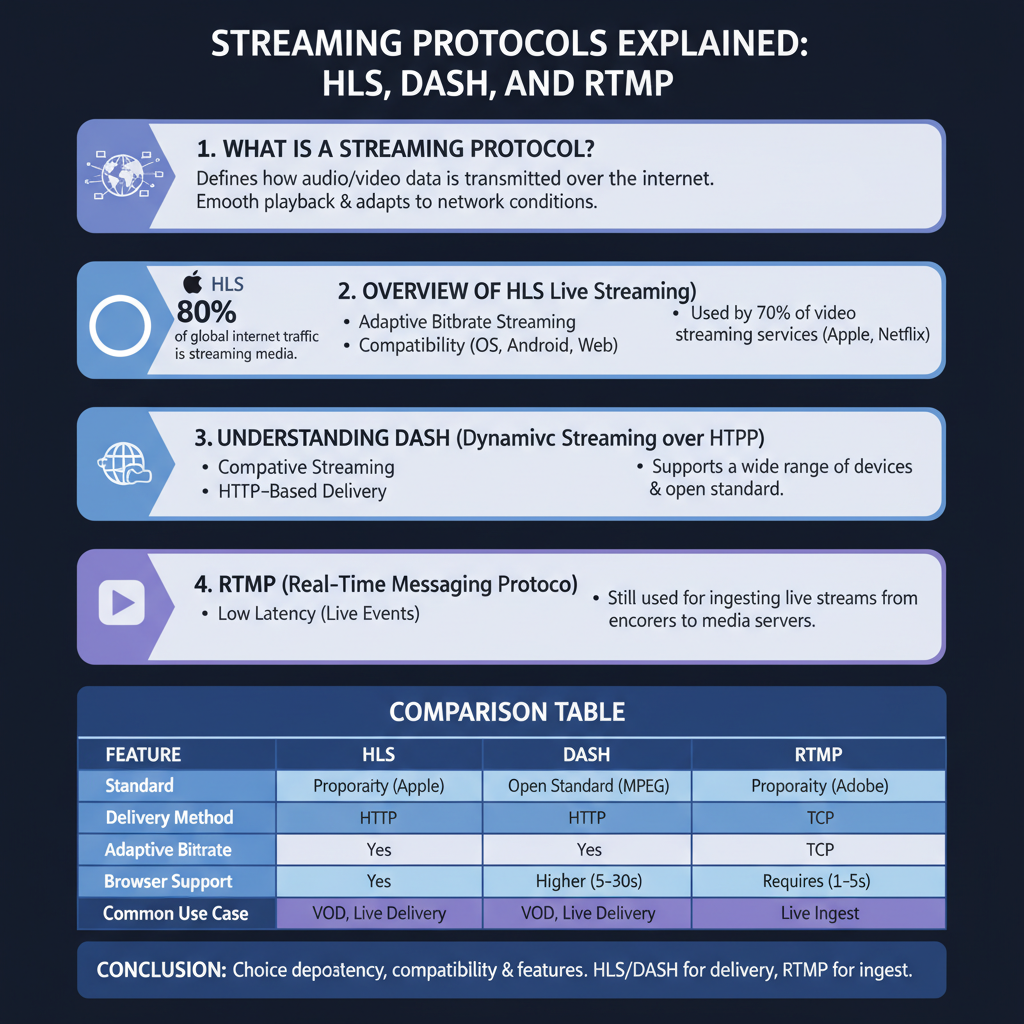
Overview of HLS (HTTP Live Streaming)

HTTP Live Streaming, or HLS, is a protocol developed by Apple to deliver media content efficiently over the web. One of its standout features is adaptive bitrate streaming, which automatically adjusts the quality of the video stream based on the user’s internet connection. This means that viewers on slower connections won’t experience buffering, while those with high-speed internet can enjoy higher quality playback.
HLS also supports live broadcasts, making it a popular choice for streaming sports events, concerts, and other real-time activities. It works by breaking the video into small segments, typically around 10 seconds long, and delivering them via HTTP. This approach not only enhances compatibility across devices but also simplifies the streaming process, as it utilizes standard web protocols. HLS is widely supported on iOS and Android devices, making it an excellent choice for mobile content delivery.
Understanding DASH (Dynamic Adaptive Streaming over HTTP)
Dynamic Adaptive Streaming over HTTP, or DASH, is a streaming protocol standardized by the Moving Picture Experts Group (MPEG). Like HLS, DASH supports adaptive bitrate streaming, allowing it to dynamically adjust the video quality based on the user’s bandwidth and device capabilities. This flexibility is one of DASH’s major advantages, as it enables a more tailored streaming experience for different users.
One of DASH’s key features is its ability to deliver content in a format that is compatible across a wide range of devices, from smartphones to smart TVs. It uses a technique called segmenting, where video files are divided into small segments that can be streamed independently. This not only improves the user experience but also optimizes bandwidth usage. DASH is particularly favored in professional broadcasting environments, where quality and adaptability are paramount.
Exploring RTMP (Real-Time Messaging Protocol)
Real-Time Messaging Protocol (RTMP) was originally developed by Adobe to facilitate the streaming of audio, video, and data over the internet for Flash applications. Although Flash is now largely deprecated, RTMP remains a popular choice for live streaming, thanks to its low-latency capabilities. This makes it ideal for applications where real-time interaction is essential, such as online gaming, video conferencing, and live broadcasts.
RTMP is particularly effective for delivering high-quality video streams, as it maintains a constant connection between the server and the client. This allows for the quick transfer of data, reducing the chances of lag or buffering during live events. Additionally, RTMP supports various codecs, enabling it to deliver a wide range of media formats. While newer protocols like HLS and DASH have become more prevalent for general streaming purposes, RTMP remains a go-to choice for live streaming scenarios where speed is crucial.
Comparison of HLS, DASH, and RTMP
When it comes to choosing the right streaming protocol, understanding the differences between HLS, DASH, and RTMP is essential.
– Latency: RTMP typically has the lowest latency, making it perfect for real-time applications. HLS and DASH, while they can also support low-latency configurations, generally have higher latency due to their chunk-based delivery methods.
– Compatibility: HLS has broad support across Apple devices and browsers, while DASH is designed for compatibility across various platforms. RTMP, although it was widely used with Flash, has limited support on modern devices but still excels in specific use cases.
– Quality: All three protocols support adaptive bitrate streaming, but HLS and DASH are often preferred for their ability to automatically adjust quality based on user conditions. RTMP can deliver high-quality streams but may require more bandwidth.
In general, HLS is a great choice for general web video delivery, DASH is ideal for professional broadcasting and adaptive streaming, while RTMP shines in scenarios requiring real-time interaction.
Practical Applications of Streaming Protocols
Streaming protocols have found applications across various industries, revolutionizing how we consume content.
– Entertainment: Streaming services like Netflix and Hulu utilize HLS and DASH to deliver movies and shows to millions of viewers worldwide, ensuring optimal playback quality based on each user’s internet speed.
– Gaming: Platforms like Twitch leverage RTMP for live streaming gameplay, providing an interactive experience for viewers through real-time chat and low-latency streaming.
– Education: E-learning platforms often use HLS and DASH to deliver video lectures and interactive courses, allowing students to learn at their own pace without interruptions.
A notable example is the live-streaming of sports events, where broadcasters integrate HLS for reliable delivery of high-quality streams to viewers, ensuring they don’t miss any action.
Future Trends in Streaming Protocols
As technology evolves, so do streaming protocols. One of the notable trends is the increasing push towards lower latency streaming. With advancements in internet technology like 5G, there’s potential for real-time streaming experiences to become even more seamless.
Additionally, the rise of WebRTC (Web Real-Time Communication) is gaining traction for live interactions, such as video conferencing and gaming, as it offers ultra-low latency and browser-based capabilities that could potentially replace RTMP in some areas.
Moreover, the integration of Artificial Intelligence (AI) in streaming protocols may enhance adaptive streaming capabilities, allowing for even smarter adjustments based on user behavior and network conditions.
In summary, the future of streaming protocols looks promising, with continuous innovations aimed at improving the user experience and expanding the possibilities of live and on-demand content delivery.
Summarizing the essential aspects of streaming protocols, we see that HLS, DASH, and RTMP each serve unique purposes in the realm of media delivery. Understanding these protocols can help you make informed decisions for your streaming needs. Explore these protocols further and consider how they can enhance your content delivery strategy.
Frequently Asked Questions
What are the main types of streaming protocols and how do they differ?
The primary types of streaming protocols include HLS (HTTP Live Streaming), DASH (Dynamic Adaptive Streaming over HTTP), and RTMP (Real-Time Messaging Protocol). HLS is widely used for its compatibility with Apple devices and ability to adapt video quality based on user bandwidth. DASH, an open standard, offers similar adaptive streaming capabilities but is more versatile across different platforms. In contrast, RTMP is primarily used for real-time streaming applications, providing low latency but requiring dedicated servers, making it less suitable for on-demand content.
How does HLS work, and what are its advantages?
HLS works by breaking the video stream into small segments and delivering them over HTTP. Each segment is encoded at different bitrates, allowing the player to switch to a higher or lower quality stream based on the user’s internet connection speed. The advantages of HLS include wide compatibility across various devices and browsers, built-in support for adaptive bitrate streaming, and the ability to deliver content securely with encryption, making it a popular choice for live and on-demand video.
Why is DASH considered an important streaming protocol?
DASH is considered important because it is an adaptive streaming protocol that allows for high-quality video delivery over the internet by dynamically adjusting the quality based on the user’s network conditions. It supports a variety of codecs and is not tied to a specific operating system, making it highly versatile. Additionally, DASH is an open standard, which means it encourages innovation and is supported by many major companies, ensuring a robust ecosystem for content delivery.
What are the best use cases for RTMP, and when should I consider using it?
RTMP is best suited for scenarios requiring low latency, such as live broadcasts, interactive applications, and real-time communication. It excels in environments where immediate content delivery is crucial, like gaming streams or live sports events. However, RTMP is less ideal for on-demand video content due to its reliance on specialized server setups. Therefore, consider using RTMP when real-time interaction is a priority, and ensure your infrastructure can support its requirements.
Which streaming protocol should I choose for my video application, and why?
The choice of streaming protocol largely depends on your specific use case. If you need broad compatibility and adaptive bitrate streaming, HLS is often the best choice for delivering content across various devices. If flexibility and open standards are important, DASH may be preferable. On the other hand, if low latency is crucial for your application, such as in live streaming, RTMP would be the ideal option. Assess your audience’s needs, device compatibility, and content delivery requirements to make the best decision.
References
- https://en.wikipedia.org/wiki/Streaming_protocol
- https://www.w3.org/TR/media-streams/
- https://www.ietf.org/rfc/rfc3550.txt
- https://www.techspot.com/news/88305-what-hls-vs-dash-streaming.html
- Ad Tech Leaders Align on Adoption of Ad Clouds and a Universal Asset Identifier
- https://www.akamai.com/us/en/multimedia/documents/white-paper/streaming-protocols-overview.pdf
- IBM Solutions
- https://www.researchgate.net/publication/220620201_Real-time_streaming_media_over_the_internet
- https://www.ncbi.nlm.nih.gov/pmc/articles/PMC7408351/