

High-quality video streaming relies heavily on Graphics Processing Units (GPUs) to deliver smooth and visually rich content. These powerful processors enable faster data processing and efficient rendering, which are essential for streaming high-definition and 4K video without buffering. In this article, we’ll explore how GPUs enhance video streaming performance, their technological advancements, and their impact on user experience.
Understanding GPU Functionality in Video Streaming

At the core of video streaming is the need to process vast amounts of visual data quickly and efficiently. GPUs excel in this area because they are designed to handle parallel processing, which allows them to manage multiple tasks simultaneously. This means they can decode and render video frames much faster than traditional CPUs, resulting in a smoother playback experience.
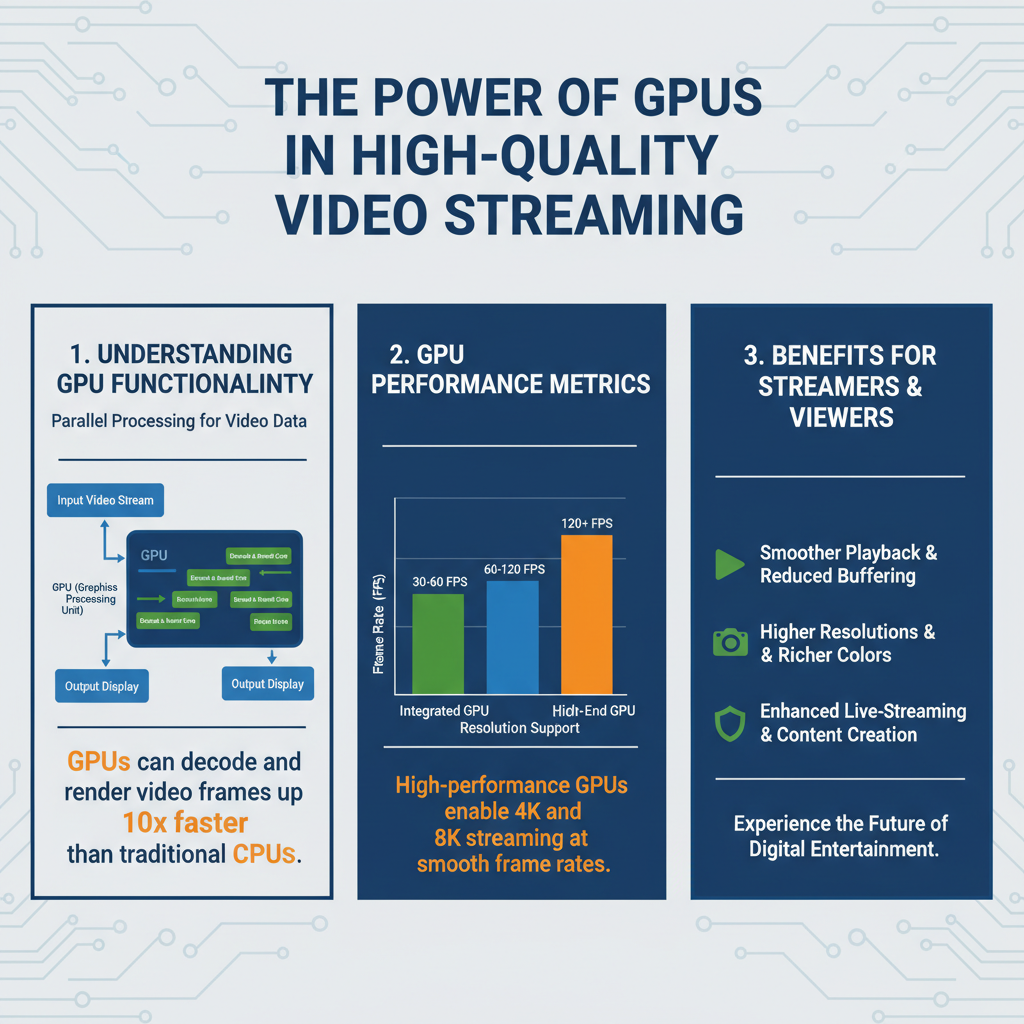
When a video is streamed, it is typically compressed to reduce file size and bandwidth usage. The GPU plays a critical role in decoding this compressed video data. By efficiently decoding video streams, GPUs reduce latency, ensuring that viewers experience minimal delays and interruptions. This is particularly important for live streaming events, where real-time performance is crucial. Additionally, GPUs optimize playback quality by enhancing color accuracy and image sharpness, which significantly improves the overall viewing experience.

The Importance of GPU Performance Metrics

When it comes to video streaming, certain performance metrics are essential for determining the quality of the experience. Frame rate, for example, refers to how many frames per second (FPS) a video displays. Higher frame rates result in smoother motion, which is particularly important for fast-paced content like sports or action films. Resolution is another critical metric; the higher the resolution, the more details viewers can see, enhancing the overall visual experience.
Key performance metrics for GPUs include memory bandwidth, core count, and power efficiency. Memory bandwidth refers to the amount of data the GPU can process in a given time, directly affecting how quickly it can render high-resolution video. Meanwhile, a higher core count allows the GPU to handle more threads simultaneously, improving its ability to manage multiple tasks without performance degradation. Lastly, power efficiency is crucial for both desktop and mobile devices, as it determines how much energy is consumed during video playback, impacting battery life and thermal performance.
Comparing Integrated vs. Dedicated GPUs
When choosing a GPU for video streaming, users often face the decision between integrated and dedicated GPUs. Integrated GPUs, which are built into the CPU, are cost-effective and suitable for casual streaming and everyday tasks. However, they may struggle with high-demand streaming tasks, such as 4K video or rendering complex graphics, leading to lower frame rates and potential buffering issues.
On the other hand, dedicated GPUs are standalone graphics cards designed specifically for demanding tasks like gaming and high-quality video streaming. They provide superior performance, efficiently handling high resolutions and high frame rates with ease. For professional streamers or content creators looking to deliver top-tier quality, investing in a dedicated GPU is essential. These graphics cards often come with their own cooling systems, ensuring optimal performance even during extended streaming sessions.
The Impact of GPU Technology on Streaming Platforms
Recent advances in GPU technology have significantly influenced how streaming platforms deliver content. One notable example is real-time ray tracing, a rendering technique that simulates how light interacts with objects to create more realistic visuals. This technology enhances visual realism in streamed content, making it more immersive for viewers.
Moreover, streaming services are increasingly leveraging GPU capabilities for features like adaptive bitrate streaming. This technology adjusts the quality of the video stream in real-time based on the viewer’s internet connection speed, ensuring a seamless experience with minimal buffering. By utilizing GPUs for these advanced features, streaming platforms can offer better quality content while optimizing bandwidth usage.
Future Trends in GPU Usage for Video Streaming
Looking ahead, the role of GPUs in video streaming will only continue to grow. One exciting trend is the rise of AI-driven enhancements that improve video compression and quality. These AI algorithms can analyze video content and optimize it for streaming, ensuring that viewers receive the best possible experience without an increase in bandwidth consumption.
Additionally, as virtual and augmented reality applications become more prevalent, there will be a growing demand for more powerful GPUs capable of rendering complex 3D environments. This shift will require advancements in GPU technology to accommodate the higher processing power needed for immersive experiences, making the role of GPUs in video streaming even more critical.
Common Misconceptions About GPUs in Streaming
Despite their importance, there are several common misconceptions about GPUs and their role in streaming. One prevalent belief is that higher resolution always requires more bandwidth. While it’s true that higher resolutions typically use more data, efficient GPU processing can alleviate this issue. GPUs can effectively compress and decompress video streams, allowing for higher-quality content to be delivered with minimal bandwidth impact.
Another misconception is that GPUs are only crucial for high-end gaming PCs. In reality, GPUs play a vital role in mobile streaming as well. Many smartphones and tablets come equipped with advanced integrated GPUs that are capable of handling high-quality video playback, proving that you don’t need a powerful desktop setup to enjoy streaming content in great quality.
As advancements in GPU technology continue to revolutionize the video streaming landscape, enhancing both quality and performance, understanding their role is essential. By recognizing the importance of GPUs, viewers and content creators alike can make informed decisions about their technology choices. Whether you’re considering upgrading your hardware or exploring the latest streaming platforms, investing in a dedicated GPU or utilizing the latest technology will undoubtedly improve your streaming experience.
Frequently Asked Questions
What is the role of GPUs in high-quality video streaming?
GPUs, or Graphics Processing Units, play a critical role in high-quality video streaming by efficiently processing and rendering video content. They handle complex graphics tasks, enabling smooth playback and high frame rates, which are essential for delivering a seamless viewing experience. Additionally, modern GPUs support advanced encoding and decoding technologies, allowing for faster processing of high-resolution video formats like 4K and 8K.
How do GPUs improve video streaming performance?
GPUs improve video streaming performance by offloading intensive tasks from the CPU, allowing for better utilization of system resources. This parallel processing capability enables real-time video encoding and decoding, which enhances frame rates and reduces buffering. Furthermore, GPUs can optimize video quality through advanced algorithms, ensuring that viewers receive crisp visuals and minimal latency during streaming sessions.
Why is a dedicated GPU preferred for streaming over integrated graphics?
A dedicated GPU is preferred for streaming because it offers superior performance compared to integrated graphics. Dedicated GPUs are specifically designed to handle high-demand tasks, such as rendering complex graphics and processing large video files, which integrated graphics may struggle with. This results in higher resolutions, better frame rates, and an overall enhanced streaming experience, particularly for demanding applications like gaming or professional video production.
What are the best GPUs for high-quality video streaming in 2023?
The best GPUs for high-quality video streaming in 2023 include models like the NVIDIA GeForce RTX 3060 Ti, AMD Radeon RX 6700 XT, and NVIDIA GeForce RTX 3080. These GPUs offer excellent performance for video encoding and decoding, support for ray tracing, and provide sufficient VRAM for handling high-resolution video streams. When choosing a GPU, consider your specific streaming requirements and budget to find the optimal balance between performance and cost.
Which video streaming applications benefit most from GPU acceleration?
Video streaming applications that benefit most from GPU acceleration include platforms like OBS Studio, Streamlabs, and Adobe Premiere Pro. These applications utilize GPU resources for encoding and rendering video streams in real-time, resulting in smoother performance and higher quality output. GPU acceleration is especially valuable for content creators and streamers who require high-definition video delivery and low latency to engage their audiences effectively.
References
- Graphics processing unit
- https://www.nytimes.com/2022/10/25/technology/gpu-video-streaming.html
- https://www.sciencedirect.com/science/article/pii/S1877050919312912
- https://www.techrepublic.com/article/how-gpus-are-changing-video-streaming/
- https://www.bbc.com/news/technology-45123630
- https://www.wired.com/story/gpu-accelerated-video-streaming/
- https://www.nature.com/articles/s41598-020-62947-5
- https://www.researchgate.net/publication/343202101_The_Role_of_Graphics_Processing_Units_in_Streaming_Media
- https://www.microsoft.com/en-us/research/publication/gpu-accelerated-video-streaming/
