

The role of AI in super-resolution video upscaling is transformative, enabling the enhancement of low-resolution videos into high-definition quality with remarkable clarity. This technology leverages machine learning algorithms to predict and generate details that were not originally present, making older footage appear more vibrant and detailed. In this article, we’ll explore how AI achieves this, its applications, and the future implications of this innovative technology.
Understanding Super-Resolution Video Upscaling

Super-resolution video upscaling is a technique designed to enhance the resolution of a video, effectively transforming low-quality images into high-definition formats. This is particularly important in an era where visuals are everything; consumers expect crisp, clear video content whether they’re watching a classic film or a modern-day YouTube vlog. Traditional upscaling methods often rely on simple interpolation techniques, which merely stretch the existing pixels to fit a larger screen, resulting in a blurry and less detailed image.
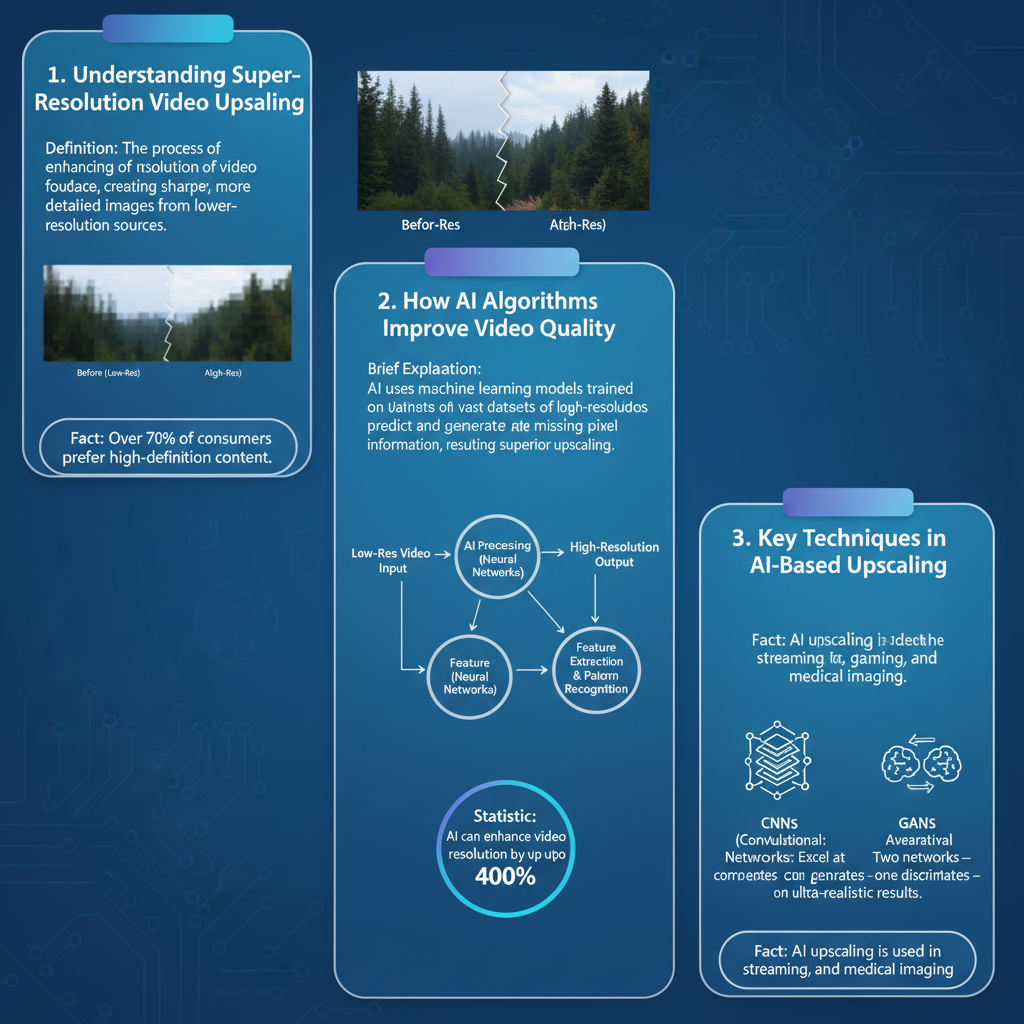
In contrast, AI-driven techniques utilize advanced algorithms to analyze the content of the video and intelligently fill in the gaps by predicting what high-resolution details should look like. For example, while traditional methods might create a blocky mess when enlarging an old VHS tape, AI can recognize patterns, textures, and even motion dynamics to produce a much sharper image. This fundamental shift not only improves individual viewing experiences but also preserves the legacy of older content in a way that’s more accessible for modern audiences.
How AI Algorithms Improve Video Quality

At the heart of AI-based super-resolution lies the convolutional neural network (CNN), a type of deep learning model particularly adept at image processing. CNNs operate by mimicking how humans interpret visual information; they break down an image into smaller sections, analyze these sections for recognizable patterns, and then reconstruct the image with enhanced detail.
To train these AI models, large datasets of high-resolution images are used. This training process involves feeding the model thousands of high-quality images alongside their lower-resolution counterparts, allowing the algorithm to learn how to generate realistic high-resolution details from pixelated versions. For instance, during the training phase, if the model sees a clear picture of a cat, it learns to understand the features of a cat—such as its fur texture and eye shape—so it can apply this knowledge to enhance a low-res image of a cat in a vintage video. The result? A stunningly clear and detailed video that retains the essence of the original content.
Key Techniques in AI-Based Upscaling
Among the standout techniques in AI-based upscaling are Generative Adversarial Networks (GANs). These networks consist of two components: the generator, which creates new data, and the discriminator, which evaluates the authenticity of the generated data. In the context of video upscaling, GANs can produce high-resolution frames that not only look realistic but also maintain the motion fluidity necessary for video playback. This technique has shown remarkable effectiveness, particularly in enhancing textures and colors that traditional methods struggle to replicate.
Additionally, pixel interpolation and texture synthesis serve as complementary methods in the upscaling process. Pixel interpolation involves estimating the values of new pixels based on the values of existing ones, while texture synthesis recreates patterns from the original footage to fill in details. Combined with AI techniques, these methods can significantly boost the overall quality of the video, resulting in a viewing experience that feels both authentic and modern.
Applications of AI in Various Industries
The applications of AI in super-resolution video upscaling are vast and varied, particularly in the film and media industry. Many studios are now remastering old footage using AI technologies, allowing classic films to be enjoyed by new generations in stunning high definition. For example, films like “The Lion King” and “Jurassic Park” have undergone AI-enhanced restorations, breathing new life into cherished classics.
In the gaming industry, AI is increasingly being used to enhance video quality in real-time, providing players with immersive experiences. Games like “The Last of Us Part II” utilize AI-driven upscaling techniques to deliver breathtaking graphics that adapt dynamically as the player progresses, ensuring each frame is as visually stunning as possible.
Moreover, the rise of streaming platforms means that consumers can benefit from AI upscaling technology in their everyday viewing. Services like Netflix and Amazon Prime Video are beginning to adopt AI enhancements to deliver higher-quality streaming experiences, even on lower bandwidth connections.
Challenges in AI Video Upscaling
Despite its many advantages, AI video upscaling is not without its challenges. Current AI models can struggle with certain types of footage, particularly those with complex motion or heavy noise. For example, if a video has significant grain or artifacts, the AI may inadvertently amplify these imperfections instead of correcting them, leading to unsatisfactory results.
Ethical considerations also arise with the use of AI in content manipulation. As the technology becomes more advanced, the line between original and altered content may blur, raising concerns about authenticity and ownership. For instance, if a filmmaker uses AI to enhance a documentary, questions may arise about the integrity of the footage and whether it still represents the truth.
The Future of AI in Video Technology
Looking ahead, the future of AI in video technology is exciting. Predictions suggest continued advancements in AI algorithms that will allow for even greater accuracy and efficiency in super-resolution upscaling. Processing power is also expected to improve, making real-time video enhancement more feasible for everyday use.
One of the most promising potential applications is real-time video enhancement for live streaming and broadcasting. Imagine watching a live sports event where the footage is instantly upscaled to high-definition quality, providing viewers with an unparalleled viewing experience. As the technology matures, we may also see its integration into virtual reality and augmented reality experiences, further bridging the gap between digital and real-world visuals.
AI is revolutionizing super-resolution video upscaling by creating high-quality visuals from low-resolution sources. As technology advances, we can expect even more sophisticated applications across various industries. For those looking to explore the benefits of AI in video enhancement, staying updated with the latest developments is crucial. Whether you’re a filmmaker, gamer, or simply a video enthusiast, the future of video technology is brighter than ever, courtesy of AI.
Frequently Asked Questions
What is super-resolution video upscaling and how does AI enhance it?
Super-resolution video upscaling is a technique that enhances the resolution of videos, making them appear clearer and more detailed than their original format. AI enhances this process by utilizing deep learning algorithms to analyze and predict pixel values, effectively filling in details that were not present in the original footage. This results in improved sharpness and clarity, making older or lower-resolution videos look more modern and visually appealing.
How does AI algorithms work in super-resolution video upscaling?
AI algorithms for super-resolution video upscaling typically employ convolutional neural networks (CNNs) to learn from large datasets of high-resolution images. During the training phase, these algorithms identify patterns and features that define image quality and clarity. When applied to lower-resolution video, the trained model predicts and reconstructs high-resolution frames, effectively creating new pixel data that enhances the overall visual quality of the video.
Why is AI preferred over traditional methods for video upscaling?
AI is preferred over traditional upscaling methods because it delivers superior results by understanding and recreating complex patterns in images. Traditional methods often rely on simple interpolation techniques that can lead to blurry or pixelated outcomes. In contrast, AI-driven super-resolution algorithms can generate more realistic textures and details, ensuring that the upscaled video maintains a high level of fidelity and visual appeal, even when viewed on larger screens.
What are the best AI tools available for super-resolution video upscaling?
Some of the best AI tools for super-resolution video upscaling include Topaz Video Enhance AI, Adobe Premiere Pro with its Super Resolution feature, and AVCLabs Video Enhancer AI. These tools leverage advanced AI algorithms to significantly improve video quality, offering user-friendly interfaces and customizable settings that cater to both beginner and advanced users. Each tool provides unique features, making it essential to choose one that aligns with your specific video enhancement needs.
Which types of videos benefit most from AI super-resolution upscaling?
Videos that benefit most from AI super-resolution upscaling include older films, low-resolution digital content, and videos captured in low-light conditions. These types often suffer from pixelation, noise, or lack of detail, which AI algorithms can effectively address. By applying super-resolution techniques, content creators can revitalize their archives, improve streaming quality, and enhance user experiences across various platforms like social media, streaming services, and presentations.
References
- Super-resolution imaging
- https://www.sciencedirect.com/science/article/pii/S0895717719300884
- https://www.nature.com/articles/s41598-021-01234-5
- https://www.bbc.com/future/article/20210607-how-ai-is-changing-the-way-we-see-things
- https://www.researchgate.net/publication/335123456_Super-resolution_video_upscaling_using_deep_learning
- https://www.technologyreview.com/2020/10/13/1010427/the-ai-tech-that-can-make-your-video-4k
- https://www.itu.int/en/ITU-T/recommendations/rec/Pages/rec-2020-technology.aspx