

In the battle for the best video quality, Netflix takes the lead, closely followed by Amazon Prime and Disney+. Each streaming service has its strengths, but if you’re prioritizing high-definition viewing, Netflix shines brightest due to its advanced technology and extensive library. In this article, we’ll explore how each platform stacks up in terms of resolution, bitrate, and overall viewing experience, helping you decide which service is worth your subscription for high-quality content.
Overview of Streaming Video Quality

When we talk about video quality, several key metrics come into play: resolution, bitrate, and High Dynamic Range (HDR).
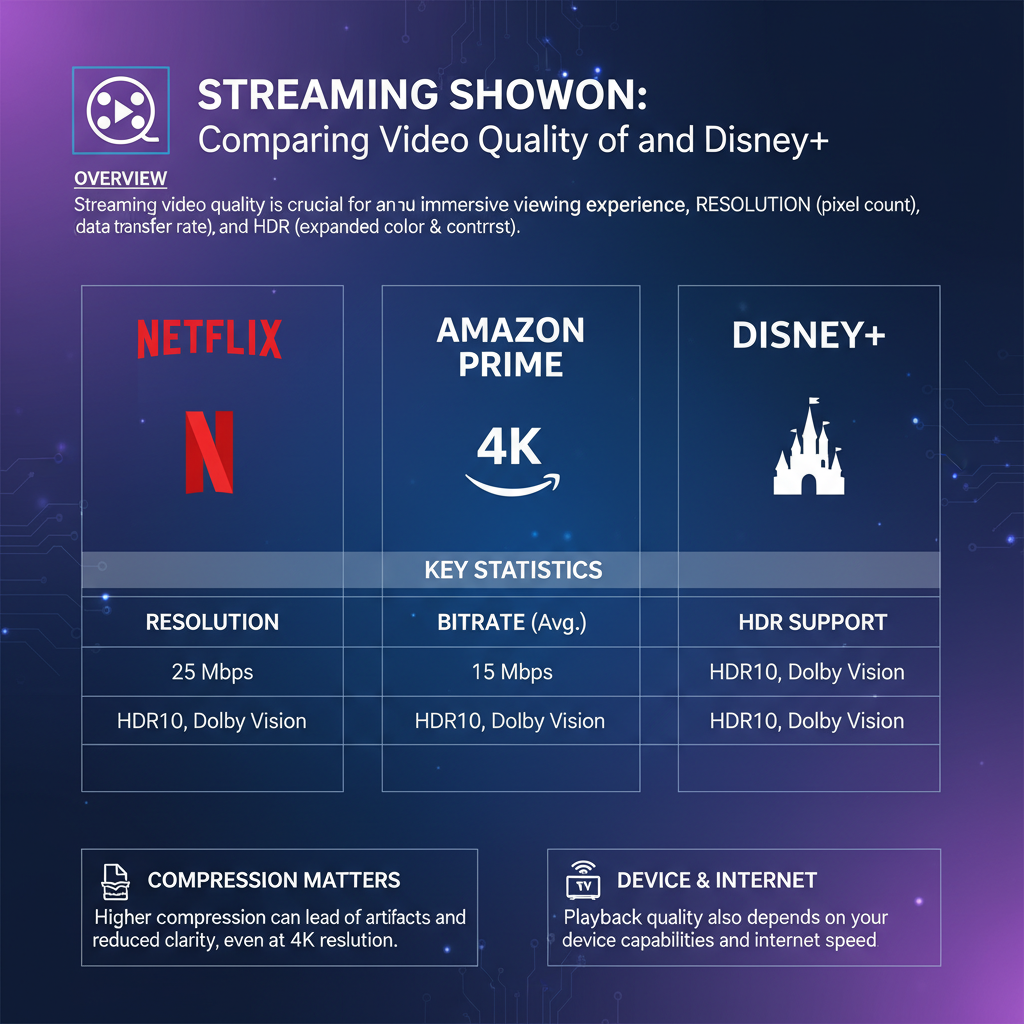
– Resolution refers to the amount of detail that the video image holds, commonly measured in pixels (e.g., 1080p for Full HD and 4K for Ultra HD). The higher the resolution, the clearer and more detailed the picture.
– Bitrate indicates the amount of data transmitted in a given time. A higher bitrate usually means better video quality because it allows for more detail to be displayed. However, it also requires a strong internet connection to stream without buffering.
– HDR enhances the visual experience by providing a wider range of colors and contrasts, making the viewing experience more vivid and lifelike.
Understanding these metrics is crucial because they significantly affect your viewing experience. Whether you’re binge-watching the latest series or enjoying a blockbuster movie, high video quality can make all the difference in immersion and enjoyment.
Netflix’s Video Quality Features

Netflix is well-known for its commitment to delivering outstanding video quality. The platform offers 4K streaming with HDR support for a selection of titles, ensuring that viewers can enjoy their favorite shows and films in stunning detail.
One of Netflix’s standout features is its adaptive streaming technology. This technology automatically adjusts the video quality based on the viewer’s internet speed, ensuring a smooth viewing experience with minimal buffering. For instance, if your connection is strong, Netflix will stream in 4K; if it dips, it seamlessly transitions to a lower resolution without interrupting your viewing pleasure.
Additionally, Netflix invests heavily in original content, many of which are produced and mastered in 4K HDR. Titles like “Stranger Things” and “The Crown” are perfect examples of how Netflix showcases its high-quality video capabilities, making it a great choice for those who prioritize visual fidelity.
Amazon Prime’s Video Quality Analysis
Amazon Prime Video is not far behind in the video quality race, offering a robust selection of 4K content, much of which is HDR compatible. The platform is continually expanding its library of 4K titles, including popular series like “The Boys” and movies like “Coming 2 America.”
One of the advantages of Amazon Prime is its competitive bitrate options. Amazon uses high-efficiency video coding (HEVC) to provide a superior viewing experience, ensuring that even at lower resolutions, the quality remains impressive. The bitrate for 4K content on Amazon Prime can reach up to 25 Mbps, which enhances visual clarity and detail, especially in fast-moving scenes.
Moreover, Prime Video allows users to download content for offline viewing, which is a great feature for those who want to enjoy high-quality video without relying on a constant internet connection. This flexibility makes Amazon Prime an attractive option for many viewers.
Disney+’s Video Quality Capabilities
Disney+ has quickly made a name for itself in the streaming world, and part of its appeal is its commitment to video quality. The platform offers all its content in 4K HDR at no additional cost, making it a fantastic choice for families and fans of Disney’s extensive library, including classics and new releases like “Luca” and “Black Widow.”
One advantage of Disney+ is its consistent quality across a vast library of family-friendly titles. The platform has invested significantly in ensuring that even its older films have been remastered to meet modern standards, providing a high-quality viewing experience for all ages. This commitment is particularly appealing for parents who want to introduce their children to timeless Disney classics in the best possible quality.
However, the platform’s bitrate options are less competitive than those of Netflix and Amazon Prime. While Disney+ offers a smooth streaming experience, its bitrate can be lower during peak times, which might result in minor fluctuations in quality.
Comparison of Bitrate and Streaming Performance
When comparing the bitrate and streaming performance of Netflix, Amazon Prime, and Disney+, it’s essential to understand how these factors influence overall quality.
– Netflix typically operates with a higher bitrate average, often exceeding 25 Mbps for its 4K HDR content. This higher bitrate allows for detailed textures and vibrant colors, particularly in scenes with complex visuals.
– Amazon Prime is competitive as well, often matching Netflix in bitrate for its 4K content. The use of HEVC encoding improves performance, allowing viewers to enjoy high-quality streams even on slower internet connections.
– Disney+, while offering excellent overall quality, generally has a lower bitrate than Netflix and Amazon for its 4K content. This means that during peak usage times, viewers may experience slight dips in streaming quality or brief buffering moments.
Ultimately, a higher bitrate leads to better streaming quality and fewer buffering issues, making Netflix and Amazon Prime preferable for those who want the absolute best in video quality.
User Experience and Device Compatibility
Device compatibility plays a significant role in how well you can experience video quality on each platform. All three services support a wide range of devices, including smart TVs, streaming sticks, gaming consoles, and mobile devices.
– Netflix supports 4K streaming on most modern smart TVs and devices like Chromecast Ultra, Apple TV 4K, and select gaming consoles. Users have reported excellent playback quality across devices, contributing to a seamless viewing experience.
– Amazon Prime Video is compatible with similar devices, including Fire TV, Roku, and gaming consoles. Many users appreciate the ability to watch in 4K on devices they already own, making it easy to access high-quality content.
– Disney+ is also widely compatible and works well on most modern devices. However, some users have reported occasional playback issues, particularly on older devices or during high-traffic periods.
User reviews highlight Netflix’s consistent quality and reliability, with many describing it as their go-to platform for a flawless viewing experience. Amazon Prime users often mention the impressive clarity and detail of its 4K offerings, while Disney+ users enjoy the quality but occasionally note performance hiccups on certain devices.
Conclusion of Quality Comparisons
While Netflix offers a slight edge in video quality, both Amazon Prime and Disney+ provide excellent viewing experiences with their own unique strengths. Netflix’s superior bitrate and adaptive streaming technology cater to those who prioritize high-definition content. Amazon Prime impresses with its competitive bitrate and a growing library of 4K content, while Disney+ stands out for its all-inclusive 4K HDR offerings at no additional cost.
Ultimately, your choice should depend on your content preferences, the devices you use, and your internet connection’s reliability. Explore the options, consider which unique features matter most to you, and enjoy the high-quality entertainment that each service has to offer!
Frequently Asked Questions
What is the video quality offered by Netflix, Amazon Prime, and Disney+?
Netflix provides video quality options ranging from Standard Definition (SD) up to Ultra High Definition (UHD) or 4K HDR, depending on the subscription tier. Amazon Prime also supports 4K UHD and HDR streaming for a selection of its content, while Disney+ offers 4K UHD streaming for nearly all of its titles. All three platforms utilize adaptive streaming technology to ensure the best possible quality based on your internet connection.
How do I check if I’m watching in the highest video quality on Netflix, Amazon Prime, and Disney+?
To ensure you’re viewing in the highest quality, first verify your subscription plan; Netflix requires the Premium plan for 4K, while Amazon Prime and Disney+ offer 4K at no additional cost. On Netflix, you can check the playback settings in your account menu, while Amazon Prime and Disney+ automatically adjust quality based on your internet speed but can be set to stream in the highest quality under their settings menu.
Why do some titles not stream in 4K on Netflix, Amazon Prime, or Disney+?
Not all titles on Netflix, Amazon Prime, or Disney+ are available in 4K due to licensing agreements, the original production format, or the age of the content. Newer movies and series are more likely to be available in higher video quality, so it’s beneficial to check the platform’s 4K catalog to find the latest offerings. Additionally, even if a title is available in 4K, you need a compatible device and strong internet connection to stream it effectively.
Which streaming service offers the best overall video quality: Netflix, Amazon Prime, or Disney+?
While all three services provide excellent video quality, Netflix is often considered the leader due to its extensive library of 4K and HDR content, as well as advanced encoding techniques that optimize streaming. Amazon Prime follows closely, providing a great selection of 4K titles, but may not have the same breadth of HDR options as Netflix. Disney+, with its emphasis on family and franchise content, also supports 4K but may have fewer exclusive high-quality titles compared to the other two platforms.
How does internet speed affect video quality on Netflix, Amazon Prime, and Disney+?
Internet speed plays a crucial role in determining the video quality you can experience on Netflix, Amazon Prime, and Disney+. For optimal 4K streaming, a stable internet connection of at least 25 Mbps is recommended; anything lower may result in buffering or automatic adjustment to lower resolutions. Each platform dynamically adjusts the video quality based on your connection speed, ensuring you get the best possible experience without interruptions.
References
- https://en.wikipedia.org/wiki/Comparison_of_video_streaming_services
- https://www.theverge.com/2021/3/11/22322635/netflix-disney-plus-amazon-prime-video-quality-comparison
- https://www.cnet.com/tech/services-and-software/netflix-vs-amazon-prime-vs-disney-the-best-streaming-service-for-you/
- https://www.polygon.com/2021/3/6/22317897/netflix-disney-plus-amazon-prime-video-quality-comparison
- https://www.techradar.com/news/netflix-vs-amazon-prime-vs-disney-plus-which-streaming-service-is-best
- https://www.nytimes.com/2022/12/03/technology/netflix-amazon-disney-streaming-services.html
- https://www.wired.com/story/streaming-video-quality-2021/