Holographic smartphones are a groundbreaking innovation that projects three-dimensional images without requiring special glasses, pushing the boundaries of how we engage with technology. This captivating approach not only enhances user experience but also opens up exciting possibilities in gaming, communication, and beyond. In this article, we will delve into the fascinating mechanics of holographic smartphones, explore the technology that powers them, and consider their impact on the future of mobile devices.
Understanding Holography

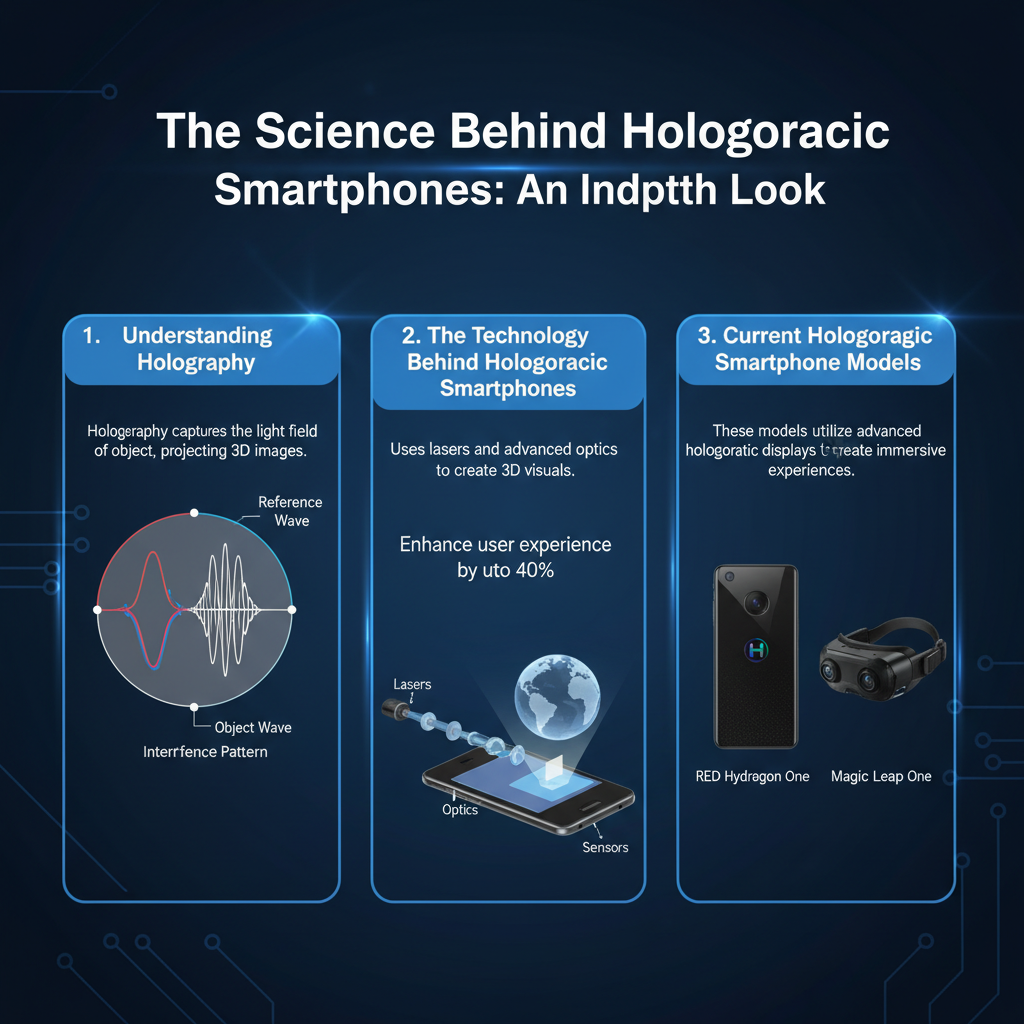
Holography is a photographic technique that captures and reconstructs the light field of an object, allowing for the creation of three-dimensional images. At its core, holography relies on the interference of light waves. When coherent light, like that from a laser, shines on an object, it creates a unique interference pattern that can be recorded on a photosensitive surface. This recorded pattern contains all the information needed to reconstruct the light field of the object, which means that when illuminated correctly, it appears as a 3D image to our eyes.
One of the main principles behind holography is the concept of diffraction, which occurs when light waves bend around edges or through openings. These diffracted waves combine to create the illusion of depth, allowing viewers to see different perspectives of the object as they move around. This technology is not just limited to static images; it can also be used to display dynamic scenes, making it an incredibly versatile tool for various applications.
The Technology Behind Holographic Smartphones

Holographic smartphones rely on several key components to create their stunning visual effects. The primary element is the display, which often employs advanced technologies such as micro-LCDs or OLEDs that can manipulate light at a microscopic level. These displays are designed to emit light in such a way that it creates the necessary interference patterns, enabling the perception of depth without the need for glasses.
In addition to the displays, sensors play a crucial role in holographic smartphones. These devices can include motion sensors, depth sensors, and cameras that detect how the user interacts with the smartphone. By analyzing user movements and gestures, the smartphone can adjust the holographic images accordingly, providing a more immersive experience.
Processors are another vital component. Holographic imagery requires significant computational power to render images in real-time. Advanced algorithms are crucial for this process; they analyze the visual data and create the necessary 3D representations. These algorithms must perform complex calculations to ensure that the holographic images remain stable and responsive, even as the user moves or interacts with the device.
Current Holographic Smartphone Models
As of now, a few notable holographic smartphones have made their way into the market. The Red Hydrogen One, for example, is one of the pioneering devices that brought holographic technology to the mainstream. It features a 5.7-inch display that can project 3D images and videos without glasses, thanks to its “Hydrogen” technology. Users can experience holographic media, such as games and videos, providing an immersive experience that traditional smartphones cannot match.
Another example is the Lenovo Mirage Solo, which, while primarily a VR headset, incorporates holographic elements to enhance the virtual experience. Although it’s not a smartphone in the traditional sense, it illustrates the potential of holographic technology in mobile devices.
When comparing the features and capabilities of these devices, it’s clear that while the technology is still in its infancy, the potential for development is vast. Users can enjoy unique content, including holographic films and apps that leverage the 3D capabilities, setting a new benchmark for mobile interaction.
Benefits of Holographic Smartphones
The benefits of holographic smartphones extend beyond mere visual appeal. One of the most significant advantages is the enhanced user experience. Holographic displays create a more engaging interaction, allowing users to visualize complex data or immersive gaming environments in ways that flat screens simply cannot replicate. This can lead to improved learning experiences in educational settings, as students can interact with 3D models of anatomy, physics concepts, or historical artifacts.
In the realm of entertainment, holographic smartphones open up new avenues for storytelling. Imagine watching a movie where characters seem to leap off the screen or playing a game that immerses you in a richly detailed virtual world. These possibilities can transform how we consume content and interact with our favorite media.
Furthermore, holographic technology has potential applications in communication. Imagine conducting virtual meetings where participants appear as holograms in your living room, creating a more personal connection than traditional video calls. This could revolutionize remote work and distance learning, making interactions feel more real and engaging.
Challenges and Limitations
Despite their promise, holographic smartphones face several challenges and limitations. One of the most pressing issues is technical limitations in current holographic technology. The resolution of holographic displays can sometimes fall short of what users expect, leading to less-than-perfect image clarity. Additionally, the hardware required to produce these effects can be bulky, limiting design options for manufacturers.
Market adoption poses another challenge. Many consumers remain skeptical about the practicality and usefulness of holographic smartphones. The high price point of early models also makes them less accessible to the average user. There is a need for more widespread education about the benefits of holographic technology to shift consumer perception and drive adoption rates.
The Future of Holographic Technology
Looking ahead, the future of holographic smartphone technology appears promising. Experts predict significant advancements in display technology, leading to higher resolutions and improved clarity. As research continues, we may see the integration of holographic capabilities with emerging technologies like augmented reality (AR) and virtual reality (VR). This convergence could create a new era of interactive experiences, where the lines between digital and physical worlds blur even further.
Moreover, as computational power continues to grow and algorithms become more sophisticated, we can expect holographic imagery to become more seamless and realistic. This evolution will likely lead to increased applications across various fields, from healthcare to design and beyond.
The evolution of holographic smartphones promises to revolutionize how we interact with technology, providing richer experiences and transforming various industries. As the technology matures, staying informed about advancements will be crucial for consumers and tech enthusiasts alike. Exploring this fascinating subject helps illuminate how it might shape our future, offering a glimpse into a world where our interactions with devices are not just flat, but vibrantly three-dimensional.
Frequently Asked Questions
What are holographic smartphones and how do they work?
Holographic smartphones are advanced mobile devices that use holographic technology to create 3D images that can be viewed without the need for special glasses. They work by utilizing a combination of light field technology and advanced display screens to project images that appear to float above the screen, providing an immersive experience. This innovative technology allows users to interact with 3D content, enhancing gaming, augmented reality, and multimedia applications.
How do holographic displays differ from traditional smartphone displays?
Holographic displays differ from traditional smartphone displays primarily in their ability to project three-dimensional images that can be viewed from multiple angles. While traditional displays produce flat 2D images, holographic technology manipulates light to create depth and perspective, making it possible to see different views of an object based on the viewer’s position. This creates a more engaging and realistic experience, especially for applications in gaming and virtual reality.
Why are holographic smartphones considered the future of mobile technology?
Holographic smartphones are considered the future of mobile technology due to their potential to revolutionize user interaction and multimedia experiences. By providing users with 3D visuals, these devices can enhance gaming, education, and virtual meetings, making them more immersive and interactive. As augmented reality and virtual reality continue to grow in popularity, holographic smartphones are positioned to meet the demand for richer and more engaging visual content.
What are the best use cases for holographic smartphones?
The best use cases for holographic smartphones include gaming, where users can experience environments and characters in 3D, and educational applications that allow for interactive learning experiences. Additionally, holographic smartphones can enhance virtual meetings by providing a more lifelike representation of participants and content. Industries such as design, architecture, and healthcare can also benefit from 3D visualizations for better presentations and simulations.
Which brands currently offer holographic smartphones, and what are their features?
As of 2023, brands like RED and ASUS have released holographic smartphones, with notable models such as the RED Hydrogen One and the ASUS ROG Phone. These devices typically feature high-resolution displays capable of producing holographic images, powerful processors for smooth performance, and advanced camera systems for capturing 3D content. Key features often include augmented reality capabilities, enhanced audio quality, and extensive connectivity options, catering to users looking for cutting-edge technology.
References
- Holography
- https://www.sciencedirect.com/science/article/pii/S1369702118301952
- https://www.nytimes.com/2018/10/20/technology/holographic-smartphones.html
- https://www.wired.com/story/holographic-smartphones/
- https://www.techrepublic.com/article/holographic-smartphones-are-they-worth-the-hype/
- https://www.bbc.com/news/technology-46806412
- https://www.researchgate.net/publication/327276118_Holographic_Display_Technologies
- https://www.nature.com/articles/s41598-018-32983-8
- https://www.nist.gov/news-events/news/2019/07/holography-technology-holds-promise-next-generation-smartphones