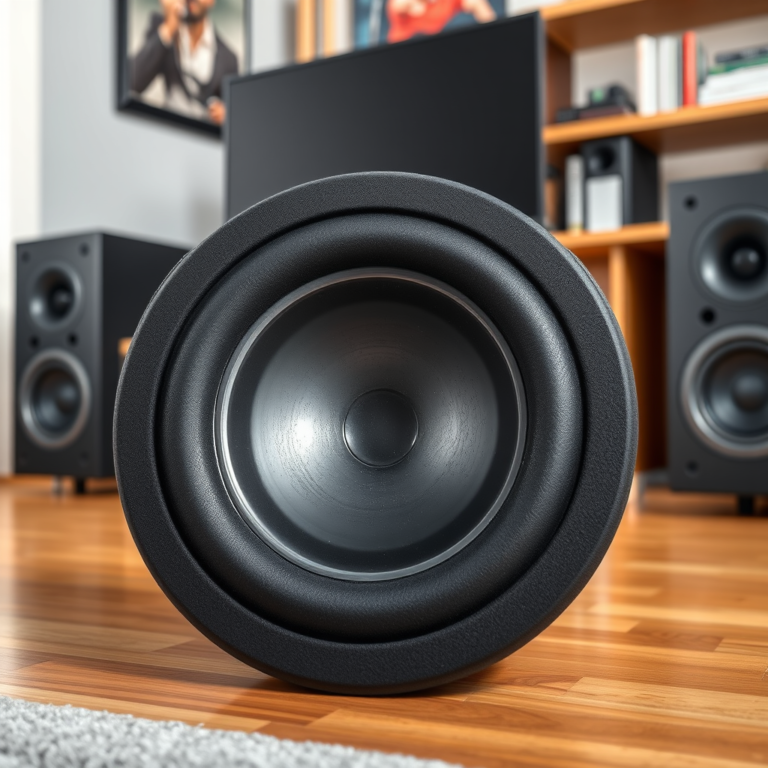

Having trouble with your subwoofer? The first step in troubleshooting common issues is to check your connections and settings, as these are the most frequent culprits. In this article, you’ll learn how to identify and resolve common subwoofer problems to enhance your home theater experience.
Understanding Subwoofer Basics

To effectively troubleshoot subwoofer issues, it’s essential to first understand the basics of how subwoofers function within a home theater system. Subwoofers are designed specifically to reproduce low-frequency sounds, typically those below 200 Hz. There are two primary types of subwoofers: active and passive.
Active subwoofers contain built-in amplifiers, making them easier to set up since they only require a power source and a signal input. Passive subwoofers, on the other hand, rely on an external amplifier for power and require more complex wiring. Understanding the differences between these types helps in determining compatibility with your existing audio equipment.
Subwoofers play a critical role in home theater systems by providing depth and richness to soundtracks, enhancing both music and film experiences. Proper integration with your main speakers ensures a seamless audio experience, making it essential to troubleshoot effectively when issues arise.
Common Subwoofer Problems
Subwoofers can exhibit a range of problems, and understanding these common issues is the first step to effective troubleshooting:
1. Lack of Sound or No Bass: This is one of the most prevalent issues users face. Begin by checking if the subwoofer is powered on and the power cable is connected securely. If it’s an active subwoofer, ensure that it is plugged into a functioning outlet. Additionally, verify that the signal cable is connected correctly to the receiver or amplifier.
2. Distorted Sound: Distortion can occur due to faulty connections or improper settings. Check that all cable connections are secure and that the subwoofer is not being pushed beyond its limits by adjusting the volume levels. Misconfigured speaker settings in the receiver can also lead to distortion, so double-check that the subwoofer is set correctly in the receiver’s audio settings.
Troubleshooting Connectivity Issues
To resolve connectivity issues effectively, follow these steps:
– Inspect Audio Cables: Look for any visible damage or fraying on the cables. Ensure that all connections are fully plugged in, as loose connections can lead to signal loss or intermittent sound. Pay particular attention to RCA cables, as these are commonly used for subwoofer connections.
– Check Receiver Settings: Access your audio receiver settings to confirm that the subwoofer output is enabled. Many receivers have separate settings for subwoofer levels and crossover frequencies. Ensure that the subwoofer is set as “On” or “Enabled,” and adjust the output levels as needed.
Common Subwoofer Issues and Solutions
| # | Issue | Possible Causes | Solutions |
|---|---|---|---|
| 1 | No Sound | Power issues, cable connections | Check power and cables |
| 2 | Distorted Sound | Incorrect settings, damaged cables | Check settings and replace cables |
| 3 | Weak Bass | Improper placement, crossover settings | Adjust placement and crossover settings |
| 4 | Humming Noise | Ground loop issues | Use a ground loop isolator |
| 5 | Overheating | Poor ventilation | Ensure proper ventilation |
| 6 | Phase Issues | Improper phase settings | Adjust phase settings |
Adjusting Settings for Optimal Performance
Once you’ve checked the connectivity, it’s time to optimize the settings for the best performance from your subwoofer:
– Crossover Frequency Settings: The crossover frequency determines the point at which the subwoofer takes over from the main speakers. Setting the crossover frequency too high can result in a lack of bass, while setting it too low can cause muddiness in the sound. For most systems, a crossover setting between 80 Hz and 120 Hz is optimal, but this can vary based on the capabilities of your main speakers.
– Phase Settings: The phase setting helps to synchronize the subwoofer’s output with the main speakers. If you hear a delay or misalignment, adjusting the phase can enhance the overall coherence of the sound. Experiment with the phase setting to find the position that provides the best integration with your speakers.
Room Acoustics and Placement
Room acoustics greatly affect how bass is perceived in your home theater. The placement of your subwoofer can either enhance or diminish its performance:
– Subwoofer Placement: The position of the subwoofer can significantly impact sound quality. Placing the subwoofer in a corner can amplify bass, while placing it away from walls may reduce unwanted resonance. However, every room is different, and finding the right spot may require some experimentation.
– Experimenting with Locations: Try moving your subwoofer to different locations within the room to observe how the sound changes. You may find that certain spots provide more punch and clarity, while others may create nulls (areas with absent bass frequencies). Utilize the “subwoofer crawl” method, where you temporarily place the subwoofer at your listening position and crawl around the room to identify the best location based on sound quality.
Subwoofer Placement Impact on Sound Quality
Common Fixes and Maintenance Tips
Maintaining your subwoofer is crucial for ensuring its longevity and optimal performance:
– Regularly Check Connections: Over time, connections can loosen or suffer wear and tear. Make it a habit to check and tighten all connections periodically to prevent signal loss and audio issues.
– Clean the Subwoofer: Dust and debris can accumulate around the subwoofer, affecting its performance. Use a soft cloth to wipe down the exterior and ensure that the vents are free from obstructions. This not only helps maintain the aesthetic but also ensures that the subwoofer operates efficiently.
When to Seek Professional Help
Despite your best efforts, some issues may require professional intervention:
– Signs of Serious Problems: If you notice blown fuses, persistent distortion, or if the subwoofer does not power on despite all troubleshooting efforts, it may be indicative of internal damage.
– Consulting a Professional: If the issue persists after attempting all troubleshooting steps, or if you’re unsure about the problem, seeking professional help is advisable. Technicians can diagnose complex issues that may not be apparent through basic troubleshooting.
In conclusion, troubleshooting subwoofer issues involves a systematic approach that includes checking connections, adjusting settings, optimizing placement, and maintaining the equipment. By understanding common problems and their solutions, you can significantly enhance your home theater experience. If challenges continue, do not hesitate to consult a professional to ensure your system performs at its best.
Frequently Asked Questions
What are the common signs that my subwoofer is not working properly?
Common signs of a malfunctioning subwoofer include no sound output, distorted audio, or an inconsistent bass response. You may also notice that the subwoofer is buzzing even when not in use. These issues can stem from connectivity problems, damaged cables, or settings misconfigurations within your home theater system.
How can I fix a subwoofer that produces distorted sound?
To fix a subwoofer with distorted sound, first check all connections to ensure they are secure and properly inserted. Next, inspect the audio settings on your receiver; lowering the gain or adjusting the crossover frequency may help. If the problem persists, consider testing the subwoofer with a different audio source to rule out any issues with your original setup.
Why is my subwoofer not turning on, and how can I troubleshoot it?
A subwoofer may not turn on due to power supply issues, faulty power cables, or incorrect settings. Start by checking if the power cable is plugged in securely and that the outlet is working. If the power indicator light is off, try a different power outlet or inspect the fuse if applicable, as a blown fuse can often lead to power issues.
What is the best way to position my subwoofer for optimal sound quality?
The best way to position your subwoofer for optimal sound quality is to place it in a corner or along a wall, as this can enhance the bass response. Experiment with placement by conducting the “subwoofer crawl” method, where you temporarily place the subwoofer at your listening position and move around the room to find the spot that produces the best sound before finalizing its location.
Which settings should I adjust on my receiver to improve my subwoofer’s performance?
To improve your subwoofer’s performance, adjust the crossover frequency to match the capabilities of your main speakers, typically between 80-120 Hz. Additionally, tweak the phase setting to ensure that the subwoofer and main speakers are working in sync, and consider increasing the subwoofer level in your receiver’s settings to achieve a balanced sound throughout your home theater system.
References
- Subwoofer
https://en.wikipedia.org/wiki/Subwoofer - https://www.nature.com/articles/s41598-018-31421-0
https://www.nature.com/articles/s41598-018-31421-0 - https://www.sciencedirect.com/science/article/pii/S221313881630021X
https://www.sciencedirect.com/science/article/pii/S221313881630021X - https://pubmed.ncbi.nlm.nih.gov/31412943/
https://pubmed.ncbi.nlm.nih.gov/31412943/ - UW Homepage
https://www.uw.edu/ - Google Scholar Google Scholar
https://scholar.google.com/scholar?q=troubleshooting+subwoofer+home+theater - Google Scholar Google Scholar
https://scholar.google.com/scholar?q=subwoofer+issues+home+theater+system - Google Scholar Google Scholar
https://scholar.google.com/scholar?q=common+subwoofer+problems+solutions - https://www.researchgate.net/publication/336493321_Troubleshooting_Subwoofer_Issues_in_Home_Theater_Systems
https://www.researchgate.net/publication/336493321_Troubleshooting_Subwoofer_Issues_in_Home_Theater_Systems - Google Scholar Google Scholar
https://scholar.google.com/scholar?q=Troubleshooting+Common+Subwoofer+Issues+in+a+Home+Theater+System