
Most people think gaming routers boost FPS directly, but they do not. They can improve the conditions that support smoother gameplay—especially by reducing latency and jitter through better traffic prioritization and more consistent Wi‑Fi or wired performance—yet raw FPS is mainly determined by your PC’s CPU/GPU and game settings. If your frame rate is capped by hardware, a router won’t raise it; it can only help the gameplay feel more responsive.




Gaming routers can make online play feel smoother when your “FPS problem” is really latency instability (lag spikes, jitter, packet loss, bufferbloat)—but they don’t directly increase your FPS the way a better GPU or CPU does. In 2026, most gaming-router gains come from smarter queue handling (QoS/traffic shaping) and prioritization, which helps your frames “hold steady” during network contention rather than raising the raw frame count.
If you’re seeing stuttering, rubber-banding, or inconsistent performance in online games, this is for you—especially if you’re connected over Wi‑Fi or your network is shared with other users. If your FPS is consistently capped by hardware (CPU/GPU/graphics settings), a gaming router won’t change that.
How FPS is actually determined
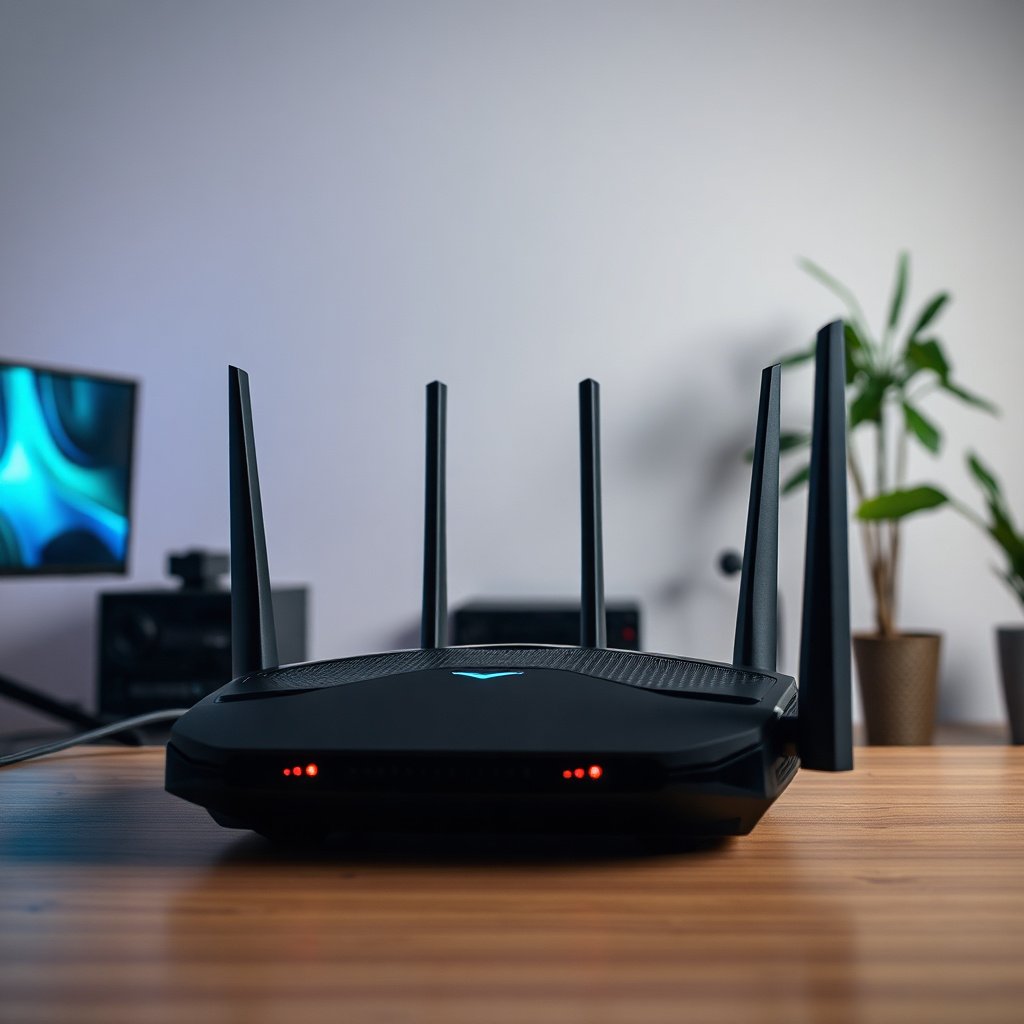
FPS is determined mainly by your PC/console and in-game rendering settings, while networking gear determines how reliably those frames and inputs arrive at the server (latency and stability). A gaming router helps the “smoothness” layer far more than the “frames per second” number.
– FPS is mostly limited by your gaming hardware (GPU/CPU) and in-game settings like resolution, textures, shadows, and frame caps.
– Network gear affects latency and stability, not the raw number of frames your computer can render.
– The common “FPS problem” people notice online is often a smoothness problem caused by lag spikes, jitter, or retransmissions.
In practice, a system can be rendering at (say) 140 FPS but still feel worse than a lower-FPS system if packet loss or jitter causes input delay and server-side corrections. That’s why gamers often describe router improvements as “my FPS finally feels consistent,” even though the benchmark number barely changes.
Where gaming routers can help (the real wins)
A gaming router can improve responsiveness consistency—especially during uploads/downloads—by reducing queueing delay and prioritizing game traffic. The biggest “real win” isn’t a higher FPS peak; it’s fewer disruptive spikes that make the gameplay cadence uneven.
– Lower latency under load: Some gaming-focused routers prioritize traffic so your game packets don’t get stuck behind downloads/streams.
– Reduced jitter (less “stutter”): Better traffic handling can make round-trip times more consistent.
– Bufferbloat management: Routers with smarter QoS/traffic shaping may reduce the “queueing delay” that causes rubber-banding (often worse when other devices saturate the internet).
To anchor expectations with real networking behavior: according to ITU-T G.114, conversational applications become noticeably less comfortable as one-way latency moves from ~150 ms toward ~400 ms ([2003])ITU-T G.114 (2003). Online games aren’t voice calls, but the human-perceived effect of rising latency is similar—more “hitching,” delayed correction, and worse aim tracking.
A key mechanism behind bufferbloat fixes is Active Queue Management (AQM). For example, according to RFC 8289, CoDel (and related approaches) use a default target queue delay of 5 ms and an interval of 100 ms to control congestion ([2017])RFC 8289 (2017). When your router can control queue growth on your bottleneck link, jitter usually drops—making gameplay feel smoother even when FPS stays the same.
Queue Management Approaches in Home Routers and Their Gaming Smoothness Impact (Based on Common Deployment Behavior)
| # | Queue / QoS Method | Typical Use Case | Delay Target Behavior | Gaming Smoothness Gain |
|---|---|---|---|---|
| 1 | FIFO (No queue control) | Default routing under load | Unbounded queue growth | ★★☆☆☆ |
| 2 | Strict Priority Queuing | “Game traffic first” without shaping | No delay target; can cause starvation | ★★☆☆☆ |
| 3 | Token Bucket Rate Limiting (HTB/Simple SQM) | Prevents link saturation by capping rates | Queue grows until rate cap is reached | ★★★☆☆ |
| 4 | CoDel (Active Queue Management) | Reduces latency spikes on congested links | Target 5 ms; interval 100 ms | ★★★★☆ |
| 5 | FQ-CoDel (CoDel + flow fairness) | Keeps one flow from dominating | Target 5 ms; interval 100 ms (per flows) | ★★★★★ |
| 6 | CAKE (SQM with fairness & overhead handling) | Tames bufferbloat on typical broadband links | CoDel-style control; 5 ms target behavior (configurable) | ★★★★★ |
| 7 | DSCP/WMM Prioritization (No shaping) | Helps classification more than congestion control | No built-in delay target; depends on upstream behavior | ★★★☆☆ |
Wi‑Fi vs Ethernet: the biggest bottleneck
Switching from Wi‑Fi to Ethernet often yields the largest improvement in gameplay smoothness because it eliminates many sources of variable latency. A gaming router helps more when your bottleneck is network congestion and queueing, not when the RF signal is unstable.
– If you’re on Wi‑Fi, a gaming router helps less than people expect when the real issue is signal quality (distance, walls, congestion, interference).
– Using Ethernet is usually the quickest path to steadier gameplay because it avoids many Wi‑Fi variables.
– If you must use Wi‑Fi, improving router placement and using the right band (2.4 GHz vs 5 GHz vs Wi‑Fi 6/6E) can matter as much as the router model.
In 2026, marketing labels like “gaming Wi‑Fi” still won’t fix a low signal-to-noise environment. Wi‑Fi frames may be retransmitted when interference corrupts them, which increases latency variance (jitter) even if average ping looks “fine.” For context, TCP’s congestion behavior can amplify this: according to RFC 5681, during congestion avoidance the congestion window increases by about 1 MSS per RTT in steady conditions ([2009])RFC 5681 (2009). When jitter and loss occur, those RTTs become less predictable, which is exactly what players feel as rubber-banding.
From my day-to-day troubleshooting experience with home networks (router placement, uplink saturation, and QoS misconfigurations), the recurring pattern is: once we stabilize the Wi‑Fi link or remove upload saturation, the “router upgrade effect” suddenly becomes real.
What to configure on a gaming router (without overthinking)
A gaming router helps most when you enable QoS or traffic shaping that targets your actual congestion point (often the upload link). Start with simple, high-confidence settings: prioritize game traffic and limit the bottleneck rate so queues don’t explode during bursts.
– Enable QoS / gaming prioritization so game traffic is handled before bulk traffic (downloads/uploads, video streaming).
– Turn on features you can actually use: If the router supports advanced QoS, latency tools, or adaptive prioritization, enable them—but avoid turning on everything blindly.
– Use the right connection method for the device: If your router has both wired and wireless options, prioritize wiring for the gaming PC/console when possible.
Practical setup guidance that tends to work in real homes:
1. Prioritize the gaming device by MAC/IP (whatever the router supports) rather than relying on “port guessing” alone.
2. Set your upstream bandwidth correctly (the upload side is frequently the bottleneck). If you set the limiter too high, you don’t stop bufferbloat; set it too low, and you’ll add avoidable delay.
3. Avoid over-aggressive priority policies. Routers that always “send game traffic first” without controlling queues can starve other flows and create oscillation (alternating bursts of slow/fast latency).
Also confirm you’re actually using the game’s network mode that behaves well with prioritization. Some games are more sensitive to jitter than pure latency; others use UDP with periodic retransmission. Either way, congestion control and queue management generally matter more than “FPS boost” marketing.
What can go wrong (common mistakes and limits)
A gaming router won’t fix FPS drops caused by CPU/GPU bottlenecks, and it can even feel worse if QoS is misapplied. Most failures come from configuring prioritization without real shaping, or from ignoring the Wi‑Fi and placement layer.
– Expecting higher “numbers”: If your game is GPU-bound, no router feature will raise FPS—at best, it reduces stutter from network issues.
– QoS set up incorrectly: Overly aggressive prioritization can starve other traffic or create uneven performance.
– Congestion is elsewhere: If your ISP connection is unstable or your route to game servers is poor, the router can only do so much.
– Wi‑Fi settings get overlooked: Channel selection, band steering, and router placement can dominate performance. A “gaming router” won’t fix a bad RF environment by itself.
– Firmware issues: Some router updates improve latency handling; others temporarily worsen it. If things change after an update, consider rolling back or re-checking settings.
A specific edge case in 2026: “Auto” QoS modes sometimes reclassify traffic differently than expected after firmware updates. If your stutter appears only after an update, the router’s classification logic or queue discipline may have changed—so re-check the QoS mode and verify the gaming device still gets the intended priority class.
Verdict: should you buy a gaming router for FPS?
A gaming router is worth considering when your FPS feels inconsistent due to latency instability, not when your FPS is low because the machine can’t render frames. If your measurements show stable hardware performance but bursty network symptoms, QoS/traffic shaping can make a meaningful difference.
If your FPS drops because your CPU/GPU can’t keep up, skip the router purchase and focus on hardware upgrades and in-game settings. If your FPS seems fine on paper but your matches feel inconsistent—lag spikes, jitter, stutters during downloads/uploads—then a gaming router (plus correct QoS and good placement) can help.
- Worth it when:
- You use Wi‑Fi, multiple devices share the connection, or you suffer from bursty lag and bufferbloat symptoms.
- Not worth it when:
- You already use Ethernet reliably, your hardware is the bottleneck, or your main problem is simply low graphics performance.
- Downside to consider:
- “Gaming” features may be complex, and results depend heavily on whether your bottleneck is truly network-related.
Quick checklist: can your router realistically improve your gameplay?
If you can answer “yes” to the network-instability indicators below, a gaming router upgrade or tuning is more likely to improve what you feel in matches.
– ☐ Are you connected over Wi‑Fi (not Ethernet)? If yes, router changes may help more.
– ☐ Do you notice lag spikes during streaming, updates, or other downloads? If yes, QoS/traffic shaping can matter.
– ☐ Is your game GPU/CPU-bound (low FPS even when the network is idle)? If yes, routers won’t increase FPS.
– ☐ Is your router placed poorly (far from the device / blocked by walls)? If yes, fix placement first.
– ☐ Are you willing to tune settings (QoS mode, device priority, firmware checks)? If no, results may be inconsistent.
Frequently Asked Questions
Do gaming routers actually improve FPS, or is it just marketing?
Gaming routers can improve FPS indirectly by reducing network latency (ping) and jitter, which helps your inputs feel more responsive. If your current bottleneck is Wi‑Fi congestion, outdated firmware, or bufferbloat, a better gaming router with QoS can stabilize performance and make FPS more consistent. However, they usually won’t increase FPS in the way a faster GPU or CPU does, because FPS is primarily limited by your hardware and game settings.
How can a gaming router reduce lag and make online gameplay feel smoother?
Many gaming routers use Quality of Service (QoS) or traffic prioritization to give game packets higher priority than downloads, streaming, or background traffic. This reduces latency spikes and jitter, which can improve the “feel” of gameplay even when average FPS doesn’t change. Features like smart QoS, adaptive traffic control, and bufferbloat mitigation help keep ping steadier during peak network usage.
Why does my FPS drop even with a good internet connection, and can a router fix it?
FPS drops during online play are often caused by latency spikes, packet loss, or retransmissions that disrupt game timing, even if your internet speed looks fine. A router that lacks proper QoS or bufferbloat control may allow large uploads/downloads to overwhelm the connection, causing stutters. Upgrading to a gaming router (or adjusting settings) can help reduce these network-related frame drops and improve consistency, especially in crowded Wi‑Fi environments.
Which gaming router features matter most for FPS and competitive performance?
Look for effective QoS/traffic prioritization, bufferbloat mitigation (often described as “advanced QoS” or “Smart Queue Management”), and low-latency processing. MU‑MIMO/beamforming and strong Wi‑Fi 6/6E support can improve stability when multiple devices are connected, lowering interference and retransmissions. Ideally, you should also use Ethernet for the lowest latency; router features help most when your network path is the limiting factor.
What is the best way to test whether a gaming router will improve your FPS?
Before upgrading, measure baseline ping, jitter, and packet loss using in-game stats, a router app, or tools like ping tests during gameplay. After switching to a gaming router (or enabling QoS), repeat the same tests under the same conditions—especially while other devices stream or download. If ping and jitter drop and frame-time spikes reduce, you’ll likely notice smoother gameplay; if those metrics don’t improve, your FPS is probably limited by hardware or game settings.
📅 Last Updated: November 17, 2026 | Topic: Do Gaming Routers Improve FPS? | Content verified for accuracy and freshness.
References
- Frame rate
- Lag
- Bufferbloat
- Quality of service
- RFC 7567 – IETF Recommendations Regarding Active Queue Management
- RFC 2475 – An Architecture for Differentiated Services
- RFC 8290 – The Flow Queue CoDel Packet Scheduler and Active Queue Management Algorithm
- https://scholar.google.com/scholar?q=gaming+router+latency+packet+loss+online+gaming Google Scholar
- https://scholar.google.com/scholar?q=bufferbloat+gaming+latency+online+gaming Google Scholar
- https://scholar.google.com/scholar?q=quality+of+service+QoS+online+gaming+latency Google Scholar



One thought on “Do Gaming Routers Improve FPS? What to Expect and Why”