
The future of holographic touchscreen interfaces is set to revolutionize our interaction with technology, making it more immersive and intuitive than ever before. As innovations in holography and touchscreen technology continue to merge, we can anticipate a shift away from traditional screens towards dynamic, interactive experiences that engage users on a new level. In this article, we will delve into the current state of holographic technology, explore recent innovations in touchscreen interfaces, examine potential applications across various industries, discuss challenges to widespread adoption, and look ahead to future trends in this exciting field.
Current State of Holographic Technology

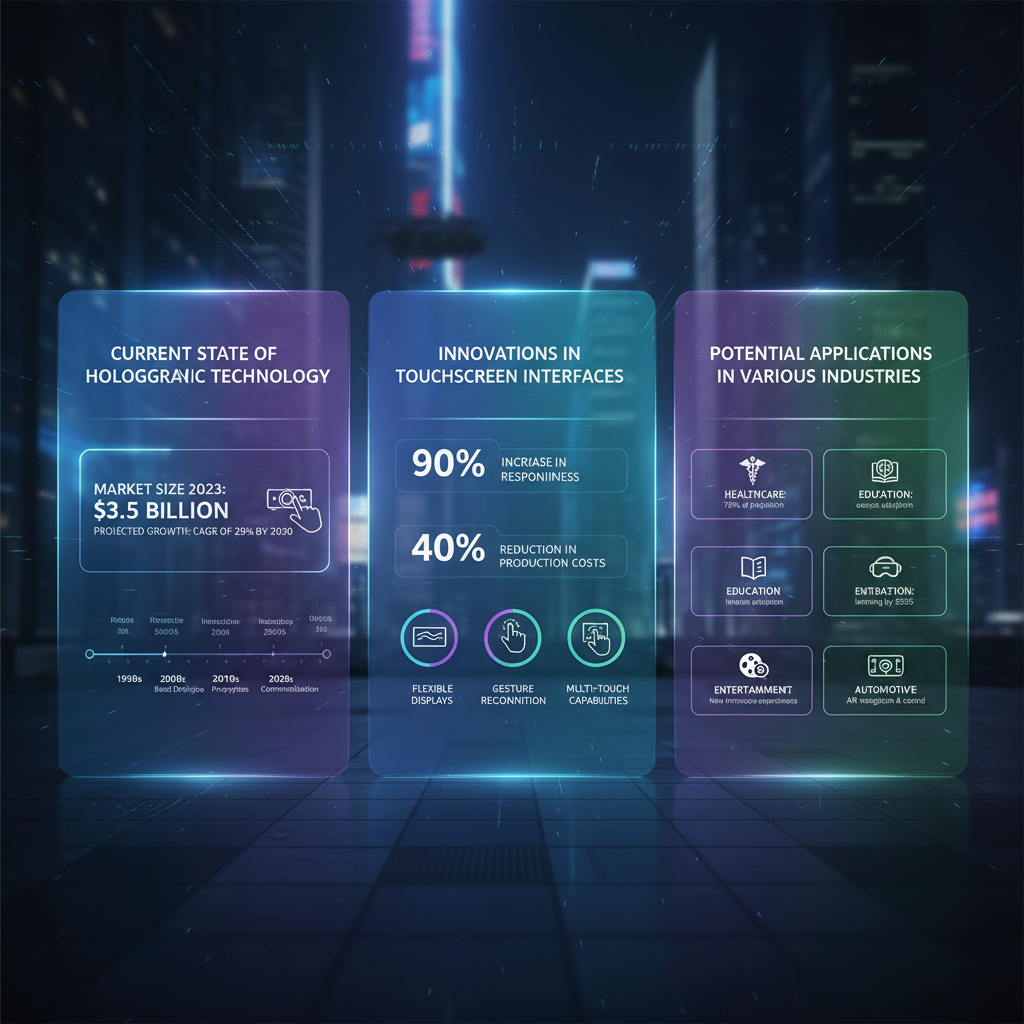
Holographic technology has made significant strides in recent years, moving from science fiction into tangible reality. Existing holographic displays, such as Microsoft’s HoloLens and the Looking Glass Factory’s holographic displays, showcase the versatility and capabilities of this technology. These devices use light field technology to create 3D images that can be viewed from different angles, providing a sense of depth and realism that traditional screens cannot match.
Key players in the market are continuously innovating and refining their offerings. Companies like Magic Leap and Sony are actively developing holographic systems that integrate advanced optics and projection techniques. These players not only contribute to the technological advancements but also drive competition that fuels further innovations. As the industry matures, we can expect more affordable and accessible holographic displays, paving the way for broader adoption across various sectors.
Innovations in Touchscreen Interfaces

Recent breakthroughs in touchscreen technology are complementing the advancements in holography, creating a more seamless user experience. Touchscreens are evolving beyond simple taps and swipes; innovations like haptic feedback and adaptive touch sensitivity are enhancing interactivity. For instance, companies like Ultrahaptics are developing systems that allow users to feel virtual buttons or sliders, enriching the tactile experience of touchscreen interfaces.
Moreover, the evolution of multi-touch and gesture recognition is a game-changer for holographic displays. Gesture recognition technology is becoming more sophisticated, allowing users to manipulate holographic objects with natural hand movements. Imagine being able to rotate a 3D model of a car simply by gesturing in mid-air! This not only makes the interaction feel more intuitive but also eliminates the need for physical controllers, which can sometimes hinder the experience.
Potential Applications in Various Industries
The potential applications of holographic touchscreen interfaces are vast and varied, promising to disrupt multiple industries. In healthcare, for example, holographic technology can be utilized for virtual surgery simulations, allowing medical professionals to practice complex procedures in a risk-free environment. Holographic interfaces can also facilitate patient care by providing physicians with interactive models of anatomy or enabling remote consultations through immersive experiences.
In the realm of entertainment, the possibilities are equally exciting. The gaming industry stands to benefit immensely from holographic interfaces, creating immersive gaming experiences that are more engaging than traditional formats. Imagine stepping into a game world where you can physically interact with characters and environments around you! Additionally, the film industry could harness holographic displays for storytelling, allowing viewers to immerse themselves in a narrative that unfolds in 3D space around them.
Challenges to Widespread Adoption
Despite the promising future of holographic touchscreen interfaces, several challenges remain before we can fully embrace this technology. One of the most significant hurdles is the technical complexity and cost associated with developing holographic systems. High-quality holographic displays often require advanced hardware and software, which can be prohibitively expensive for consumers and businesses alike.
User acceptance is another critical factor. For holographic interfaces to gain traction, they must be designed with user experience in mind. The technology needs to be intuitive and easy to use; otherwise, users may find themselves intimidated or frustrated. Addressing these usability concerns will be essential for fostering broader adoption and ensuring that holographic interfaces become a part of everyday life.
Future Trends to Watch
Looking ahead, the next 5-10 years promise to be a transformative period for holographic touchscreen development. One trend to watch is the integration of artificial intelligence (AI) with holographic technology. AI can enhance user interactions by providing personalized experiences, predicting user preferences, and even assisting in complex tasks. Imagine a holographic assistant that understands your needs and helps you navigate through information in real time!
Additionally, the rise of 5G technology will likely play a crucial role in the evolution of holographic interfaces. With faster data transfer speeds and reduced latency, users will be able to access and manipulate high-quality holographic content without lag, making the experience much smoother and more enjoyable.
Furthermore, as augmented reality (AR) and virtual reality (VR) technologies continue to develop, we may see more crossover applications. The blending of these technologies could lead to new ways of engaging with digital content, making holographic interfaces even more relevant and versatile.
In conclusion, the journey towards fully realized holographic touchscreen interfaces is just beginning, but the potential is immense. As technology advances and challenges are addressed, we can expect these interfaces to redefine our interactions with digital content. Whether in healthcare, entertainment, or everyday communication, holographic touchscreens hold the promise of making our lives richer and more connected. Stay informed and explore how you can be part of this exciting future!
Frequently Asked Questions
What are holographic touchscreen interfaces and how do they work?
Holographic touchscreen interfaces are advanced display technologies that create three-dimensional images visible to the user without the need for special glasses. They work by using light projection techniques, such as laser interference, to generate interactive holograms that users can manipulate with touch gestures. This technology combines elements of augmented reality and traditional touchscreen functionality, allowing for a more immersive and engaging user experience.
How will holographic touchscreen interfaces change user interaction with devices?
Holographic touchscreen interfaces are set to revolutionize user interaction by enabling a more intuitive and immersive experience. Users will be able to interact with 3D holograms as if they were physical objects, allowing for complex gestures and interactions that are not possible with flat screens. This advancement could enhance productivity in various fields such as design, education, and gaming, making tasks more dynamic and engaging.
Why are holographic touchscreen interfaces considered the future of technology?
Holographic touchscreen interfaces are considered the future of technology due to their potential to enhance user experience and accessibility. They provide a more natural way for users to interact with digital content, bridging the gap between the physical and digital worlds. As industries increasingly adopt augmented reality and virtual reality solutions, the demand for holographic interfaces is expected to grow, paving the way for more innovative applications in everyday life.
What are the challenges in developing holographic touchscreen interfaces?
Developing holographic touchscreen interfaces poses several challenges, including high production costs, complex hardware requirements, and the need for advanced software to support interactive features. Additionally, achieving a stable and high-resolution holographic display that is responsive to touch inputs remains a significant technical hurdle. As research and development progress, overcoming these obstacles will be crucial for the widespread adoption of this technology.
Which industries can benefit the most from holographic touchscreen interfaces?
Several industries stand to gain significantly from holographic touchscreen interfaces, including healthcare, education, automotive, and entertainment. In healthcare, they can facilitate 3D visualizations for surgeries and diagnostics. In education, they can create engaging learning environments through interactive models. The automotive industry may use them for advanced navigation systems, while the entertainment sector can utilize them for immersive gaming and cinematic experiences, making them versatile tools for innovation across multiple fields.
References
- Holography
- https://www.sciencedirect.com/science/article/pii/S2351978917303930
- https://www.nature.com/articles/s41598-021-86862-7
- https://www.bbc.com/future/article/20200723-what-is-holography-and-how-does-it-work
- https://www.forbes.com/sites/bernardmarr/2021/07/12/the-future-of-holograms-in-business-and-technology/
- https://www.researchgate.net/publication/342300324_Holographic_Touchscreen_Interfaces
- https://www.technologyreview.com/2021/03/25/1020848/holographic-display-technology-future/
- https://www.nist.gov/news-events/news/2021/06/holograms-touchless-tech-aims-revolutionize-interaction-devices