

Serverless architecture significantly improves cloud video processing by offering scalability, cost efficiency, and simplified management. This modern approach allows developers to focus on creating high-quality video applications without the burden of managing servers. By utilizing serverless functions, businesses can efficiently handle video workloads, streamline their workflows, and respond to changing demands in real-time. In this article, we will explore the key benefits and features of serverless architecture in cloud video processing.
The Basics of Serverless Architecture

Serverless computing is a cloud-based execution model that allows developers to build and run applications without the complexities of server management. This paradigm shifts the focus from infrastructure to application logic, enabling developers to concentrate on writing code rather than worrying about server provisioning, scaling, or maintenance. At its core, serverless architecture operates on the principle of event-driven functions that automatically execute in response to specific triggers, such as file uploads or API requests.
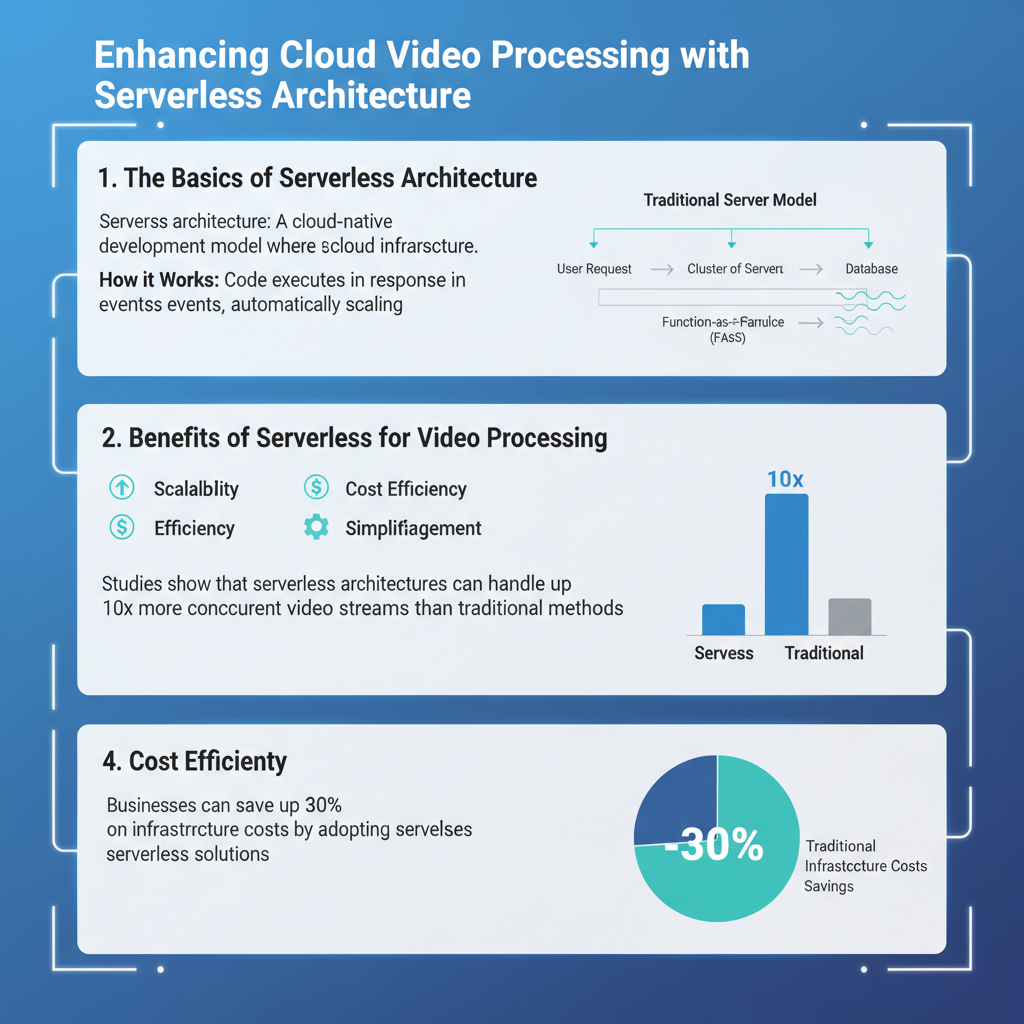
In the cloud, serverless functions work by utilizing a platform-as-a-service (PaaS) model, where cloud providers handle the underlying infrastructure. Developers write small units of code known as functions, which are deployed in the cloud and executed on demand. This means that instead of running code on a dedicated server, the cloud provider dynamically allocates resources to run the function only when needed, ensuring efficient resource utilization.
Benefits of Serverless for Video Processing

Scalability
One of the standout features of serverless architecture is its ability to automatically scale based on demand. In the realm of video processing, workloads can fluctuate significantly. For instance, during a live event, thousands of users might be streaming video simultaneously, necessitating instantaneous resource allocation to handle the increased load. Serverless functions automatically scale up to manage this demand and scale down when traffic decreases, ensuring that resources are used efficiently without manual intervention.
This automatic scaling is particularly advantageous for businesses that experience unpredictable spikes in video processing needs. For example, a video-sharing platform may see a sudden influx of uploads during a trending event. With serverless architecture, the platform can seamlessly handle the increased processing workload without downtime or service interruptions.
Cost Efficiency
Cost efficiency is another crucial advantage of serverless architecture, especially for video processing applications. Traditional server-based architectures often require businesses to maintain infrastructure, leading to fixed costs regardless of actual usage. In contrast, serverless computing operates on a pay-per-use pricing model, which means businesses only pay for the compute resources they consume.
For video processing, this translates to significant savings. If a company processes videos sporadically, they won’t incur the costs of having dedicated servers sitting idle. Instead, they pay only for the execution time of their functions. This model allows startups and small businesses to compete effectively with larger players in the industry, as they can scale their operations without incurring exorbitant costs.
Key Use Cases for Serverless Video Processing
Real-time Video Transcoding and Streaming
One of the most prominent use cases for serverless architecture in video processing is real-time video transcoding. As users upload videos in various formats and resolutions, serverless functions can automatically convert these files into suitable formats for playback across different devices. This process can happen in seconds, ensuring a smooth streaming experience for users.
Moreover, serverless architecture can facilitate live streaming events where video content is transcoded on-the-fly. For instance, during a live sports event, serverless functions can adapt the video quality in real-time based on the viewer’s internet speed, preventing buffering and enhancing user satisfaction.
Automated Video Analysis and Content Moderation
Another exciting application of serverless architecture is in automated video analysis and content moderation. Businesses can deploy serverless functions to analyze uploaded videos for inappropriate content, ensuring compliance with community guidelines and legal regulations. This process can be enhanced with machine learning models that detect objectionable material, allowing for swift moderation of user-generated content.
For example, a video-sharing platform can use serverless functions to scan video uploads for copyrighted material or explicit content, automatically flagging or removing such videos. This not only protects the platform but also enhances user trust and safety.
Integration with Other Cloud Services
Serverless architecture shines in its ability to integrate seamlessly with other cloud services. For video processing, this means that serverless functions can work harmoniously with various storage and database services. For instance, a cloud storage solution like Amazon S3 can be used to store uploaded videos, while serverless functions can trigger processes such as transcoding or analysis when new videos are added.
Popular cloud platforms like AWS, Google Cloud, and Microsoft Azure offer robust serverless solutions tailored for video processing. AWS Lambda, for example, allows developers to run code in response to events in other AWS services, creating a cohesive ecosystem for video applications. By leveraging these integrations, businesses can create powerful, automated workflows that enhance the efficiency of their video processing systems.
Challenges and Considerations
Potential Latency Issues
While serverless architecture offers numerous benefits, it’s essential to be aware of potential challenges, particularly regarding latency. Since serverless functions are event-driven, they may introduce some latency when executing code, especially if the functions need to spin up resources from a cold state. This can impact user experience, particularly in applications requiring immediate responses, such as live video interactions or real-time editing.
Understanding Cold Start Times
Cold start times refer to the delay that occurs when a serverless function is triggered after being idle for a period. During this time, the cloud provider must allocate resources and initialize the environment, leading to a slight delay in function execution. Depending on the use case, this delay can be a critical factor to consider. For example, in real-time applications like live streaming, minimizing cold start times is vital to ensure a seamless user experience.
Best Practices for Implementing Serverless Video Solutions
To maximize the potential of serverless architecture for video processing, here are some best practices to consider:
– Optimize Serverless Functions: Ensure that your functions are lightweight and focused on specific tasks to minimize execution time. This helps reduce costs and improve performance.
– Monitor Performance: Implement monitoring tools to track function performance, execution times, and error rates. This data will help identify bottlenecks and optimize workflows.
– Implement Security Measures: Security is paramount in cloud environments. Use authentication and authorization measures, encrypt sensitive data, and regularly audit your serverless architecture for vulnerabilities.
– Manage Dependencies: Minimize external dependencies within your functions to enhance execution speed and reduce cold start times. Instead, consider using microservices for more complex tasks.
By following these best practices, businesses can ensure a smooth and efficient implementation of serverless video processing solutions.
Harnessing the power of serverless architecture, businesses can streamline their cloud video processing capabilities, making it easier to deliver high-quality video content. Emphasizing scalability and cost savings, serverless solutions offer a competitive edge in the fast-evolving digital landscape. If you’re ready to enhance your video processing workflow, consider exploring serverless options today.
Frequently Asked Questions
What is serverless architecture and how does it relate to cloud video processing?
Serverless architecture is a cloud computing model where the cloud provider manages server infrastructure, automatically scaling resources as needed. In the context of cloud video processing, this allows developers to focus on writing code for video transcoding, editing, and streaming without worrying about server management. This flexibility reduces operational overhead and can lead to faster deployment cycles for video applications.
How does serverless architecture improve scalability for video processing applications?
Serverless architecture enhances scalability by automatically allocating resources based on demand, which is crucial for video processing workloads that can vary significantly. For example, during peak times, such as live events or viral video releases, serverless platforms like AWS Lambda or Azure Functions can instantly scale up to handle increased processing demands, ensuring smooth performance without manual intervention.
Why should businesses consider using serverless architecture for video processing instead of traditional cloud solutions?
Businesses should consider serverless architecture for video processing because it offers cost efficiency, reduced latency, and simplified management. With a pay-as-you-go model, organizations only pay for the compute time they actually use, which can lead to significant savings compared to provisioning fixed server resources. Additionally, this architecture eliminates the need for infrastructure maintenance, allowing teams to focus on innovation rather than upkeep.
What are the best practices for implementing serverless video processing solutions?
To implement effective serverless video processing solutions, businesses should adopt best practices such as breaking down video processing tasks into microservices, using event-driven architectures to trigger processing workflows, and leveraging cloud storage solutions for efficient data handling. Additionally, optimizing function performance by minimizing cold starts and monitoring usage through analytics can further enhance system reliability and user experience.
Which cloud providers offer robust serverless options for video processing, and what are their features?
Major cloud providers like AWS, Google Cloud, and Microsoft Azure offer robust serverless options for video processing. AWS Lambda provides built-in integrations with services like Amazon S3 for storage and Amazon Transcribe for video-to-text capabilities. Google Cloud Functions offers similar features along with advanced machine learning tools, while Azure Functions provides seamless integration with Azure Media Services for video encoding and streaming. Each platform has unique offerings that cater to diverse video processing needs.
References
- Serverless computing
- https://cloud.google.com/serverless/docs/overview
- https://www.microsoft.com/en-us/cloud-platform/serverless
- Topics | IBM
- https://www.forbes.com/sites/bernardmarr/2021/03/22/how-serverless-architecture-is-revolutionizing-video-processing/
- https://www.sciencedirect.com/science/article/pii/S0360835219302493
- https://www.techrepublic.com/article/what-is-serverless-computing-and-why-should-you-care/