Quantum computing has now reached a stage of commercial viability, opening up exciting avenues for businesses to innovate and enhance efficiency. This emerging technology is no longer just theoretical; it’s becoming a tangible asset that companies can leverage to solve complex problems and streamline operations. In this article, we will explore how quantum computing is transforming various industries, what this means for the future, and the challenges that lie ahead on this revolutionary journey.
The Breakthroughs Leading to Commercial Viability

Recent advancements in quantum algorithms and hardware have created a perfect storm for the practical application of quantum computing. Key breakthroughs include the development of quantum annealing and gate-based quantum computing, which allow for more efficient problem-solving capabilities. Companies like Google and IBM have made significant strides in this area, investing billions into research and development. For instance, Google’s Sycamore processor has already demonstrated quantum supremacy by performing a specific task faster than the world’s most powerful supercomputer.
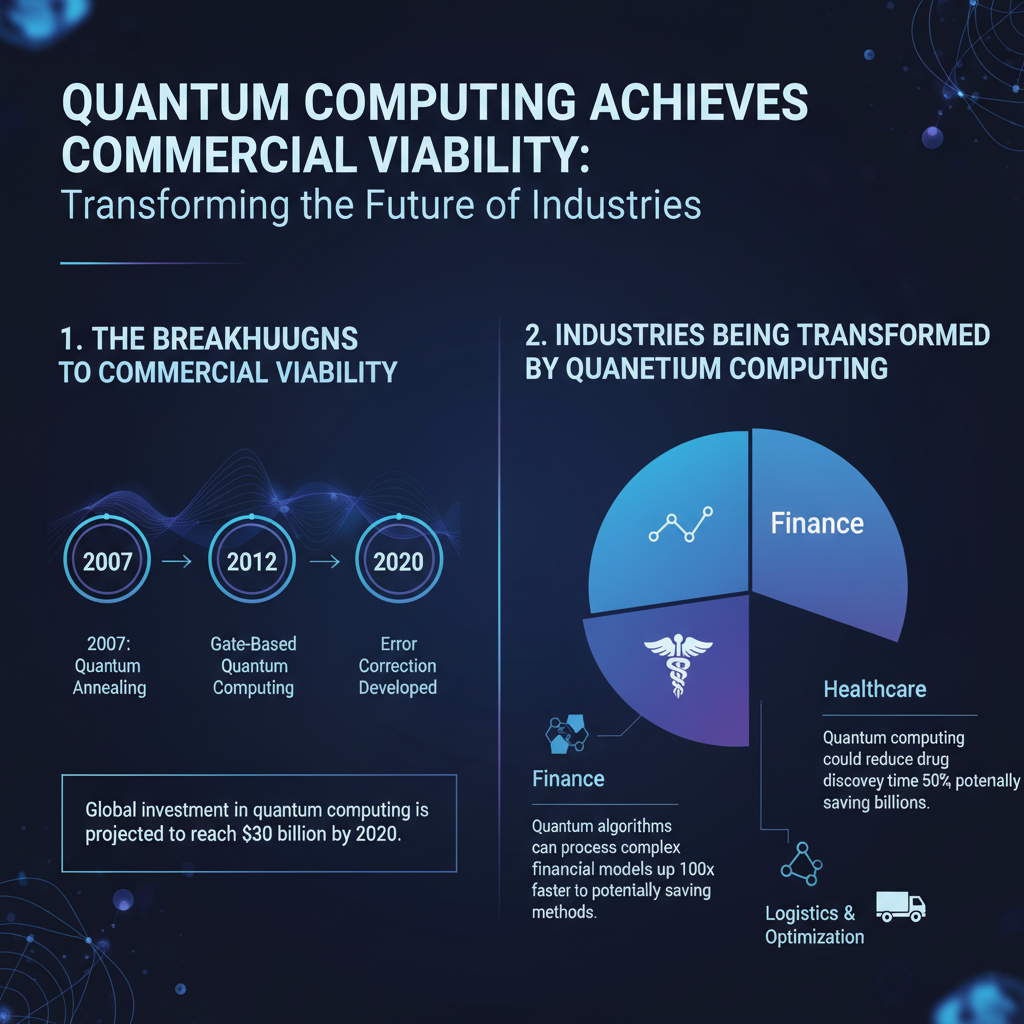
Moreover, the race for quantum advantage has spurred collaborations within the tech industry, where firms are pooling resources and expertise to tackle the complex challenges associated with quantum technology. This collaborative spirit has accelerated the pace of innovation, making quantum computing accessible to businesses of all sizes. With the right algorithms, companies can now use quantum computing to optimize logistics, enhance machine learning models, and even improve cybersecurity protocols.
Industries Being Transformed by Quantum Computing

Finance
In the finance sector, quantum computing is revolutionizing how companies approach risk analysis and trading strategies. Traditional methods often fall short when processing vast datasets to forecast market fluctuations. Quantum computers, however, can analyze multiple variables simultaneously, allowing for real-time risk assessments that were previously unattainable. For example, JPMorgan Chase is experimenting with quantum algorithms to optimize trading strategies, which could lead to more effective investment decisions and reduced risks.
Healthcare
The healthcare industry is also experiencing a seismic shift due to quantum computing. Its superior data processing capabilities are enabling faster drug discovery processes and the development of personalized medicine. Companies like D-Wave are collaborating with pharmaceutical giants to utilize quantum algorithms for molecular modeling, significantly speeding up the time it takes to identify viable drug candidates. This not only reduces costs but also brings life-saving treatments to market much quicker than traditional methods.
Challenges Facing Quantum Computing Adoption
Despite its potential, several challenges persist that may hinder widespread adoption of quantum computing. The high cost of technology is a significant barrier; quantum computers require specialized environments and maintenance, making them an expensive investment for many businesses. Additionally, there’s a shortage of skilled personnel well-versed in quantum mechanics and quantum programming, which complicates the deployment of these systems.
Technical challenges also remain. Error rates in quantum computations can lead to inaccurate results, and qubit coherence times—how long qubits can maintain their quantum state—are still limited. Researchers are actively working to overcome these hurdles, but until substantial progress is made, many organizations may hesitate to fully embrace quantum technology.
The Role of Startups in Quantum Innovation
Emerging startups are playing a crucial role in driving quantum innovation forward. These nimble companies are exploring niche applications that established firms may overlook, offering unique solutions to specific challenges. For instance, startups like Rigetti Computing and Xanadu are developing their own quantum processors and software platforms, pushing the boundaries of what’s possible in quantum computing.
Collaboration between established firms and startups is essential for accelerating development in this field. By partnering with innovative startups, larger corporations can tap into new ideas and technologies while providing the resources and expertise needed to scale these innovations. This symbiotic relationship can help foster a vibrant ecosystem that propels quantum computing into mainstream use.
Future Trends in Quantum Computing
Looking ahead, we can expect to see increased integration of quantum computing with classical systems, resulting in hybrid solutions that leverage the strengths of both. This approach will enable businesses to tackle complex problems without completely overhauling their existing infrastructure. Additionally, research into quantum networking and cloud computing is set to enhance accessibility, allowing more organizations to experiment with quantum technologies without the need for substantial upfront investment.
As cloud-based quantum computing services emerge, companies will have the opportunity to access quantum power on-demand. This democratization of technology will pave the way for wider adoption and experimentation across various sectors, helping organizations to develop innovative solutions that were previously out of reach.
Preparing for a Quantum Future
As quantum computing continues to evolve, businesses need to proactively invest in quantum literacy and talent development. This means equipping teams with the knowledge necessary to understand and leverage quantum technologies effectively. Offering training programs and workshops can help demystify quantum computing and prepare employees for the changes ahead.
Strategic partnerships with quantum technology providers will also facilitate smoother transitions into this new computing paradigm. By collaborating with experts in the field, organizations can better navigate the complexities of quantum computing and ensure they are well-positioned to harness its transformative power.
The transformative potential of quantum computing is becoming a reality for businesses across various sectors. To harness its power, organizations must stay informed about advancements and prepare for the changes ahead. Engage with your team, explore quantum training resources, and consider partnerships that can enhance your position in this evolving landscape. By taking these proactive steps, companies can not only adapt to the quantum future but thrive in it.
Frequently Asked Questions
What are the key factors that have led to quantum computing achieving commercial viability?
The commercial viability of quantum computing has been driven by advancements in technology, increased investment from both private and public sectors, and the development of practical applications. Key factors include breakthroughs in error correction techniques, the miniaturization of quantum chips, and partnerships between tech companies and research institutions which have accelerated innovation. These developments have made quantum computers more reliable and accessible for businesses looking to leverage quantum advantages in fields like cryptography, optimization, and drug discovery.
How is quantum computing impacting industries today?
Quantum computing is transforming various industries by providing unprecedented computational power for complex problem-solving. For example, in pharmaceuticals, quantum algorithms can simulate molecular interactions to expedite drug discovery. In finance, quantum computing enhances risk modeling and optimizes trading strategies, while in logistics, it improves supply chain management by solving intricate optimization problems faster than classical computers. These applications are helping companies gain a competitive edge and drive significant cost savings.
Why is quantum computing considered a game-changer in technology?
Quantum computing is considered a game-changer due to its ability to process and analyze vast amounts of data at speeds unattainable by classical computers. Utilizing principles of quantum mechanics, such as superposition and entanglement, quantum computers can tackle complex problems in minutes that would take traditional computers millions of years. This capability opens up new possibilities in various sectors, including artificial intelligence, materials science, and cryptography, ultimately leading to innovations that can reshape industries and enhance capabilities.
What are the best examples of companies leveraging quantum computing commercially?
Some of the best examples of companies leveraging quantum computing include IBM, Google, and D-Wave Systems. IBM’s Quantum Experience offers a cloud-based platform for businesses to access quantum computing resources and develop applications. Google has made headlines with its quantum supremacy claims, showcasing potential breakthroughs in machine learning. D-Wave Systems focuses on quantum annealing technology, enabling optimization solutions for industries like logistics and finance. These companies are at the forefront of integrating quantum technologies into real-world applications.
Which challenges must be overcome for quantum computing to become mainstream?
Several challenges must be addressed for quantum computing to achieve mainstream adoption, including scalability, error rates, and the need for specialized skill sets. Maintaining qubit stability (coherence) is crucial, as qubits are highly susceptible to environmental disturbances. Additionally, creating user-friendly software and tools that can bridge the gap between quantum and classical computing is essential. Lastly, a shortage of trained professionals in quantum technology and programming languages remains a barrier, necessitating education and training initiatives to build a skilled workforce.
References
- Quantum computing
- https://www.bbc.com/news/technology-58987707
- https://www.sciencedirect.com/science/article/pii/S1369701821000833
- https://www.nytimes.com/2021/10/26/technology/quantum-computing.html
- https://www.reuters.com/technology/quantum-computing-gets-closer-commercial-viability-2021-10-26/
- https://www.nature.com/articles/d41586-021-02884-9
- What Is Quantum Computing? | IBM
- https://www.forbes.com/sites/bernardmarr/2021/11/08/how-quantum-computing-is-becoming-commercially-viable/?sh=1b02f8b5576e