The rise of AI-powered virtual news anchors is revolutionizing our news consumption by delivering real-time, personalized content without the constraints of human limitations. These advanced technologies are reshaping traditional journalism, allowing for faster updates and tailored news experiences. As we delve deeper into this topic, we will explore the underlying technology, the evolution of virtual anchors, their benefits and challenges, audience reception, and future trends in AI news reporting.
Understanding AI in News Broadcasting

At the core of AI-powered virtual news anchors are sophisticated technologies such as natural language processing (NLP) and machine learning (ML). NLP enables machines to understand and generate human language, allowing virtual anchors to present news in a conversational tone that feels relatable. Machine learning, on the other hand, allows these systems to analyze vast amounts of data, learn from it, and improve their performance over time.
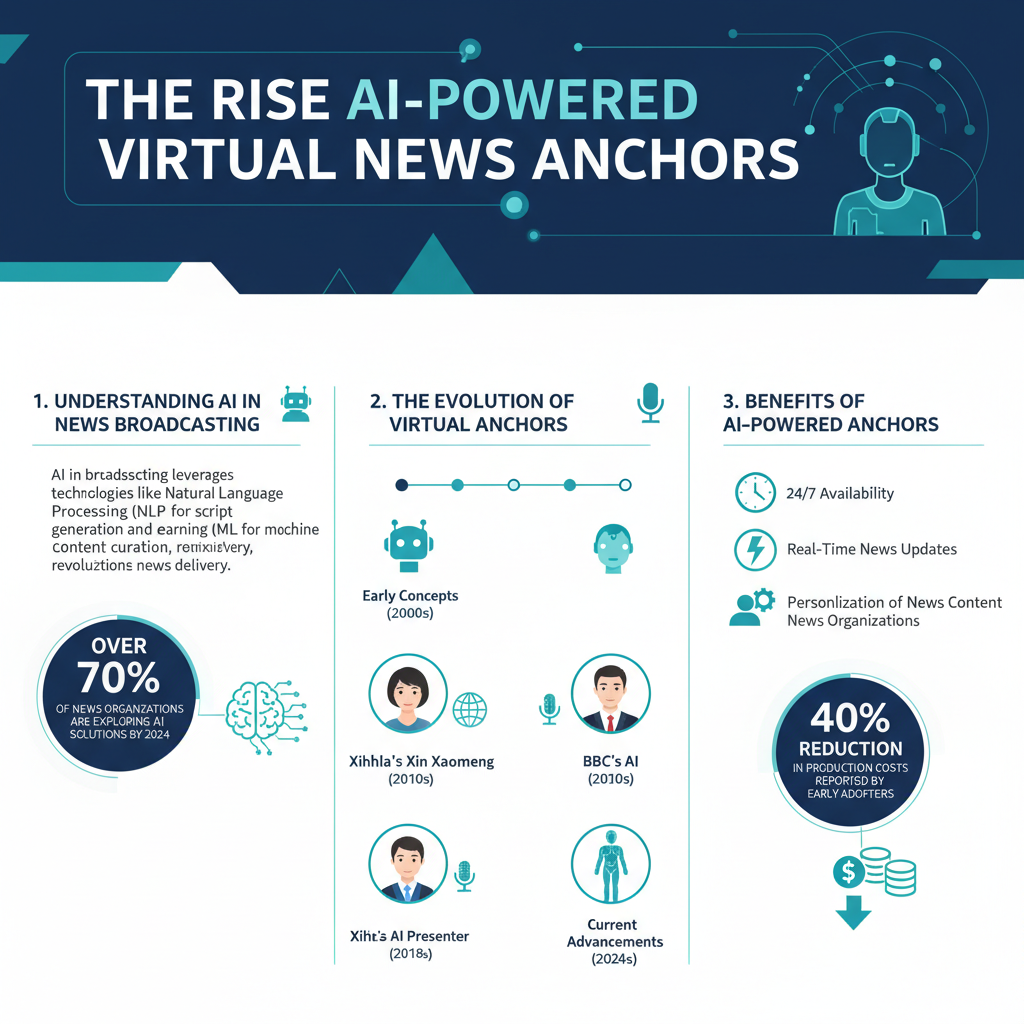
These technologies empower virtual news anchors to provide real-time updates by continuously scanning various news sources, social media platforms, and online communities. For instance, when breaking news occurs, AI systems can quickly curate relevant information, analyze its reliability, and present it to viewers almost instantaneously. This capability enhances audience engagement by ensuring that viewers get timely updates tailored to their interests, making the news experience more interactive and personal.
The Evolution of Virtual Anchors

The journey of virtual news anchors began in the early 2000s when broadcasters experimented with computer-generated avatars to present news. Early implementations were rudimentary and often lacked the lifelike attributes that we see today. However, as technology advanced, so did the sophistication of these virtual presenters.
A significant milestone came in 2018 when China’s Xinhua News Agency introduced its AI news anchor, which could read news in a human-like manner using real-time data. This innovation set the stage for other news organizations worldwide to explore similar technologies. In 2020, the BBC launched a virtual anchor named “BBC News Virtual Presenter,” showcasing the potential of AI in delivering news in a credible and engaging way. Each of these milestones has contributed to the growing acceptance and integration of AI in news broadcasting.
Benefits of AI-Powered Anchors
The advantages of AI-powered anchors are numerous. One of the most significant benefits is the increased efficiency in news production and dissemination. AI can automate tasks such as scriptwriting, video editing, and even scheduling, freeing up human journalists to focus on in-depth reporting and investigative journalism. For example, while AI handles breaking news updates, journalists can work on longer, more comprehensive stories that require human insight and nuance.
Moreover, AI-powered anchors can deliver news tailored to individual viewer preferences through data analysis. By analyzing viewer behavior and preferences, news organizations can curate content that resonates with specific audiences. For instance, if a viewer frequently watches health-related news, the AI system can prioritize and highlight health stories, ensuring that the viewer always receives relevant updates.
Challenges and Limitations
Despite the advantages, there are significant challenges and limitations associated with AI-generated news. One of the most pressing ethical concerns is the potential for misinformation and bias. AI systems learn from existing data, and if that data contains biases or inaccuracies, those flaws can be perpetuated in the news output. For instance, if an AI model is trained primarily on data from one demographic, it may overlook important perspectives from others, leading to skewed reporting.
Additionally, technological limitations still exist in AI news reporting. While AI can analyze data quickly, it often lacks the critical thinking and emotional intelligence required to understand the nuances of complex news stories. This gap can lead to oversimplification or misinterpretation of important events. As such, the ideal scenario remains a collaboration between human journalists and AI systems, leveraging the strengths of each.
Audience Reception and Impact
Audience reception of AI news anchors varies, with many viewers expressing both intrigue and skepticism. Some individuals appreciate the efficiency and immediacy that virtual anchors can provide, while others miss the human touch that traditional anchors offer. Research indicates that younger audiences, in particular, are more open to engaging with AI news presenters, often finding them innovative and refreshing.
Successful implementations of AI news anchors have garnered positive feedback in various settings. For example, the use of AI by news outlets like Reuters has shown promising results, where viewers reported increased satisfaction with news delivery speed and personalization. However, it is crucial to monitor audience reactions continually, as perceptions may evolve as AI technology becomes more integrated into daily news consumption.
Future Trends in AI News Reporting
Looking ahead, we can anticipate several exciting trends in AI news reporting. One prediction is the evolution of interactivity, where viewers may engage with virtual anchors in real-time. Imagine being able to ask a virtual anchor questions about a news story or request additional information. This interactivity could create a more personalized news experience, fostering deeper connections between viewers and the content.
Furthermore, advancements in AI technology will likely lead to more sophisticated algorithms capable of understanding emotional context in news reporting. This development could help mitigate issues related to bias and misinformation by providing more balanced and nuanced coverage. As AI continues to improve, the possibilities for innovation in the news industry are virtually limitless.
The emergence of AI-powered virtual news anchors marks a significant shift in the media landscape, combining technology with journalism to create a new era of news delivery. As this trend continues to evolve, it will be essential to keep an eye on both the advancements and the challenges that come with it. By staying informed and considering how these innovations may affect your news consumption habits in the future, you’ll be better equipped to navigate this fascinating intersection of technology and news.
Frequently Asked Questions
What are AI-powered virtual news anchors and how do they work?
AI-powered virtual news anchors are computer-generated presenters that use artificial intelligence and machine learning algorithms to deliver news content. They analyze data, synthesize information, and generate speech in a human-like manner, allowing them to present news updates without human intervention. By leveraging natural language processing and voice synthesis technologies, these virtual anchors can provide real-time news coverage across various platforms, enhancing accessibility and engagement for viewers.
How are AI virtual news anchors changing the landscape of journalism?
AI virtual news anchors are transforming journalism by automating routine news reporting, enabling news organizations to deliver content faster and more efficiently. This technology allows for personalized news experiences, as AI can curate stories based on viewer preferences. Additionally, the use of virtual anchors can significantly reduce operational costs for media companies, enabling them to allocate resources to more in-depth investigative journalism and storytelling.
Why are news organizations adopting AI-powered virtual news anchors?
News organizations are adopting AI-powered virtual news anchors primarily to enhance efficiency and meet the growing demand for 24/7 news coverage. These virtual presenters can operate continuously without breaks, providing timely updates to audiences around the clock. Furthermore, AI technology can analyze viewer engagement data, allowing organizations to tailor content to audience interests, ultimately increasing viewer retention and satisfaction.
What are the advantages and disadvantages of using AI news anchors?
The advantages of using AI news anchors include reduced production costs, increased speed in news delivery, and the ability to personalize content for viewers. However, disadvantages include potential job displacement for human journalists and concerns about the accuracy and ethics of AI-generated news. Additionally, while AI can replicate human speech and mannerisms, it may lack the emotional depth and critical thinking skills of experienced reporters, which can impact the quality of storytelling.
Which companies are leading the development of AI-powered virtual news anchors?
Leading companies in the development of AI-powered virtual news anchors include major tech firms like NVIDIA and IBM, as well as media organizations such as Reuters and Bloomberg. These companies are integrating advanced AI technologies into their news delivery systems, creating virtual anchors that can present news in multiple languages and styles. Additionally, startups like Synthesia and Hour One are also making significant strides, offering customizable virtual news anchors tailored to specific content needs and brand identities.
References
- https://en.wikipedia.org/wiki/Virtual_news_anchor
- https://www.bbc.com/news/technology-58591334
- https://www.nytimes.com/2021/01/15/technology/ai-news-anchors.html
- https://www.theguardian.com/media/2020/nov/23/ai-virtual-news-anchors
- https://www.sciencedirect.com/science/article/pii/S0360131521003281
- https://www.reuters.com/technology/meet-ai-news-anchors-2022-02-14/
- https://www.npr.org/2021/09/12/1035947323/ai-news-anchors-are-here-and-they-look-just-like-us
- https://www.ijcai.org/proceedings/2021/0201.pdf