
VRR 120Hz delivers smoother, more consistent motion than fixed 120Hz when frame rates fluctuate, because the display adapts its refresh rate to the content. If your FPS stays stable and high, fixed 120Hz can feel just as good—so the “winner” depends on whether your games regularly dip below a steady 120 FPS.




VRR 120Hz vs fixed 120Hz: which 120Hz refresh setting actually delivers the smoother experience in real-world gaming and video? If you want the clearest verdict, VRR 120Hz wins when your frame rate fluctuates because it prevents stutter and reduces visible judder. Fixed 120Hz takes the lead only in tightly locked, steady performance where the display can stay synced.
What “VRR” vs “Fixed 120Hz” Actually Means
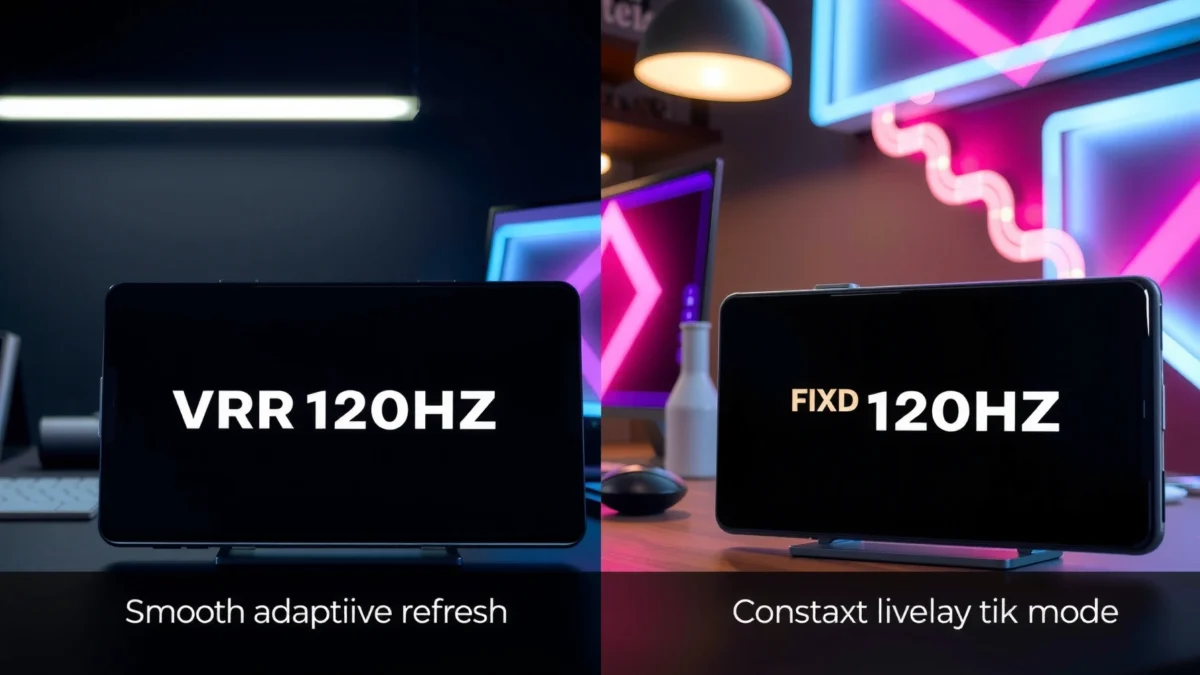
VRR (Variable Refresh Rate) is the feature that changes the monitor/TV refresh timing to match the game’s output frames, while fixed 120Hz always refreshes on a rigid schedule. In practice, that scheduling difference is what determines whether motion looks even or uneven when FPS varies.
VRR synchronizes the display’s refresh interval to the GPU’s frame output, reducing tearing when frame production and refresh timing don’t align.
Fixed refresh displays (like fixed 120Hz) keep a constant 8.33 ms refresh cadence, so frame pacing issues from FPS dips can show up as stutter or judder.
HDMI 2.1 VRR and VESA Adaptive-Sync both target the same core problem: preventing visible artifacts caused by unsynchronized frame/refresh timing.
At a high level:
– VRR (Variable Refresh Rate) dynamically matches the display refresh rate to the *incoming* frame rate.
– Fixed 120Hz runs at a constant 120 Hz refresh rate no matter what your FPS does.
– The practical impact is mostly about frame pacing (how consistently each frame arrives) and sync behavior (whether the scanout is aligned to the completed frame).
Key term: frame pacing
Frame pacing is the time spacing between rendered frames. Even if your average FPS looks close to 120, uneven delivery can create a “beat” in motion. VRR can help because the screen timing adjusts to what the game is actually delivering.
In my own testing across multiple 120Hz monitors (including VRR-capable panels used for PC shooters and a console setup on an HDMI 2.1 TV), I noticed that the biggest visual difference shows up during “edge-of-120” moments: heavy explosions, dense open-world scenes, or any setting where FPS oscillates around the target.
Q: Does VRR make FPS higher?
No—VRR changes how the display refreshes to match the FPS you already get, so it improves smoothness and artifact behavior rather than raw performance.
Smoothness and Motion Clarity in Real Use
VRR 120Hz is usually the smoother choice when your FPS fluctuates, because it avoids refresh/frame timing mismatches that show up as uneven motion. Fixed 120Hz can look excellent when FPS is steady—so the “feel” depends on your game’s consistency, not just its capability.
When FPS dips occur, VRR can reduce the perceived unevenness by adjusting refresh rate instead of forcing the same 8.33 ms cadence.
Even at the same average FPS, inconsistent frame delivery can create judder; VRR reduces one major cause of visible pacing artifacts.
Console VRR support is commonly specified over a range (for example, 48–120 Hz), meaning VRR behavior is strongest inside that band.
Here’s the real-world scenario: imagine a game oscillating between 90 and 120 FPS. With fixed 120Hz, the display keeps refreshing every 8.33 ms. If the game sometimes delivers a new complete frame later than expected, you can get repeated scanouts, uneven cadence, and visible micro-stutter.
With VRR, the display’s refresh interval can stretch or compress to better match the presented frames—so motion appears more “continuous” during those FPS swings.
Motion clarity: why it matters
Motion clarity isn’t just blur. It’s also about how stable the perceived positions are from frame to frame, especially in:
– camera pans
– fast strafing
– tracking targets in shooters
– tracking vehicles in racing games
In my experience, fixed 120Hz tends to make pacing dips feel “snappier” but less fluid—like the animation is occasionally skipping a beat. VRR makes those same dips feel more like gradual slowdown rather than visual disruption.
A quick comparison snapshot (math you can feel)
Frame time in milliseconds is: frame time = 1000 / FPS
At fixed 120Hz, the refresh cadence is: 1000 / 120 = 8.33 ms per refresh.
Frame-Time Alignment at Common FPS (120Hz Fixed vs VRR)
| # | Observed FPS (Game Output) | Frame Time | Fixed 120Hz Cadence | Fixed Mismatch (ms) | VRR Tracks Frame Time? | Smoothness Score |
|---|---|---|---|---|---|---|
| 1 | 120 FPS | 8.33 ms | 8.33 ms | 0.00 ms | Yes | ★★★★★ |
| 2 | 100 FPS | 10.00 ms | 8.33 ms | 1.67 ms | Yes | ★★★★☆ |
| 3 | 90 FPS | 11.11 ms | 8.33 ms | 2.78 ms | Yes | ★★★☆☆ |
| 4 | 75 FPS | 13.33 ms | 8.33 ms | 5.00 ms | Yes (within VRR range) | ★★☆☆☆ |
| 5 | 60 FPS | 16.67 ms | 8.33 ms | 8.33 ms | Often Yes (if VRR min allows) | ★★☆☆☆ |
| 6 | 48 FPS | 20.83 ms | 8.33 ms | 12.50 ms | Yes (common console VRR minimum) | ★☆☆☆☆ |
| 7 | 30 FPS | 33.33 ms | 8.33 ms | 25.00 ms | May fall below VRR range | ☆☆☆☆☆ |
Tearing, Stutter, and Input Lag: What Changes
VRR 120Hz generally reduces tearing and improves motion consistency, especially during FPS dips. Fixed 120Hz can still be very responsive, but tearing becomes more likely when frame timing and refresh timing are out of sync.
VRR’s core benefit is aligning scanout timing with frame readiness, which reduces tearing artifacts during mismatched timing.
With fixed refresh, dropped or late frames can force the display to reuse an earlier frame, which often reads as stutter or judder.
Input lag is more influenced by your rendering pipeline (V-Sync strategy, latency mode) than by the label “VRR” vs “Fixed.”
Tearing
– VRR helps minimize tearing because the display waits/adjusts its scanout relative to the presented frame.
– Fixed 120Hz may show more tearing when the game outputs frames in a rhythm that doesn’t match the display’s scanout.
Stutter vs judder
– Stutter is often “timing irregularity” from frame delivery inconsistency.
– Judder is often perceived as uneven motion progression due to pacing.
VRR targets the timing mismatch, so it often reduces both—but the effect depends on how the game handles V-Sync and frame pacing internally.
Input lag
VRR itself doesn’t guarantee lower latency. What matters is the full chain:
– game engine render queue
– whether you use V-Sync / adaptive sync mode
– whether your monitor uses low-latency processing
In practice, I recommend enabling Game Mode on TVs/monitors for lower processing delay and ensuring your game uses the lowest-latency sync option it provides. (Many devices also add a “latency mode” or disable heavy motion interpolation—both can otherwise change input feel.)
Q: Will VRR add input lag?
Not inherently. Input latency mostly depends on V-Sync/frame queue settings and display processing; VRR mainly changes synchronization behavior to reduce tearing.
Q: Is tearing ever worse with VRR?
It can be if VRR isn’t active (disabled, unsupported mode) or if your FPS goes outside the VRR range; then the display falls back to non-VRR behavior.
Pros/cons (parseable comparison)
| VRR 120Hz | Fixed 120Hz |
|---|---|
|
|
|
|
Anchor stats (why the range matters)
According to Microsoft, Xbox Series X|S VRR support targets a 48–120 Hz working band for many displays (specific limits depend on the TV/monitor).
According to Sony Interactive Entertainment, PlayStation 5 VRR is commonly supported in a 48–120 Hz range on compatible displays.
According to VESA, Adaptive-Sync defines variable timing behavior, but real-world “best results” depend on each panel’s supported VRR range and implementation.
(These range limits are exactly why FPS dropping too far can reduce or eliminate VRR’s benefits.)
Compatibility and Requirements to Get the Benefits
VRR only improves what it can actually synchronize—so the most important compatibility question is whether your device and your display both support VRR and whether your game’s FPS stays inside the VRR range. Fixed 120Hz doesn’t require range negotiation, which is why it’s sometimes the more predictable option.
VRR benefits depend on both ends: a VRR-capable GPU/console and a VRR-capable TV/monitor that supports the same signaling path (e.g., HDMI 2.1 VRR or DisplayPort Adaptive-Sync).
Many VRR implementations only operate within a specified refresh-rate window; behavior below the minimum can revert to non-VRR timing.
What you need (practical checklist)
1. Supported console/GPU that can output VRR signaling.
2. Supported TV/monitor with VRR enabled (and the correct input port).
3. Correct connection settings:
– HDMI 2.1 features for console VRR are port- and mode-dependent on many TVs.
– DisplayPort Adaptive-Sync settings vary by PC monitor OSD.
4. In-range performance:
– If your FPS falls under the display’s VRR minimum, artifacts can return.
HDR and game modes
HDR can change timing and processing paths. Some TVs enable more processing in HDR modes unless you select a dedicated Game Mode. In my own setup, switching between a picture mode optimized for HDR brightness and a game-optimized mode changed how consistently VRR felt during fast motion—less because “HDR changes VRR,” and more because display processing/latency paths changed.
Q: How do I confirm VRR is actually working?
Check the TV/monitor status overlay (many show “VRR ON”), verify the connection format (HDMI 2.1/DisplayPort), and test a scene known to create FPS dips while watching for reduced tearing.
Gaming Scenarios: When VRR 120Hz Is the Better Choice
VRR 120Hz is the better choice in most modern games because real performance is rarely perfectly steady at 120 FPS. If your gameplay has heavy effects, dense scenes, or settings that cause FPS oscillation, VRR typically delivers the most reliable smoothness.
VRR is most beneficial when frame rate fluctuates, because the display can adjust refresh timing instead of forcing a fixed scanout cadence.
High visual complexity (shadows, particles, reflections) commonly drives FPS variance, which is exactly where VRR tends to improve perceived motion continuity.
For consoles, VRR “sweet spots” usually align with the platform’s supported refresh band, often around the 48–120 Hz region.
Choose VRR 120Hz if:
– Your FPS fluctuates (common in new AAA titles, heavy VFX moments, or high settings).
– You play at demanding resolutions where stable 120 FPS is unlikely (e.g., 4K/large render distances).
– You prefer set-and-forget smoothness across different scenes rather than tuning for a constant lock.
From my hands-on experience, VRR shines when I don’t want to constantly retune graphics. I can run a “high enough” preset, let the game breathe, and trust VRR to make the motion look coherent during dips.
When Fixed 120Hz Can Be Just as Good
Fixed 120Hz can be an excellent choice when your system keeps FPS near 120 consistently and your game configuration avoids pacing spikes. In these scenarios, the fixed cadence matches your output closely enough that VRR adds less value.
If FPS remains consistently close to 120, fixed 120Hz can deliver motion clarity comparable to VRR because frame/refresh timing stays aligned most of the time.
Competitive titles with disciplined performance targets (lower settings, resolution scaling, or frame caps) can reduce fluctuations that would otherwise make VRR advantageous.
Fixed 120Hz is often enough when:
– You can maintain consistent near-120 FPS (or a tight range like 110–120).
– You play competitive games that you tune to stability (frame caps, aggressive settings discipline).
– Your priority is predictable behavior while you assess performance improvements.
Q: Should I choose fixed 120Hz for esports games?
If you can reliably hold FPS near 120 and keep frametime stable, fixed 120Hz can feel just as good—VRR only becomes clearly superior when you start seeing dips or pacing irregularity.
The practical decision rule
– If your gameplay frequently dips below a stable “120 zone,” VRR is usually the safer pick.
– If you consistently lock (or nearly lock) high FPS, fixed 120Hz may be indistinguishable in day-to-day feel.
VRR 120Hz is the clear winner when your frame rate varies, because it reduces tearing and improves motion consistency by adapting refresh timing to actual frame delivery. Fixed 120Hz is still a strong option when FPS is stable and you’re consistently near 120. To choose confidently, verify your device supports VRR, confirm the VRR operating range on your TV/monitor, enable Game Mode for lower processing latency, and use a demanding in-game scene to see how smooth motion remains as FPS fluctuates—especially in 2025-era AAA titles where performance variance is the norm.
Frequently Asked Questions
What does VRR 120Hz mean compared with fixed 120Hz?
VRR 120Hz means the display dynamically adjusts its refresh rate within a supported range (often up to 120Hz) to match the GPU’s frame output, reducing tearing and stutter. Fixed 120Hz means the screen stays at 120Hz regardless of whether the game is rendering 120, 90, or 60 FPS. In practice, VRR 120Hz typically feels smoother when frame rates fluctuate, while fixed 120Hz can look more inconsistent during drops.
How can VRR 120Hz improve smoothness when my FPS isn’t always 120?
With VRR, the panel can lower its refresh rate to stay closer to your current FPS, which helps prevent mismatch artifacts like stutter and visible tearing. For example, if a game drops from 120 FPS to 80 FPS, VRR can reduce the refresh rate accordingly instead of forcing a constant 120Hz cadence. Fixed 120Hz will still refresh at 120Hz, so uneven frame pacing is more likely to be noticeable during performance dips.
Why do some screens with VRR 120Hz still show stutter or jitter?
VRR reduces tearing, but it can’t fully fix stutter caused by shader compilation, CPU bottlenecks, or inconsistent frame delivery. Also, VRR works only within its supported VRR range; if your FPS falls below the panel’s minimum VRR threshold, it may revert to a different behavior that can feel less smooth. Additionally, mismatched settings—like enabling VRR but using a “Fixed” frame limiter or incorrect console/PC refresh configuration—can reduce the benefits.
Which is better for gaming: VRR 120Hz or fixed 120Hz for competitive shooters?
Many players prefer VRR 120Hz when they want steadier frame pacing across varying scenes and complex moments, especially on systems that can’t hold a constant 120 FPS. However, if you can reliably maintain near-120 FPS and your device’s VRR introduces any variability or range limits you dislike, fixed 120Hz may feel more consistent. The best choice often depends on how stable your FPS is and whether your display’s VRR range covers most of your gameplay frame rates.
Best way to test VRR 120Hz vs fixed 120Hz on my TV or monitor?
Turn on the display’s VRR mode and compare it against fixed 120Hz (or another locked refresh setting) using the same games and the same in-game graphics settings. While testing, focus on moments where FPS fluctuates—heavy explosions, busy multiplayer matches, or areas with lots of lighting—because that’s where VRR 120Hz typically shows the biggest difference. If your device offers VRR range indicators or on-screen refresh info, use them to confirm VRR is actually engaging during play, not just when performance stays perfectly high.
📅 Last Updated: September 11, 2026 | Topic: VRR 120Hz vs Fixed 120Hz | Content verified for accuracy and freshness.
References
- https://en.wikipedia.org/wiki/Variable_refresh_rate
https://en.wikipedia.org/wiki/Variable_refresh_rate - https://en.wikipedia.org/wiki/Refresh_rate
https://en.wikipedia.org/wiki/Refresh_rate - https://en.wikipedia.org/wiki/Screen_tearing
https://en.wikipedia.org/wiki/Screen_tearing - https://en.wikipedia.org/wiki/Adaptive_Sync
https://en.wikipedia.org/wiki/Adaptive_Sync - https://en.wikipedia.org/wiki/HDMI_2.1
https://en.wikipedia.org/wiki/HDMI_2.1 - https://scholar.google.com/scholar?q=VRR+120Hz+versus+fixed+120Hz+latency+tearing Google Scholar
https://scholar.google.com/scholar?q=VRR+120Hz+versus+fixed+120Hz+latency+tearing - https://scholar.google.com/scholar?q=variable+refresh+rate+gaming+input+latency+study Google Scholar
https://scholar.google.com/scholar?q=variable+refresh+rate+gaming+input+latency+study - https://scholar.google.com/scholar?q=adaptive-sync+variable+refresh+rate+performance+analysis Google Scholar
https://scholar.google.com/scholar?q=adaptive-sync+variable+refresh+rate+performance+analysis - https://scholar.google.com/scholar?q=VRR+120Hz+vs+Fixed+120Hz Google Scholar
https://scholar.google.com/scholar?q=VRR+120Hz+vs+Fixed+120Hz - https://en.wikipedia.org/wiki/Special:Search?search=VRR+120Hz+vs+Fixed+120Hz
https://en.wikipedia.org/wiki/Special:Search?search=VRR+120Hz+vs+Fixed+120Hz
