The future of space exploration will be significantly enhanced by the integration of high-resolution displays, which offer unparalleled detail and clarity in visual data representation. These advanced screens will facilitate better navigation, mission planning, and real-time data analysis, ultimately leading to more successful space missions. In this article, we’ll explore how high-resolution displays are poised to revolutionize our understanding and exploration of the cosmos.



The Importance of High-Resolution Displays in Space Missions

High-resolution displays are not just a luxury in modern space missions; they are becoming an essential tool for ensuring mission success. Enhanced visualization of complex data sets greatly improves decision-making by allowing astronauts and mission controllers to see critical information at a glance. For instance, during planetary exploration, the ability to analyze high-resolution images of Mars or the Moon can reveal geological features that are crucial for understanding the history and composition of other celestial bodies.
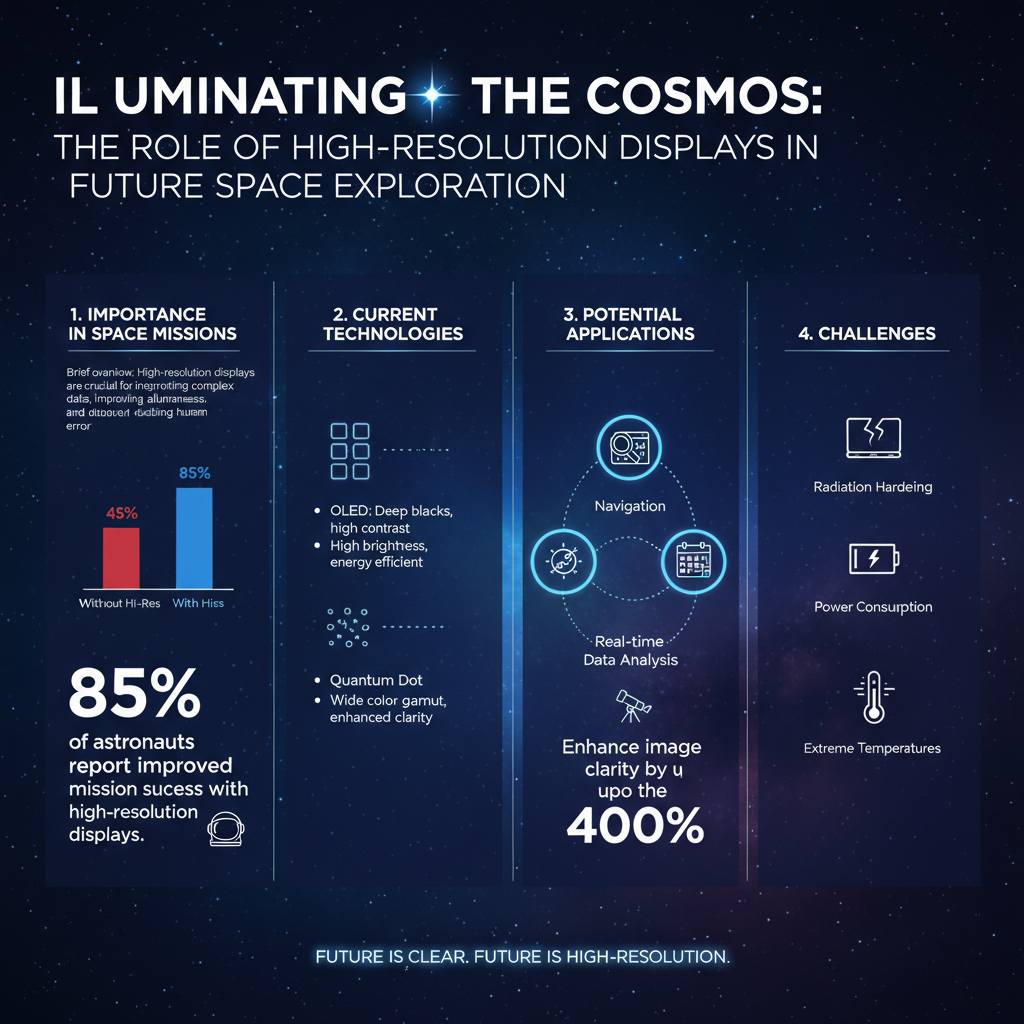
Moreover, high-resolution displays facilitate the interpretation of vast amounts of scientific data collected from various sensors and instruments. This means that astronauts can make informed decisions based on the most detailed imagery and analysis available, increasing the likelihood of mission success. As we venture farther into the cosmos, the clarity provided by these advanced displays will be indispensable.
Current Technologies in High-Resolution Displays
Two technologies currently leading the charge in high-resolution displays are Organic Light Emitting Diodes (OLED) and MicroLED. OLED technology is known for its ability to produce vibrant colors and deep blacks, making it ideal for environments where contrast is key. MicroLED, on the other hand, boasts improved energy efficiency and brightness, which is particularly beneficial for space applications where power management is critical.
When looking at display resolutions, we see a vast range, from Full HD (1920×1080) to 8K (7680×4320). Each step up in resolution enhances detail and clarity, which is vital for tasks such as navigation or scientific observation. For instance, a spacecraft outfitted with 4K displays can provide astronauts with a much clearer view of their surroundings than standard HD displays, allowing for more precise maneuvering and decision-making.
Potential Applications in Space Exploration
The applications of high-resolution displays in space exploration are diverse and promising. In spacecraft cockpits, high-resolution displays can be utilized for improved navigation and situational awareness. Imagine pilots being able to monitor detailed maps of space debris or celestial bodies in real-time, allowing them to make quick adjustments during flight.
Additionally, these displays can play a crucial role in remote missions, such as those planned for Mars or the outer planets. For example, rovers equipped with high-resolution cameras can send back stunning images of planetary surfaces and atmospheres, which can then be displayed in real-time for scientists on Earth to analyze. This immediate feedback loop can enhance our understanding of other planets and ultimately help us determine which locations are worth further exploration.
Challenges to Implementing High-Resolution Displays in Space
Despite the obvious benefits, several challenges remain in implementing high-resolution displays in space missions. One of the foremost issues is related to power consumption and weight limitations in spacecraft. Space missions are often constrained by the amount of power available and the weight that can be carried, which means that any new technology must be both lightweight and energy-efficient.
Moreover, the harsh conditions of space pose another significant challenge. High-resolution displays must withstand extreme temperatures, radiation, and microgravity. Engineers are tasked with designing screens that not only deliver stunning visuals but also have the durability to survive the rigors of space travel. This involves using specialized materials that can endure radiation without degrading and ensuring that components are securely mounted to prevent vibrations from causing damage.
Future Innovations in Display Technology
As we look to the future, several emerging trends in display technology promise exciting advancements. Flexible and transparent displays, for example, could revolutionize how astronauts interact with their environments. These displays could be integrated into the cockpit’s design or even serve as heads-up displays, providing critical information without obstructing the astronaut’s view.
Additionally, advancements in resolution and interactivity are on the horizon. Future displays may offer even higher resolutions than 8K, allowing for an almost lifelike representation of space environments. Interactive capabilities could enable astronauts to manipulate data or imagery by touch, providing a more immersive experience that enhances their ability to make informed decisions quickly.
Case Studies of High-Resolution Displays in Current Missions
Several current missions are already taking advantage of high-resolution displays, with notable examples stemming from NASA’s Artemis program. The Artemis missions aim to return humans to the Moon and establish a sustainable presence there. High-resolution displays are being integrated into the Orion spacecraft, allowing astronauts to visualize navigation data and mission parameters in real-time, thus increasing situational awareness during critical phases of flight.
International space agencies are also exploring high-resolution display technologies. The European Space Agency (ESA) has been implementing advanced display systems on its ExoMars rover, which will use high-resolution cameras to analyze the Martian surface. This allows scientists to make real-time decisions about where to send the rover for further exploration based on the most detailed imagery available.
The positive impact of these high-resolution displays in ongoing projects provides a glimpse into the future of space exploration, where technology and human ingenuity work hand in hand to push the boundaries of what’s possible.
The integration of high-resolution displays in space exploration is set to transform how we view and interact with the universe. By improving data visualization and decision-making processes, these technologies will play a pivotal role in the success of future missions. As we continue to explore the cosmos, it’s exciting to think about the innovations that lie ahead and how they will enrich our understanding of space. Stay tuned for more advancements in space tech as we embark on this thrilling journey into the stars!
Frequently Asked Questions
What are high-resolution displays, and why are they important for space exploration?
High-resolution displays refer to screens that offer high pixel density, resulting in sharper images and clearer visuals. In the context of space exploration, these displays are crucial for tasks such as navigation, data analysis, and monitoring equipment systems. Enhanced visual fidelity allows astronauts and scientists to interpret complex data more accurately, improving decision-making and operational efficiency in high-stakes environments.
How will high-resolution displays improve astronaut training and mission preparation?
High-resolution displays can significantly enhance astronaut training by providing immersive simulations and realistic visual scenarios. These advanced displays allow trainees to interact with 3D models of spacecraft and planetary environments, fostering a deeper understanding of mission protocols and equipment handling. As a result, astronauts can better prepare for the challenges of space missions, ultimately reducing the risk of errors during actual operations.
Why is the integration of high-resolution displays essential for remote space missions?
The integration of high-resolution displays is essential for remote space missions because they enable real-time monitoring and control of spacecraft from Earth. High-quality visuals allow mission control teams to assess conditions, troubleshoot issues, and make informed decisions quickly. This is particularly important for unmanned missions, where visual feedback is the primary means of ensuring mission success and safety.
What are the best high-resolution display technologies currently being used in space exploration?
Currently, some of the best high-resolution display technologies used in space exploration include OLED (Organic Light Emitting Diode) and MicroLED displays. These technologies offer superior contrast ratios, vibrant colors, and energy efficiency, making them ideal for the harsh conditions of space. Additionally, advancements in flexible displays are paving the way for innovative applications, such as lightweight and foldable screens that can be easily integrated into spacecraft designs.
Which challenges do developers face when implementing high-resolution displays in space environments?
Developers face several challenges when implementing high-resolution displays in space environments, including radiation exposure, extreme temperatures, and the need for durability in microgravity. Ensuring that displays can withstand these conditions while maintaining functionality and clarity is crucial. Moreover, power consumption is a concern, as energy resources are limited in space, prompting the need for displays that balance high performance with energy efficiency.
References
- Space exploration
- https://www.nasa.gov/mission_pages/exploration/overview/index.html
- https://www.sciencedirect.com/science/article/pii/S0094576521000128
- https://www.jpl.nasa.gov/news/nasa-works-to-improve-spacecraft-displays
- https://www.bbc.com/future/article/20200914-how-we-will-explore-space-in-the-future
- https://www.nsf.gov/news/special_reports/spaceexploration/
- https://www.theguardian.com/science/2021/jul/20/the-future-of-space-exploration
- https://www.aaas.org/resources/space-policy-and-exploration
- https://www.nasa.gov/feature/what-are-advanced-displays-in-space-exploration