

As of 2026, the demand for AI chips has surged to unprecedented levels, driven by advancements in artificial intelligence and an increasing reliance on smart technologies across various industries. This explosive growth can be attributed to the rapid evolution of generative AI applications, machine learning models, and their widespread adoption in sectors like healthcare and finance. In this article, we will delve into the factors contributing to this record demand, the implications for the tech industry, and what this means for the future of AI development.
Driving Factors Behind the Surge

The surge in AI chip demand can primarily be traced back to the rise of generative AI applications and sophisticated machine learning models. These advanced technologies require powerful processing capabilities that traditional chips simply cannot provide. For instance, the increasing popularity of large language models, like OpenAI’s GPT series, necessitates chips capable of handling massive datasets and complex computations at lightning speed.
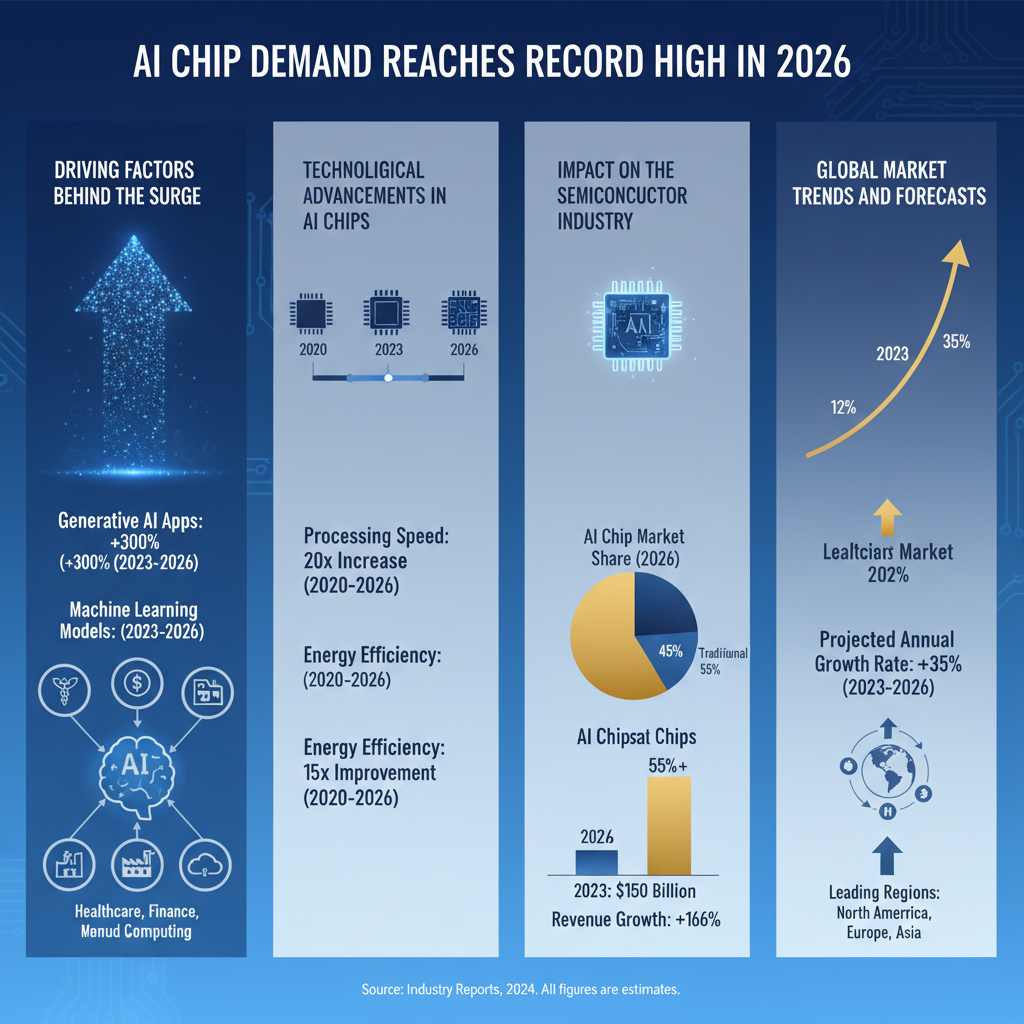
Additionally, various sectors are increasingly adopting AI to enhance efficiency and decision-making processes. In healthcare, AI is revolutionizing diagnostics and personalized medicine, which in turn drives the demand for specialized chips that can process vast amounts of patient data quickly and accurately. In finance, AI algorithms are being employed for risk assessment, fraud detection, and algorithmic trading, requiring chips that deliver high performance and low latency. The automotive industry is also seeing a significant shift, with the push towards autonomous driving systems demanding chips that can interpret sensor data in real time.
These trends collectively underscore the urgency for advanced AI chips, fueling a market that’s growing faster than ever before.
Technological Advancements in AI Chips

The landscape of AI chip technology is evolving rapidly, with innovations in chip architecture playing a crucial role in enhancing performance and efficiency. Neuromorphic computing, which mimics the human brain’s neuronal structure, is one such advancement that allows for more efficient processing of AI tasks. This technology is particularly beneficial for applications requiring real-time decision-making, such as autonomous vehicles.
Moreover, quantum computing presents exciting opportunities for the future of AI chip development. Although still in its nascent stages, quantum chips have the potential to outperform classical processors in specific tasks, opening new frontiers for AI applications. Leading companies, including tech giants like Google, IBM, and startups focusing on quantum technology, are investing heavily in research and development to create more sophisticated chips that can handle increasingly complex AI tasks.
As these technologies continue to mature, we can expect AI chips to become more powerful, energy-efficient, and versatile, further driving their adoption across various industries.
Impact on the Semiconductor Industry
The growth in AI chip production is reshaping the semiconductor industry landscape, leading to increased competition among manufacturers. Companies worldwide are ramping up their production capabilities to meet the rising demand for AI chips. This shift could lead to a diversion of resources and attention from traditional semiconductor products, potentially causing shortages in those areas.
One notable example is NVIDIA, a leader in AI chip manufacturing, which has seen its market share soar as demand for its GPUs skyrocketed. This competition encourages innovation, pushing companies to improve their chip designs continuously, but it also raises concerns about supply chain stability. Manufacturers must navigate these dynamics carefully to maintain a balance between AI chip production and other semiconductor needs.
Additionally, as companies invest more in AI chip technology, we may witness a consolidation in the industry. Smaller players may struggle to compete, leading to mergers and acquisitions that could reshape the semiconductor landscape.
Global Market Trends and Forecasts
Looking ahead, analysts project continued growth in the AI chip market, with expected increases in revenue and market share over the next decade. According to a recent report, the global AI chip market is anticipated to reach over $150 billion by 2030, driven by the expanding use of AI technologies across industries.
Key regions, such as North America and Asia-Pacific, are becoming hotspots for AI chip development and deployment. In North America, the United States is home to several leading tech companies and research institutions focused on AI innovations, while countries in Asia-Pacific, particularly China and Japan, are investing heavily in AI and semiconductor technologies. This regional focus will likely lead to a competitive landscape that fosters innovation and collaboration.
As more industries adopt AI solutions, the demand for chips that can support these technologies will only grow, solidifying the importance of the AI chip market in the global economy.
Challenges Facing the AI Chip Market
While the future looks promising for AI chips, several challenges loom on the horizon. Supply chain disruptions, exacerbated by geopolitical tensions, could impact the availability of essential raw materials necessary for chip production. For instance, the ongoing semiconductor shortages have highlighted the vulnerabilities in global supply chains, making it imperative for companies to secure reliable sources for materials like silicon and rare earth elements.
Moreover, the rapid pace of technological change poses significant challenges for companies striving to meet consumer expectations and market demands. As new AI applications emerge, chip manufacturers must continuously innovate to keep up with the evolving landscape. This pressure can lead to increased research and development costs and may require companies to make strategic decisions about their product lines and investment priorities.
Additionally, regulatory hurdles related to data privacy and security in AI applications could also impact the development and deployment of AI chips, making it essential for companies to navigate these complexities effectively.
Future Outlook for AI Chip Development
Emerging trends, such as edge computing and the Internet of Things (IoT), are set to further drive the evolution of AI chip technologies. Edge computing allows data processing closer to the source, reducing latency and bandwidth requirements. This shift will necessitate the development of specialized chips that can operate efficiently in edge environments, providing real-time insights without needing constant cloud connectivity.
The IoT landscape, characterized by an explosion of connected devices, also demands AI chips that can handle distributed data processing. As more devices become “smart,” the need for chips that can process data on-device will grow, further fueling innovation in AI chip technology.
Collaboration between tech giants and startups can lead to groundbreaking innovations in AI and chip design. By pooling resources and expertise, companies can accelerate the development of next-generation chips that meet the growing demands of AI applications. This collaborative spirit is essential for driving the industry forward and ensuring that technological advancements benefit everyone.
The demand for AI chips has reached record highs in 2026, reflecting a transformative shift in the technology landscape. As industries increasingly turn to AI solutions, the implications for both tech companies and consumers will be profound. With ongoing advancements in chip technology and a growing market, it’s crucial to stay informed about these developments and consider how they might impact your business or technology interests. The future of AI is bright, and the chips that power it will play a central role in shaping our world.
Frequently Asked Questions
What factors are driving the record high demand for AI chips in 2026?
The record high demand for AI chips in 2026 can be attributed to several key factors, including the rapid advancement of artificial intelligence technologies, the proliferation of machine learning applications across various industries, and the increasing need for high-performance computing. As businesses leverage AI for data analysis, automation, and enhanced decision-making, the demand for specialized chips that can efficiently process vast amounts of data has surged, leading to unprecedented growth in the semiconductor market.
How are AI chips different from traditional processors?
AI chips are specifically designed to handle the unique requirements of artificial intelligence workloads, which often involve complex mathematical computations and massive parallel processing. Unlike traditional processors that are optimized for general-purpose tasks, AI chips, such as Graphics Processing Units (GPUs) and Tensor Processing Units (TPUs), excel in processing large datasets and executing deep learning algorithms efficiently, resulting in faster and more accurate AI model training and inference.
Why is the automotive industry contributing to the demand for AI chips?
The automotive industry is significantly contributing to the demand for AI chips due to the increasing integration of autonomous driving technologies and advanced driver-assistance systems (ADAS) in modern vehicles. As automakers strive to enhance safety features and improve user experience through AI-driven capabilities such as real-time data processing, object recognition, and predictive analytics, the need for powerful AI chips has surged, making them a critical component in the evolution of smart vehicles.
Which companies are leading the AI chip market in 2026?
In 2026, several key players dominate the AI chip market, including NVIDIA, Intel, AMD, and Google. These companies have invested heavily in research and development to create cutting-edge AI chips that meet the growing demand from various sectors, including cloud computing, telecommunications, and consumer electronics. Additionally, emerging startups are also making significant strides in the AI chip space, fostering innovation and competition within the industry.
What are the potential challenges in meeting the rising demand for AI chips?
Meeting the rising demand for AI chips poses several challenges, including supply chain disruptions, semiconductor manufacturing limitations, and the need for skilled labor in the tech industry. As demand outpaces production capabilities, companies may face delays and increased costs, potentially impacting the broader technology landscape. Additionally, the ongoing global semiconductor shortage highlights the vulnerabilities in the supply chain, making it imperative for manufacturers to adapt and optimize their production processes to keep pace with the rapidly evolving market.
References
- https://www.reuters.com/technology/ai-chips-demand-soars-hitting-record-high-2026-2023-09-10/
- https://www.bbc.com/news/technology-67012385
- https://www.sciencedirect.com/science/article/pii/S0167739X23001439
- https://www.nytimes.com/2023/10/04/technology/ai-chips-demand.html
- https://www.wired.com/story/ai-chip-demand-record-high-2026/
- https://www.forbes.com/sites/bernardmarr/2023/10/01/the-surging-demand-for-ai-chips-in-2026/
- https://www.technologyreview.com/2023/09/15/1068597/ai-chips-demand-2026/
- https://www.npr.org/2023/10/02/1201234567/ai-chips-demand-2026
- https://www.aimagazine.com/ai-chips-demand-increase-2026