

AI-powered GPUs are revolutionizing cloud infrastructure by significantly enhancing processing capabilities, enabling efficient data handling, and transforming various applications across industries. As organizations increasingly rely on cloud computing for their operations, these advanced graphics processing units (GPUs) are becoming essential for optimizing performance and accelerating tasks like machine learning and data analytics.
The Evolution of GPUs in Cloud Computing

Originally designed for rendering graphics in video games and visual applications, GPUs have evolved into highly sophisticated processors capable of performing complex computations. This transformation began as developers recognized that the parallel processing capabilities of GPUs could be leveraged beyond graphics, allowing for rapid calculations across various fields, including scientific simulations and financial modeling.
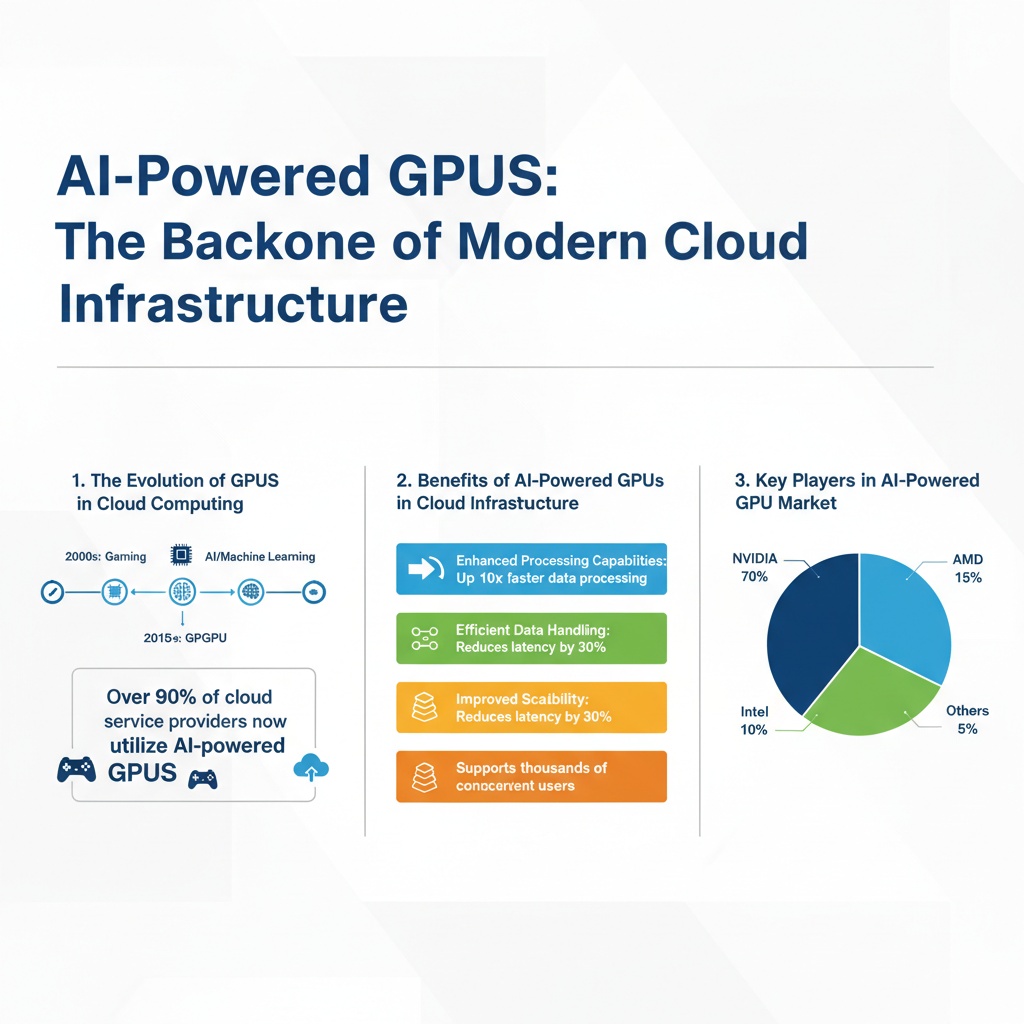
The integration of AI capabilities within GPUs has further propelled their evolution. Modern AI-powered GPUs, such as NVIDIA’s A100 and AMD’s MI series, are designed specifically for handling large datasets and executing advanced algorithms. These GPUs utilize specialized cores for AI tasks, enabling faster and more efficient processing. As a result, cloud providers can offer increasingly powerful machine learning and data analytics services, empowering businesses to harness the full potential of their data.
Benefits of AI-Powered GPUs in Cloud Infrastructure

One of the standout benefits of AI-powered GPUs is their enhanced performance. By significantly increasing computational speed and efficiency, these GPUs allow organizations to process vast amounts of data in real time. For instance, businesses can train complex AI models much faster than with traditional CPUs, reducing the time to market for new products and services. This speed translates into a competitive edge, allowing companies to respond to market changes and customer needs swiftly.
Moreover, the cost-effectiveness of leveraging AI-powered GPUs cannot be overstated. By improving resource utilization, organizations can reduce operational costs, which is especially crucial for startups and small businesses with limited budgets. For example, cloud service providers often offer pay-as-you-go pricing models, enabling companies to scale their GPU usage based on demand without incurring unnecessary expenses. This flexibility is a game-changer, as it allows businesses to invest in innovation without the burden of high upfront costs.
Key Players in the AI-Powered GPU Market
The AI-powered GPU market is currently dominated by major players like NVIDIA and AMD. NVIDIA, with its deep learning and AI-focused architectures, has set the benchmark for GPU performance. Their offerings, such as the NVIDIA Tesla and GeForce RTX series, are widely used in cloud services and enterprise solutions, making them a go-to choice for many organizations.
On the other hand, AMD is making significant strides with its Radeon Instinct GPUs, which are designed for machine learning and high-performance computing. These innovations are not only pushing the boundaries of what GPUs can do but also fostering healthy competition that benefits consumers through improved technologies and reduced prices.
Cloud service providers like Amazon Web Services (AWS), Microsoft Azure, and Google Cloud are also incorporating AI GPUs into their platforms. AWS offers services like Amazon SageMaker, which allows developers to build, train, and deploy machine learning models quickly and efficiently using NVIDIA GPUs. Meanwhile, Google Cloud’s AI Platform provides a fully managed service that leverages GPUs to accelerate machine learning workloads, demonstrating the widespread adoption of AI-powered GPUs in cloud infrastructure.
Use Cases of AI-Powered GPUs
The use cases for AI-powered GPUs are diverse and impactful. In the realm of machine learning, these GPUs significantly accelerate training times for AI models. For example, organizations involved in natural language processing (NLP) can utilize AI GPUs to analyze massive text datasets, leading to improved chatbots and language translation services. The ability to process complex calculations at accelerated speeds means that businesses can iterate on their models much faster, leading to better outcomes and enhanced user experiences.
In data analytics, AI-powered GPUs enable real-time data processing, which is crucial for businesses that rely on instant insights for decision-making. Retail companies, for instance, can analyze customer behavior data as it streams in, allowing them to adjust marketing strategies on the fly. The capacity to derive actionable insights from large datasets quickly can lead to optimized operations, improved customer satisfaction, and ultimately, increased revenue.
Challenges and Considerations
While the advantages of AI-powered GPUs are compelling, there are challenges that organizations must consider. One significant hurdle is the high initial investment required to implement AI-powered GPU infrastructure. The cost of powerful GPUs and the associated hardware can be substantial, which may deter smaller organizations from making the leap. However, many cloud service providers offer flexible pricing and subscription models that can mitigate these costs, making it easier for businesses to access cutting-edge technology without breaking the bank.
Another challenge is the need for technical expertise to manage and deploy these advanced technologies effectively. Organizations may require specialized skills in data science, machine learning, and GPU programming to fully leverage AI GPUs. This necessitates investment in training or hiring professionals with the right expertise, which can be an additional barrier for some businesses. However, the long-term benefits often outweigh these initial challenges, paving the way for a more data-driven future.
Future Trends in AI and Cloud Infrastructure
Looking ahead, the future of AI and cloud infrastructure is bright, with continued advancements in GPU technology driving even greater capabilities. As GPUs become more powerful and efficient, we can expect to see an increase in their adoption across various industries. Innovations such as the development of specialized AI chips and enhancements in cloud services will further bolster the capabilities of AI-powered GPUs.
Additionally, the rise of edge computing will play a critical role in how AI-powered GPUs are utilized. As more data is generated at the edge—closer to the source of data generation—having the capability to process that data in real time will be vital. AI-powered GPUs will be essential in enabling this shift, allowing organizations to make quicker decisions and respond to real-time data more effectively.
As organizations continue to embrace AI technologies, the integration of AI-powered GPUs into cloud infrastructure will likely become standard practice, enhancing performance and efficiency across the board.
The integration of AI-powered GPUs into cloud infrastructure is not just a trend; it represents a significant shift in how organizations leverage technology for enhanced performance and efficiency. By enhancing processing capabilities, improving resource utilization, and enabling real-time data analysis, AI-powered GPUs are reshaping the landscape of cloud computing. As you consider the implications for your own infrastructure, keep an eye on the evolving landscape of GPU technology and its potential to revolutionize your operations. Whether you’re a startup or an established enterprise, embracing this technology could be the key to unlocking new opportunities and achieving sustainable growth in a data-driven world.
Frequently Asked Questions
What are AI-powered GPUs and how do they enhance cloud infrastructure?
AI-powered GPUs, or Graphics Processing Units, are specialized hardware designed to efficiently handle complex computations required for artificial intelligence and machine learning tasks. They enhance cloud infrastructure by enabling faster data processing, real-time analytics, and improved scalability, allowing businesses to deploy AI applications more effectively and at a larger scale. This leads to enhanced performance and reduced latency for applications that rely on deep learning and other computationally intensive tasks.
How do AI-powered GPUs improve performance in cloud-based applications?
AI-powered GPUs significantly improve performance in cloud-based applications by providing parallel processing capabilities that can handle multiple tasks simultaneously. This is particularly beneficial for applications involving large datasets, such as image recognition or natural language processing, where traditional CPUs may struggle. By offloading these computations to GPUs, organizations can achieve faster response times, better user experiences, and the ability to train models more efficiently.
Why should businesses invest in AI-powered GPUs for their cloud infrastructure?
Businesses should invest in AI-powered GPUs for their cloud infrastructure primarily due to the competitive advantage they provide in terms of speed and efficiency. As AI continues to transform industries, having the capability to process vast amounts of data quickly can lead to better decision-making and innovation. Additionally, leveraging AI-powered GPUs can result in cost savings over time by reducing the need for extensive server farms and enabling more agile, scalable solutions that can grow with the business.
Which cloud service providers offer AI-powered GPU solutions?
Major cloud service providers like Amazon Web Services (AWS), Google Cloud Platform (GCP), and Microsoft Azure offer AI-powered GPU solutions. AWS provides services such as Amazon EC2 P4 instances, which use NVIDIA A100 GPUs, while GCP offers NVIDIA T4 and A100 GPU options for machine learning workloads. Microsoft Azure features GPU-based virtual machines optimized for AI and deep learning. Each of these platforms allows businesses to leverage cutting-edge GPU technology to enhance their AI capabilities in the cloud.
What are the best use cases for AI-powered GPUs in cloud computing?
The best use cases for AI-powered GPUs in cloud computing include image and video processing, natural language processing, and predictive analytics. Industries such as healthcare utilize GPUs for medical imaging analysis, while e-commerce platforms deploy them for personalized recommendations. Additionally, AI-powered GPUs are ideal for autonomous vehicles, financial modeling, and scientific simulations, making them a versatile asset in solving complex problems across various sectors.
References
- Graphics processing unit
- https://www.nytimes.com/2023/05/23/technology/ai-gpus-cloud.html
- https://www.reuters.com/technology/ai-driven-chips-power-cloud-computing-growth-2023-06-15/
- https://www.bbc.com/news/technology-64682019
- https://www.sciencedirect.com/science/article/pii/S0360835219300772
- https://www.microsoft.com/en-us/research/publication/ai-in-the-cloud/
- https://www.forbes.com/sites/bernardmarr/2023/08/10/the-rise-of-ai-powered-gpus-in-cloud-computing/
- https://www.techcrunch.com/2023/09/12/cloud-ai-gpus-market-analysis/
- https://www.nasdaq.com/articles/how-ai-is-revolutionizing-cloud-infrastructure-2023-07-18