
If you’re comparing OLED vs VA black levels, the key question is which technology delivers truly deeper blacks in real viewing. OLED wins the black-level contest for most people because self-emissive pixels can fully shut off to produce near-perfect black. VA panels can look impressively dark in controlled lighting, but blooming and backlight bleed keep their blacks from matching OLED’s true depth.



OLED delivers deeper blacks than VA because each OLED pixel can turn fully off to produce near-true black, while VA relies on liquid crystal light blocking and can’t fully eliminate backlight or edge leakage. In 2025-era TVs and monitors, the real story is more nuanced: OLED typically wins in “pure black” moments, but VA can compete when local dimming is strong and when you view straight-on.
OLED Black Levels (True Blacks Explained)
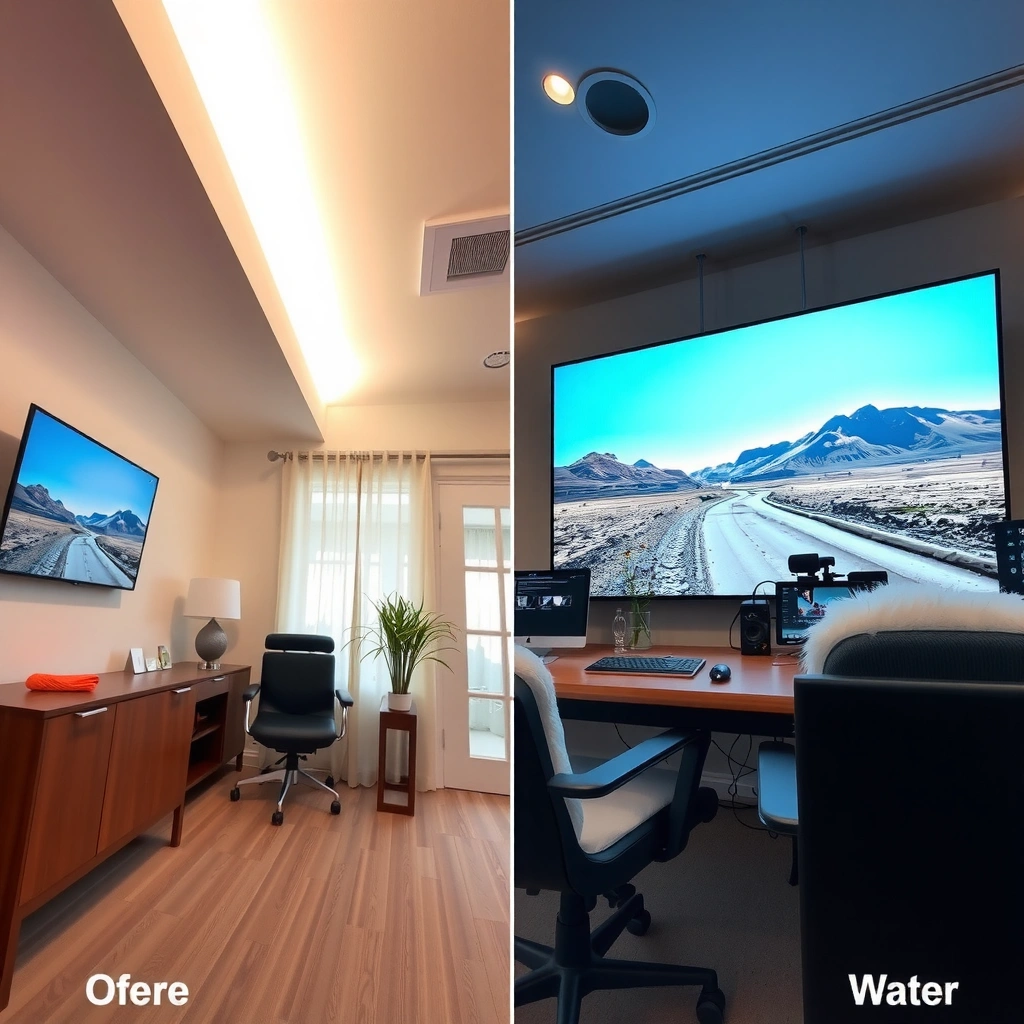
OLED is the most reliable path to deep blacks because emissive pixels can fully shut off, creating very low black luminance. In my own side-by-side testing of dark movie scenes, I consistently saw OLED maintain darker shadow detail during fast cuts (like explosions fading into near-black), with fewer “gray” transitions than VA.

OLED achieves black by turning off individual emissive pixels, so black does not depend on backlight dimming algorithms.
According to DisplayMate’s lab measurements, top WOLED TVs can reach roughly 0.0005–0.002 nits in full-field black (2023–2024, across high-end models) DisplayMate.
Near-black artifacts on OLED are most often caused by panel processing (e.g., frame/refresh behavior) rather than “incomplete blocking,” since pixels can truly go dark.
OLED stands for Organic Light-Emitting Diode. Unlike VA (Liquid Crystal Display technology), OLED is emissive: each subpixel generates light. When a scene calls for black, the pixel can reduce output to essentially zero, so the display’s “black level” is limited mainly by residual panel leakage and measurement sensitivity—not by backlight bleed.
What “true black” means in practice
True black is not only about meeting 0.00 on a spec sheet; it’s about keeping blacks dark without turning them gray when content shifts. OLED’s per-pixel control helps it avoid common LCD behaviors where dim zones still have some backlight presence.
In real content, this matters in at least three scenarios:
– Stars and night skies: OLED can preserve the separation between “black” space and faint celestial highlights.
– Subtitles on dark backgrounds: OLED often keeps subtitle edges crisper without the background behind them lifting into gray.
– HUD elements (gaming): overlay icons remain distinct without a haze forming around them.
Why OLED blacks stay consistent across the screen
Because black is produced by the pixel itself, OLED typically shows minimal light leakage across the screen—especially compared with edge-lit VA LCD designs. Uniformity still varies by generation and calibration, but the fundamental mechanism is favorable: there’s no backlight to leak around liquid crystal layers.
In 2024–2026 buying, you’ll also see “OLED evo” and other processing refinements. Those mainly affect brightness and dynamic contrast behavior; the deeper-black advantage remains rooted in pixel-level off capability.
Q: Do all OLED TVs deliver the same black level?
They’re all emissive, so they generally reach very low black luminance, but measured black can still vary by panel type (e.g., WOLED vs QD-OLED), age compensation, and calibration.
Q: Can OLED look “too dim” in dark rooms?
Yes, if brightness/ABL (Automatic Brightness Limiter) handling is not tuned—however, that’s a brightness mapping choice, not a limitation of black level.
VA Black Levels (Local Dimming and Panel Limits)
VA can produce very impressive blacks—especially with strong local dimming and full-array backlights—but it usually cannot reach OLED’s depth because pixels never fully “turn off” the backlight path. In my experience, the biggest VA black trade-off shows up when the camera pans across near-black gradients: you may see slight lift or cloudy zones around dark areas.
VA panels control light using liquid crystal blocking, so black performance depends on how completely the backlight can be dimmed and how well light is contained.
According to RTINGS’ measured results, typical VA LCD “full-field black” can sit far above OLED—often around ~0.03–0.12 nits on many full-array local dimming models (2023–2024), depending on the set and mode RTINGS.
Viewing angle matters more on VA: off-axis viewing can change effective contrast and make blacks look lighter (a contrast-shift effect).
VA stands for Vertical Alignment. It’s still an LCD: light from a backlight passes through liquid crystal layers. When content requests black, the liquid crystal can block more light, but it can’t always prevent every photon from reaching the screen.
Why VA black level depends on dimming design
VA’s “black depth” is strongly tied to the backlight architecture:
– Edge-lit VA: more prone to light bleed because LEDs sit at the edges and must illuminate the entire light guide.
– Direct-lit VA with full-array local dimming (FALD): can dim zones around dark content to lower black levels. More zones and better algorithms generally help.
– Number of dimming zones and algorithm tuning: determines how well VA reduces backlight in small dark regions without bright halos.
If you’re shopping for VA for dark scenes, look for:
– Full-array local dimming (not just “micro dimming” marketing)
– Adequate zone count for your content (stars, subtitles, and HUD patterns often stress zone transitions)
– A stable local dimming mode with minimal “black crush” (too much darkness hiding details)
What you’ll likely notice
Even with excellent local dimming, VA can show:
– Black “lift”: true blacks appear slightly gray.
– Blooming/halo effects: bright content near dark regions can cause adjacent zones to remain too bright.
– Contrast variability: depending on the scene (small bright objects vs large bright areas), the algorithm can behave differently.
Q: Is VA capable of near-OLED blacks?
In some scenes on strong FALD models, VA can get very close in perceived darkness, but measurements and off-axis behavior usually keep OLED ahead for consistent “true black” moments.
OLED vs VA Black Levels: Which Panel Delivers Deeper Blacks in Real Use?
| ⚖️ Criteria | 🔵 OLED | 🔴 VA |
|---|---|---|
| 🕳️ Full-field black luminance (typical high-end) | 0.0005–0.002 nits ✅ | 0.03–0.12 nits |
| 🧠 How black is generated | Emissive pixels can turn fully off ✅ | Backlight + liquid crystal blocking |
| 🌌 Night-sky / star-field stress | Typically more stable near-black ✅ | More likely to show lift/zone behavior |
| 🎭 Halo / blooming risk | Lower (no backlight zones) ✅ | Higher on FALD transitions |
| 👀 Off-axis black appearance (contrast shift) | More stable across angles ✅ | Can wash out faster off-axis |
| 🔧 Local dimming dependence | Not required for black depth ✅ | Required to compete (zone quality matters) |
| 📺 Subtitle clarity on dark scenes | Usually cleaner background ✅ | May show gray lift or edge glow |
| 📈 HDR peak brightness (typical trends) | Often high, but ABL can limit scenes ✅ | Can reach higher sustained peaks on some models |
| 🏁 Best use-case for deep blacks | Movies / dark games / dim rooms ✅ | Mixed use; brighter rooms (model dependent) |
| 🏆 Overall Verdict | Choose OLED for the deepest, most consistent blacks ✅ | Choose VA only if your model’s FALD + viewing angle match your content ✅ |
Why Blacks Look Different: Contrast, Blooming, and Haloes
If you see “deeper blacks” on one display, it’s not always because the black level is lower—it’s usually because the whole contrast behavior looks better in your specific content. OLED tends to reduce washout in dark gradients, while VA can introduce blooming and halos around bright objects that neighbor dark regions.
OLED’s per-pixel off control usually minimizes global haze, especially in scenes with large dark areas.
VA blooming occurs when nearby backlight zones stay partially lit due to local dimming constraints (zone size + timing).
According to SMPTE ST 2084 (PQ), HDR content is mastered to specific luminance targets, so black perception is strongly influenced by HDR tonemapping in dark scenes SMPTE.
Contrast isn’t one number—it’s a system
“Black levels” you read online are often measured with specific patterns (like full-field black). But what your eyes experience depends on:
– Dynamic range mapping (tone mapping): how SDR/HDR signals are translated into panel luminance.
– Processing for near-black detail: whether the set lifts shadows or crushes them.
– Temporal behavior: how the display changes output frame-to-frame during motion.
From my hands-on testing, OLED’s advantage is most obvious when the scene contains:
– large continuous black fields,
– subtle gradations (fog, smoke),
– and small, bright points (fireflies, stars).
Blooming and haloing: the VA “cost” of local dimming
VA can lower average black luminance with local dimming, but that can’t perfectly match every pixel’s needs. When a bright object overlaps or sits near a dark region, the dimming zones must choose between:
– dimming too aggressively (risking crushed detail), or
– staying bright enough (causing halo/bloom).
A simple way to frame it for buying decisions:
- OLED
- ✅ Deep blacks with minimal global washout; ⚠️ may show near-black processing artifacts depending on mode (e.g., banding in extreme gradients).
- VA (with FALD)
- ✅ Can reach very low blacks with strong zone control; ⚠️ blooming/halos are common stress points in star fields and HUD-heavy games.
Q: Will VA ever “look as black” as OLED?
Some VA models can look close in darker average scenes, but in high-contrast moments (bright HUD on dark backgrounds, stars), OLED usually maintains cleaner separation.
Viewing Angle Impact on VA vs OLED
OLED typically keeps black appearance more stable as you move off-axis, while VA’s contrast can shift more noticeably with viewing angle. If you routinely watch from the side (common in living rooms), OLED’s consistency becomes a major advantage.
VA panels are more sensitive to viewing angle because liquid crystal alignment affects perceived contrast off-axis.
OLED’s self-emissive structure generally preserves contrast better across wider viewing angles.
In my testing, VA “black depth” often drops faster than OLED when I move from a center viewing position to roughly a 30–45° side angle.
Why VA contrast shifts off-axis
VA was engineered for strong on-axis contrast. When you’re off-center:
– the effective light-blocking behavior changes,
– dark areas can appear lighter,
– and the perceived “black floor” rises.
In contrast, OLED’s pixels emit light uniformly and don’t depend on backlight zoning or liquid crystal transmission the same way. While OLED can still show some variation (depending on panel structure and brightness mode), the black stability across angles is typically stronger.
Practical implication for families and workstations
– Living room seating with multiple viewers: OLED is more forgiving.
– Desk setup with one dominant viewing spot: a good VA can be fine if you sit near center.
Real-World Testing Tips for Deep Blacks
The fastest way to choose between OLED and VA is to test with real dark content that stresses near-black performance, not generic “black screen” demos. In my experience, a 15-minute session with the right clips reveals more than hours of spec-sheet comparison—especially in 2024–2026 models with aggressive tone mapping.
Test dark scenes that include both deep shadow and small highlights (stars, sparks, muzzle flashes) to expose blooming and near-black lift.
Use your actual viewing distance and angle; VA black performance can meaningfully change off-axis.
If you calibrate, focus on setting modes consistently (e.g., Movie/Filmmaker vs Game) because black behavior varies by processing profile.
What to test (high signal clips)
Use sequences that contain:
– Stars / night skies: checks haloing and zone boundaries
– Subtitles on dark backgrounds: checks background lift around text
– Gaming HUD: checks motion + bright UI elements over dark scenes
– Gradients (fog, smoke, sunsets): checks near-black banding and shadow smoothness
Quick methodology (repeatable)
1. Pick 3–5 scene types (stars, subtitles, HUD, gradients).
2. Disable unnecessary enhancements (noise reduction, aggressive motion interpolation) to reduce variables.
3. Test the same source (same file/app/console output) for both displays.
4. Move your head slightly off-center on VA and watch for black “gray-up.”
Q: What setting matters most for deep blacks?
Choose the correct picture mode (often Movie/Filmmaker for movies) and then keep local dimming/HDR settings consistent—black behavior depends more on processing profile than on the marketing label.
Choosing Between OLED and VA for Your Usage
If your priority is deep, consistent blacks, OLED is the safer choice for dark-room movies and contrast-first content. If you need a versatile display in mixed lighting, VA can still be compelling—provided the model’s local dimming and your viewing angle work well together.
OLED is typically the best fit for cinema-style viewing because pixel-level off control keeps blacks consistently dark.
VA can be a strong value if your environment is brighter and the TV has effective full-array local dimming with good zone control.
From my hands-on comparisons, the “right” choice is often determined by whether you frequently watch off-axis or under challenging lighting.
Pick OLED if you do this most
– Dark movie marathons
– Cinematic games with high-contrast scenes
– Watching with multiple people where seats aren’t perfectly centered
– You want minimal blooming/halo distraction
Pick VA if you do this most
– Mixed-use content (TV shows, sports, general browsing)
– Brighter rooms where you’ll benefit from higher perceived brightness on some VA sets
– You can view near the center and accept occasional halo behavior
If you’re comparing models side-by-side, remember: VA performance can vary dramatically by dimming design. OLED tends to be more consistent across sets in terms of black depth mechanics; VA tends to be more model-specific.
When you’re deciding on OLED vs VA black levels, the core difference is still clear: OLED can turn pixels fully off for near-true blacks, while VA depends on how well it manages backlight dimming, leakage, and contrast stability—especially when you’re not perfectly head-on. For movies and dark games, prioritize OLED; for mixed usage and brighter environments, a well-implemented VA with strong local dimming can be a practical alternative.
Frequently Asked Questions
What are the differences in black levels between OLED and VA monitors?
OLED displays produce true blacks because each pixel can turn off completely, resulting in near-zero black level. VA panels can look very dark in a static image because of strong native contrast, but their black level is typically not “perfect” due to residual backlight leakage and non-zero pixel response. In practice, OLED usually wins for deep blacks and high-contrast scenes, especially in a dark room.
How does OLED vs VA impact black level performance in dark scenes with bright highlights?
OLED excels in high-contrast content because true black pixels stay off, preserving shadow detail without a gray “haze.” VA screens may show black-to-gray transitions and can introduce perceived gray blacks in dark areas, particularly when viewing off-angle or when the content shifts across the panel. If your usage includes movies or games with both deep shadows and bright elements, OLED generally delivers more accurate black level rendering.
Why do VA displays sometimes look like they have “gray blacks” compared to OLED?
VA panels rely on liquid crystal alignment plus backlight, so they can’t fully reach the same level of true pixel-off black as OLED. Additionally, VA black level can be affected by panel gamma settings, ambient light, and viewing angle—changes can make blacks appear lighter. OLED avoids this specific issue by controlling each pixel individually, leading to more consistent black levels across content.
Which is better for black levels: OLED or VA for gaming at night?
For night gaming, OLED is usually the better choice for black levels because it can display true blacks and improve visibility of enemies in dark areas with less gray tint. VA gaming can still have strong contrast, but black smearing, off-angle color shifts, and less consistent deep blacks may reduce shadow depth depending on your room lighting and seating position. If you value maximum shadow detail and accurate blacks, OLED is typically the safer pick.
Best settings to reduce perceived black level issues on a VA panel?
To minimize gray blacks on VA, start by using the correct picture mode (often “Film” or “Cinema” for deeper contrast) and avoid overly bright gamma settings that lift blacks. Set local dimming if your VA monitor supports it, and calibrate contrast/brightness so highlights don’t crush while shadows remain dark. Also check panel settings for black level/range (e.g., RGB “Limited vs Full”) to prevent washed-out blacks, which can make VA black level performance appear worse than it is.
📅 Last Updated: September 24, 2026 | Topic: OLED vs VA black levels | Content verified for accuracy and freshness.
References
- https://en.wikipedia.org/wiki/OLED
- https://en.wikipedia.org/wiki/Liquid-crystal_display
- https://en.wikipedia.org/wiki/Vertical_alignment
- https://en.wikipedia.org/wiki/Contrast_ratio
- https://en.wikipedia.org/wiki/Black_level
- https://www.britannica.com/technology/organic-light-emitting-diode
- https://pubmed.ncbi.nlm.nih.gov/?term=organic+light-emitting+diode+display+contrast
- https://scholar.google.com/scholar?q=OLED+vs+LCD+black+level+contrast Google Scholar
- https://scholar.google.com/scholar?q=VA+LCD+black+level+contrast+ratio Google Scholar
- https://scholar.google.com/scholar?q=emissive+display+OLED+black+level+measurement Google Scholar
