The integration of AI-enhanced 3D scans is revolutionizing telemedicine by significantly boosting diagnostic accuracy and improving patient engagement. By allowing healthcare providers to visualize patient anatomy in remarkable detail, this innovative technology facilitates more effective remote consultations and tailored treatment plans. In this article, we will explore how these advancements are reshaping telemedicine practices and paving the way for a more efficient healthcare landscape.
Understanding AI-Enhanced 3D Scans

AI-enhanced 3D scanning technology combines traditional imaging techniques with artificial intelligence to create detailed three-dimensional representations of a patient’s anatomy. This process involves capturing multiple 2D images from various angles and using AI algorithms to stitch them together into a cohesive 3D model. The beauty of this technology lies in its ability to analyze vast amounts of data quickly, identifying patterns and anomalies that would be challenging for the human eye to discern.
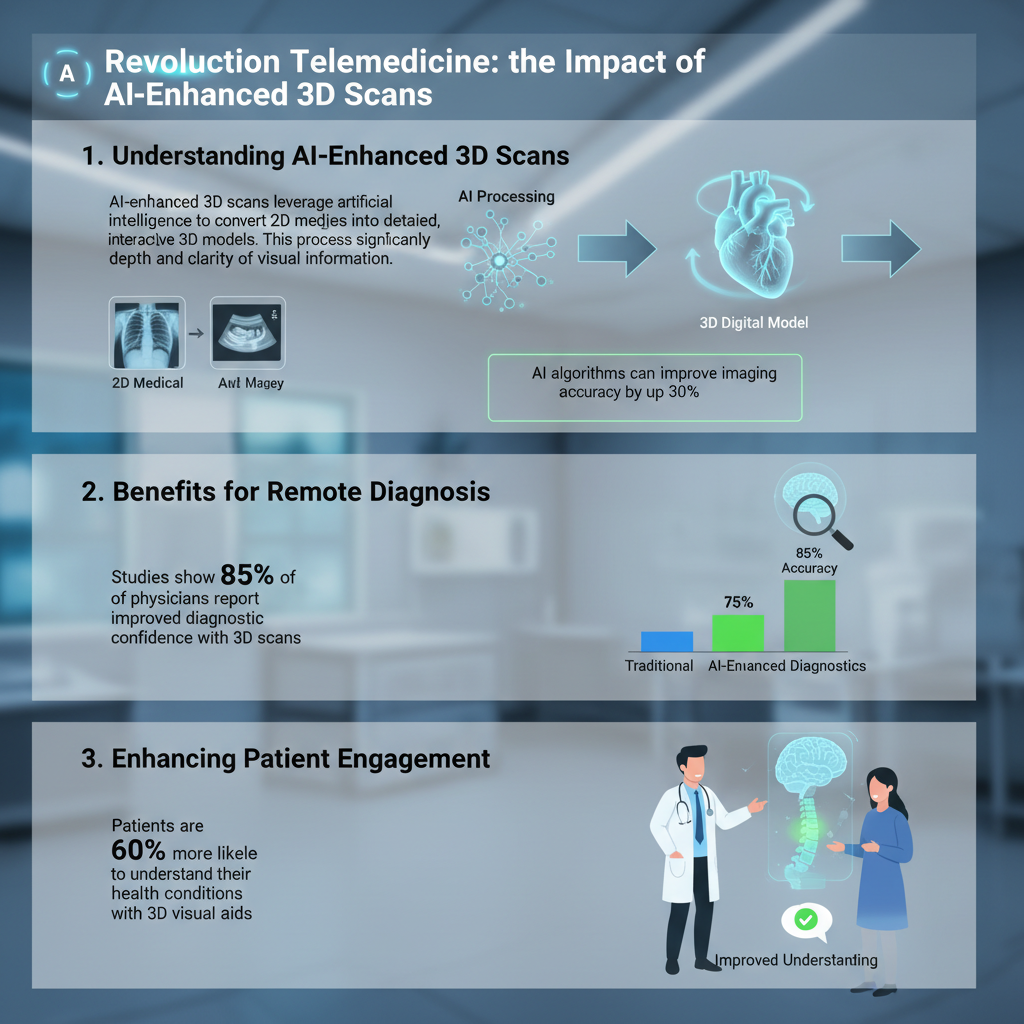
AI plays a critical role in improving the accuracy and efficiency of these scans. By leveraging machine learning algorithms, AI can enhance image resolution, reduce noise, and even predict the likelihood of certain medical conditions based on the scanned data. For instance, AI-enhanced scans can identify early signs of tumors or structural abnormalities in bones and tissues, allowing for a more comprehensive assessment than conventional 2D images. This level of detail is particularly beneficial in telemedicine, where healthcare providers rely on visual data to make informed decisions without the advantage of physical examinations.
Benefits for Remote Diagnosis

One of the most significant benefits of AI-enhanced 3D scans in telemedicine is the increased precision in diagnosing complex conditions from a distance. For example, consider a patient presenting symptoms of a potential fracture. With traditional imaging, the provider might rely on 2D X-rays, which can sometimes miss subtle fractures. However, with AI-enhanced 3D scans, the provider can view the bone structure from multiple angles and depths, leading to a more accurate diagnosis and timely intervention.
Moreover, the ability to analyze scans in real-time during virtual consultations is a game-changer. Healthcare providers can share 3D visualizations with patients during appointments, fostering a collaborative environment where patients can see and understand their conditions better. This immediacy not only enhances diagnostic accuracy but also allows for quicker decision-making regarding treatment options, ultimately leading to better patient outcomes.
Enhancing Patient Engagement
Patient engagement is an essential aspect of effective healthcare, and AI-enhanced 3D visualizations play a vital role in this area. When patients can see a 3D model of their anatomy, it demystifies medical jargon and complex conditions. For instance, a patient diagnosed with a heart condition can visualize how their heart functions and where abnormalities exist, making the situation more relatable and understandable.
Additionally, the role of AI in personalizing treatment plans based on detailed scans cannot be overstated. By analyzing the unique characteristics of a patient’s anatomy, AI can help healthcare providers devise tailored treatment strategies that align with the patient’s specific needs. For example, in orthopedic care, AI can analyze a patient’s bone structure and suggest individualized rehabilitation exercises, enhancing the recovery process and improving overall health outcomes.
Streamlining Workflow for Healthcare Providers
The integration of AI-enhanced 3D scans not only benefits patients but also streamlines workflows for healthcare providers. One of the primary advantages is the reduction in time spent on interpreting traditional scans. With AI’s ability to quickly analyze and highlight critical areas of concern, healthcare providers can focus their attention on diagnosing and treating patients rather than getting bogged down in the details of image interpretation.
Moreover, AI tools can assist in prioritizing patient cases based on scan results. For instance, if a scan indicates a potentially critical condition, such as a tumor, the AI system can flag that case for immediate review, ensuring that patients receive timely care. This triage capability is especially valuable in busy telemedicine practices, where providers juggle multiple cases simultaneously. By streamlining workflows, healthcare providers can enhance their productivity and improve the overall quality of care.
Challenges and Considerations
While the benefits of AI-enhanced 3D scans are compelling, there are also challenges and considerations to address. One significant concern is the potential limitations and ethical implications surrounding data privacy. As healthcare systems increasingly rely on AI and data analytics, safeguarding patient information becomes paramount. Ensuring that data is securely processed and stored is vital to maintaining patient trust and complying with regulations.
Additionally, there is a pressing need for training healthcare professionals to utilize these advanced technologies effectively. Although AI can enhance diagnostic capabilities, it does not replace the need for clinical expertise. Providers must be equipped with the knowledge and skills to interpret AI-generated insights and make informed decisions. Continuous education and training will be essential to fully realize the potential of AI-enhanced 3D scans in telemedicine.
Future Trends in Telemedicine and AI
Looking ahead, the evolution of AI and 3D scanning in telehealth promises to bring even more innovative applications and technologies. Predictions suggest that we will see increased integration of AI with wearable devices, allowing for continuous monitoring of patient health. This real-time data, combined with AI-enhanced 3D scans, could lead to predictive healthcare models where potential issues are identified before they become serious problems.
Furthermore, advancements in augmented reality (AR) may enable healthcare providers to overlay 3D scans onto real-world environments during consultations. Imagine a scenario where a surgeon can visualize a 3D model of a patient’s anatomy while discussing surgical options, providing an interactive and informative experience for both the provider and the patient. These developments could redefine how telemedicine is practiced, leading to more precise and personalized healthcare.
Incorporating AI-enhanced 3D scans into telemedicine is poised to revolutionize how healthcare is delivered remotely, making it more efficient and patient-centered. As these technologies continue to evolve, healthcare providers must stay informed and adapt to leverage the full potential of these innovations for better patient outcomes. Embracing this digital transformation will ultimately enhance the quality of care, foster stronger patient-provider relationships, and pave the way for a brighter future in telehealth.
Frequently Asked Questions
What are the benefits of using AI-enhanced 3D scans in telemedicine?
AI-enhanced 3D scans significantly improve the accuracy and efficiency of remote diagnostics in telemedicine. By providing high-resolution, detailed images, these scans facilitate better visualization of anatomical structures, allowing healthcare professionals to make more informed decisions. Additionally, the integration of AI algorithms helps in detecting anomalies and patterns that may be missed by the human eye, ultimately leading to quicker and more precise diagnoses.
How do AI-enhanced 3D scans improve patient outcomes in telemedicine?
AI-enhanced 3D scans contribute to improved patient outcomes by enabling more accurate assessments and timely interventions. Telemedicine allows patients to receive care from the comfort of their homes, and when combined with advanced imaging technologies, it ensures that healthcare providers can effectively monitor conditions, develop personalized treatment plans, and track progress over time. This holistic approach minimizes the need for in-person visits, reducing healthcare costs and enhancing patient satisfaction.
Why are AI-enhanced 3D scans considered a game changer for remote consultations?
AI-enhanced 3D scans are considered a game changer for remote consultations due to their ability to combine advanced imaging technology with artificial intelligence, leading to unprecedented levels of detail and analysis. This technology allows healthcare professionals to conduct thorough evaluations without being physically present, making it easier to manage complex cases and improve access to specialized care. Additionally, the speed at which these scans can be processed and analyzed means that patients receive timely feedback, which is critical in managing health effectively.
Which medical specialties benefit the most from AI-enhanced 3D scans in telemedicine?
Several medical specialties benefit significantly from AI-enhanced 3D scans in telemedicine, particularly radiology, orthopedics, and dermatology. In radiology, advanced imaging allows for enhanced detection of tumors and other abnormalities. Orthopedic specialists use 3D scans to assess joint and bone conditions more accurately, while dermatologists can evaluate skin lesions with precision. The ability to share and analyze these scans remotely fosters collaboration among specialists, ultimately leading to improved patient care.
What challenges are associated with implementing AI-enhanced 3D scans in telemedicine?
Implementing AI-enhanced 3D scans in telemedicine comes with several challenges, including high costs of technology, the need for training healthcare providers, and concerns about data privacy. The initial investment in advanced imaging equipment and AI software can be substantial, posing a barrier for some healthcare facilities. Additionally, providers must be adequately trained to interpret the scans and utilize the technology effectively. Lastly, ensuring the security of patient data is paramount, necessitating robust cybersecurity measures to protect sensitive information during remote consultations.
References
- https://www.ncbi.nlm.nih.gov/pmc/articles/PMC7400705/
- https://www.healthaffairs.org/doi/abs/10.1377/hlthaff.2020.01220
- https://www.sciencedirect.com/science/article/pii/S1386505619304601
- https://www.ama-assn.org/delivering-care/public-health/how-ai-technology-impacting-telemedicine
- https://www.ncbi.nlm.nih.gov/pmc/articles/PMC7928859/
- https://www.who.int/news-room/fact-sheets/detail/telehealth
- https://www.frontiersin.org/articles/10.3389/fmed.2021.661960/full
- https://www.bbc.com/news/technology-56912598