
Quantum computing is set to revolutionize video encoding by dramatically enhancing processing speeds and improving compression algorithms. This cutting-edge technology can tackle complex data processing in ways that traditional computing simply cannot, paving the way for faster and more efficient video rendering and transmission. In this article, we’ll explore how quantum computing will transform the future of video encoding, offering exciting new possibilities for content creators and viewers alike.


Understanding Quantum Computing

At its core, quantum computing leverages the principles of quantum mechanics to process information in fundamentally different ways than classical computers. While classical computers use bits as the smallest unit of data, represented as either a 0 or a 1, quantum computers utilize quantum bits, or qubits. These qubits can exist in multiple states simultaneously thanks to a phenomenon known as superposition. This allows quantum computers to perform complex calculations at an exponential speed compared to their classical counterparts.
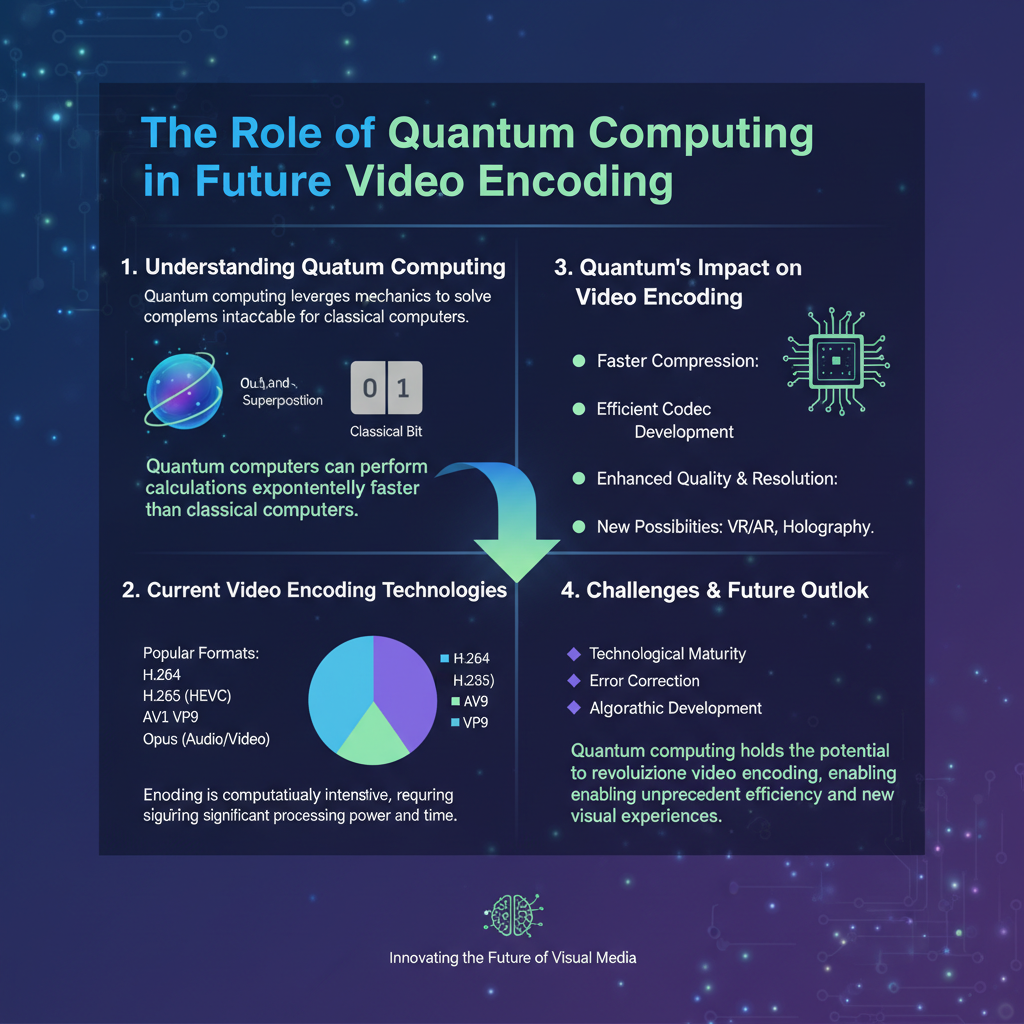
Another key difference lies in entanglement, a unique property that enables qubits to be interconnected in such a way that the state of one qubit can depend on the state of another, no matter the distance separating them. This interconnectedness allows quantum computers to tackle problems involving vast datasets far more efficiently than classical computers. As we delve deeper into the world of video encoding, these differences in processing power become crucial.

Current Video Encoding Technologies

Currently, traditional video encoding methods like H.264 (also known as AVC) and HEVC (H.265) dominate the landscape. H.264 has been the gold standard for years, providing decent compression ratios and good video quality, making it suitable for streaming and broadcasting. HEVC, on the other hand, offers improved compression, enabling higher resolutions like 4K and beyond without significantly increasing file sizes. However, despite their advantages, these technologies face limitations, particularly as video resolutions continue to soar.
One of the primary challenges with current encoding methods is their ability to handle high-resolution video, such as 8K and immersive formats like 360-degree video. As these technologies evolve, the demand for higher video quality and efficiency increases, exposing inefficiencies in current algorithms that can lead to longer rendering times and increased storage needs. This is where quantum computing promises to make a significant impact.
How Quantum Computing Enhances Video Encoding
Quantum computing can revolutionize video encoding by significantly speeding up both encoding and decoding processes. The potential for faster processing stems from the ability to analyze multiple data points simultaneously, which is especially beneficial when dealing with the complex calculations involved in video compression.
Moreover, quantum algorithms, such as the Quantum Fourier Transform and Grover’s Search Algorithm, can enhance compression techniques by optimizing the way data is analyzed and stored. These algorithms can drastically reduce the amount of data needed to represent high-quality video, making it possible to transmit large files over networks more efficiently and with fewer resources. As a result, content creators can deliver richer, more immersive experiences without compromising on quality or incurring excessive costs.
Real-World Applications of Quantum Video Encoding
While quantum computing is still in its early stages, the film and streaming industries are already beginning to experiment with its potential. Companies like IBM and Google are conducting research to explore quantum algorithms for video processing. For instance, IBM’s Quantum Experience platform allows developers to experiment with quantum computing applications, including video encoding. Early adopters are already reporting improved rendering times for complex video projects, signaling the beginning of a shift in how we produce and consume content.
The implications for live streaming and real-time video processing are also significant. Imagine attending a live sports event streamed in 8K resolution with virtually no buffering or lag, thanks to quantum-encoded video. This capability could transform the way audiences engage with live events, providing a more immersive experience than ever before.
Challenges and Considerations
Despite its immense potential, implementing quantum computing for video encoding is not without its challenges. Technical hurdles remain, including the need for stable qubits and error correction mechanisms. Quantum computers are still in the experimental phase, and scaling them for widespread use in video encoding presents a significant engineering challenge.
Moreover, there are ethical and practical implications to consider. As video quality improves and becomes more accessible, concerns around privacy and data security may arise, especially with the increased capabilities for real-time video processing. It’s essential for stakeholders in the industry to consider these implications as they move toward adopting quantum technologies.
The Future of Video Encoding with Quantum Computing
As we look ahead to the next decade, predictions suggest that quantum computing will play a crucial role in shaping the future of video technology. We can expect to see a rise in the adoption of quantum encoding methods, leading to faster rendering times and enhanced video quality that could revolutionize how content is created and consumed.
Businesses and content creators should start preparing for these advancements by investing in research and development, collaborating with quantum computing experts, and staying informed about the latest technological trends. By embracing these changes, they can position themselves at the forefront of the industry and leverage the benefits of quantum computing to enhance their video offerings.
The advancements in quantum computing are set to reshape video encoding, offering unprecedented speed and efficiency. As the technology matures, it will not only enhance the viewing experience but also open new avenues for creativity and innovation in video content. Stay informed and consider how you can leverage these technologies in your own work or projects, as the future of video encoding is bright—and quantum.
Frequently Asked Questions
What is quantum computing and how does it relate to video encoding?
Quantum computing is an advanced computational technology that leverages the principles of quantum mechanics to process information in fundamentally different ways than traditional computers. In video encoding, quantum computing has the potential to significantly speed up the encoding process and improve compression techniques, enabling higher quality videos at lower file sizes. This could revolutionize streaming services and multimedia content delivery by allowing for faster processing of large video files.
How can quantum computing improve video encoding efficiency?
Quantum computing can enhance video encoding efficiency by utilizing quantum algorithms that outperform classical algorithms in complex data processing tasks. For example, quantum algorithms like Grover’s search can expedite the search for optimal encoding parameters, while quantum Fourier transforms can improve compression rates. This means content creators can achieve higher-quality video with less bandwidth, addressing the increasing demand for high-definition content in a bandwidth-constrained environment.
Why is the integration of quantum computing in video encoding important for the future of media?
The integration of quantum computing in video encoding is crucial as it addresses the growing challenges of data storage, bandwidth limitations, and the demand for higher resolution content. As video consumption continues to rise, particularly with 4K and 8K formats, traditional encoding methods may struggle to keep up. Quantum computing offers solutions that can handle larger data sets efficiently, thus ensuring that users have seamless access to high-quality video content without compromising on speed or quality.
What are the potential challenges of adopting quantum computing for video encoding?
While quantum computing holds great promise for video encoding, there are several challenges to its adoption. These include the current state of quantum hardware, which is still in developmental stages, and the need for specialized knowledge to implement quantum algorithms effectively. Additionally, transitioning from established encoding standards to quantum-driven methods may require significant investment in research and infrastructure, which could slow down widespread implementation.
Which industries are likely to benefit the most from quantum computing in video encoding?
Industries such as entertainment, telecommunications, and virtual reality are poised to benefit significantly from quantum computing in video encoding. Streaming platforms can enhance user experiences with faster load times and improved video quality, while telecommunications companies can optimize data transmission. Furthermore, the gaming industry can leverage quantum computing for real-time rendering of high-quality graphics, creating more immersive experiences for users.
References
- Quantum computing
- https://www.sciencedirect.com/science/article/pii/S1369701819300292
- Blog – IBM Research
- https://www.nature.com/articles/s41534-019-0173-1
- https://www.technologyreview.com/2021/03/03/1020369/quantum-computing-video-encoding/
- https://www.bbc.com/future/article/20210503-how-quantum-computing-could-change-video-encoding
- https://www.researchgate.net/publication/333124688_Quantum_Computing_and_the_Future_of_Information_Technology
- https://www.nist.gov/news-events/news/2021/12/nist-researchers-tackle-quantum-computing-challenges-video-encoding
