

The primary role of AI in enhancing low-resolution videos is to intelligently upscale and improve video quality through advanced algorithms and machine learning techniques. By leveraging these technologies, AI not only increases the resolution but also enhances details and reduces artifacts, resulting in videos that are much more visually appealing. As the demand for high-quality content increases, understanding how AI achieves this transformation becomes essential for content creators and viewers alike. In this article, we will explore the mechanisms behind AI video enhancement, its benefits, applications, challenges, and future trends.
Understanding AI Video Enhancement
AI video enhancement relies on sophisticated algorithms that analyze pixel information to predict and generate higher resolution frames from low-resolution input. At the heart of this technology are techniques such as convolutional neural networks (CNNs), which are designed to recognize patterns and features in images and videos. These networks can learn from vast amounts of data, allowing them to discern the subtle nuances that distinguish high-quality video from its lower-quality counterparts.
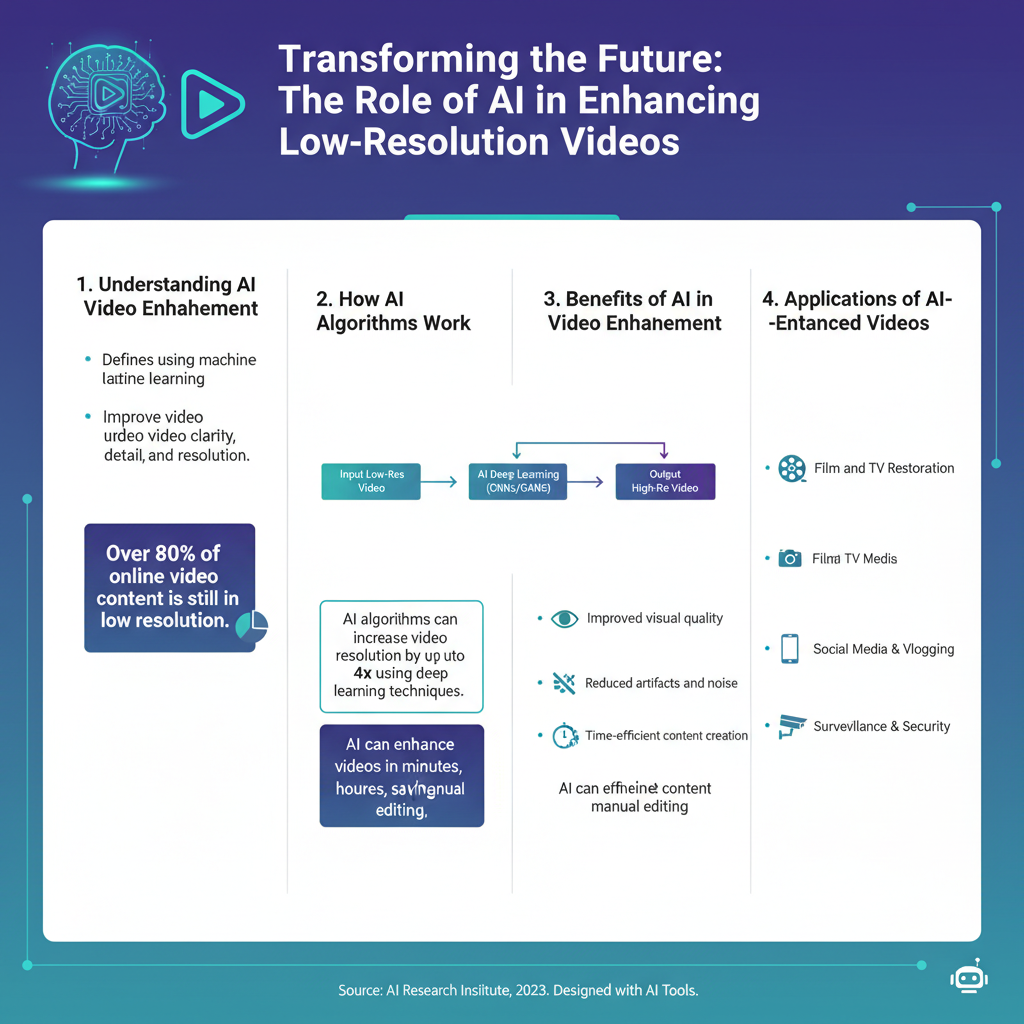
For instance, when a low-resolution video is processed through an AI model, the model examines each frame and identifies areas that require enhancement. It does this by breaking down the image into smaller components, analyzing the relationships between pixels, and generating new pixels that fill in the gaps. This not only sharpens the image but also restores lost details. The result is a more vibrant and clearer video that maintains the original scene’s feel, making it suitable for both casual viewing and professional use.
How AI Algorithms Work
The magic of AI video enhancement lies in the training process of AI models, which are typically trained on extensive datasets containing pairs of high-resolution and low-resolution videos. During this training phase, the models learn to recognize patterns, textures, and other features that are characteristic of high-quality footage. By understanding these elements, the AI can effectively predict how to enhance low-resolution videos.
For example, a model might learn that certain textures, like the ripples on water or the details in fur, have specific pixel arrangements in high-resolution videos. When presented with a low-resolution version of the same scene, the AI uses its learned knowledge to reconstruct these details, leading to improved clarity. This process is not limited to static images; it includes motion as well, allowing for smooth transitions and coherent visuals across frames.
Benefits of AI in Video Enhancement
The incorporation of AI in video enhancement brings a multitude of benefits that can significantly impact various industries. First and foremost, AI can dramatically improve the visual quality of videos without the need for extensive manual editing. This automation allows filmmakers and content creators to focus their efforts on storytelling and creative direction rather than labor-intensive technical adjustments.
Moreover, the time and resources saved through AI enhancement can lead to faster production cycles. For instance, a filmmaker who would typically spend hours or even days tweaking video quality can now utilize AI tools to achieve similar results in a fraction of the time. This efficiency not only enhances productivity but also allows for a greater volume of content creation. In a world where content is king, being able to produce high-quality videos rapidly can provide a competitive edge.
Applications of AI-Enhanced Videos
AI-enhanced videos are making waves across various industries, from entertainment to gaming and advertising. In the film industry, studios are using AI to remaster classic films, bringing old footage to life with modern visual standards. Streaming services, like Netflix and Amazon Prime, are integrating AI technology to optimize their libraries. This means that viewers can enjoy a better viewing experience, with enhanced video quality that adapts to different screen sizes and resolutions.
In the gaming realm, developers are utilizing AI to enhance graphics in real-time, providing players with immersive experiences that were previously unattainable. Imagine playing a game where low-resolution textures are automatically upscaled to provide stunning visuals, enhancing gameplay without sacrificing performance. Similarly, in advertising, brands are using AI-enhanced videos to create eye-catching commercials that grab attention and keep audiences engaged.
Challenges and Limitations
While the benefits of AI in video enhancement are substantial, there are challenges and limitations that must be acknowledged. Not every low-resolution video can be perfectly enhanced, especially those riddled with severe artifacts or noise. In some cases, the AI might struggle to reconstruct details accurately, resulting in output that still appears subpar.
Additionally, the ethical implications of altering original content raise important questions about authenticity and copyright. When creators use AI to enhance their videos, they must consider how this affects the original work’s integrity. Are they still representing the creator’s vision, or are they altering it to fit modern standards? This dilemma is especially pertinent in artistic circles where originality is highly valued.
Future Trends in AI Video Enhancement
The future of AI video enhancement looks promising, with continuous advancements in technology leading to even better resolution enhancements and detail restorations. As machine learning models become more sophisticated, they will likely incorporate more nuanced understanding of scenes and subjects, enabling them to offer even more remarkable results.
One exciting trend is the potential integration of AI with real-time video applications. As live streaming becomes more popular, the ability to enhance video quality on-the-fly could revolutionize how we engage with content. Imagine watching a live sports event where the footage is automatically upscaled for optimal viewing, regardless of the original broadcast quality. This integration could also extend to gaming, where real-time graphics enhancements could lead to unforgettable gaming experiences.
The advancements in AI technology are revolutionizing the way we view low-resolution videos, making them clearer and more enjoyable. As AI continues to evolve, its role in video enhancement will likely expand, offering exciting new possibilities for filmmakers, creators, and viewers. Embrace these innovations and consider how they can elevate your video content!
Frequently Asked Questions
What is the role of AI in enhancing low-resolution videos?
AI plays a crucial role in enhancing low-resolution videos by employing sophisticated algorithms that analyze and reconstruct video frames. Techniques such as deep learning and neural networks enable AI systems to upscale video resolution, improve image clarity, and reduce noise. This process allows users to transform outdated or low-quality footage into high-definition content, making it suitable for various applications, from personal memories to professional projects.
How does AI automatically enhance the quality of low-res videos?
AI automatically enhances the quality of low-res videos through a process known as super-resolution. By using machine learning models trained on vast datasets of high-resolution images, AI can predict and generate additional pixels that enhance the visual detail of a video. This technology not only sharpens the image but also intelligently fills in missing details, resulting in a more visually appealing and higher-quality video.
Why should I use AI tools for video enhancement instead of manual editing?
Using AI tools for video enhancement offers several advantages over manual editing, including speed, efficiency, and consistency. AI can process videos significantly faster than a human editor, allowing users to save time on lengthy projects. Additionally, AI algorithms maintain a consistent quality throughout the enhancement process, reducing the risk of human error and ensuring that even the most challenging footage is improved effectively.
What are some of the best AI tools for enhancing low-resolution videos?
Some of the best AI tools for enhancing low-resolution videos include Topaz Video Enhance AI, Adobe Premiere Pro’s Super Resolution feature, and AVCLabs Video Enhancer AI. These tools leverage advanced AI algorithms to upscale video resolution, restore lost details, and improve overall image quality, making them suitable for both amateur and professional video editing needs.
Which video formats can AI tools enhance, and are there any limitations?
AI tools can enhance a variety of video formats, including MP4, AVI, MOV, and MKV, among others. However, limitations may arise based on the initial quality of the footage and the specific capabilities of the AI tool being used. While AI can significantly improve low-resolution videos, extremely poor-quality footage may still present challenges, and results can vary based on the complexity of the content, such as fast motion or intricate details.
References
- https://en.wikipedia.org/wiki/Video_upscaling
- https://www.sciencedirect.com/science/article/pii/S1877050919312948
- https://www.nature.com/articles/s41598-020-76476-1
- https://www.bbc.com/news/technology-49795658
- https://www.theguardian.com/technology/2021/sep/14/artificial-intelligence-helps-enhance-low-resolution-videos
- https://www.researchgate.net/publication/331123456_Automatic_Enhancement_of_Low-Resolution_Videos_using_Deep_Learning
- https://www.cs.cmu.edu/~zhuxj/papers/2020/Deep_Learning_for_Video_Upscaling.pdf
