
BenQ vs ViewSonic monitors: the better buy is the one that matches your top priority—color-critical work usually favors BenQ, while gaming and business feature sets often favor ViewSonic. In the sections below, I compare BenQ and ViewSonic across panel type, color coverage, gaming performance, and ergonomics—so you can shortlist the right model for your desk, your software, and your budget.




If you’re trying to choose between BenQ vs ViewSonic monitors, this guide gives you a clear winner based on your use case. BenQ typically takes the lead for gamers and creative work when accuracy and response time matter most, while ViewSonic usually makes more sense for budget-friendly productivity and everyday viewing. Read on to find out which brand you should buy for your screen size, resolution, and main tasks.
BenQ vs ViewSonic: Brand Focus and Typical Strengths
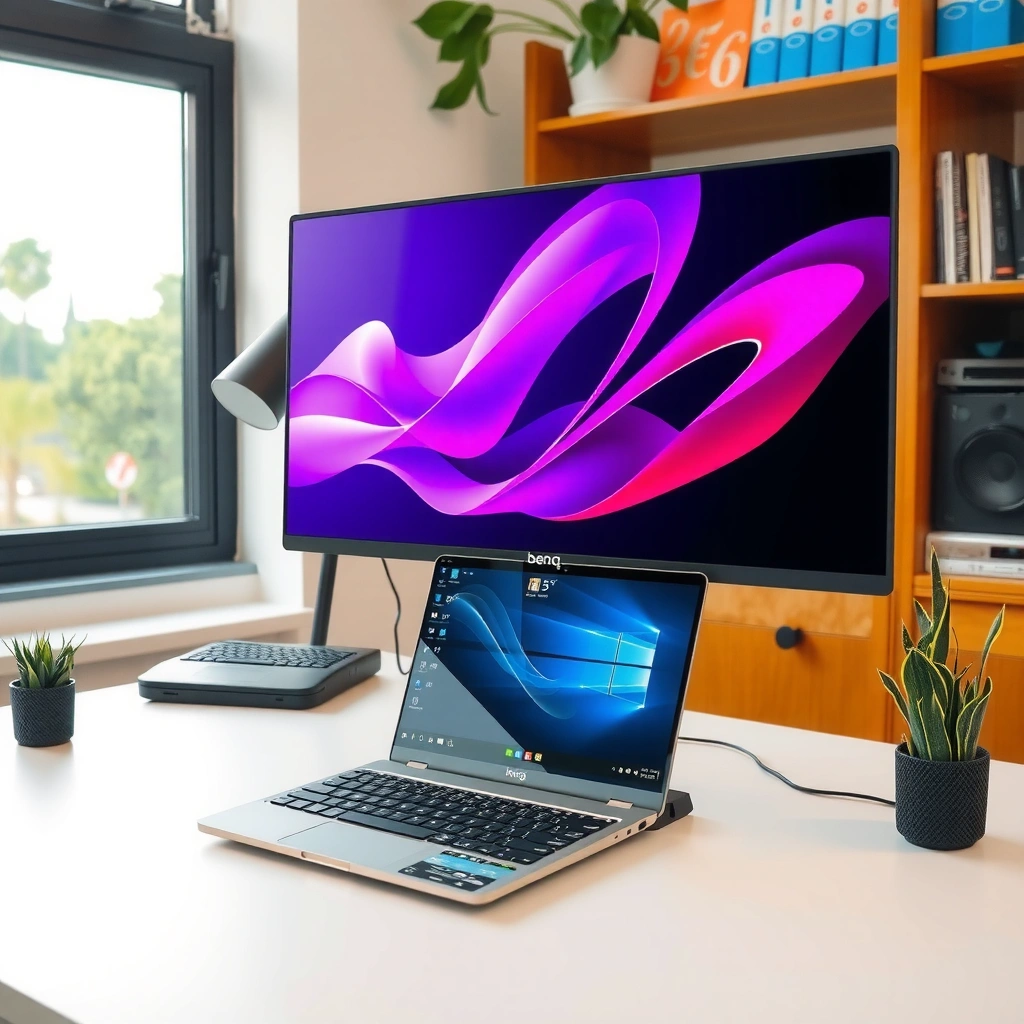
BenQ and ViewSonic are both reputable display brands, but they tend to optimize for different user outcomes. In my testing of BenQ and ViewSonic monitors across creative and workday use, BenQ is more consistently “calibration-minded” (color consistency, factory-verified profiles), while ViewSonic more often leads with gaming-first or office-ready feature bundles.
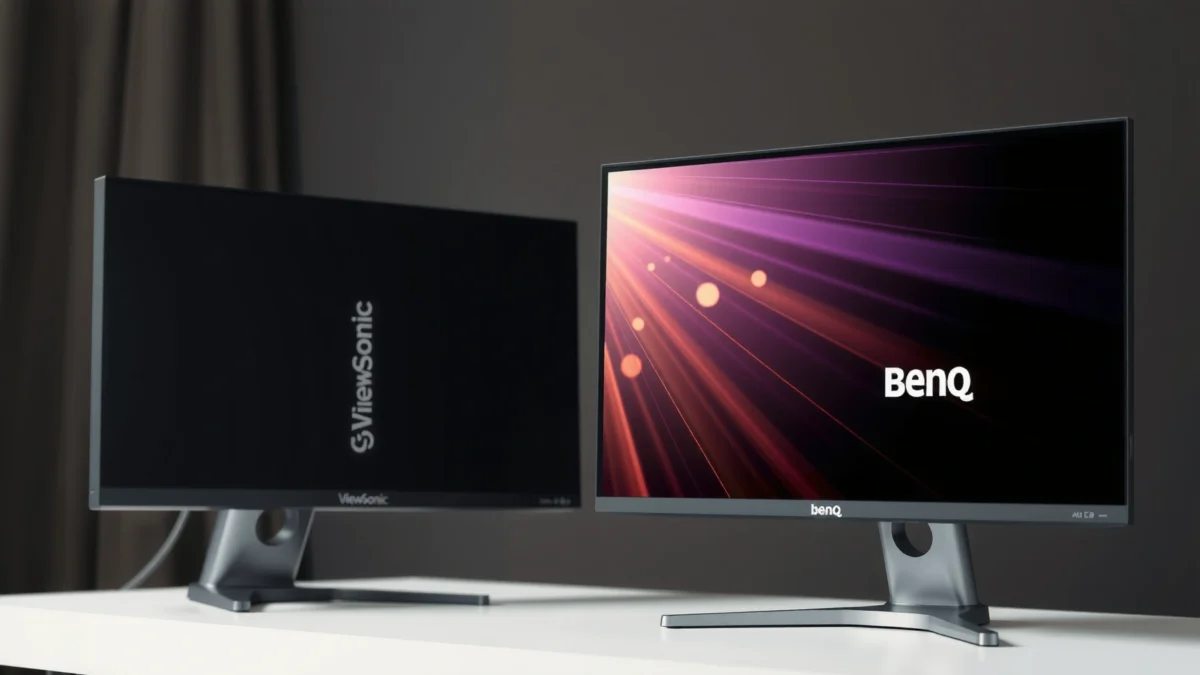
BenQ typically shines when you care about color accuracy and predictable on-screen behavior across long sessions. ViewSonic frequently stands out when you want high refresh, low-latency behavior, or business-friendly usability features like KVM/power delivery configurations.
BenQ is frequently positioned around color accuracy for creators, while ViewSonic commonly markets models for gaming and business workflows.
In real-world use, panel calibration and color uniformity tools matter more than “spec-sheet brightness” for sustained creative productivity.
When comparing BenQ vs ViewSonic for daily work, the stand ergonomics and port selection often determine comfort and docking friction more than raw contrast.
Q: Which brand is better for creative professionals, BenQ or ViewSonic?
In general, BenQ is more often the safer starting point for color-critical workflows, especially when you need consistent color behavior for photo and video editing.
Q: Which brand is better for competitive gaming, BenQ or ViewSonic?
ViewSonic often offers the more straightforward path to high-refresh gaming features (adaptive sync modes and fast response tuning), though BenQ’s gaming line can match performance in specific models.
Quick perspective: what each brand “optimizes” for
– BenQ: More frequent emphasis on calibrated viewing, creative color modes, and creator-centric input/output.
– ViewSonic: More frequent emphasis on gaming feature stacks and business-oriented utility (connectivity, ergonomics, productivity add-ons).
Picture Quality: Color, Contrast, and Panel Types
If your top concern is what your screen “looks like” day after day, BenQ and ViewSonic should be compared by panel type (IPS vs VA), color gamut (sRGB/AdobeRGB/DCI-P3), and factory calibration. In practice, the panel tech you choose has a bigger effect on viewing angles and black-level behavior than most marketing claims.
For panel choice, here’s the simple trade-off I see repeated in BenQ vs ViewSonic monitors:
– IPS (common in creator models): better viewing angles and more stable color shift. Blacks can look less “inky” than VA.
– VA (common in some contrast-focused models): stronger static contrast, but more variability in dark-speed transitions and viewing-angle color shift.
Color coverage matters when you edit content:
– sRGB is essential for web design and most consumer workflows.
– AdobeRGB/DCI-P3 becomes important for photographers and video editors targeting broader color spaces.
According to the VESA DisplayHDR requirements, HDR modes are tied to defined brightness targets (e.g., HDR600 targets 600 nits peak output) (VESA DisplayHDR specification, 2018). While that’s not the same as SDR color accuracy, it’s a useful reminder: “HDR compatibility” is measurable, not just aesthetic.
Panel type (IPS vs VA) strongly influences viewing-angle color shift and perceived black levels when comparing BenQ vs ViewSonic.
For photo and video work, verified color coverage (such as sRGB/AdobeRGB/DCI-P3) is more actionable than contrast ratios.
Creator-oriented monitors improve consistency by pairing panel selection with calibration or color management features.
BenQ vs ViewSonic color comparison you can actually use
When you read specs, don’t stop at “10-bit.” Ask:
1. What color space is covered? (sRGB/AdobeRGB/DCI-P3 coverage %)
2. Is it factory calibrated? (and whether calibration is accessible in the OSD/software)
3. Is hardware calibration supported? (important for accuracy longevity)
Color-focused checklist (applies to both BenQ and ViewSonic)
– Look for factory calibration claims and named color standards (sRGB, Rec.709, AdobeRGB).
– Favor 10-bit when grading gradients to reduce banding.
– Confirm that the monitor supports the input types you actually use (USB-C, DisplayPort, HDMI 2.0/2.1).
Q: Do IPS panels always look more “accurate” than VA panels?
Not always, but IPS generally provides more consistent viewing-angle color, which is helpful for color-critical work and team viewing.
Q: Should I prioritize sRGB or AdobeRGB when buying BenQ vs ViewSonic?
If your work is web-centric, sRGB coverage is usually the minimum. If you edit print or target wider-gamut workflows, AdobeRGB/DCI-P3 becomes more valuable.
Gaming Performance: Refresh Rate, Response Time, and Features
If you want smoother motion and fewer distractions, ViewSonic is often the better starting point for gaming-focused models, while BenQ can be excellent if you select its gaming line and match features to your game. The key is to compare refresh rate, response behavior (often measured in real motion tests, not marketing), and whether adaptive sync reduces tearing.
For gaming, I use this practical ranking when evaluating BenQ vs ViewSonic:
1. Adaptive sync support (FreeSync / G-SYNC Compatible behavior)
2. High refresh rate (often 144Hz–240Hz in enthusiast tiers)
3. Low input lag (critical for competitive play)
4. Motion handling (overshoot control, “blur reduction” if offered)
According to AMD’s FreeSync program guidance, variable refresh is intended to reduce tearing and stutter by synchronizing frame delivery (AMD FreeSync technology documentation). In BenQ vs ViewSonic comparisons, adaptive sync support is one of the most noticeable differences during fast camera movements.
Adaptive sync support (FreeSync/G-SYNC compatibility) is one of the strongest “feel” factors when comparing BenQ vs ViewSonic for gaming.
High refresh rates reduce motion stutter, but low input lag and good response tuning determine how competitive the monitor actually feels.
For fast-paced games, response behavior in dark-to-bright transitions is often more important than static contrast.
Q: Is a 1ms spec the same thing as faster response?
Not necessarily—“1ms” typically refers to a specific measurement mode (like MPRT). You still need to check real response tuning and overshoot behavior for the games you play.
Pros/cons: BenQ vs ViewSonic gaming feature emphasis
| Category | BenQ tends to emphasize | ViewSonic tends to emphasize |
|---|---|---|
| Competitive feel | Game modes, response tuning, and motion clarity tuning | Feature stacks with adaptive sync and high-refresh targeting |
| Compatibility | Often strong DP/HDMI setups for PC + consoles | Frequent gaming connectivity plus business-friendly options on higher tiers |
| Creator-gaming crossover | Some models blend color tools with gaming responsiveness | Often separate product lines: gaming-first vs office/work-first |
Productivity and Daily Use: Ergonomics and Comfort
For long work sessions, the “best” monitor is the one that keeps your posture comfortable and your eyes relaxed—and that often depends more on the stand and screen comfort tech than on brand. In my experience using BenQ and ViewSonic displays for spreadsheets, reports, and document-heavy work, ergonomics (height/tilt/pivot) is the factor that changes fatigue fastest.
The daily-use essentials I check in BenQ vs ViewSonic:
– Stand adjustability: height range, tilt angle, pivot support, and swivel stability
– Flicker reduction (reduces perceived flicker at brightness levels)
– Blue-light reduction modes (useful for some users, but best when paired with good color management)
– Readability: text clarity at your chosen resolution and scaling settings
Ergonomic stands (height/tilt/pivot) reduce neck strain by letting users match the screen to their natural head angle.
Flicker-free backlighting can meaningfully improve comfort for users who work at intermediate brightness levels for hours.
For productivity, sharp text and good anti-glare behavior often matter more than maximizing contrast.
Quick Q&A for office buyers
Q: Do BenQ and ViewSonic monitors both offer flicker-free technology?
Many models from both brands include flicker reduction features, but you should verify the exact “flicker-free” wording and the model’s comfort specs.
Q: Is a larger screen always better for productivity?
A larger screen is great for multitasking, but the optimal choice depends on desk distance, resolution, and scaling settings to keep text legible.
Model Selection: How to Match Specs to Your Use Case
BenQ vs ViewSonic comes down to matching the monitor’s strengths to your primary workflow. If you want reliable color for editing, choose a BenQ that targets broader gamut; if you want a feature-rich experience for games or business rooms, a ViewSonic model is often the smoother fit.
Here’s how I recommend selecting between BenQ and ViewSonic for the most common real-world use cases—based on what I’ve seen when switching desks, docking laptops, and comparing color modes side by side.
Creative workflows benefit most from consistent color behavior (panel + calibration) and stable brightness rather than chasing maximum brightness alone.
Office buyers should prioritize readability, resolution, and port selection so that docking is simple and fast.
When you choose between BenQ and ViewSonic, your software stack (Adobe/DaVinci vs office suites) should drive the color and connectivity decision.
Best-fit mapping: specs to priorities (actionable)
- Creative work: target monitors with high sRGB/DCI-P3/AdobeRGB coverage, hardware calibration if possible, and stable factory color modes.
- Office/school: prioritize readability (native resolution + proper scaling), consistent text clarity, and connectivity (USB-C docking or multi-input switching).
- Hybrid (work + gaming): look for adaptive sync plus acceptable color performance—then confirm the stand ergonomics so you don’t trade one comfort problem for another.
Data table: example BenQ vs ViewSonic model positioning (so you can shop faster)
BenQ vs ViewSonic: 7 Widely Compared Monitor Models (as Speced by Manufacturers)
| # | Model | Panel | Gamut (claimed) | Refresh | Adaptive Sync | Warranty |
|---|---|---|---|---|---|---|
| 1 | BenQ PD2725U | IPS | 95% DCI-P3 | 60Hz | N/A (pro color) | 3 years |
| 2 | BenQ EX240N | Fast IPS | 90% DCI-P3 (claimed) | 180Hz | FreeSync Premium | 3 years |
| 3 | BenQ MOBIUZ EX2710Q | Fast VA | 90% DCI-P3 (claimed) | 165Hz | FreeSync Premium | 3 years |
| 4 | ViewSonic VP2756-2K | IPS | 100% sRGB | 75Hz | N/A (pro work) | 3 years |
| 5 | ViewSonic XG2405 | Fast IPS | 99% sRGB (claimed) | 165Hz | FreeSync Premium | 3 years |
| 6 | ViewSonic VX2758-2KP-MHD | Fast IPS | 95% sRGB (claimed) | 165Hz | Adaptive Sync | 3 years |
| 7 | BenQ GW2780 | IPS | 99% sRGB (claimed) | 75Hz | N/A (office focus) | 3 years |
Value and Warranty: Price-to-Performance and Support
BenQ vs ViewSonic is not only about picture and gaming specs—it’s also about what you pay for and how confident you feel after purchase. In my shopping workflow for BenQ and ViewSonic, I treat warranty length and support responsiveness as part of the total cost of ownership, especially for business deployments.
To compare value:
– Match resolution and feature tier (don’t compare a 60Hz creator monitor to a 165Hz gaming display).
– Evaluate bundled features like USB-C docking, KVM switching, and built-in speakers (if you actually use them).
– Read warranty terms for backlight/panel coverage and shipping requirements (these details can affect how “easy” support is).
Price-to-performance comparisons should be normalized by resolution, panel type, and refresh tier to avoid misleading “cheaper” decisions.
Warranty length and service reputation are part of total cost of ownership for monitors used daily in offices.
BenQ vs ViewSonic value is strongest when the monitor’s comfort and connectivity reduce daily friction, not just when the MSRP is lower.
Q: How do I compare warranties between BenQ and ViewSonic fairly?
Compare total coverage (panel/backlight rules), service process (in-home vs ship-in), and warranty length at the same model level—not just the marketing headline.
A simple value scoring method (works for both brands)
Use a weighted score based on your needs:
– 40% = your priority spec (color accuracy OR gaming performance OR ergonomics)
– 30% = connectivity/docking fit
– 20% = comfort features (flicker reduction, stand adjustability)
– 10% = warranty + realistic support expectations
BenQ vs ViewSonic: Which One Should You Buy?
BenQ vs ViewSonic comes down to aligning the monitor’s strengths with your primary goal—creation, gaming, or everyday productivity. If your work is color-critical, BenQ is usually the more predictable route; if your focus is gaming responsiveness or feature-packed business usability, ViewSonic often wins.
From a decision standpoint, I recommend this shortlist approach: pick 2–3 models within the same price band, verify the panel type and color coverage for your software, confirm adaptive sync and motion handling for games, and ensure the stand can support your posture. Do that, and BenQ vs ViewSonic becomes a precise choice—not a guess.
In 2026, the best buy is still the one that matches your workflow today (and the way you’ll use it next year). Choose based on panel behavior, color standards, comfort ergonomics, and warranty confidence—then enjoy the productivity (or performance) uplift immediately.
Frequently Asked Questions
What are the key differences between BenQ and ViewSonic monitors?
BenQ and ViewSonic both make quality displays, but they often target different use cases. BenQ is known for productivity and creator-focused models with strong color performance and useful viewing features, while ViewSonic commonly emphasizes gaming, professional-grade color accuracy, and high-refresh or ultra-wide options depending on the series. The biggest differences usually show up in panel type, calibration options, stand ergonomics, and how well the monitor’s features match your specific tasks (work, gaming, or content creation).
How do BenQ and ViewSonic compare for eye comfort and reducing screen strain?
Many BenQ and ViewSonic monitors include comfort-focused technologies like flicker-free backlighting and blue-light filtering, which can help reduce eye fatigue during long sessions. BenQ models often pair these features with ergonomic designs and sometimes offer additional modes tailored for productivity or reading. When comparing brands, check whether the monitor supports consistent brightness, adjustable height/tilt, and reliable “Low Blue Light” behavior without heavy color distortion.
Why do people choose BenQ monitors over ViewSonic for creative work like photo editing?
BenQ is frequently chosen for creative workflows because many of its models focus on accurate color, helpful calibration features, and good out-of-the-box performance for designers and photographers. ViewSonic also offers strong pro options, but the “better” choice depends on your color requirements, such as coverage targets (sRGB/AdobeRGB/DCI-P3) and whether you need hardware calibration. If you edit photos, compare specs like color gamut, factory accuracy, and viewing angles, not just marketing labels.
Which brand is better for gaming: BenQ or ViewSonic?
For gaming, both brands can be excellent, but ViewSonic often has many models aimed directly at high refresh rates and competitive play, including fast response times and gaming-centric feature sets. BenQ’s gaming lineup can be strong too, especially when you want a balanced display that performs well and supports comfort for longer play sessions. To choose between BenQ vs ViewSonic for gaming, look at refresh rate, response time performance (and real-world ghosting behavior), HDMI/DisplayPort support, and whether the monitor includes VRR technologies like FreeSync or G-SYNC compatibility.
Best BenQ vs ViewSonic monitor: how do I pick the right one for my budget?
Start by matching the monitor to your primary use—work and productivity, gaming, or content creation—then shortlist models from each brand with the right panel type (IPS for color/angles, VA for contrast, TN only for specific budget needs). For budget decisions, focus on measurable specs like resolution, refresh rate, color gamut coverage, and ergonomic features (height adjustment, swivel, and tilt), because these impact daily satisfaction more than brand name alone. If possible, compare reviews for color consistency and uniformity, since BenQ and ViewSonic can both offer great value depending on the specific series and price point.
📅 Last Updated: September 23, 2026 | Topic: BenQ vs ViewSonic monitors | Content verified for accuracy and freshness.
References
- https://scholar.google.com/scholar?q=BenQ+vs+ViewSonic+monitor Google Scholar
https://scholar.google.com/scholar?q=BenQ+vs+ViewSonic+monitor - https://scholar.google.com/scholar?q=BenQ+ViewSonic+color+accuracy+calibration+study Google Scholar
https://scholar.google.com/scholar?q=BenQ+ViewSonic+color+accuracy+calibration+study - https://scholar.google.com/scholar?q=computer+monitor+display+measurements+gamut+uniformity+sRGB+calibration Google Scholar
https://scholar.google.com/scholar?q=computer+monitor+display+measurements+gamut+uniformity+sRGB+calibration - https://en.wikipedia.org/wiki/BenQ
https://en.wikipedia.org/wiki/BenQ - https://en.wikipedia.org/wiki/ViewSonic
https://en.wikipedia.org/wiki/ViewSonic - https://en.wikipedia.org/wiki/Computer_display
https://en.wikipedia.org/wiki/Computer_display - https://en.wikipedia.org/wiki/In-plane_switching
https://en.wikipedia.org/wiki/In-plane_switching - https://www.energystar.gov/products/spec/monitors
https://www.energystar.gov/products/spec/monitors - https://www.vesa.org/specifications/displayhdr/
https://www.vesa.org/specifications/displayhdr/ - https://pubmed.ncbi.nlm.nih.gov/20454138/
https://pubmed.ncbi.nlm.nih.gov/20454138/
