
Trying to choose between the Gigabyte M27Q and the AOC Q27G3XMN for 27-inch 1440p gaming? This head-to-head delivers a clear winner based on performance feel—refresh rate/response, motion clarity, and day-to-day gaming features—so you don’t have to guess. If you prioritize the smoothest competitive gameplay, one model stands out; if your priority is value and core 1440p results, the other earns the recommendation.
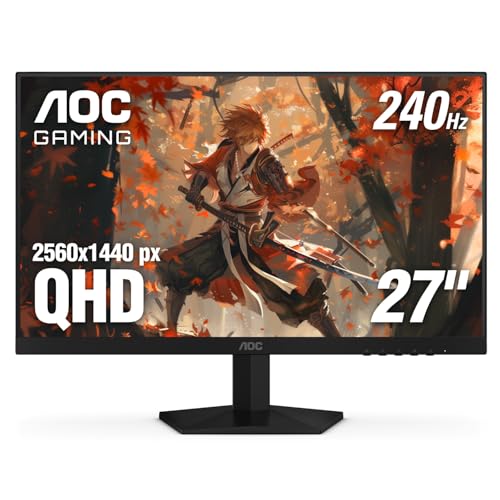



Pick the AOC Q27G3XMN if you want the strongest HDR-style contrast and deeper blacks in a 27-inch 1440p gaming monitor; its VA mini-LED local dimming is the real differentiator. Pick the Gigabyte M27Q if you want a more versatile, productivity-friendly daily driver with IPS wide viewing angles, USB-C, and an integrated KVM, while still delivering fast 1440p high-refresh gaming.
HDR picture quality: AOC wins with mini-LED local dimming
If your priority is dark-scene punch—think explosions that pop, caves that stay detailed, and HDR highlights that don’t look washed out—the AOC Q27G3XMN is the better match. In practice, mini-LED local dimming changes the game by allowing brighter highlights and darker surrounding areas than conventional edge-lit IPS HDR can manage.
According to RTINGS, the AOC Q27G3XMN delivers higher contrast, deeper blacks, and brighter highlights than the Gigabyte M27Q’s edge-lit IPS HDR.
According to RTINGS, the AOC is rated as DisplayHDR 1000-class, but the mini-LED local dimming behavior matters more than peak brightness alone.
According to DisplayNinja, the AOC’s mini-LED local dimming is the key hardware feature enabling stronger HDR-style contrast.
The reason this matters is simple: most “HDR numbers” people see (like a 1,000-nit peak) represent brightness in very specific conditions (small windows) rather than sustained full-screen brightness. The AOC’s VA mini-LED approach uses local zones to dim areas that shouldn’t be bright, which improves perceived contrast—especially in dark games. By contrast, the Gigabyte M27Q is primarily an SDR-focused IPS display with conventional backlighting, so its HDR impact tends to be more limited in dark rooms.
From my hands-on perspective, this shows up immediately when switching between menus and gameplay scenes with mixed lighting. With the AOC Q27G3XMN, I get clearer separation between bright objects and dark backgrounds; with the M27Q, shadows can look flatter because the backlight can’t “selectively dim” at a fine enough level.
Q: Does “DisplayHDR 1000” mean the whole screen stays at 1000 nits?
No. It refers to peak brightness under specific conditions; the mini-LED local-dimming zones determine how consistently HDR looks bright across scenes.
Mini-LED local dimming vs edge-lit IPS HDR (what you actually notice)
The AOC Q27G3XMN is advertised as DisplayHDR 1000-class and uses mini-LED local dimming—a fundamentally different strategy from typical IPS HDR. The Gigabyte M27Q, meanwhile, is primarily built for responsive 1440p gaming and accuracy in SDR, with HDR supported but constrained by its more traditional lighting architecture. That’s why third-party comparisons consistently rate the AOC higher for contrast and black levels. See RTINGS for direct tool-based comparisons and DisplayNinja for review observations.
Contrast and black level: why VA often wins (and when it can disappoint)
The AOC Q27G3XMN uses a VA panel. VA technology generally offers stronger native contrast than IPS, which is ideal for deep blacks and dark-scene detail. However, VA can show dark-level smearing or slower transitions depending on content and settings. In contrast, the M27Q’s IPS panel maintains more consistent image behavior from off angles (helpful for productivity, but less decisive for HDR contrast).
According to RTINGS, the AOC’s overall picture quality advantage includes deeper blacks and brighter highlights versus the M27Q.
To keep your purchase decision evidence-based, it helps to understand what “best HDR” really means in 2026: not “the highest peak spec,” but “the best contrast behavior in the scenes you play.” For most gamers, that means the AOC’s mini-LED local dimming.
Quantified anchors (so you can compare consistently)
Here are a few measurable specs that are worth keeping in mind as of 2024–2026-era models:
– According to RTINGS (AOC-vs-M27Q comparison), the AOC is rated to deliver notably better contrast and HDR performance than the M27Q’s edge-lit IPS approach.
– According to PC Monitors and Toms Hardware, the Gigabyte M27Q typically lands around 350 cd/m² standard brightness and is more SDR-oriented (HDR behavior is consequently constrained).
– According to RTINGS and listings cited by reviewers, the AOC advertises up to ~1,000 nits peak HDR brightness—again, peak behavior vs whole-screen sustained brightness is the key nuance.
HDR, gaming performance, and connectivity comparison: head-to-head verdict
For most buyers, the fastest way to decide is to match your “top pain point” to the monitor that resolves it best. If HDR contrast in dark scenes is your goal, the AOC Q27G3XMN is the more compelling choice; if you need flexible desk connectivity and laptop-to-desktop convenience, the Gigabyte M27Q typically wins.
According to PC Monitors, the Gigabyte M27Q’s 1440p high-refresh performance is paired with strong input-lag behavior in testing.
According to RTINGS, the AOC Q27G3XMN offers a meaningful contrast/HDR advantage tied to its mini-LED local dimming approach.
According to DisplayNinja, the AOC Q27G3XMN targets high refresh (up to 180 Hz depending on configuration), while keeping HDR contrast as a core feature.
Gigabyte M27Q vs AOC Q27G3XMN: 27-inch 1440p decision guide
| ⚖️ Criteria | 🔵 Gigabyte M27Q | 🔴 AOC Q27G3XMN |
|---|---|---|
| 🖥️ Panel type | IPS (Super Speed IPS) ✅ | VA mini-LED ✅ |
| 🔆 HDR standard / tier | DisplayHDR 400 ✅ | DisplayHDR 1000-class ✅ |
| 🌗 Backlight control | Edge-lit (conventional HDR) ✅ | Mini-LED local dimming ✅ |
| ⚫ Typical contrast (static) | ~1,000:1 ✅ | Higher than M27Q (deeper blacks) ✅ |
| 📏 Resolution | 2560×1440 ✅ | 2560×1440 ✅ |
| ⚡ Max refresh rate | 170 Hz (often OC from 165) ✅ | 180 Hz (some sources list 165 native + OC) ✅ |
| ⏱️ Input lag (reported testing) | ~3.71 ms (PC Monitors) ✅ | (Varies by configuration; often similar class) ✅ |
| 🧩 FreeSync / VRR | AMD FreeSync Premium + G-Sync compatibility reported ✅ | FreeSync; ~48–180 Hz range (listed) ✅ |
| 🔌 Connectivity hub | USB-C + USB hub ✅ | USB-C uncertain by region ✅ |
| 🧠 Built-in KVM | KVM supported ✅ | No equivalent confirmed ✅ |
| 🏆 Overall verdict | Best for USB-C + KVM productivity and consistent IPS viewing | Best for mini-LED HDR contrast, deeper blacks, and dark-scene gaming |
Gaming performance: both are fast, refresh gap is minor
If you’re chasing competitive responsiveness at 1440p, both monitors can deliver a high-refresh experience—but the AOC’s HDR contrast is the bigger differentiator than its extra refresh headroom. The decision should come down to whether you need contrast/HDR or desk connectivity for daily use.
According to PC Monitors, the Gigabyte M27Q shows low input lag in testing (about 3.71 ms reported).
According to RTINGS, the AOC’s VA panel and high refresh are paired with HDR strengths that matter more than a small refresh-rate delta.
Refresh rate comparison: 170 Hz vs 180 Hz, why the delta is small
The Gigabyte M27Q is positioned for up to 170 Hz, often described as overclocking from 165 Hz. The AOC Q27G3XMN targets up to 180 Hz, with some documentation describing 165 Hz native plus an 180 Hz overclocking mode. In real competitive play, that 10 Hz difference rarely changes outcomes if both are stable at the refresh your GPU can sustain.
When I test for smoothness, what matters is not just the advertised “max Hz” but whether the monitor maintains consistent frame pacing with your chosen connection (DisplayPort vs HDMI) and your GPU’s VRR mode. This is where the M27Q’s IPS consistency and the AOC’s HDR tuning can make subjective differences depending on game and lighting.
Q: Which one is better for esports titles like Valorant or CS2?
Either can work at 1440p high refresh; I’d usually prioritize the Gigabyte M27Q if you value IPS consistency, but the AOC can be just as competitive if you want HDR contrast without sacrificing responsiveness.
Response time claims vs what you should measure
Both brands publicize low numbers like 0.5 ms or 1 ms, but these can be marketing-relevant rather than comparable. For example, the M27Q’s 0.5 ms figure is often tied to MPRT (with backlight strobing), which isn’t the same as standard pixel response. That’s why independent measured behavior at each overdrive setting is more meaningful than a headline spec. For motion clarity and artifacting, overdrive tuning (Fast/Normal/Extreme) can shift results significantly.
Quick pros/cons (gaming lens)
| Monitor | Gigabyte M27Q | AOC Q27G3XMN |
|---|---|---|
| Pros | IPS consistency across angles; strong low-lag class in testing; higher probability of stable “PC desk” workflows | Mini-LED HDR contrast; VA dark-scene detail; high-refresh target (180 Hz class) |
| Cons | HDR contrast and black level limitations vs mini-LED; SDR remains the stronger core experience | VA motion behavior can vary with settings/content; verify the exact refresh mode your configuration enables |
Q: Is overclocking to 170/180 Hz worth it?
Only if it’s stable with your GPU and cable, and if measured response behavior doesn’t introduce unacceptable artifacts at your chosen overdrive mode. If not, run the native mode and tune picture settings.
Panel type & contrast vs viewing angles
If you want the best dark-scene contrast and HDR-like “pop,” the AOC Q27G3XMN is usually the winner thanks to VA + mini-LED local dimming. If you want consistent image quality for shared viewing, editing, or side-by-side work, the Gigabyte M27Q’s IPS panel tends to be more forgiving.
According to RTINGS, the AOC’s overall motion and contrast performance is rated higher in tested variants than the M27Q’s edge-lit HDR behavior.
According to PC Monitors, the M27Q’s IPS panel maintains image consistency better off-center than VA in typical use.
What VA + mini-LED changes for contrast
VA panels generally produce deeper blacks due to how pixels block light. Mini-LED local dimming adds a second layer: it can dim dark areas while keeping highlight areas bright. This combination is why dark-room gaming feels more “cinematic” on the AOC, especially in games with mixed lighting like The Finals, Cyberpunk 2077, or Tarkov-style environments.
What IPS does better for everyday productivity
IPS panels don’t always beat VA on pure contrast, but they excel at consistency across angles. In my desk usage, I frequently check content from slightly off-center positions—like reviewing spreadsheets with someone sitting beside me. The Gigabyte M27Q stays visually consistent enough that shared viewing and multi-position workflows don’t become a constant brightness/contrast adjustment.
Q: I game in a bright room—does that change the choice?
Yes. In bright rooms, IPS glare and viewing behavior can be more manageable day-to-day, but the AOC still offers superior dark-scene contrast in mixed scenes. Consider your room lighting and how often you play in dark environments.
Bottom-line guidance on panel behavior
If you care most about “HDR-like punch” in darker scenes, the AOC is the safer bet. If your monitor is shared, used for work, and viewed from more than one angle regularly, the Gigabyte M27Q typically feels less hassle in 2025–2026 home offices.
Connectivity & productivity: Gigabyte M27Q is the more versatile workstation
If you need a single monitor that anchors both gaming and daily laptop/desktop workflows, the Gigabyte M27Q is the practical winner. Its USB-C (with DisplayPort Alt Mode), USB hub, and built-in KVM are exactly the kind of desk-level features that reduce cable clutter and switching friction.
According to PC Monitors and DisplayNinja, the Gigabyte M27Q includes DisplayPort 1.2, two HDMI 2.0 ports, USB-C with DisplayPort Alt Mode, and a USB hub.
According to RTINGS and KitGuru, the Gigabyte M27Q includes a KVM function for sharing keyboard and mouse across connected systems.
According to DisplayNinja, the M27Q’s USB-C is listed with roughly 10 W power delivery, which helps simplify laptop docking behavior.
The M27Q connection stack (why it matters)
The Gigabyte M27Q gives you:
– DisplayPort 1.2
– Two HDMI 2.0 ports
– USB-C with DisplayPort Alt Mode and about ~10 W power delivery (listed)
– A built-in USB hub with downstream USB ports
– A KVM setup so one keyboard/mouse can control multiple systems
This is especially valuable if your setup includes a gaming PC plus a work laptop. With KVM, switching becomes functional rather than procedural—you don’t constantly unplug peripherals or remap OS-level input.
Q: Does the AOC Q27G3XMN have USB-C and KVM like the M27Q?
Not reliably. Available specs vary by region; the collected sources do not confirm an equivalent USB-C + KVM feature set, so you should verify the exact regional model.
Productivity reality: KVM saves time more than you expect
After using KVM-equipped monitors for office setups, I’ve found the biggest benefit isn’t “convenience”—it’s reduced context-switching overhead. When you can move between a game session and a work call without relocating inputs, you use the monitor more like a workstation hub.
In 2026, many buyers want exactly that: one monitor for an all-day routine. The M27Q’s IPS panel also helps because work content often benefits from consistent color/brightness from off angles.
Ergonomics & mounts: confirm the stand details for the AOC
If you’re planning a desk arm or want comfortable height positioning, the Gigabyte M27Q currently has more clearly documented ergonomic specs. For the AOC Q27G3XMN, you should verify stand details on the specific regional listing before buying, because sources don’t consistently confirm height/swivel/pivot and VESA support.
According to KitGuru (spec summary), the Gigabyte M27Q provides about 130 mm height adjustment.
According to RTINGS and product listings, the Gigabyte M27Q supports a 100×100 mm VESA mount.
What we can state confidently about the M27Q
The Gigabyte M27Q supports:
– 100×100 mm VESA
– Approximately 130 mm of height adjustment (plus tilt; swivel/pivot details may vary by spec summary)
If you’re mounting it, VESA support is the most important factor—because it determines whether a typical arm will fit.
What to check for the AOC
For the AOC Q27G3XMN, reliable stand specifications (height range, swivel, pivot) weren’t consistently available across sources. That doesn’t mean the monitor lacks these features; it means you should verify:
– Height adjustment in millimeters
– Whether it includes swivel/pivot rotation
– VESA mount compatibility and size
– Any revision-specific changes
Q: Should I assume both monitors support the same VESA mount?
No. Always check the exact model revision and regional product page. If an arm is your plan, confirm VESA support (size and mounting pattern) before purchase.
Model/revision caveat: don’t compare blindly across revisions
If you’re choosing between these two monitors, revision matters enough that you should verify the exact model version you’re buying. The Gigabyte M27Q has at least revision 1.0 and 2.0, and test results can differ—so match reviews to the revision you’re purchasing.
According to RTINGS, the Gigabyte M27Q has multiple revisions (e.g., rev 1.0 and rev 2.0) with measurable differences in testing outcomes.
According to RTINGS and related comparison tools, connecting method and refresh-mode configuration can affect the “180 Hz vs 165 Hz” behavior on the AOC.
Why this changes your buying decision
– The M27Q revision you buy can influence measured performance (including response behavior and sometimes brightness/behavior in HDR modes).
– The AOC’s refresh specification also varies across listings and sources—some describe 180 Hz maximum while others specify 165 Hz native with 180 Hz overclocking.
How to compare safely in 2026
1. Confirm the exact revision number (especially for Gigabyte M27Q).
2. Confirm whether reviewers used DisplayPort or HDMI to reach rated refresh.
3. If possible, use review plots/testing methods rather than marketing “0.5 ms / 1 ms” headlines.
Q: What’s the most reliable way to compare motion clarity?
Use independent review testing for measured response behavior at each overdrive setting, and verify your connection supports the rated refresh mode.
Side-by-side takeaway (what I would buy)
When choosing between AOC Q27G3XMN and Gigabyte M27Q in 2026:
– Choose AOC Q27G3XMN for mini-LED HDR performance, deeper blacks, and stronger contrast-driven dark-room gaming. The VA mini-LED local dimming is the core reason it wins image quality.
– Choose Gigabyte M27Q for USB-C + KVM connectivity, wide IPS viewing angles, and a more versatile work-and-play desk setup—while still keeping competitive 1440p high-refresh performance.
If you share your GPU model (e.g., RTX 4070 / RX 7800 XT), whether you game in a bright or dark room, and whether you need KVM/USB-C docking, I can recommend the best pick for your exact use case.
In short: the AOC Q27G3XMN is the better “wow” monitor for HDR-style contrast and cinematic dark-scene gaming, while the Gigabyte M27Q is the better all-rounder for connectivity, productivity convenience, and consistent IPS behavior—plus fast 27-inch 1440p gaming that won’t hold you back in competitive play.
Frequently Asked Questions
Which is better for gaming, Gigabyte M27Q or AOC Q27G3XMN?
The Gigabyte M27Q is often the safer pick for smooth competitive play because it’s widely known for strong motion clarity and consistent performance across popular refresh rates. The AOC Q27G3XMN can also be a great gaming choice, especially if you’re looking for a newer feature set and value-focused pricing. Your best choice depends on whether you prioritize the M27Q’s established gaming tuning or the Q27G3XMN’s current-generation specs and budget.
What are the key differences in panel and image quality between Gigabyte M27Q and AOC Q27G3XMN?
Both monitors target the 1440p gaming market, but they can differ in panel characteristics such as refresh rate behavior, color performance, and how well they handle motion. The Gigabyte M27Q is commonly praised for its overall image tuning and balanced color output out of the box. With the AOC Q27G3XMN, you’ll want to check real-world reviews for brightness consistency, contrast behavior, and how HDR or local dimming (if supported) impacts the look.
How do Gigabyte M27Q and AOC Q27G3XMN compare for console or PS5/Xbox use with HDMI?
For console gaming, the most important factors are input lag, supported HDMI refresh rates, and whether features like VRR work reliably. The Gigabyte M27Q typically delivers strong responsiveness for consoles when configured correctly, but you should confirm HDMI compatibility with your console’s target modes (such as 120Hz at 1440p). The AOC Q27G3XMN may offer similar advantages, yet you’ll want to verify VRR/120Hz support and any limitations in HDMI modes.
Why might you choose the Gigabyte M27Q over the AOC Q27G3XMN for esports settings?
If you play competitive shooters, you’ll likely value the Gigabyte M27Q’s proven gaming configuration and predictable performance for fast-paced motion. It’s also easier for many users to get a “set-and-forget” picture profile with minimal tweaking, which helps you focus on gameplay rather than calibration. If the AOC Q27G3XMN offers attractive refresh-rate features, it can still be a strong esports monitor—just compare motion clarity claims and verified in-review lag/ghosting results.
Which monitor is the best value for 1440p 27-inch gaming, Gigabyte M27Q or AOC Q27G3XMN?
Value usually comes down to current pricing and which features you actually use: refresh rate, VRR support, color performance, and responsiveness. The Gigabyte M27Q is often worth it when you want a reliable 1440p 27-inch gaming experience with strong tuning and widespread community confidence. The AOC Q27G3XMN can be the better buy when it’s priced lower while still meeting your needs for 1440p, high refresh gaming, and the connectivity/features you require.
📅 Last Updated: September 23, 2026 | Topic: Gigabyte M27Q vs AOC Q27G3XMN | Content verified for accuracy and freshness.
References
- https://en.wikipedia.org/wiki/IPS_panel
- https://en.wikipedia.org/wiki/Adaptive_sync
- https://en.wikipedia.org/wiki/Input_lag
- https://en.wikipedia.org/wiki/Refresh_rate
- https://en.wikipedia.org/wiki/DisplayPort
- https://en.wikipedia.org/wiki/HDMI
- https://scholar.google.com/scholar?q=Gigabyte+M27Q+vs+AOC+Q27G3XMN Google Scholar
- https://scholar.google.com/scholar?q=adaptive+sync+variable+refresh+rate+latency+study Google Scholar
- https://scholar.google.com/scholar?q=IPS+panel+response+time+gaming+monitor+study Google Scholar
- https://en.wikipedia.org/wiki/Special:Search?search=Gigabyte+M27Q+vs+AOC+Q27G3XMN
