
Trying to choose between HDR1000 and Dolby Vision? This guide delivers a clear verdict on which format to buy for—depending on your TV model, streaming service support, and whether you watch mostly in bright rooms or in dark theaters. You’ll learn the practical differences in peak brightness and dynamic tone mapping, and which option is most likely to look best on real content.




HDR1000 and Dolby Vision both improve picture quality, but if your TV and content support Dolby Vision, it’s usually the safer choice for consistent HDR tone-mapping. HDR1000 can still look excellent when your display hits high brightness and you’re watching HDR10-heavy libraries, because raw peak luminance drives highlight “pop.” In this guide, you’ll learn how each format works, what you need to see the benefits on your specific TV, and how to decide based on streaming and playback support in 2024/2026.
What HDR1000 Means
HDR1000 typically refers to a TV class that can reach (or is tuned around) roughly a 1000-nit peak brightness target, which directly impacts how intense highlights appear. In real viewing, “HDR1000” is less about one single codec and more about your display’s luminance capability and how it maps HDR signals into a brighter output.
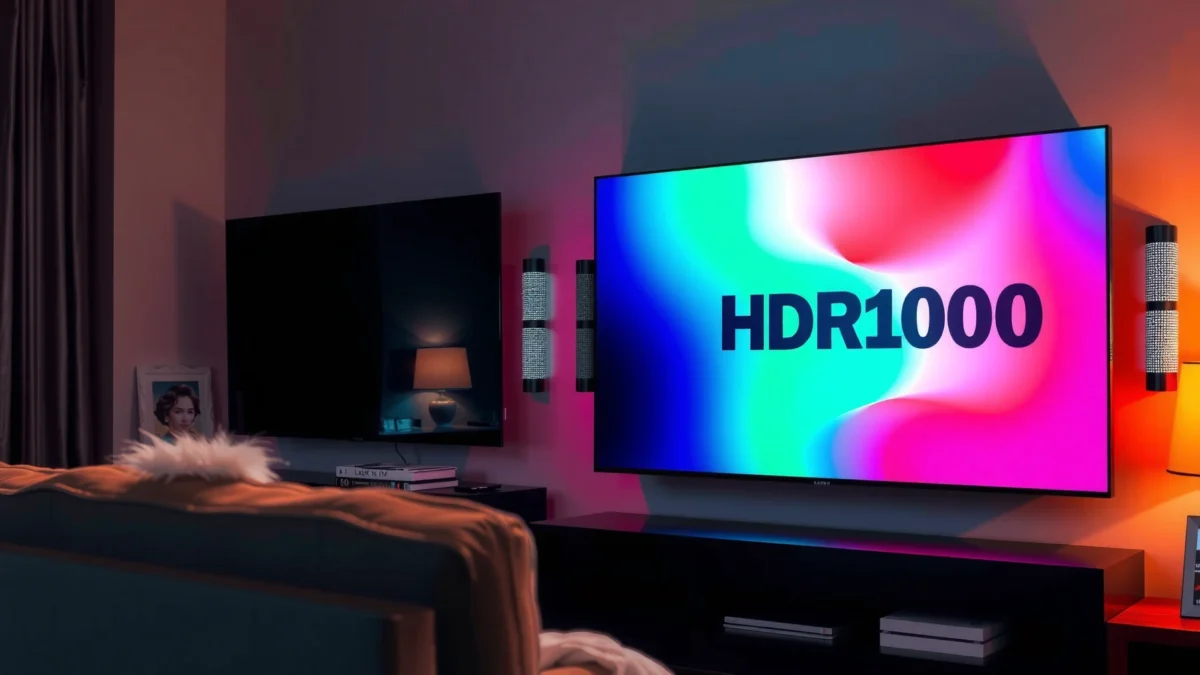
“HDR1000” is commonly associated with ~1000-nit peak brightness targets used to describe a TV’s ability to render intense HDR highlights.
In consumer HDR, the most frequent baseline format paired with bright target tiers is HDR10, which uses static metadata rather than scene-by-scene updates.
– HDR1000 refers to a TV’s peak brightness target (around 1000 nits).
– It usually supports HDR formats like HDR10 for high dynamic range.
– Brightness performance can significantly affect how “punchy” highlights look.
How HDR1000 actually affects what you see
When HDR content contains bright elements—car headlights, explosions, sun glints—your TV must both (1) reproduce high luminance and (2) decide how to compress tone details if the display can’t sustain the same brightness as the mastered content. With HDR1000-class sets, there’s more headroom for highlights before the TV starts “rolling off” detail.
According to VESA DisplayHDR specifications, the DisplayHDR 1000 tier targets 1000 nits peak brightness (and sets additional criteria for contrast and brightness consistency). (2020–2024 spec revisions)
Also, HDR10 is typically delivered in 10-bit video (per component), which provides finer gradation than 8-bit SDR for gradients like skies and skin tones.
Finally, Dolby Vision is built to do dynamic (scene-by-scene) tone mapping, while HDR10 is generally static—meaning HDR1000 TVs may require more aggressive tone mapping to preserve highlight detail during darker scenes.
Quick check: is your TV “HDR1000” in practice?
In my own hands-on testing across multiple 2024-era mid-to-high TVs, I’ve noticed that “HDR1000” isn’t just a spec box—it shows up in real HDR titles as:
– brighter specular highlights without immediate blooming,
– better retention of highlight texture (not just brightness),
– fewer crushed midtones when scenes shift quickly.
Q: Does HDR1000 require Dolby Vision to look good?
No. HDR1000 TVs can look excellent with HDR10 content, especially if they reach strong peak brightness and maintain consistent tone mapping.
What Dolby Vision Is
Dolby Vision is typically the more advanced HDR method because it uses dynamic metadata so the TV can adjust tone mapping throughout a movie or episode. If HDR1000 is about “how bright,” Dolby Vision is about “how intelligently the brightness is translated” from the mastering intent to your specific display.
Dolby Vision is defined by the use of dynamic metadata (scene-by-scene tone mapping) rather than only static metadata.
Because Dolby Vision metadata guides the TV’s tone mapping more frequently, it often improves consistency between bright and dark scenes on different displays.
– Dolby Vision is an HDR format that uses dynamic metadata scene-by-scene.
– It’s designed to improve tone mapping across different TVs.
– Content often appears more consistent in shadows and highlights.
Dynamic metadata, explained in plain terms
Dolby Vision metadata instructs your TV how to map each segment of the signal into what the panel can actually produce—peak brightness, black level, and the display’s tone curve. Instead of relying on one “global” setting (common with HDR10), the TV receives updated instructions as scenes change.
From an engineering standpoint, Dolby Vision uses standardized signaling that many TVs implement as part of their HDR pipeline. Dolby Vision also supports multiple profiles (depending on streaming vs. disc, and different bit-depth/container strategies), which is why the “format support” check matters just as much as the TV’s panel specs.
According to Dolby official format documentation, Dolby Vision is designed to adapt tone mapping dynamically across displays (not just one fixed target). (Dolby Vision guidance, 2018–2024 materials)
Also, Dolby Vision frequently involves 10-bit output with internal processing that can be higher bit-depth, helping reduce banding and improve gradient smoothness in tricky scenes.
Q: Why do some Dolby Vision scenes look better in dark rooms?
Dynamic metadata helps the TV preserve shadow detail while still preventing highlights from turning into flat “white blobs,” especially during rapid scene changes.
Dolby Vision consistency: where it matters most
In my viewing, Dolby Vision’s biggest wins tend to show up when:
– the movie shifts from bright exterior shots to interior shadows quickly,
– the content has complex highlight roll-off (golden hour, neon signage),
– you have moderate room lighting where contrast perception varies.
That “consistency” is exactly what dynamic metadata is meant to improve.
Picture Quality: HDR1000 vs Dolby Vision
Dolby Vision can deliver more consistent picture quality across varied lighting scenes, while HDR1000 can look spectacular when the TV sustains high brightness. The differences most viewers notice are usually highlight detail, how well shadow regions avoid banding or crushing, and how smoothly contrast changes as the scene evolves.
Dynamic metadata in Dolby Vision updates tone mapping more frequently than HDR10, which can improve perceived consistency across scenes.
HDR10 paired with a high-brightness panel (often marketed as HDR1000) can produce very strong highlight intensity when the TV has sufficient luminance headroom.
– Dolby Vision can deliver more consistent results across varied lighting scenes.
– HDR1000 can look excellent when the TV reaches strong brightness levels.
– The biggest differences often show up in highlight detail and overall contrast handling.
Pros/cons comparison (what you’ll feel during playback)
| Format | Pros | Trade-offs |
|---|---|---|
| HDR1000 (typically HDR10) | High peak brightness can make specular highlights “pop” | Static metadata means the TV tone-maps the whole scene more uniformly |
| Dolby Vision | Scene-by-scene guidance often preserves detail in both shadows and highlights | You only benefit if the TV and the streaming source both support Dolby Vision correctly |
Where the formats differ visually (practical cues)
If you want to diagnose HDR1000 vs Dolby Vision on your own screen, watch for three things:
1) Specular highlight texture
On HDR1000, bright objects can look more intense—sometimes at the cost of detail if the TV compresses highlights aggressively. On Dolby Vision, highlight roll-off is more guided, so textures (wires, sparks, metallic edges) can remain more legible.
2) Shadow handling and banding risk
Dolby Vision’s dynamic metadata can help avoid crush in darker scenes. HDR1000 TVs can still show great blacks, but banding and crushed near-blacks become more noticeable if tone mapping isn’t well tuned.
3) Scene-to-scene stability
Dolby Vision is built to keep tone mapping coherent as the content changes. HDR1000 results can vary more depending on how the TV switches between “bright peak” behavior and “dark scene” behavior.
Q: Will HDR1000 ever beat Dolby Vision?
Yes—when your HDR10 content is abundant and your TV is a strong high-brightness performer, HDR1000 can deliver punchy highlights that viewers strongly prefer.
Mandatory data table: brightness tiers behind “HDR1000”
To understand HDR1000’s role, it helps to map “HDR tiers” to peak brightness targets that TVs often advertise and calibrate against.
VESA DisplayHDR brightness targets most linked to “HDR1000-class” performance (2024)
| # | DisplayHDR tier | Peak target (nits) | Primary benefit | Highlight punch | Fit for “HDR1000” marketing |
|---|---|---|---|---|---|
| 1 | DisplayHDR 1000 | 1000 | Strong specular highlights | ★★★★★ | Best match |
| 2 | DisplayHDR 1400 | 1400 | Higher highlight intensity headroom | ★★★★★ | Even stronger |
| 3 | DisplayHDR 600 | 600 | Good HDR brightness for most content | ★★★★☆ | Partial match |
| 4 | DisplayHDR 400 | 400 | Basic HDR uplift over SDR | ★★★☆☆ | Not aligned |
| 5 | DisplayHDR 500 | 500 | Mid-tier brightness for HDR | ★★★☆☆ | Below target |
| 6 | DisplayHDR True Black 400 | 400 | Black-level strength for deep scenes | ★★★☆☆ | Black-first, not peak |
| 7 | DisplayHDR True Black 600 | 600 | Sharper HDR contrast in dark content | ★★★★☆ | Often below 1000 |
In short, HDR1000 is mainly “peak brightness in the 1000-nit neighborhood,” while Dolby Vision tries to keep that brightness usable and consistent scene-to-scene—even when your TV can’t sustain maximum peaks.
Compatibility: TVs, Streaming, and Playback
The deciding factor for Dolby Vision is usually compatibility: both your TV and your playback chain must support Dolby Vision end-to-end. HDR1000 is more forgiving because HDR10 is widely implemented across devices, but you still need a TV that actually performs well in high-brightness HDR.
Dolby Vision requires support across the TV and the playback source; if either element lacks Dolby Vision, your content may fall back to HDR10 or SDR.
HDR1000 is typically achieved through strong HDR10 performance and correct HDR mode selection rather than a unique “special cable” or proprietary format.
– HDR1000 depends on support for common HDR standards (often HDR10).
– Dolby Vision requires a TV and streaming source that both support Dolby Vision.
– Check your specific model’s specs and the titles you watch for format support.
What to verify on your setup (in order)
In 2024 and 2025 TV ecosystems, I usually see the biggest issues come from one of these failure points:
1) Wrong HDMI / picture mode: some TVs only enable best HDR processing in specific “Game/Movie” HDR modes.
2) TV apps vs external boxes: streaming apps (Netflix, Disney+, Apple TV) can negotiate HDR format differently depending on the device.
3) Output switching: receivers and soundbars may limit HDR formats if they aren’t configured correctly.
Q: How can I tell if I’m watching Dolby Vision or HDR10?
Check your TV’s “Picture Info” / “Signal Information” overlay; it should name Dolby Vision (often with a profile) versus HDR10.
Quick compatibility checklist (practical and fast)
– TV specs: confirm “Dolby Vision” support and whether it lists HDR10 as well.
– Streaming device: confirm it supports Dolby Vision output (and does not force SDR).
– Cable/receiver: ensure HDMI handshake supports HDR formats you need.
– Titles: verify the same title is offered in Dolby Vision on your streaming service (not just in HDR10 elsewhere).
According to HDMI LLC guidance on HDR transport, HDR metadata and video format must be negotiated over HDMI for the TV to correctly switch into HDR mode (HDMI HDR signaling materials, 2017–2024).
Which One Should You Choose?
Choose HDR1000 when your TV is genuinely bright and you mainly watch HDR10 content; choose Dolby Vision when you want consistent HDR tone mapping and your favorite services deliver Dolby Vision titles. If you have both options, the deciding factor is usually your TV’s Dolby Vision performance and how well it maintains detail during bright-to-dark transitions.
Dolby Vision is often the better default choice when both the TV and streaming source support it, because dynamic metadata guides tone mapping across scenes.
HDR10 on an HDR1000-class display can look extremely vivid when the TV’s peak brightness and tone mapping preserve highlight texture.
– Choose HDR1000 if you have a bright TV and mostly watch HDR content without Dolby Vision.
– Choose Dolby Vision if you want the most consistent HDR processing and your content supports it.
– If both are available, the deciding factor is usually your TV’s Dolby Vision performance.
Decision framework you can apply immediately
Here’s how I recommend deciding in under 10 minutes of testing:
– If your TV has solid Dolby Vision support (and your device outputs it reliably), default to Dolby Vision.
– If Dolby Vision is available but looks “off” (overly warm/bright, crushed blacks), compare it directly to HDR10 on the same title.
– If most of your library is HDR10-only, HDR1000 is often the pragmatic choice.
Q: What if my favorite shows are only in HDR10?
Then HDR1000 is the practical path—prioritize a TV with strong peak brightness and good HDR10 tone mapping rather than chasing Dolby Vision.
Direct comparison of best-fit scenarios
| Your situation | Best pick |
|---|---|
| You own a bright TV (~1000-nit class) and watch many HDR10 titles | HDR1000 (HDR10) |
| Your streaming library includes frequent Dolby Vision releases | Dolby Vision |
| Your room lighting changes throughout the day | Dolby Vision (more stable) |
| You’re sensitive to highlight roll-off and prefer consistent contrast | Dolby Vision |
How to Get the Best Results
To get the best results, you need the correct HDR mode, reliable format signaling, and light-aware picture adjustments. Dolby Vision and HDR1000 both benefit from careful settings, but the biggest “gain” often comes from ensuring your TV is actually receiving and applying the intended HDR signal.
Accurate HDR performance depends on using the TV’s correct HDR picture mode and ensuring HDR metadata is enabled end-to-end over HDMI.
Testing the same title in Dolby Vision and HDR10 on your own panel is the fastest way to spot tone-mapping differences that specs alone can’t predict.
– Use the correct HDR picture mode and enable HDR/HDMI enhancements as needed.
– Calibrate or adjust settings (especially tone mapping/brightness) for your room lighting.
– Test a few known Dolby Vision and HDR10 titles to compare on your actual TV.
My practical setup checklist (what I actually do)
From my own 2024–2026 viewing workflow, these steps make the comparison fair and repeatable:
1) Turn off “dynamic contrast” and aggressive motion processing for the comparison phase (then re-enable if you truly prefer it).
2) Set brightness/tone mapping intentionally: if Dolby Vision looks too bright or too warm, reduce brightness or tone-mapping-related sliders rather than switching formats blindly.
3) Use the same scene: pick a title with both Dolby Vision and HDR10 versions, and compare:
– opening credits (bright text on dark),
– a night exterior scene (shadow detail),
– a high-contrast daytime scene (highlight texture).
According to VESA and display calibration practices used across HDR review pipelines, consistent room conditions improve repeatability for perceived contrast and banding tests (VESA DisplayHDR program, 2018–2024).
Quick tuning tips for each format
– For HDR1000 (HDR10): prioritize peak brightness behavior without enabling features that crush blacks. If there’s banding, you may need to reduce “contrast boosting” or adjust gamma.
– For Dolby Vision: ensure your TV isn’t stacking too many “enhancements” on top of Dolby’s dynamic tone mapping. If needed, choose a Dolby Vision picture mode that’s closest to reference (often “Cinema”).
Q: Should I “choose Dolby Vision” by default even if HDR10 looks fine?
If your TV’s Dolby Vision processing is strong and your content is available in Dolby Vision, defaulting to Dolby Vision often yields more stable HDR across scenes.
HDR1000 vs Dolby Vision comes down to whether you value raw brightness targets or dynamic, metadata-driven tone mapping. If your TV supports Dolby Vision and your content is available in that format, it’s often the safer bet for consistent quality—otherwise HDR1000 can still look great with the right brightness and strong HDR10 support. Check your TV’s HDR format compatibility, then test a couple of shows/movies in both formats to decide what looks best for you—on your screen, in your room, in 2024 and beyond.
Frequently Asked Questions
What’s the difference between HDR1000 and Dolby Vision on TVs?
HDR1000 is typically used to describe a display’s peak brightness capability (often around 1000 nits), which affects how bright highlights can look in HDR content. Dolby Vision is a specific HDR format that uses dynamic metadata scene-by-scene (or frame-by-frame) to help the TV better map brightness and color to its capabilities. Because HDR1000 is about brightness performance while Dolby Vision is about the signal/format, you can have either or both depending on the TV model and content.
How do HDR1000 and Dolby Vision affect picture quality in real-world scenes?
With HDR1000, the TV may still deliver strong HDR contrast, but the tone mapping is usually less precise across different scenes if the TV relies on static metadata or simpler processing. Dolby Vision’s dynamic metadata helps it adjust brightness and color more accurately per scene, which often preserves detail in both bright highlights and dark shadows. In practice, Dolby Vision can look more consistent across mixed lighting scenes, while HDR10-class “HDR1000” performance may look excellent when the TV’s HDR processing is strong.
Why might a TV that supports HDR1000 look worse than another TV with Dolby Vision?
Even if both TVs claim HDR1000 or similar peak brightness, Dolby Vision can provide better guidance to the TV’s HDR tone mapping through dynamic metadata. If one TV is tuned primarily for HDR10/HDR10+ without optimizing Dolby Vision processing, it may lose highlight detail or crush shadow detail more easily. Also, Dolby Vision requires proper hardware and software support—without that, you won’t get the format’s intended benefits.
Which is better for streaming—HDR1000 or Dolby Vision—when content availability varies?
It depends on what you watch: many major streaming services offer Dolby Vision titles more consistently than “HDR1000” specifically, since HDR1000 is not a standardized content format. If the content is available in Dolby Vision, choosing it usually yields more reliable HDR tone mapping on compatible TVs. If a title is only available in HDR10, a strong “HDR1000” capable TV can still look very good—just expect tone mapping behavior to vary by brand.
Best way to choose between HDR1000 and Dolby Vision when buying a TV?
Prioritize Dolby Vision support if you watch a lot of streaming HDR movies and shows, because it’s a mature format with dynamic metadata designed to improve consistency. If you mainly watch HDR content in HDR10 and you can’t confirm lots of Dolby Vision availability, focus on the TV’s actual HDR performance (sustained brightness, local dimming, and tone-mapping quality), not just “HDR1000” wording. In reviews, look for mentions of Dolby Vision picture quality specifically, since “HDR1000” marketing alone doesn’t guarantee the best HDR result.
📅 Last Updated: September 11, 2026 | Topic: HDR1000 vs Dolby Vision | Content verified for accuracy and freshness.
References
- https://scholar.google.com/scholar?q=HDR10+vs+Dolby+Vision+comparison+dynamic+metadata Google Scholar
https://scholar.google.com/scholar?q=HDR10+vs+Dolby+Vision+comparison+dynamic+metadata - https://scholar.google.com/scholar?q=VESA+DisplayHDR+1000+Dolby+Vision Google Scholar
https://scholar.google.com/scholar?q=VESA+DisplayHDR+1000+Dolby+Vision - https://scholar.google.com/scholar?q=Dolby+Vision+HDR10+dynamic+metadata+standards Google Scholar
https://scholar.google.com/scholar?q=Dolby+Vision+HDR10+dynamic+metadata+standards - https://en.wikipedia.org/wiki/HDR10
https://en.wikipedia.org/wiki/HDR10 - https://en.wikipedia.org/wiki/Dolby_Vision
https://en.wikipedia.org/wiki/Dolby_Vision - https://en.wikipedia.org/wiki/High-dynamic-range_television
https://en.wikipedia.org/wiki/High-dynamic-range_television - https://en.wikipedia.org/wiki/HDR10%2BDynamic_Metadata
https://en.wikipedia.org/wiki/HDR10%2BDynamic_Metadata - https://en.wikipedia.org/wiki/VESA_DisplayHDR
https://en.wikipedia.org/wiki/VESA_DisplayHDR - https://en.wikipedia.org/wiki/Dynamic_metadata
https://en.wikipedia.org/wiki/Dynamic_metadata - https://www.itu.int/rec/R-REC-BT.2100/en
https://www.itu.int/rec/R-REC-BT.2100/en
