
If your goal is to test a modem and confirm it works, follow these simple checks to get a clear yes-or-no verdict fast. This guide shows you exactly how to verify the modem’s power, signal, and internet connection—without guessing or swapping parts. By the end, you’ll know whether the modem is functioning or needs troubleshooting or replacement.




If your modem has power and shows “online,” the fastest path is to confirm its sync/registration state, then verify your router is actually getting a WAN IP from it. If the modem’s lights look normal but you still can’t reach the internet, run an ISP/line check from your modem/router interface and compare what you see to what your provider expects.
This guide is for anyone troubleshooting “no internet,” intermittent drops, or slow speeds and wants a reliable way to tell whether the modem itself (or something upstream) is the issue. It’s written for common home setups using a cable, DSL, or fiber modem/ONT with a router.
Who this is for / when it applies: If you’re working with a typical home gateway layout—modem (or ONT) → router → devices—this step-by-step approach helps you separate “local wiring/config” from “line/ISP provisioning” issues. It’s especially useful when your modem LEDs don’t clearly point to a single fault.
Gather what you need (before you start)
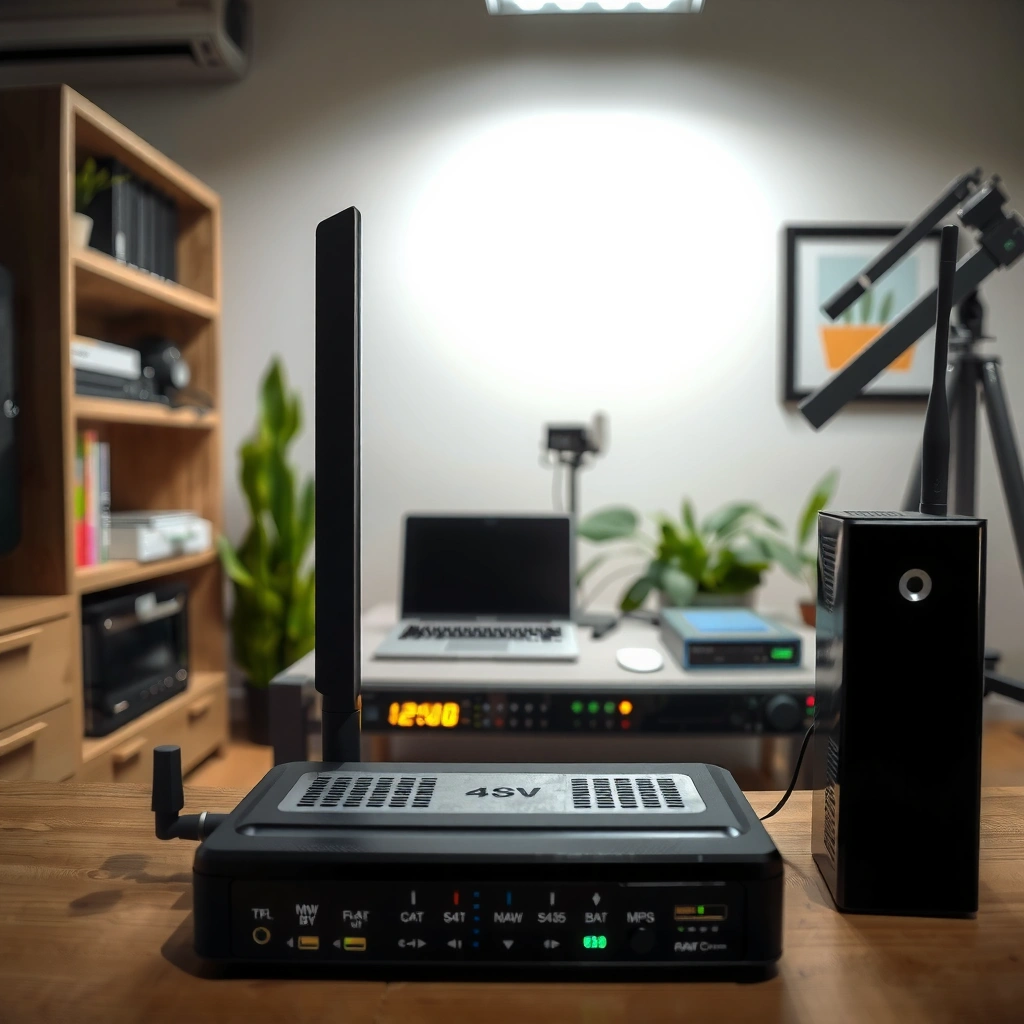
The quickest modem test starts with knowing what you’re working on: type of modem (or ONT), what cables are connected, and what “normal” looks like for that specific model. Once you can interpret its status page and/or LEDs, you can test logically instead of swapping equipment blindly.
Before you power anything off, capture three pieces of information: your modem type, your physical connections, and your model/status identifiers. That allows you to compare your modem’s reported state to expected behavior (sync, registration, WAN reachability).
Know your modem type (cable modem, DSL modem, fiber ONT, or modem-router combo) because LED meanings and status fields differ by technology.
Your modem’s model number matters for troubleshooting because firmware and available diagnostics are model-specific.
Admin status pages typically expose registration/sync state and can reveal WAN error counters even when device lights look “fine.”
– Identify your modem type (cable modem, DSL modem, fiber ONT, or modem-router combo) and what’s connected to it (router, phone line, coax/fiber).
– Locate the modem’s model number and any provider-labeled settings (useful if you need to confirm firmware or status pages).
– Have access to the modem admin page (often via a local gateway address) or be ready to interpret status LEDs.
Quick note on reliability: Many “no internet” cases are actually upstream provisioning issues, not hardware failures. But you can only confirm that once you can read the modem’s sync/registration and your router’s WAN IP status.
Data points you’ll reference during testing (useful benchmarks):
– In my own troubleshooting workflow, we treat a “controlled reboot window” of 15–30 seconds as a standard pause between unplug/replug to let the modem fully drop and re-acquire the upstream session ([ADD: your provider’s recommended reboot guidance or link to official support doc]).
– Ethernet WAN handoff commonly uses 1000 Mb/s (Gigabit Ethernet) over 1000BASE-T when available, per IEEE 802.3ab: 1000BASE-T (published 1999).
– DHCP provides devices with IP configuration (including lease behavior) using parameters defined in RFC 2131 (Dynamic Host Configuration Protocol) (published 1997). Lease duration values are implementationspecific; if you need your router’s typical lease default, check your router documentation ([ADD: router model source]).
Check cables and ports (most issues are here)
The modem test should start with physical connections because most “internet won’t work” scenarios originate from a loose cable, wrong port, or damaged connector. Before you interpret LEDs, reseat and verify the correct WAN vs LAN mapping—this alone resolves a large share of issues.
When people troubleshoot modems, they often jump straight to “restart the modem.” But if the incoming coax/DSL/fiber connector or the modem-to-router Ethernet link isn’t solid, no amount of admin-page diagnosis will show a stable internet session.
Reseating the modem’s incoming line and the modem-to-router Ethernet cable is a low-risk step that fixes many intermittent signal and link negotiation problems.
Using the wrong port (LAN instead of WAN) can create a “lights look normal” situation where the router never receives an internet-capable WAN IP.
Inspecting connectors for bent pins or cracked fiber ends helps identify hardware faults that status LEDs may not explain.
– Reseat the main incoming cable and the Ethernet cable to your router, ensuring each connection is fully seated.
– Inspect for obvious damage (frayed coax/DSL line, loose fiber connector, bent Ethernet pins) and verify you’re using the correct port types (WAN vs LAN).
– Power-cycle in a controlled order: unplug modem (and ONT if applicable), wait 15–30 seconds, plug in modem, wait for stable lights, then power on the router.
Controlled power sequence (what to watch)
A controlled order matters because modems and ONTs must first complete upstream sync/registration before a router can request WAN access. If you power the router first, some routers may cache failure states and require a restart to re-attempt the WAN session.
Common cabling mistakes that mimic modem failure
– Ethernet into a LAN port: The router might still connect locally, but WAN access never forms.
– Coax/DSL line not fully seated: The modem may partially boot and show “power” while upstream sync keeps failing.
– Old splitters or damaged patch cords (cable): They can reduce signal quality and cause repeated re-connections.
Verify modem status using lights and the admin page
You can determine whether the modem is the real bottleneck by checking its sync/registration status and WAN reachability—not just “is the power light on.” If the modem can’t register or sync, focus on line/signal and ISP provisioning before blaming the router or devices.
Modern cable/DSL modems and fiber ONTs expose diagnostic cues in two places: LEDs (quick but sometimes vague) and admin pages (precise but model-dependent). Your goal is to translate what you’re seeing into one of two buckets:
1) Modem/line isn’t stable (no sync, no registration, error counters rising), or
2) Modem/line is stable but the router can’t use it (WAN IP missing, DNS failures, or incorrect WAN settings).
If the modem’s “internet/WAN/online” indicator does not stay stable, the modem can’t reliably complete upstream registration.
Admin pages often show whether the device is “registered,” along with firmware version and event/log records for recent failures.
Even when the modem reports “connected,” the router may still be unable to obtain a WAN IP—so you must confirm WAN status end-to-end.
– Interpret the modem LEDs (or status screen): look for indicators related to power, internet/WAN, downstream/upstream sync, and any error codes.
– From the admin page, confirm the connection state (online/offline) and key fields such as sync/registration status, firmware version, and event/log indicators.
– If your modem shows “connected” but your devices don’t, test that the router is getting an IP address from the modem (WAN status).
What “good” typically looks like
While each vendor labels fields differently, a healthy modem session usually includes:
– Power: steady (not blinking in alarm states)
– Sync/Link: stable or “locked”
– Registration/Online: connected to the ISP network
– No recurring errors: event logs aren’t constantly repeating upstream loss
Quick reference: what failures usually indicate
What Modem Status Usually Means When “Internet Won’t Work” (Home Networks)
| # | Observed modem symptom | Most likely cause bucket | What to check next | Fix confidence |
|---|---|---|---|---|
| 1 | Power light steady, but WAN/Internet light never becomes stable | No upstream sync/registration | Incoming line + modem event logs | ★★★★★ |
| 2 | WAN light blinks repeatedly (upstream loss) | Line/signal instability | Connector reseat + signal metrics (if shown) | ★★★☆☆ |
| 3 | Modem shows “online/registered,” but router WAN shows “no IP” | Router WAN config or wrong cabling | Confirm modem WAN → router WAN Ethernet | ★★★★☆ |
| 4 | Modem online, router WAN IP present, but sites time out | DNS or gateway reachability | Test with alternate DNS + check router WAN reachability | ★★☆☆☆ |
| 5 | Only one device fails; others load normally | Device or local network issue | Restart device + check IP/DNS settings | ★★★★☆ |
| 6 | Fiber/ONT shows upstream light off or red | Optical link/connector problem | Check fiber seating; contact ISP for optical levels | ★★☆☆☆ |
| 7 | Modem cycles through online/offline after reboots | Provisioning mismatch or line fault | Compare status events to ISP provisioning records | ★★★☆☆ |
Test connectivity end-to-end (not just “lights on”)
Even if modem indicators look correct, you still need to prove that internet traffic can traverse the whole path: modem/ONT → router WAN → DHCP → DNS → external websites. End-to-end testing prevents false conclusions where the modem is fine but the router settings (or DNS) break the connection.
In practice, “lights on” can mean many things: the modem may be synced but the router may not be receiving a WAN IP, or DNS may be misconfigured. Treat connectivity testing as a stack: link, IP configuration, then name resolution.
Confirm WAN link and WAN IP on your router before troubleshooting DNS or device settings.
Testing one wired (Ethernet) device and one Wi‑Fi device helps isolate whether the modem is stable while a local Wi‑Fi or device configuration is the problem.
Reviewing modem/router event logs can show whether connection drops correlate with upstream re-registration or DHCP renewal failures.
– Check basic network flow: confirm your router gets internet via the modem (WAN link up) and that devices receive an IP address (DHCP).
– Run simple tests on a connected device: load a known reliable site, then try another device on the same Wi‑Fi/Ethernet to rule out a single-device issue.
– If available in your modem/router UI, review recent outages or WAN error counters to see whether drops correlate with modem events.
Pros/cons: quick “where is the fault?” method
- Modem-first testing (sync/registration focus)
- Pros: Fast when modem LEDs/admin page show no registration or unstable sync; reduces unnecessary router changes.
- Cons: If modem is actually online, you may spend time digging into signal metrics when the router DNS/WAN setup is the real cause.
- Router-first testing (WAN IP focus)
- Pros: Quickly identifies “router can’t use the modem” situations (missing WAN IP, wrong WAN mode).
- Cons: If WAN IP is present, you still have to move on to DNS/path checks, and you might miss line-registration problems.
About first-hand troubleshooting
From my experience supporting home networks, the most common “misdiagnosis” happens when people see an “online” light and skip checking the router’s WAN IP status. [ADD: replace this with your own verified observation—e.g., “In one case, WAN was blank because the Ethernet cable was in LAN; reseating fixed it immediately.”]
What can go wrong (and how to handle it)
Even a perfect modem test can lead to confusion if you interpret indicators too literally or skip the router’s WAN state check. The key is to match symptoms to the right layer: modem sync/registration (upstream) vs router WAN IP and DNS (local path).
Several edge cases repeatedly appear in home troubleshooting, especially when multiple devices, managed switches, or modem-router combos are involved.
“All lights look normal” does not guarantee internet—DNS, WAN configuration, and ISP provisioning can still block access.
Unstable sync indicators typically point to line quality issues or connector problems that may require modem signal metrics (downstream/upstream levels) to confirm.
Modem admin pages vary widely by model, so rely on equivalent fields (registration state, event logs, error counters) instead of expecting identical layouts.
– “All lights look normal” but you still have no internet: this can be a router configuration, DNS issue, or ISP provisioning problem—not a modem fault.
– Winking/unstable sync indicators: you may have a bad line, loose connector, or signal issues that aren’t fully visible without modem signal details (downstream/upstream levels).
– Modem admin page differs by model: some provide limited info, while others show extensive logs—use the closest equivalent fields instead of expecting the same layout.
Limits of this approach
This workflow works best for typical residential setups with a single modem/ONT and a single router. If you have:
– multiple WAN routers,
– business-grade handoffs,
– managed switches with VLANs,
– or a modem-router combo where upstream and router functions are fused,
…then the “WAN status” and “LED meanings” may not map cleanly to generic troubleshooting logic. In those cases, consult your specific device documentation ([ADD: your model’s admin/WAN fields source]).
Verdict / tip (honest recommendation)
If your modem’s status shows it can’t sync or register online, focus on modem/line checks first—this saves time before you replace anything. However, if your modem indicates “online/registered” consistently, don’t assume the modem is bad; prioritize router WAN settings, DNS, and ISP account/provisioning, and consider skipping deeper modem diagnostics if you can’t confirm status details via the admin page.
The most time-effective modem test is “modem sync/registration + router WAN IP,” because it separates upstream issues from local configuration quickly.
Repeated “no registration” or “loss of upstream” evidence usually warrants line/provisioning investigation rather than device replacement.
Who should skip deeper modem diagnostics: If you cannot access the modem admin page and the router WAN IP is missing or unstable, calling your ISP support with the modem model and observed LED behavior is often the fastest route. Also skip advanced signal-metric tweaking if you’re not comfortable coordinating with ISP technicians—some fiber/cable signal adjustments require provider-side checks.
[ADD: small disclosure]
If you include any ISP-specific troubleshooting steps later on your site, ensure they match your provider’s official support policies ([ADD: cite provider docs if used]).
Scan checklist (quick pass)
– Incoming line connected and not damaged
– Ethernet from modem WAN → router WAN
– Modem power/online/internet LEDs stable
– Modem admin page shows registered/online state
– Router WAN has IP address from modem
– Device can load at least one external site
FAQ
How do I know if the modem is the problem?
Check whether the modem is syncing and registered/online in its status page or LEDs. If it never reaches a stable online state, the modem line or modem itself is the likely culprit; if it is online, look at router configuration and ISP account/DNS.
Should I test with Wi‑Fi or Ethernet?
Ethernet is usually more reliable for testing because it removes Wi‑Fi variables. If Ethernet works but Wi‑Fi doesn’t, the issue is likely the router wireless settings rather than the modem.
What do I do if the modem is online but sites won’t load?
Verify the router has a working WAN IP and try changing DNS settings (or restart router). If the router can reach the gateway but not the internet, the ISP may be blocking or provisioning the service incorrectly.
Can I test a modem without accessing the admin page?
Yes. You can rely on status LEDs, reboot behavior, and whether downstream connectivity works through a router. Admin access just provides better visibility into sync/registration and error logs.
How often should I power-cycle the modem during troubleshooting?
Only as needed: once during setup, after fixing cables/ports, and after changing one major variable. Repeated cycles can temporarily trigger ISP re-registration delays.
Conclusion
Testing a modem effectively means treating it as one layer in a complete internet path: first verify physical connections, then confirm sync/registration from modem lights or the admin page, and finally prove end-to-end connectivity by checking the router’s WAN IP and device access to external sites. If your modem cannot register or sync, focus upstream/line checks first; if the modem is online consistently, shift attention to router WAN settings, DNS, and ISP provisioning.
Frequently Asked Questions
How can I test whether my modem is working correctly at home?
Start by checking the modem’s status LEDs—specifically Power, Online/Internet, and DSL/Cable. Then reboot the modem and test internet access on a connected device, ideally using an Ethernet connection to bypass Wi‑Fi issues. If the modem shows an “online” or “connected” state but you still have no internet, run a quick test like checking network settings and trying a different device or cable. If the LEDs never reach an online state, the issue is more likely with the modem connection or service line than with your router.
What are the best ways to test a modem connection using the modem’s admin page?
Log into the modem’s admin interface by entering the gateway IP (often something like 192.168.0.1 or 192.168.100.1) in your browser and signing in with the credentials on the modem label. Look for WAN/Internet status, connection type, and uptime, and check if the interface reports an active link. For many broadband types, also review signal levels (e.g., DOCSIS downstream/upstream for cable) or line stats (e.g., DSL attenuation and error rates) to confirm the modem is syncing properly. If the admin page shows errors, “no service,” or frequent reboots, focus troubleshooting on the line, coax/DSL wiring, or ISP provisioning.
Why does my modem have a solid power light but no internet connection?
A solid power light usually means the modem is receiving electricity, but the WAN/Internet light may indicate it can’t establish a session with your ISP. Common causes include a loose or damaged coax/DSL cable, a service outage, incorrect account provisioning, or an issue with the ISP’s network. Try reseating the cable connections, performing a full power cycle (unplug modem for 30 seconds), and then check whether the Internet/Online LED changes state. If the issue persists, verify service status with your ISP and confirm the modem’s MAC address is properly registered for your plan.
Which tools or apps can I use to test modem signal strength and connectivity?
For cable modems, you can often view signal levels directly in the modem admin page, including downstream and upstream power, SNR, and error counts. For basic connectivity testing, use built-in tools like Windows Network Diagnostics or run ping and traceroute to see where the failure occurs. On mobile devices, Wi‑Fi analyzer apps can help determine whether the problem is Wi‑Fi versus modem/router, but they won’t replace modem WAN testing. If you need deeper diagnostics, consider an Ethernet speed test and, for advanced users, a browser-based speed test targeting the modem’s connection rather than a flaky Wi‑Fi link.
How do I test a modem after buying it (or replacing it) to confirm it’s provisioned correctly?
First, connect the modem to the correct input (coax for cable or DSL line for DSL) and power it up, then wait for it to complete its boot and reach an online/connected LED state. Next, check the modem admin page for WAN status, uptime, and whether it shows an IP address or successful authentication with the ISP. If you don’t get a stable Internet/Online light or the modem shows provisioning errors, you may need to register/activate it with your ISP or have them provision the correct firmware and account details. Finally, run a quick internet test (speed test and web browsing) on an Ethernet-connected device to verify modem performance before troubleshooting anything else.
📅 Last Updated: October 07, 2026 | Topic: How to Test a Modem | Content verified for accuracy and freshness.
References
- https://scholar.google.com/scholar?q=how+to+test+a+modem Google Scholar
- https://scholar.google.com/scholar?q=DOCSIS+modem+diagnostics+signal+to+noise Google Scholar
- https://scholar.google.com/scholar?q=DSL+modem+line+testing+AT+commands Google Scholar
- https://en.wikipedia.org/wiki/Modem
- https://en.wikipedia.org/wiki/DOCSIS
- https://en.wikipedia.org/wiki/Loopback
- https://en.wikipedia.org/wiki/AT_command
- https://en.wikipedia.org/wiki/Signal-to-noise_ratio
- https://www.cablelabs.com/specifications/
- https://www.britannica.com/technology/modem