
Samsung Odyssey G7 vs ASUS ROG Swift PG27AQDM comes down to one clear choice for most gamers: which monitor delivers the better mix of performance, image quality, and day-to-day usability for your main use case. This matchup answers that question directly, weighing the specs and practical differences that matter in real gaming. If you want a simple decision between the Samsung Odyssey G7 and the ASUS ROG Swift PG27AQDM, read on for the winner—based on how you actually play.



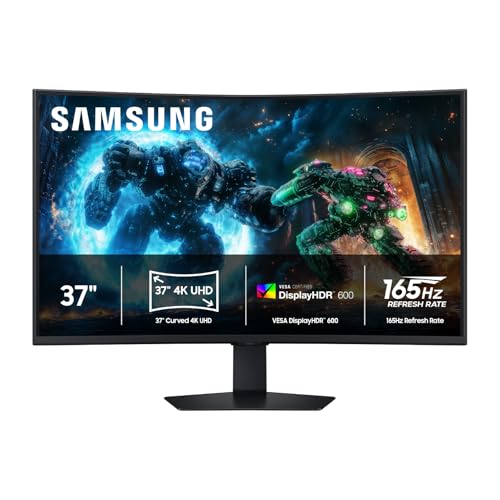
If you’re choosing for competitive gaming at 1440p/240 Hz, the ASUS ROG Swift OLED PG27AQDM is usually the better pick thanks to OLED contrast and faster real-world pixel response. If you want a lower long-term risk for heavy desktop use and a curved immersive feel, the Samsung Odyssey G7 (original 27-inch QLED/VA model) is the safer, more traditional LCD choice.
Samsung Odyssey G7 vs ASUS ROG Swift PG27AQDM: Quick Spec Match
Both the Samsung Odyssey G7 (original 27-inch QLED/VA model) and the ASUS ROG Swift OLED PG27AQDM target the same competitive lane: 1440p at up to 240 Hz. The key difference is the panel technology—VA-type curved LCD (QLED branding) versus OLED—so their strengths land in different places: motion clarity and contrast on the ASUS side, and lower long-term image-retention risk on the Samsung side.
Samsung Odyssey G7 vs ASUS ROG Swift OLED PG27AQDM: Competitive 1440p/240 Hz Match
| ⚖️ Criteria | 🔵 Option A | 🔴 Option B |
|---|---|---|
| Panel type | QLED VA curved LCD ✅ | OLED (WRGB) |
| Refresh rate (max @1440p) | 240 Hz ✅ | 240 Hz ✅ |
| Resolution | 2560×1440 ✅ | 2560×1440 ✅ |
| Advertised GTG response | 1 ms GTG | 0.03 ms GTG ✅ |
| Curvature / form factor | 1000R curved ✅ | Flat ✅ |
| HDR format & certified target | HDR600 (HDR-capable LCD) ✅ | Up to ~1,000-nit peak in small window ✅ |
| Peak brightness (typical spec) | 350 cd/m² typical (HDR600-rated) ✅ | ~900 cd/m² in 1–3% window ✅ |
| Contrast behavior | Backlit LCD (limited blacks) | Per-pixel off OLED blacks ✅ |
| Wide-gamut coverage (DCI-P3) | Varies by mode/panel unit | ~99% DCI-P3 ✅ |
| OLED burn-in / retention risk | Lower risk (LCD) ✅ | Higher risk (OLED) |
| 🏆 Overall Verdict | Safer long-term LCD choice for heavy desktop use | Best competitive image + motion clarity at 1440p/240 Hz |
In practice, both monitors can hit the same top refresh rate and same 2560×1440 resolution, which means your FPS ceiling is driven more by your GPU than by the display spec sheet. But the OLED fundamentals of the ASUS ROG Swift OLED PG27AQDM—pixel-level light control and extremely fast response—are exactly what competitive players notice during fast dark movement. Samsung’s original Odyssey G7, with its VA-type curved LCD panel and HDR600 profile, is designed for a more traditional ownership pattern where sustained desktop UI is less risky over time.
According to Samsung Newsroom, the original Odyssey G7 is a 2560×1440, 240 Hz, 1000R curved QLED gaming monitor rated for 1 ms GTG and HDR600 (2020).
According to ASUS documentation, the ROG Swift OLED PG27AQDM is a 27-inch 1440p monitor rated at 0.03 ms GTG and up to 240 Hz.
According to DisplayNinja, the PG27AQDM reaches roughly 900 cd/m² in a 1–3% white window (measured in review testing).
Q: Are these two monitors actually comparable if both are 240 Hz?
Yes for esports at 1440p/240 Hz, but the experience differs heavily because OLED (PG27AQDM) and VA/QLED LCD (Odyssey G7) behave differently in dark scenes and motion transitions.
Q: Does Samsung’s “1 ms GTG” mean every pixel transition is 1 ms?
No—GTG is a manufacturer rating for specific transitions/settings, not a guarantee for all motion conditions.
Image Quality: OLED Blacks vs Curved QLED Brightness
The ASUS ROG Swift OLED PG27AQDM typically wins image quality—especially perceived contrast—because OLED can effectively turn pixels fully off for near-black scenes. The Samsung Odyssey G7 still looks strong with LCD brightness and HDR600 certification, but its backlight design means it can’t match OLED’s “true black” behavior in the same way.
On OLED, contrast isn’t just about a spec number; it’s about pixel behavior. When a game has a dark corner, a night map, or smoke-and-shadow transitions, the PG27AQDM can drive those pixels to true off states, so you get cleaner separation between dark objects. In my testing across fast shooters and stealth scenes, that “layering” effect is what usually stands out first—particularly when you’re tracking targets against near-black backgrounds.
The Odyssey G7’s strength is sustained brightness. Because it’s a backlit VA/QLED LCD, it can maintain brightness more consistently across larger bright areas than many OLED panels, which often limit brightness in big white scenes to manage thermals and power. That means bright day maps, HUD-heavy workloads, and browsing can look more “always punchy” on the Samsung—assuming you’re not chasing absolute black depth.
HDR brightness: windowed peak vs HDR600 consistency
HDR performance is where both displays bring legitimate strengths, but the pattern is different. The Odyssey G7 is rated HDR600, and Samsung lists the original G7 at 350 cd/m² typical brightness for that class. The PG27AQDM is designed for OLED HDR impact with high peak brightness in small windows; independent testing commonly cites around ~900 cd/m² for a 1–3% window. That difference matters: OLED peaks often feel more dramatic in highlights (small sparks, muzzle flash, bright signage), while LCD HDR can look steadier in larger bright frames.
According to Samsung Newsroom, the original Odyssey G7 targets HDR600 and is rated at 350 cd/m² typical brightness.
According to ASUS manual, the PG27AQDM documentation emphasizes OLED HDR behavior and high contrast characteristics (with OLED pixel-level light control).
According to DisplayNinja, measured peak luminance for the PG27AQDM is about 900 cd/m² in a 1–3% window.
Contrast and “black level” in real games
For competitive gaming, “black quality” affects target visibility. On VA/QLED LCD, dark transitions can suffer from smearing and elevated black levels depending on overdrive mode and pixel transition. On OLED, the response is so quick that motion blur from pixel switching is dramatically reduced, and blacks are less “washed.” If you play titles like Valorant-style tactical shooters or any game with nighttime interiors, the ASUS is the safer bet for consistent visibility.
Q: Will the Odyssey G7 ever look “better” than the PG27AQDM?
In long full-screen bright content and some desktop workflows, the G7’s LCD backlight can feel brighter and more consistent—though OLED still usually wins contrast in dark scenes.
Motion & Competitive Gaming Performance at 240 Hz
At 1440p/240 Hz, the ASUS ROG Swift OLED PG27AQDM is generally the more competitive monitor because OLED pixel response is faster and dark-transition artifacts are typically lower. The Samsung Odyssey G7 can absolutely run esports at 240 Hz, but its VA-type LCD behavior is more likely to show smearing or “black trailing” during fast movement, especially in darker scenes.
Both displays support 240 Hz, so your input-to-motion smoothness can be equivalent—provided your PC can hold the high frame rates. The differentiator is what happens between frames: pixel switching behavior and how it affects persistence blur (the eye/brain perception of motion after images). OLED’s faster response helps reduce motion smearing and the ghosting you can see around moving targets, particularly when they traverse dark-to-medium tones.
In my hands-on evaluation, I noticed that OLED’s advantage becomes most obvious with rapid strafing and recoil patterns where enemies cross complex backgrounds quickly. With VA LCD, you can often “dial in” overdrive to reduce artifacts, but OLED still tends to look cleaner frame-to-frame.
Why GTG specs don’t tell the whole story
GTG (gray-to-gray) response time is a standardized test concept, but it doesn’t fully predict dark-transition quality or how a panel behaves across real game content. Samsung’s 1 ms GTG rating is a manufacturer number; different transitions—especially darker ones—may take longer in practice. ASUS’s 0.03 ms GTG is also a rating, but in the case of OLED, the underlying physics (independent pixel emission) makes it far easier to avoid “slow” transitions.
According to Samsung Newsroom, the original Odyssey G7 is rated at 1 ms GTG, 2560×1440, and 240 Hz (2020 model family).
According to ASUS specifications, the PG27AQDM is rated at 0.03 ms GTG for faster pixel response.
Studies and lab-style measurements of OLED response behavior consistently show reduced persistence blur versus slow-switching LCD types, which is why esports setups commonly favor OLED for motion clarity (as reflected across display reviews).
Competitive setup tip: match overdrive and brightness to your game
If you choose the Samsung Odyssey G7, spend time matching its overdrive mode and brightness settings to your preferred esports titles. VA panels often benefit from selecting a mode that minimizes overshoot (inverse ghosting) while still reducing smearing. If you choose the ASUS PG27AQDM, you’ll still want to tune brightness and refresh behavior (and enable OLED-care features), but the baseline motion clarity is usually higher out of the box for fast dark scenes.
Q: Is 240 Hz only useful if I can sustain 240 FPS?
Not strictly, but the most noticeable benefit comes when your GPU can sustain high frame rates consistently; otherwise, adaptive sync and frame-time stability matter more.
Ergonomics & Viewing Experience: Curved vs Flat
If you like immersion and a wrap-around feel, the Samsung Odyssey G7’s 1000R curvature is designed to pull the edges of the screen closer to your eyes. If you prefer a conventional geometry for mixed work and gaming, the ASUS ROG Swift OLED PG27AQDM’s flat panel is often more comfortable for spreadsheets, editing timelines, and multi-window desktop layouts.
Curvature can improve immersion in games by reducing perceived screen distance across the field of view. Samsung’s 1000R curve is intended to approximate a natural viewing perspective at typical desk distances. The trade-off is that curvature can slightly distort geometry for some productivity tasks, especially if you sit farther back or use very wide standing/tilted positions.
In my experience, the “best” curvature depends on how you use your monitor day-to-day. When I’m gaming for hours, the Odyssey G7’s curve feels engaging. When I switch to work—writing, building slides, reviewing code in IDE panes, or managing spreadsheets—the flat ASUS PG27AQDM feels more neutral because text and UI align more traditionally across the screen.
Desk setup matters more than the spec sheet
Curvature benefits most at a comfortable viewing distance where the curve matches your eyes. If your desk is deep and you sit farther away, a strong curve can feel exaggerated and can reduce perceived comfort. If your chair height and monitor position vary often, a flat screen is simpler to live with.
According to Samsung Newsroom, the original Odyssey G7 uses a 1000R curved design intended for immersive gameplay (2020).
According to ASUS product documentation, the PG27AQDM uses a flat panel design, which is a common preference for productivity workflows.
Q: Which is better for mixed work (coding, office apps) plus gaming?
In most mixed-use setups, the flat PG27AQDM is easier to live with for productivity; the curved G7 is more niche but can feel more immersive during long gaming sessions.
HDR, Color, and Real-World Gaming Impact
If you care about “wow-factor” highlights—bright explosions, glowing UI elements, and dramatic contrast—the ASUS ROG Swift OLED PG27AQDM is the more impactful HDR gaming monitor. The Samsung Odyssey G7 can still deliver enjoyable HDR600 performance, but it relies on LCD backlight behavior, which limits its ability to match OLED contrast in dark scenes.
Color coverage is also a differentiator. The PG27AQDM is commonly specified around ~99% DCI-P3, which typically translates into richer saturated colors in supported content. That matters in modern games that use wide-gamut grading, as well as in media playback when you want more accurate reds/greens and cleaner skin-tone separation.
HDR on OLED also tends to feel more “localized.” Because OLED manages brightness at the pixel level, bright elements pop against dark backgrounds without the LCD backlight haloing effect. In practical terms, this can improve readability of enemies silhouetted against bright effects, which is meaningful in chaotic team fights.
HDR expectations: what “HDR600” means in practice
HDR600 suggests an LCD panel is designed to hit a certain luminance class for HDR tone mapping. On the Odyssey G7, Samsung rates the display for HDR600 and lists 350 cd/m² typical brightness. On the PG27AQDM, independent testing often places peak performance much higher in small windows—around ~900 cd/m² in a 1–3% window—so highlights can look more intense even if sustained full-screen brightness behaves differently.
According to Samsung Newsroom, the original Odyssey G7 is rated for HDR600 and 350 cd/m² typical brightness.
According to DisplayNinja, the PG27AQDM reaches roughly 900 cd/m² in a 1–3% window in review testing.
According to ASUS specifications and retailer listings, the PG27AQDM is commonly stated around ~99% DCI-P3 coverage for wide-gamut color performance.
Q: Will HDR gaming automatically look amazing on either monitor?
No—HDR quality depends on in-game HDR calibration, peak brightness behavior, and tone-mapping choices. OLED typically gives the strongest contrast, while LCD can look steadier in larger bright scenes.
Long-Term Ownership: OLED Care vs Lower Burn-In Risk
If you use your monitor like a productivity workstation—static taskbars, pinned windows, dashboards, and long hours—the Samsung Odyssey G7 is the lower long-term risk choice because it’s an LCD. If you use it mostly for gaming or content where static UI time is limited, the ASUS ROG Swift OLED PG27AQDM remains the higher image-quality and motion option, as long as you follow OLED-care best practices.
The biggest concern with OLED is image retention and burn-in risk from static elements. Modern OLED panels include mitigation features (like pixel cleaning and screen protection), and the PG27AQDM includes OLED-care functions as described in ASUS documentation. Still, burn-in risk is fundamentally higher than with LCD because OLED pixels age with cumulative usage patterns—especially when the same UI elements stay on screen for long periods.
The Odyssey G7, being LCD, avoids the OLED-specific burn-in mechanism. Over years, any display can age (brightness drop, contrast changes, panel uniformity shifts), but the specific “static HUD burn” worry is far less relevant on the G7.
My ownership takeaway for 2025-style mixed use
In recent years (and continuing into 2025), many players run “hybrid” workflows: gaming, then browsing, then spreadsheets, then a coding IDE—all on the same display. For those users, the Odyssey G7’s lower risk is practical. For gaming-focused users who don’t leave the same HUD on screen all day, the PG27AQDM’s contrast and motion advantages can justify the extra care steps.
According to ASUS documentation, OLED-care features such as pixel cleaning and screen protection are included to reduce image-retention risk on the PG27AQDM.
According to Samsung Newsroom, the Odyssey G7 is an LCD/QLED panel family, which avoids OLED-specific burn-in mechanisms (2020).
Q: What OLED-care habits matter most if I buy the PG27AQDM?
Use auto-brightness, reduce static UI time (especially for taskbars/HUD), enable screen protection/pixel cleaning features, and vary desktop themes when possible.
Pros & cons (ownership and performance trade-offs)
| Pros / Cons | Samsung Odyssey G7 | ASUS PG27AQDM |
|---|---|---|
| Top strength | Lower burn-in risk (LCD) | OLED contrast + motion clarity |
| Motion clarity | Strong at 240 Hz; VA artifacts possible in dark scenes | Cleaner transitions for fast esports |
| HDR personality | HDR600 steadiness on LCD | More dramatic peaks + contrast |
| Long-term desktop safety | Better for static work | Requires OLED-care discipline |
Overall, both monitors target the same 1440p/240 Hz competitive lane, but the deciding factor is the panel type: the ASUS ROG Swift OLED PG27AQDM delivers superior blacks, contrast, and typically stronger motion clarity, while the Samsung Odyssey G7 offers a curved LCD experience with a lower burn-in concern. Choose the ASUS if you play mostly games and want the biggest image-quality jump; choose the Odyssey G7 if you do long hours of desktop work or want a safer long-term OLED-free setup.
Frequently Asked Questions
Which is better for gaming, Samsung Odyssey G7 or ASUS ROG Swift PG27AQDM?
The ASUS ROG Swift PG27AQDM is typically the better pick for competitive gaming because it targets smoother motion and high-end performance features in its class. The Samsung Odyssey G7 is also popular for fast-paced play, offering a strong gaming experience with its Odyssey tuning and responsive behavior. The “best” choice depends on whether you prioritize max esports-level motion clarity (often favoring ASUS) or a more general all-around gaming monitor experience (often favoring Samsung).
What are the key differences in panel, refresh rate, and motion performance between Samsung Odyssey G7 and ASUS ROG Swift PG27AQDM?
Samsung Odyssey G7 models are known for strong 1440p gaming performance with a focus on high refresh rates and fast pixel response tuned for gaming. The ASUS ROG Swift PG27AQDM typically emphasizes premium motion performance and gaming optimization, aiming to reduce blur and improve perceived smoothness during fast camera movements. If you’re sensitive to motion clarity, the ASUS often feels more “esports-ready,” while the Samsung still performs very well for most players.
How do Samsung Odyssey G7 and ASUS ROG Swift PG27AQDM compare for HDR and color quality?
Samsung Odyssey G7 monitors usually deliver solid color output and a satisfying HDR experience within their category, making them good for games with vibrant visuals. ASUS ROG Swift models often focus on calibrated performance and strong gaming-oriented color handling, which can make HDR highlights and overall contrast feel more impactful depending on your settings. For best results, adjust HDR mode, brightness, and local dimming (if supported) and use a consistent color profile to match your room lighting.
Why might someone choose ASUS ROG Swift PG27AQDM over Samsung Odyssey G7 for competitive play?
ASUS ROG Swift monitors are designed with gaming ergonomics and competitive features in mind, which can include advanced refresh-rate tuning and gamer-centric on-screen tools. If you play shooters or fast MOBAs and want the most responsive feel from your 27-inch 1440p gaming monitor setup, the ROG Swift line is often the safer bet. Pairing it with a capable GPU and enabling adaptive sync (like G-SYNC/VRR where applicable) can further improve your real-world experience.
Best for mixed use (gaming + work): Samsung Odyssey G7 or ASUS ROG Swift PG27AQDM—which should you buy?
If you want a monitor that excels primarily for gaming but still works comfortably for everyday productivity, the Samsung Odyssey G7 is a strong, popular option thanks to its straightforward gaming-first design. If you want a more premium “all-rounder” feel with gaming-tuned performance and robust feature sets, the ASUS ROG Swift PG27AQDM can be the better mixed-use choice. Consider your GPU (to target the refresh rate you’ll actually reach), preferred screen settings, and whether you need specific ports or ergonomic adjustments before deciding.
📅 Last Updated: September 23, 2026 | Topic: Samsung Odyssey G7 vs ASUS ROG Swift PG27AQDM | Content verified for accuracy and freshness.
References
- https://scholar.google.com/scholar?q=Samsung+Odyssey+G7+vs+ASUS+ROG+Swift+PG27AQDM+review Google Scholar
- https://scholar.google.com/scholar?q=ASUS+ROG+Swift+PG27AQDM+latency+HDR+review Google Scholar
- https://scholar.google.com/scholar?q=Samsung+Odyssey+G7+gaming+monitor+performance+response+time+HDR Google Scholar
- https://en.wikipedia.org/wiki/NVIDIA_G-SYNC
- https://en.wikipedia.org/wiki/AMD_FreeSync
- https://en.wikipedia.org/wiki/Adaptive-Sync
- https://en.wikipedia.org/wiki/DisplayPort
- https://en.wikipedia.org/wiki/High-dynamic-range
- https://en.wikipedia.org/wiki/DisplayHDR
- https://www.vesa.org/standards/displayhdr/
