
Setting up a home theater surround sound system can significantly enhance your audio experience, transforming your living room into a cinema-like environment. By strategically placing speakers, calibrating audio settings, and selecting the right components, you can achieve an immersive sound experience that elevates your movie-watching and gaming sessions. This guide outlines best practices that will help you optimize your home theater surround sound setup.
Understanding Surround Sound Formats
When it comes to surround sound formats, two of the most popular are Dolby Atmos and DTS:X. Dolby Atmos, known for its object-based sound technology, allows sound to come from all directions, including overhead, providing a three-dimensional audio experience. On the other hand, DTS:X offers flexibility in speaker placement and is also object-based, allowing for a tailored sound that adapts to your room’s dimensions.
Understanding the compatibility of these formats with your audio/video receiver (AVR) is crucial. Not all receivers support every format, so ensure that your AVR can decode the specific surround sound format you intend to use. This compatibility is essential for maximizing the performance of your audio system and achieving the best sound experience possible.
Speaker Placement Essentials
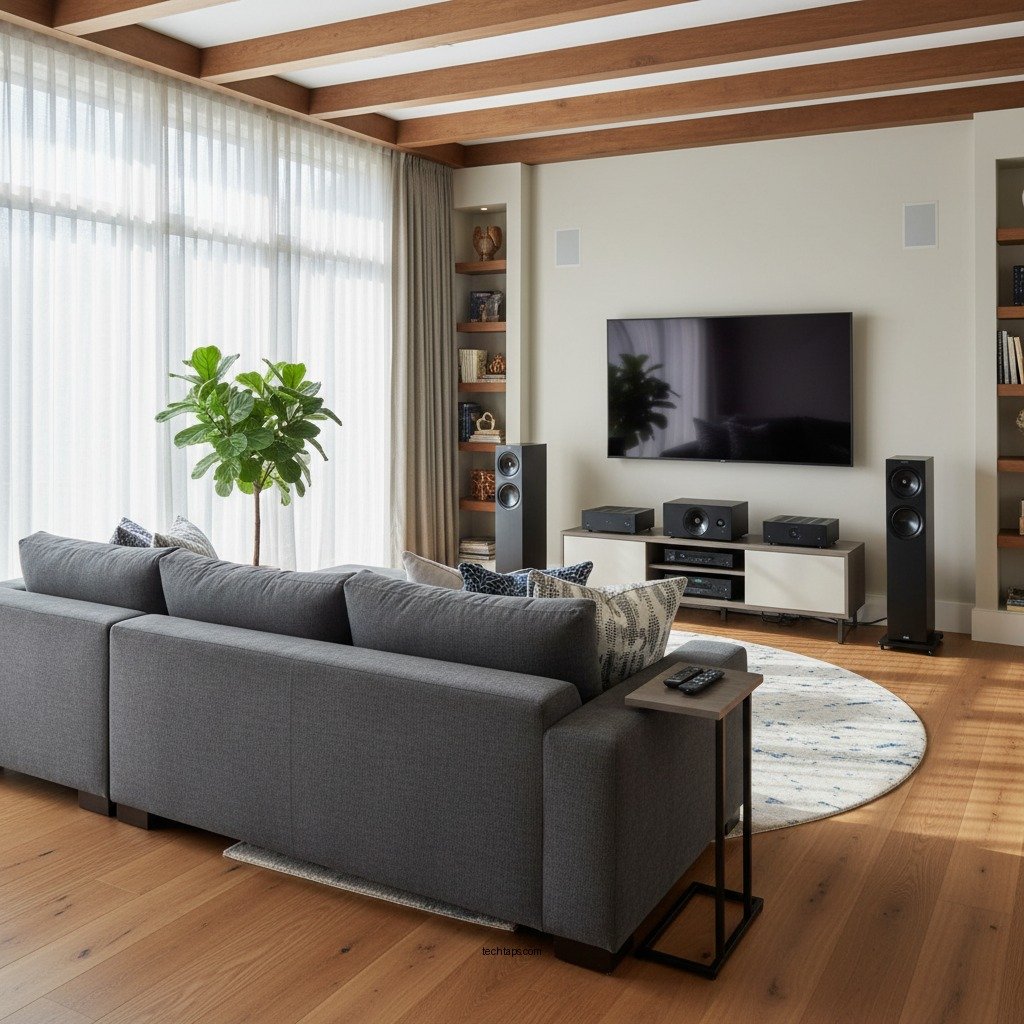
Proper speaker placement is vital for achieving a surround sound system that delivers an immersive audio experience. The ideal setup typically includes a 5.1 or 7.1 configuration, consisting of front left, front right, center, surround left, surround right, and optionally, one or two subwoofers.1. Front Speakers: Position these at ear level, angled toward the listening area. The center speaker should be directly above or below the screen to anchor dialogue and central sounds.
2. Surround Speakers: Place these at ear level, slightly above the listeners, ideally 90 to 110 degrees from the center channel.
3. Height Speakers: If your system includes height speakers for formats like Dolby Atmos, they should be mounted on the ceiling or high on the walls to create an enveloping sound environment.
4. Optimal Viewing Angles: The listening position should ideally form a triangle with the front speakers, with the distance between them equal to the distance from the listener to each speaker.
Room Acoustics and Treatment
Room acoustics play a significant role in sound quality. The dimensions, shape, and materials of your room can either enhance or hinder audio performance. For example, a room with hard surfaces may create echoes, while a room with soft furnishings can absorb sound and improve clarity.
To optimize acoustics, consider the following treatments:
– Acoustic Panels: These can be strategically placed on walls to absorb sound and reduce reflections.
– Bass Traps: Position these in corners to manage low-frequency sounds and prevent muddiness in bass response.
– Rugs and Curtains: Soft furnishings can help absorb sound and improve overall acoustics.
Below is a table summarizing the impact of different room shapes on sound quality.
Impact of Room Shapes on Sound Quality
| # | Room Shape | Impact on Sound Quality | Recommended Treatment |
|---|---|---|---|
| 1 | Square | Reverb and echo issues | Acoustic Panels, Bass Traps |
| 2 | Rectangular | Balanced sound | Minimal Treatment |
| 3 | L-Shaped | Uneven sound distribution | Strategic Acoustic Panels |
| 4 | Circular | Echo issues | Acoustic Panels, Carpeting |
| 5 | Irregular | Highly varied sound quality | Comprehensive Acoustic Treatment |
| 6 | Long and Narrow | Potential for echo | Acoustic Treatments |
| 7 | High Ceilings | Difficulty in sound focus | Ceiling Treatments |
Calibration Techniques
Calibration is essential for optimizing your surround sound system. Most modern AVRs come equipped with automatic calibration tools that utilize a microphone to analyze the room’s acoustics and adjust speaker levels and distances accordingly.
However, manual calibration may yield better results for discerning audiophiles. Start by adjusting the levels of each speaker so that they sound equally loud from the listening position. Use a sound level meter or a smartphone app to measure sound levels.
Pay particular attention to the subwoofer settings, as achieving the right crossover frequency and phase alignment can greatly enhance the bass response without overpowering other frequencies.
Selecting the Right Equipment
Selecting high-quality equipment is crucial for a premium audio experience. Here are some best practices:
– Speakers: Look for speakers with a good balance of frequency response and sensitivity. Brands like Klipsch, Bowers & Wilkins, and KEF are renowned for their excellent sound quality.
– Receivers: Choose a receiver that supports the latest surround sound formats and has enough channels for your setup. Brands like Denon and Yamaha often receive high marks for performance and features.
– Audio Cables: Invest in quality cables that minimize signal loss. While expensive cables are not always necessary, ensuring your cables are well-made and appropriately rated for your system is essential.
– Subwoofer: For deep, rich bass, consider a subwoofer with ample power and adjustable settings. Placement is also crucial; ideally, place the subwoofer in a corner or along a wall to enhance bass response.
Maintenance and Upgrades
To keep your system running smoothly, regular maintenance is essential. Here are a few tips:
– Check Connections: Periodically inspect your cables and connections for wear and ensure everything is securely connected.
– Dust and Clean: Regularly dust your speakers and components to prevent overheating and maintain aesthetic appeal.
– Update Firmware: For receivers with firmware, keep the software updated to ensure compatibility with new formats and improve performance.
When considering upgrades, evaluate your listening habits and whether any components are underperforming. Upgrading speakers or the receiver can yield significant gains in audio performance.
Troubleshooting Common Issues
Even the best systems can encounter issues. Here are some common problems and solutions:
– No Sound from Surround Speakers: Check the audio settings on your receiver to ensure that surround sound is enabled. Verify the connections between the receiver and speakers.
– Unbalanced Sound: If one channel sounds louder than the others, use your receiver’s calibration settings to equalize levels.
– Bass Overpowering: Adjust the crossover frequency on your subwoofer and ensure its placement is not too close to walls, which can cause excessive bass.
– Echo or Reverb: If you experience echo, consider adding acoustic treatments or repositioning speakers to minimize reflections.
By following these troubleshooting tips, you can maintain a seamless audio-visual experience that enhances your entertainment.
In summary, setting up a home theater surround sound system requires careful planning and execution. By understanding surround sound formats, strategically placing speakers, addressing room acoustics, and utilizing calibration techniques, you can create an immersive audio environment. Additionally, selecting the right equipment, performing regular maintenance, and knowing how to troubleshoot common issues will ensure that your home theater remains a source of enjoyment for years to come. For personalized guidance or product recommendations, consider reaching out to audio experts in your area.
Frequently Asked Questions
What are the key components needed for a home theater surround sound system?
To set up an effective home theater surround sound system, you will need a surround sound receiver, multiple speakers (including a subwoofer), and a source device such as a Blu-ray player or streaming device. Additionally, high-quality cables for connectivity and an HDMI switcher can enhance your setup. Investing in a good speaker placement will significantly improve audio performance.
How can I optimize speaker placement for the best surround sound experience?
To achieve optimal surround sound, position your front left and right speakers at ear level, forming a 22-30 degree angle from your viewing position. The center channel should be directly above or below your screen, while surround speakers should be placed slightly above ear level and to the sides or behind your seating area. Don’t forget to calibrate your system using the receiver’s setup tool to ensure balanced audio output.
Why is room acoustics important in setting up a home theater surround sound system?
Room acoustics play a critical role in how sound is perceived in your home theater. Hard surfaces can cause echo and distortion, while soft furnishings can absorb sound and enhance clarity. To improve acoustics, consider adding rugs, curtains, and acoustic panels to minimize sound reflection and create a more immersive listening environment.
What are the best practices for wiring a home theater surround sound system?
When wiring your home theater surround sound system, use high-quality speaker wire and ensure that connections are secure to avoid signal loss. Run cables neatly along baseboards or walls using cable management solutions to keep your setup tidy. Always follow the manufacturer’s guidelines for wire gauge based on your speaker’s distance from the receiver to maintain optimal sound quality.
Which surround sound format should I choose for my home theater system?
The best surround sound format for your home theater largely depends on your equipment and preferences. Dolby Atmos and DTS:X provide immersive audio experiences by adding height channels for a more three-dimensional sound. If you have compatible speakers and receiver, these formats are recommended; otherwise, standard 5.1 or 7.1 surround sound systems are excellent choices for most setups.
References
- Home cinema
https://en.wikipedia.org/wiki/Home_theater - UW Video – University of Washington
https://www.uw.edu/uwtv/producing-a-home-theater/ - Google Scholar Google Scholar
https://scholar.google.com/scholar?q=home+theater+surround+sound+best+practices - https://www.sciencedirect.com/topics/engineering/home-theater
https://www.sciencedirect.com/topics/engineering/home-theater - https://www.bbc.com/future/article/20200103-how-to-choose-the-best-sound-system-for-your-home
https://www.bbc.com/future/article/20200103-how-to-choose-the-best-sound-system-for-your-home - Google Scholar Google Scholar
https://scholar.google.com/scholar?q=surround+sound+setup+guide - https://www.nytimes.com/wirecutter/blog/home-theater-guide/
https://www.nytimes.com/wirecutter/blog/home-theater-guide/ - Google Scholar Google Scholar
https://scholar.google.com/scholar?q=Best+Practices+for+Setting+Up+Your+Home+Theater+Surround+Sound - Best Practices for Setting Up Your Home Theater Surround Sound – Search results
https://en.wikipedia.org/wiki/Special:Search?search=Best+Practices+for+Setting+Up+Your+Home+Theater+Surround+Sound - https://www.ncbi.nlm.nih.gov/search/research-articles/?term=Best+Practices+for+Setting+Up+Your+Home+Theater+Surround+Sound
https://www.ncbi.nlm.nih.gov/search/research-articles/?term=Best+Practices+for+Setting+Up+Your+Home+Theater+Surround+Sound