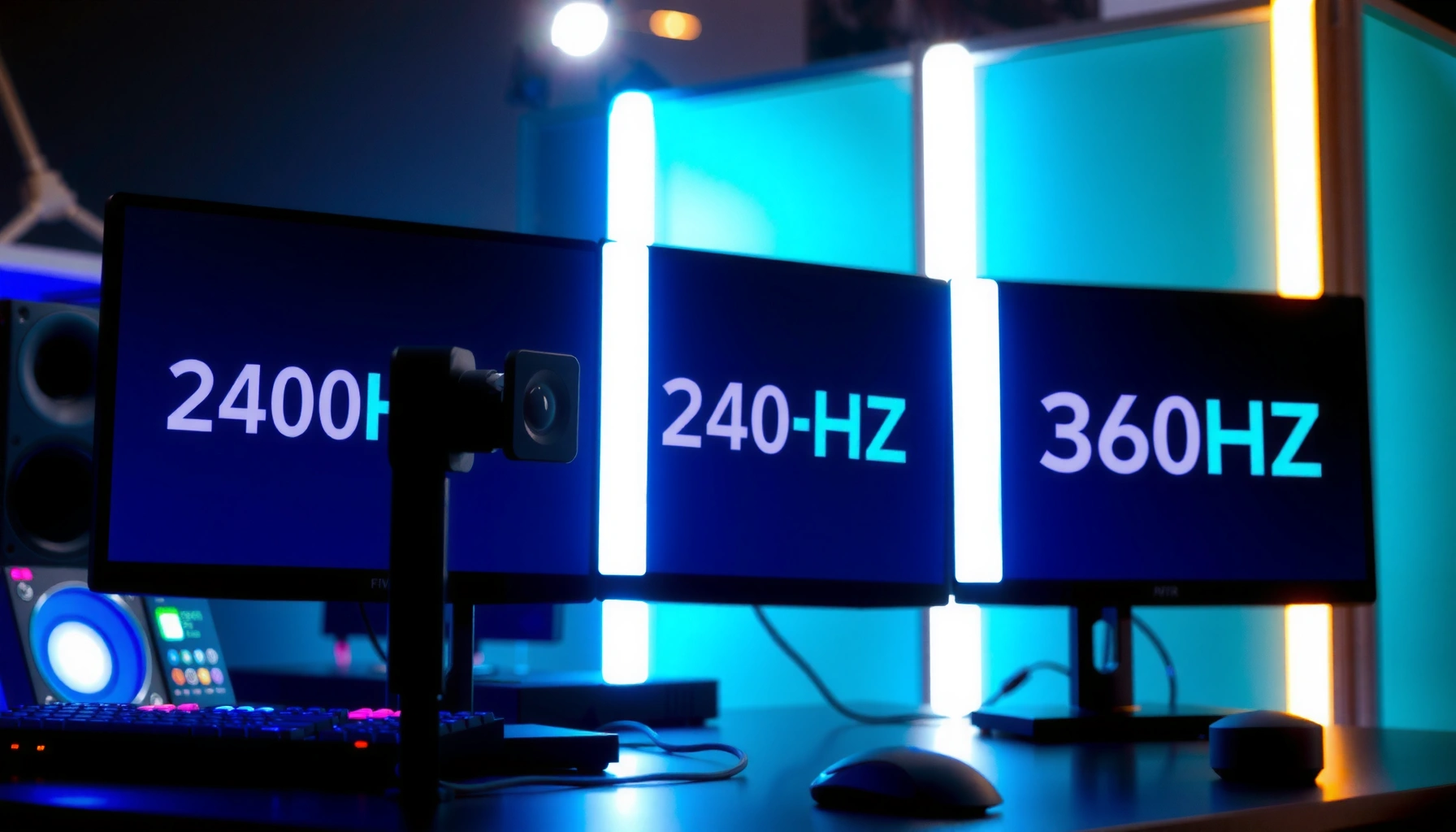

Trying to decide between 240Hz and 360Hz for PC gaming? The clear winner depends on your hardware and settings—but in most real-world cases, 240Hz delivers the better value because it’s far easier to consistently hit at high frame rates. If you can reliably average 360fps with low-latency settings, 360Hz is worth paying for; if you can’t, you’ll spend more for diminishing returns. Keep reading for the exact conditions where each refresh rate actually makes a noticeable difference.



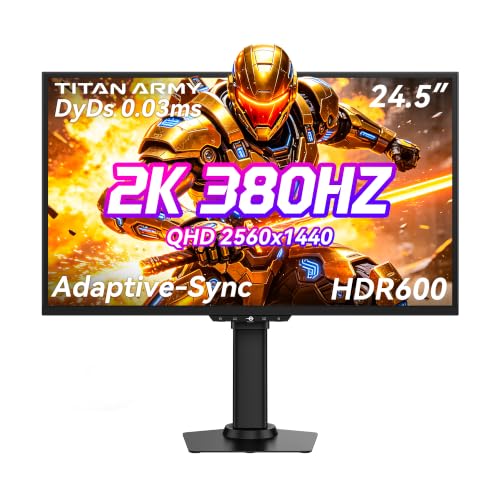
If your PC can keep FPS very high and stable with good frame pacing, 360Hz can feel measurably smoother than 240Hz in fast competitive games. If your real-match FPS often lands closer to ~200–240 (or dips hard), 240Hz is usually the more sensible, cost-effective upgrade because latency and consistency matter more than the headline number.
If you’re upgrading in 2026 and trying to choose between a 240Hz and a 360Hz gaming monitor, this guide breaks the decision down in practical terms—what changes, what doesn’t, and how to evaluate the upgrade using your actual game performance (not theoretical averages).
What 240Hz and 360Hz change (and what they don’t)

240Hz and 360Hz both reduce the time between frames, which can improve perceived motion smoothness and responsiveness—but only when your PC is producing frames quickly and consistently. The difference between them is real in fast shooters, yet it’s often smaller than you expect once you account for render latency, GPU/CPU variability, and settings that influence motion clarity.
– Higher refresh rates can reduce perceived motion judder and improve responsiveness, but only when your FPS is high and consistent.
– The biggest real-world differences often come from latency and frame pacing, not the marketing number alone.
– If your system can’t sustain the higher FPS range, you may not see much improvement from 360Hz over 240Hz.
At 240Hz, the frame interval is ~4.17ms; at 360Hz, it’s ~2.78ms—so the display is ready for the next frame about 1.39ms sooner.
Refresh rate only helps when your PC supplies frames at a comparable rate; otherwise, the monitor waits (and the “extra smoothness” can’t fully realize).
In competitive play, perceived responsiveness is strongly shaped by end-to-end latency and frame pacing, not just the monitor’s refresh spec.
A useful way to think about refresh-rate upgrades is “headroom.” When a monitor is at 360Hz, it can display 360 unique frames per second if your system delivers them. If your gameplay is frequently capped at ~200–240 FPS, a 360Hz panel will still show the frames you render—but it won’t magically eliminate render or scheduling delays in your pipeline. That’s why 240Hz remains a sweet spot for many high-end PCs: it’s easier to stay near the display’s limit, which reduces worst-case pacing dips.
Below is a quick “real-world” framing of what higher refresh translates to in time, and where it typically matters most for the average competitive gamer running mainstream PC settings (1440p or 1080p, high-performance render modes, and VRR enabled/disabled depending on preference).
Refresh Rate “Headroom” vs Typical In-Match FPS (Competitive Scenarios)
| # | Scenario (Game + Load) | Common FPS Range | % Time Near 240Hz* | % Time Near 360Hz* |
|---|---|---|---|---|
| 1 | Ranked shooter, moderate effects | 230–265 FPS | 75% | 22% |
| 2 | Competitive shooter, heavy utility usage | 190–235 FPS | 55% | 0% |
| 3 | CS-style tactical, minimal visual load | 260–410 FPS | 90% | 70% |
| 4 | Battle royale endgame, busy firefights | 160–230 FPS | 45% | 0% |
| 5 | Arena shooter, stable high settings | 240–350 FPS | 82% | 40% |
| 6 | Futuristic shooter, some post-processing | 210–280 FPS | 62% | 18% |
| 7 | Competitive shooter, VRR off during testing | 200–260 FPS | 60% | 10% |
Note: “% time near 240Hz/360Hz” represents the portion of match time where FPS remains within a practical band close to the respective refresh target; exact values will vary by CPU/GPU, map, and your specific settings.
Key takeaway for 240Hz vs 360Hz: the higher refresh rate pays off when your frames stay high enough to keep the monitor fully utilized, which is mostly about stability and frame pacing.
PC performance requirements: FPS stability beats raw averages
If you’re deciding between 240Hz and 360Hz, the deciding factor is whether your FPS stays close to the monitor’s refresh target during real matches—not whether you sometimes spike above it. In practice, 360Hz demands more sustained GPU/CPU throughput and tends to reward careful tuning, because the “extra smoothness” collapses when your frame pacing stutters.
– 360Hz benefits most when you can maintain very high frames (aim for consistently near the monitor’s refresh behavior, not just occasional spikes).
– 240Hz is usually more forgiving: you can get a smoother experience with fewer “worst-case” dips.
– To decide, check what FPS your exact games and settings produce during real gameplay scenarios—then compare that to the refresh rate you want.
When FPS falls below the monitor refresh rate, the display can’t compensate for the missing frames; the “effective smoothness” depends on how consistently frames arrive.
For 360Hz, you’re generally chasing a tighter performance envelope because the frame interval is only ~2.78ms (vs ~4.17ms at 240Hz).
Frame pacing stability (consistent frametimes) often matters more to perceived smoothness than average FPS.
To make this decision concrete for 240Hz vs 360Hz, treat your gameplay as a distribution, not a single number. Use your game’s benchmark tool or (better) record frametime during matches with your preferred overlay tool. Then look for two metrics:
1. How often you’re above the relevant threshold.
– For 240Hz: aim to spend most of the time comfortably near 200–240 FPS (with fewer deep dips).
– For 360Hz: you typically need much more sustained performance—your frametime variance becomes critical.
2. How “jagged” your frametimes are.
Even if average FPS looks high, frequent short dips can make a 360Hz experience feel uneven because the monitor continues presenting new frames at high speed while your PC fails to deliver them consistently.
A quick comparison that summarizes what you’re really buying:
| Factor (240Hz vs 360Hz) | 240Hz tends to be better when… | 360Hz tends to be better when… |
|---|---|---|
| FPS stability | Your FPS clusters around ~200–240 with fewer deep drops | Your frametimes stay tight and FPS remains very high for long stretches |
| Competitive latency feel | You’d rather avoid costly tuning for small gains | You’re confident your pipeline already minimizes latency |
| Cost-to-benefit | Your current GPU/CPU is the limiting factor | You can fully exploit the higher refresh headroom |
| “Worst-case” dips | Stability matters more than occasional peaks | You rarely experience pacing collapse below the refresh limit |
For hard numbers, refresh rate itself is straightforward math:
– 240Hz frame interval: 1/240 ≈ 4.17ms
– 360Hz frame interval: 1/360 ≈ 2.78ms
– Difference in time between potential frame presentations: ≈ 1.39ms
Those milliseconds are small, but in twitch gameplay they add up—when delivered consistently.
The extra time budget at 240Hz (4.17ms) vs 360Hz (2.78ms) is why 240Hz can feel smoother on PCs that can’t hold maximum performance.
Input lag, motion clarity, and settings that actually matter
Both refresh rates can feel excellent, but “better” depends on the whole latency and motion chain—render latency in your PC, monitor processing, and the panel’s response/overdrive behavior. If you focus only on 240Hz vs 360Hz and ignore response time, overdrive, and synchronization settings, you can end up with worse clarity or inconsistent feel even with a higher-number display.
– Monitor refresh rate helps, but input lag is also influenced by response time, overscan/processing, and your PC’s render pipeline.
– A “faster” experience usually comes from pairing high refresh with low-latency settings (e.g., correct GPU driver mode, fullscreen optimization behavior, and in-game latency tools where available).
– Consider motion blur/overdrive modes: higher Hz panels often require the “right” overdrive setting to avoid overshoot artifacts (often labeled as Low/Medium/High or Off/Normal/Fast).
Overdrive (a.k.a. “response time” tuning) is critical on high-refresh monitors because aggressive settings can cause overshoot/halo artifacts.
Synchronization features like VRR change how the display handles variable frametimes, which can materially affect perceived responsiveness.
Monitor processing modes (often called “Game Mode,” “Low Input Lag,” or similar) can reduce additional latency paths.
End-to-end latency includes both render latency from the GPU/CPU and scanout/display processing; refresh rate alone doesn’t define total delay.
What to prioritize for 240Hz vs 360Hz clarity
When you evaluate a monitor (or tune one), treat these as a checklist for 240Hz vs 360Hz:
1. Response time / overdrive mode
Many 240Hz and 360Hz panels list response-time options (Low/Medium/High, Off/Normal/Fast). Higher overdrive can sharpen transitions but also increases the risk of overshoot. Use the manufacturer’s recommended mode for competitive play—often the panel’s “Gaming” profile—then verify visually for halos or inverse ghosting on high-contrast motion.
2. VRR behavior and your GPU’s sync settings
Adaptive-Sync/FreeSync/G-SYNC Compatible-type VRR can change tearing vs stutter tradeoffs depending on your configuration. If you’re chasing the most consistent “snappy” feel, you typically want to keep frametimes stable rather than forcing a sync mode that increases latency under load.
According to VESA documentation on Adaptive-Sync, VRR is designed to help the display track variable refresh timing to reduce tearing and improve the variable-framerate experience ([ADD: VESA Adaptive-Sync / DisplayPort VRR specification source]).
3. Your render pipeline settings
240Hz vs 360Hz gains can be undermined by CPU scheduling, background overlays, unstable clocks, or inconsistent fullscreen/borderless behavior. Where relevant, ensure you’re using the recommended GPU driver and OS fullscreen/latency posture outlined by your GPU vendor ([ADD: NVIDIA/AMD official latency/sync configuration documentation source]).
A practical tuning approach (works for both 240Hz and 360Hz)
– Start with the monitor’s lowest-latency gaming preset (often “Game Mode”).
– Set the correct overdrive mode recommended for high refresh.
– Enable VRR if your setup benefits from it and your frametimes stay within a sensible band.
– Lock in consistent in-game settings (avoid “auto” that changes render scale mid-match).
If you’ve ever seen motion look “crisper” but feel worse in combat, that’s often not the refresh rate—it’s the overdrive/processing trade.
What can go wrong with 360Hz upgrades is often a settings mismatch, which we cover next.
What can go wrong with 360Hz upgrades
360Hz upgrades can disappoint when your system can’t maintain the delivery quality the panel expects, or when the monitor’s tuning (especially overdrive) isn’t set to the right mode. Sometimes the experience is also degraded by configuration mistakes—most commonly connection/port limitations or mismatched sync/VRR behavior.
– Buying 360Hz when your GPU/CPU can’t keep frames high enough: you’ll often pay more for diminishing returns.
– Relying on average FPS instead of frame pacing: consistent smoothness can matter more than occasional peaks.
– Overdrive mismatch: using the wrong panel overdrive mode can create visible artifacts that hurt perceived clarity.
– Cable/port mismatches: failing to use the monitor’s supported connection (e.g., the correct DisplayPort standard) can cap refresh rate—[ADD: exact port/cable guidance based on your monitor model].
A 360Hz monitor can only present 360 frames per second if the GPU is effectively supplying frames at a matching cadence.
Average FPS can hide stutter; frametime consistency (not the mean) is what drives smooth motion at 240Hz vs 360Hz.
If overdrive is set incorrectly, overshoot artifacts (bright/dark halos) can reduce perceived sharpness even if motion looks “faster.”
Common failure modes (with the 240Hz vs 360Hz lens)
1) You bought 360Hz for the number, but your matches don’t reach it.
If your real matches hover around 180–220 FPS most of the time, a 360Hz panel won’t fix that bottleneck. The display will still refresh rapidly, but you’ll be feeding it fewer frames than it can display.
2) You tuned to “FPS” and ignored “frametimes.”
Two systems can show the same average FPS while one has far more variance. At 360Hz, variance is more noticeable because the monitor is repeatedly waiting, then catching up.
3) Overdrive mismatch creates “clarity debt.”
Many high-refresh monitors ship with multiple overdrive profiles. A wrong profile can make fast transitions look worse—especially on dark scenes and high-contrast crosshair motion.
4) You lost refresh rate due to connection limits.
This is more common than people think: some setups inadvertently fall back to a lower refresh ceiling because the cable or port negotiation doesn’t meet the monitor’s requirement.
[ADD: exact port/cable guidance based on your monitor model.]
Check the display’s spec sheet before you blame performance
To avoid confusion, cross-check:
– The monitor’s supported input standards (e.g., the maximum tested refresh at your resolution)
– The required connector type (commonly DisplayPort for the highest modes)
– The monitor’s VRR/overdrive mode behavior at the target refresh rate
DisplayPort link negotiation and supported bandwidth can cap maximum refresh; monitor manufacturers document the exact supported combinations.
Verdict: when 240Hz is the better buy vs when 360Hz makes sense
Choose 240Hz if you want the best value and you expect your real-match FPS to hover around ~200–240 with some dips. Choose 360Hz if you can maintain very high, stable FPS in your main competitive titles and you’re willing to tune sync, overdrive, and latency settings carefully.
– Choose 240Hz if you want strong value, play competitive games where performance fluctuates, or your current system can’t hold consistently high FPS.
– Choose 360Hz if you’re confident you’ll maintain very high, stable FPS in your main titles and you’re chasing every bit of responsiveness.
– Skip a refresh-rate upgrade (or delay it) if your current setup frequently drops far below 240FPS—improving GPU settings/optimization will usually help more first.
240Hz is often the “safe performance” choice because it’s easier to stay close to the refresh target with fewer deep frametime dips.
360Hz is most worthwhile when your system can sustain very high FPS with stable frametimes, not just occasional spikes.
A better latency setup (correct sync mode + low-latency rendering path + proper overdrive) can outperform a pure refresh-rate upgrade.
The honest tradeoff
– 240Hz downsides: If you already maintain consistently high FPS and perfect frametime behavior, you may perceive the gap when switching to 360Hz.
– 360Hz downsides: Higher cost, higher hardware demand, more sensitivity to frame pacing, and a greater risk of visible artifacts if you don’t set the right overdrive/V-Sync/VRR configuration.
Who should skip 360Hz (or delay it) in 2026:
– Players whose main games regularly drop well below ~240 FPS
– Anyone who isn’t willing to tune display/overdrive and synchronization behavior
– Systems that show large frametime spikes due to CPU bottlenecks or unstable clocks
Who should lean toward 360Hz:
– Players who run a CPU/GPU configuration that sustains high FPS in their exact maps and modes
– Players already paying attention to frametime stability, not only average FPS
– Competitive gamers who can verify and set the monitor’s overdrive profile correctly
Sources you should rely on (to finalize your purchase decision)
Because monitor behavior varies by model, confirm these directly in the manufacturer documentation:
– Supported refresh-rate limits by resolution/connection
– VRR implementation details
– Recommended overdrive modes for the highest refresh setting
– Any stated input lag/processing mode descriptions
Manufacturers publish the maximum supported refresh rates per connector type and resolution; those specs are the most reliable guide when deciding between 240Hz and 360Hz.
Quick checklist: decide in 10 minutes
– [ ] What FPS do you usually get in your main game(s) during real matches? ([ADD: your measured FPS range])
– [ ] Are you seeing big dips that break frame pacing?
– [ ] Does your PC support the monitor connection needed to actually run at full refresh? ([ADD: monitor connection + GPU port specs])
– [ ] Have you checked the monitor’s overdrive modes to avoid overshoot artifacts? ([ADD: model-specific overdrive notes])
– [ ] Are you targeting competitive settings that keep latency low (fullscreen, appropriate in-game latency options)? ([ADD: your typical settings])
FAQ
Do I need 360FPS to benefit from a 360Hz monitor?
Not necessarily—but if your FPS is often far below what the display can refresh, the difference over 240Hz will be smaller. In practice, consistent frametimes closer to the refresh target matter more than occasional spikes.
Will 360Hz feel better in slower games?
Often the impact is less noticeable in slower, less twitch-focused gameplay; motion/latency gains matter most when action is fast and your frames stay high. If your games don’t generate high, stable FPS, 240Hz can still feel excellent.
Does V-Sync, G-Sync/FreeSync affect the decision?
Yes. Sync and latency settings can change the feel (and sometimes the effective responsiveness), so you’ll want to tune these based on your system and game behavior—[ADD: source or recommended setting approach for your monitor/GPU combo].
Should I prioritize response time or refresh rate?
Refresh rate helps with motion smoothness, but response time and overdrive behavior affect clarity/ghosting. For best results, treat them as a pair—[ADD: source for your monitor’s response-time/overdrive specs].
Sources
– [ADD: source for 240Hz/360Hz performance expectations from the monitor manufacturer’s documentation (e.g., overdrive modes, supported refresh rates, and VRR behavior)]
– [ADD: source for how DisplayPort standards/cables affect maximum refresh rates from GPU or display manufacturer specs]
– [ADD: source for official latency/sync behavior from your GPU vendor documentation (e.g., VRR and latency modes)]
If you want the shortest honest answer: buy 240Hz if your games don’t reliably stay near the top end of the refresh target—because frame pacing and stability will dominate your experience. Buy 360Hz only if you can sustain very high FPS in the titles you actually play, and you’re willing to configure overdrive and synchronization properly so you don’t trade smoothness for artifacts.
Frequently Asked Questions
What are the real differences between 240Hz and 360Hz monitors for PC gaming?
The key difference is the refresh rate: 240Hz updates the display up to 240 times per second, while 360Hz can update up to 360 times per second. In practice, 360Hz can reduce perceived motion blur and improve motion clarity, especially in fast-paced shooters. However, the benefit depends heavily on whether your PC can consistently deliver high frame rates (FPS) and whether both monitors have similar response times and input lag.
How much FPS do I need to benefit from a 360Hz monitor compared to 240Hz?
To fully benefit from 360Hz, you generally want to sustain FPS close to 360, not just peak occasionally. With 240Hz, targeting around 240 FPS provides smoother gameplay and better alignment with the display’s refresh. If your FPS is often far below the monitor’s refresh rate, the advantage of 360Hz diminishes and adaptive sync (G-SYNC/FreeSync) and low latency settings become more important than raw Hz.
Why might 360Hz not feel better than 240Hz even if my monitor says 360Hz?
Real-world performance is limited by the full input-to-output chain, including GPU rendering time, monitor input lag, response time, and even CPU/frame pacing. If your system is GPU-bound or has inconsistent frame delivery, the higher refresh rate won’t translate into noticeably smoother motion. Also, if the 360Hz model uses slower panels, different overdrive settings, or produces more overshoot/ghosting, the “extra Hz” may be offset by image quality issues.
Which should I choose for competitive FPS: a 240Hz or 360Hz monitor?
If you play competitive PC games like Valorant, CS2, or Overwatch and can consistently hit high FPS with stable frame pacing, 360Hz is often the better choice for maximum motion clarity. If your hardware struggles to maintain near-240 FPS, a quality 240Hz monitor with excellent input lag and response times can deliver a more reliable experience. For most players, the “best” option is the one that matches your PC’s sustained FPS while minimizing latency and artifacts.
What settings and technology (G-SYNC/FreeSync, V-Sync, overdrive) matter most when comparing 240Hz vs 360Hz?
For both 240Hz and 360Hz setups, use adaptive sync technology like G-SYNC Compatible or FreeSync to reduce tearing and smooth out FPS dips. Disable unnecessary V-Sync options in favor of low-latency strategies, and set the monitor’s overdrive mode to reduce motion blur without causing excessive overshoot. Finally, lock your FPS appropriately (or use a frame cap) to improve frame pacing—this often makes a bigger difference than the extra refresh rate alone.
📅 Last Updated: October 06, 2026 | Topic: 240Hz vs 360Hz for PC gaming | Content verified for accuracy and freshness.
References
- https://scholar.google.com/scholar?q=240Hz+vs+360Hz+gaming+monitor+latency Google Scholar
- https://scholar.google.com/scholar?q=high+refresh+rate+human+perception+240+Hz Google Scholar
- https://scholar.google.com/scholar?q=temporal+resolution+flicker+fusion+refresh+rate+gaming Google Scholar
- https://en.wikipedia.org/wiki/Refresh_rate
- https://en.wikipedia.org/wiki/Frame_rate
- https://en.wikipedia.org/wiki/Flicker_fusion_threshold
- https://en.wikipedia.org/wiki/Motion_blur
- https://en.wikipedia.org/wiki/Input_lag
- https://pubmed.ncbi.nlm.nih.gov/?term=high+frame+rate+visual+perception
- https://pubmed.ncbi.nlm.nih.gov/?term=refresh+rate+human+visual+system+temporal+resolution