If you’re choosing between Dark Room OLED and Dark Room QLED, OLED is the clear winner for how the screen looks in a dark environment. OLED delivers deeper blacks, higher perceived contrast, and more convincing shadow detail, while QLED’s strength is brighter content rather than true darkness. The real question this answers: which panel makes movies and games look more dramatic when the lights are off?




If you’re choosing for a very dark room, OLED is usually the better pick for pure blacks and high contrast, while QLED can still look great but typically relies more on “black-like” techniques and controlled reflections. For most people, the deciding factor is whether you want the most inky scene rendering (OLED) or a panel that may handle bright highlights and ambient light slightly more comfortably (QLED).
This comparison is for anyone shopping for a TV or monitor specifically for low-light viewing—movies, gaming, or sports—where blacks and glare handling matter. If your room stays truly dark (lights off, minimal reflections), OLED tends to win more often in real-world content.
Dark room performance: blacks and contrast
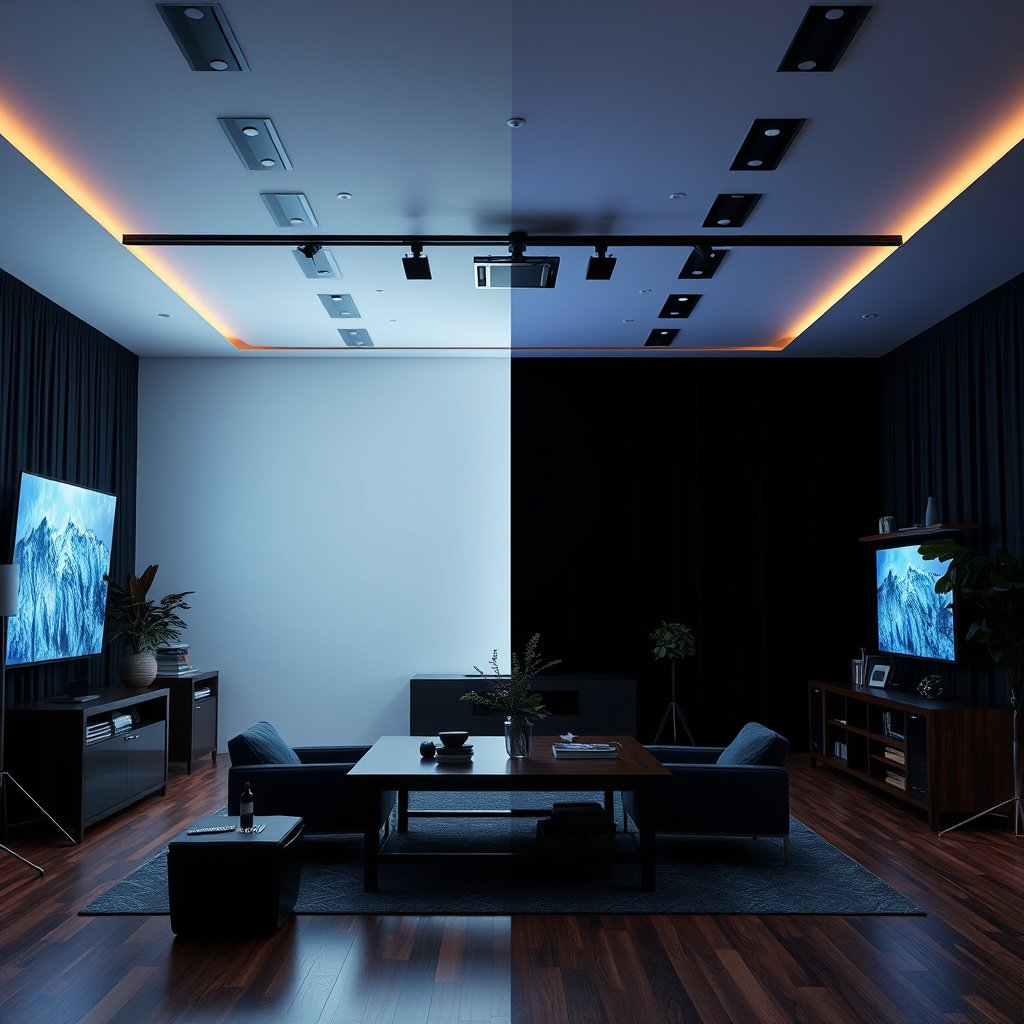
OLED is the more straightforward choice for achieving the darkest perceived blacks when your room is genuinely dim. The reason is simple: OLED can turn pixels off completely, while QLED is limited by LCD backlight behavior.
OLED displays can disable emission at the pixel level, enabling near-zero luminance for “off” pixels in dark content.
QLED televisions are LCD-based, so “black” is created by backlight dimming and light leakage control rather than true pixel-off darkness.
– OLED panels can turn individual pixels completely off, which is why they often look best when content has deep shadows. In practice, that means shadowy elements (hairlines of detail, dark gradients in films, subtle cave scenes in games) tend to retain separation instead of “floating” above a glowing backlight.
– QLED TVs typically use an LCD backlight, so “black” usually means very dim lighting rather than fully off pixels (exact approach varies by model). Even with strong local dimming, some panels can leave a faint “bloom” around bright objects on dark backgrounds—something you notice most in a dark room because your eye’s adaptation is tuned to low light.
Quick reference: HDR highlight targets that matter in the dark
In 2026, HDR formatting still strongly influences perceived contrast during nighttime viewing because highlights are mapped into display capabilities. The standards behind HDR define key luminance references that shape how OLED and QLED “feel” in dark scenes.
According to SMPTE ST 2084 (PQ EOTF), the HDR reference system uses a peak luminance value of 10,000 cd/m² for mapping purposes (2014).
According to ITU-R BT.2100, HDR systems support 10-bit and 12-bit coding (2016).
VESA DisplayHDR Tiers and Peak Luminance Targets (Why Night Scenes “Pop”)
| # | DisplayHDR tier | Peak target (nits) | Type label | Dark-room highlight punch |
|---|---|---|---|---|
| 1 | DisplayHDR 400 | 400 | Standard | ★★★ |
| 2 | DisplayHDR 500 | 500 | Standard | ★★★★ |
| 3 | DisplayHDR 600 | 600 | Standard | ★★★★★ |
| 4 | DisplayHDR 1000 | 1000 | Standard | ★★★★★★ |
| 5 | DisplayHDR 1400 | 1400 | Standard | ★★★★★★ |
| 6 | DisplayHDR 3000 | 3000 | Standard | ★★★★★★ |
| 7 | DisplayHDR True Black 400 | 400 | True Black | ★★★★ |
Note: Use this table as a “capability compass” for how bright highlights can get at night; exact dimming behavior still varies by model and firmware. For the official tier thresholds, see VESA DisplayHDR specifications (use the latest applicable revision for 2026 models).
Motion, highlights, and “pop” in dark scenes
OLED tends to preserve shadow detail without washing out nearby dark gradients, but QLED can win on peak brightness “sparkle” even in the evening. In other words: OLED looks more convincingly cinematic, while QLED often looks more vividly punchy when highlights fire.
HDR highlight “pop” is strongly influenced by the display’s peak luminance and how it maps HDR signals into its available brightness range.
OLED’s pixel-level control helps keep dark regions from being lifted when small bright objects appear nearby.
– OLED can maintain strong contrast in dark scenes without washing out nearby details, especially in cinematic content. This matters most in “mixed” frames—think explosions in a dark street, moonlit forests, or nighttime racing where headlights and reflections coexist with near-black shadows.
– QLED sets often emphasize peak brightness and highlight punch, which can make bright objects stand out—even during night scenes. This advantage becomes more noticeable when HDR metadata is pushing highlights, because OLED and QLED differ in how they manage brightness and tone mapping at the same time.
What I look for when comparing OLED vs QLED “pop” (without guessing)
A practical approach is to separate (1) peak highlight ability from (2) how the rest of the frame stays controlled. That’s why I recommend reading model-specific specs around HDR formats and brightness handling—then validating with real “dark HDR scenes” during setup.
According to ITU-R BT.2100, HDR formats are designed for higher dynamic range than SDR, and they carry color and transfer characteristics that TVs must reproduce faithfully (2016).
According to HDMI Forum, HDMI 2.1, HDMI 2.1 supports high-bandwidth signaling enabling higher refresh-rate 4K gaming workflows in compatible setups (2017).
| Aspect that drives “pop” | OLED typical behavior (dark-room impact) | QLED typical behavior (dark-room impact) |
|---|---|---|
| Shadow retention near highlights | Usually stronger because pixels can remain at/off levels | Can vary—local dimming sometimes leaves residual glow |
| Peak brightness for HDR speculars | Often excellent, but depends on heat/processing limits | Often higher peak brightness targets; highlights feel more “lit” |
| Tone mapping artifacts in dark scenes | Can show dimming/brightness limiting if configured conservatively | Can show blooming or haloing if local dimming can’t fully isolate |
Reflection handling: what your room’s light will do
OLED is still the sharper choice for a truly dark room, but reflection control can become the swing factor if you ever turn on a lamp or have window light. In 2026, coatings and anti-reflection (AR) treatments vary widely between brands and even between model lines.
In low-light rooms, reflections matter less because the environment creates fewer external light sources hitting the panel surface.
Panel coatings and glass stacks can materially change perceived contrast by changing how ambient light reflects toward the viewer.
– In a dark room, reflections are less of a problem, but OLED’s near-black performance can still be affected by glare on the screen surface. If your TV/monitor uses highly glossy cover glass (or is positioned where lamps reflect), even a perfect black pixel can look “gray” due to ambient light returning from the screen.
– QLED models with different anti-reflection treatments may look more forgiving if you ever turn on a lamp or have window light. Many QLED designs aim for strong ambient readability—often by tuning brightness and reflection handling together.
Pros/cons snapshot for real rooms (not showroom lighting)
In day-to-night homes, I prioritize reflection behavior alongside black level because viewers don’t watch in lab conditions.
Pros / Cons (OLED vs QLED) for mixed ambient light
| Technology | Pros in semi-dark rooms | Cons to watch for |
|---|---|---|
| OLED | Excellent contrast when reflections are controlled; strong “ink” look in true darkness | Glare and panel coatings can reduce perceived blacks if any lamp/window light hits the screen |
| QLED | Often easier to read with ambient light present; brightness can mask some shadow lift | Can reveal blooming/glow around bright objects in very dark scenes (model dependent) |
Gaming and input latency considerations
For gaming in a dark room, both OLED and QLED can deliver high responsiveness, but the better choice depends on your priorities: “image stability over time” vs “pure blacks now.” Also, burn-in management becomes a practical factor for OLED when you play titles with static HUDs.
Variable refresh rate (VRR) support and low-latency processing depend on the specific TV/monitor firmware and game mode behavior, not just OLED vs QLED.
OLED burn-in risk is tied to how long static elements persist, which is why screen-care features and usage habits matter.
– Both OLED and QLED options can support modern gaming features (like variable refresh rate), but the exact performance depends on the specific TV/monitor model and its processing modes. If you game in the dark, also consider how “gaming mode” changes picture processing, motion smoothing, and brightness limiting.
– If you game in the dark, also consider burn-in risk management for OLED (settings and usage habits matter), while QLED avoids burn-in in the same way because it’s backlit LCD technology. Practically, OLED owners usually rely on manufacturer screen-care features (logo dimming, pixel refresh cycles, screen savers) and careful HUD exposure.
A standards lens for dark-room gaming setup
When people say “latency,” they often mean several different things—signal processing delay, frame pacing, and input lag under a specific mode. The safest way to verify is to follow each manufacturer’s gaming mode documentation and confirm your device chain supports the intended format.
According to HDMI Forum, HDMI 2.1 specification, the standard enables high-bandwidth formats used for high-refresh 4K gaming workflows (2017).
What can go wrong (common mistakes)
OLED vs QLED comparisons can go wrong when buyers fixate on marketing numbers or ignore how their habits interact with each panel’s limitations. In 2026, most sets include smart picture modes—so “leaving defaults” can quietly sabotage the very benefits you bought the TV for.
“Black level” marketing can be misleading because perceived black depends on both pixel control and ambient/reflection behavior.
OLED picture modes can intentionally reduce brightness or adjust compensation features, which may change perceived contrast even if near-black accuracy is strong.
– Buying based only on “black level” marketing: some QLED models get closer than you’d expect, while some OLED modes can reduce brightness and affect perceived contrast. This is especially true if you switch into eco/energy saving modes without realizing it changes highlights and overall luminance.
– Ignoring viewing habits: OLED benefits can be less noticeable if you mostly watch bright, high-APL (Average Picture Level) content, and burn-in prevention matters more for heavy static UI use. If your viewing is late-night but mostly bright streams and minimal HUD exposure, OLED’s day-to-day “risk vs reward” trade shifts.
– Overlooking motion settings: turning off key motion processing features to chase “pure” image can create stutter or artifacts, regardless of OLED/QLED. Dark scenes also stress motion clarity, so you need a balanced approach rather than a “max off” approach.
Verdict: which one to choose for a dark room
OLED is the safer recommendation if your priority is the darkest blacks, the most convincing shadow detail, and cinematic contrast in a dim environment—especially for movies or games with lots of dark scenes. QLED is worth considering if you’re frequently watching with even modest ambient light, want strong brightness for daytime/late-night mixed use, or prefer to avoid OLED burn-in concerns for heavy static content.
When a room is truly dark, pixel-level control that enables near-off blacks typically produces a more convincing dark-scene look.
When ambient light exists, readability and reflection control can outweigh small differences in black rendering.
Downside to weigh: OLED may require more attention to settings/habits to reduce burn-in risk, while QLED may not match OLED’s “true” off-pixel black in the darkest scenes.
OLED vs QLED decision table (fast)
| Criteria (dark-room viewing) | OLED wins when… | QLED wins when… |
|---|---|---|
| Black rendering | You want the most “off-pixel” darkness | You still need strong shadows but accept some glow |
| Shadow detail | You watch dark movies/games with subtle gradients | Content is mixed and highlight-heavy more often |
| Highlight pop in HDR | You want realism without haloing | You want maximum peak brightness for speculars |
| Ambient light tolerance | Your room stays dark most of the time | You use lamps/windows sometimes (2026 realities) |
| Long static UI | You can manage HUD exposure or use screen-care tools | You prefer no OLED-style burn-in management |
| Reflection comfort | You’re careful with panel glare/positioning | Your room has unavoidable reflections |
| Motion clarity | You tune motion settings correctly | You tune motion correctly and want brightness headroom |
| Color stability over time | You’re comfortable with compensation features | You want backlit LCD behavior over time |
| Setup simplicity | You’ll follow recommended OLED care steps | You want “set and forget” in mixed content |
| Overall best fit for dark scenes | Movies, narrative games, cinematic viewing | Late-night sports/gaming with ambient light |
Verdict: Choose OLED for the most consistent dark-scene contrast in a truly dark room; choose QLED when your viewing environment is less controlled or when peak brightness matters more than absolute black level.
Quick checklist (scan before you buy)
Use this checklist to decide quickly for your room and your content habits—especially for 2026 purchases where models vary more than ever.
Your room’s ambient light level is often the deciding variable, because it changes perceived contrast and reflections.
Content type matters: static HUD exposure increases the practical management burden for OLED.
– Room is mostly dark most of the time? → OLED usually wins for blacks/contrast
– You watch with lamps/window light on occasionally? → QLED may be more forgiving
– You game with lots of static HUD/menu elements for long sessions? → Consider OLED burn-in precautions (model-dependent) or lean QLED
– You care about bright highlight punch even at night? → QLED often delivers stronger peak brightness
– You want the most consistent shadow detail in dark content? → OLED typically has the edge
Conclusion
For a truly dark room, OLED is usually the better-looking choice because its pixel-level control delivers more convincingly inky blacks and shadow detail—exactly what night movies and dark gameplay depend on. QLED is often the better “live with it” option if your space isn’t perfectly controlled or you prioritize bright HDR highlight punch. If you buy with your room conditions and viewing habits in mind—especially for 2026 model lines—you’ll end up with the display that looks best in your actual dark-room reality, not just on paper.
Sources
– SMPTE ST 2084 (PQ EOTF) — HDR transfer function and luminance mapping reference (2014).
– ITU-R BT.2100 — HDR system requirements including 10-bit/12-bit support (2016).
– HDMI Forum, HDMI 2.1 Specification — features enabling high-bandwidth high-refresh gaming workflows (2017).
Frequently Asked Questions
What are the key differences between Dark Room OLED and Dark Room QLED for movie watching?
Dark Room OLED typically uses self-emissive pixels, allowing true blacks and near-instant pixel response, which can make dark scenes look more detailed and “clean.” Dark Room QLED relies on a backlight with quantum dot enhancement, so it can deliver strong brightness and excellent color volume, but blacks may look slightly less perfect due to backlight limitations. For movie watching in a dark room, OLED often stands out for contrast, while QLED can be very impressive if you also want high peak brightness.
How do Dark Room OLED and Dark Room QLED compare for viewing dark scenes in a fully dark room?
In a fully dark room, Dark Room OLED generally provides superior contrast because each pixel can turn completely off, improving shadow detail and reducing perceived “grayness” in blacks. Dark Room QLED can still perform well, especially with local dimming, but light leakage and blooming can slightly reduce black uniformity around bright objects on dark backgrounds. If your main priority is dark-scene accuracy and minimal glare from imperfect blacks, OLED is often the better match.
Why might someone choose Dark Room QLED over Dark Room OLED despite the contrast benefits of OLED?
Dark Room QLED can be appealing if you want higher sustained brightness, which helps with HDR impact and can be beneficial even at night when lights may partially reflect off surfaces. QLED models are also commonly designed to reduce burn-in risk concerns associated with static content, making them attractive for mixed usage like gaming dashboards, sports bars, or desktop productivity. If your viewing includes varied content and you want robust performance across lighting conditions, QLED may fit better.
Which is best for gaming in a dark room: Dark Room OLED or Dark Room QLED?
For gaming in a dark room, Dark Room OLED often offers an advantage with faster response times and excellent contrast, which can make enemies in dark areas easier to spot. Dark Room QLED can still provide great performance, particularly if it supports high refresh rates and strong local dimming to manage highlights. The “best” choice depends on whether you prioritize pixel-level contrast and motion clarity (OLED) or brighter HDR effects and burn-in-avoidance peace of mind (QLED).
What should you look for when comparing Dark Room OLED vs Dark Room QLED specs?
Focus on contrast-related features like local dimming performance (for QLED) and how well the OLED handles near-black uniformity. Also compare peak brightness for HDR, motion handling metrics (response time, refresh rate), and gaming features such as VRR and low input lag. Finally, consider your content habits: frequent static UI or long-term gaming sessions may make QLED a safer bet, while frequent dark movies and high-contrast content usually favor Dark Room OLED.
📅 Last Updated: October 21, 2026 | Topic: Dark Room OLED vs Dark Room QLED | Content verified for accuracy and freshness.
References
- OLED
- Quantum dot display
- Quantum dot
- Backlight
- Contrast ratio
- Black level
- High-dynamic-range television
- https://scholar.google.com/scholar?q=OLED+vs+LCD+black+level+contrast+HDR Google Scholar
- https://scholar.google.com/scholar?q=local+dimming+LCD+blooming+study Google Scholar
- https://scholar.google.com/scholar?q=quantum+dot+display+QLED+vs+OLED+contrast+perceived+image+quality Google Scholar