
The expansion of chip manufacturing at 3nm and below is revolutionizing the semiconductor industry, delivering unprecedented performance and efficiency. This technological leap is crucial for powering next-generation devices and enhancing computing capabilities across various sectors. As we delve into the advancements, challenges, and future outlook of this cutting-edge technology, it becomes clear that the implications of 3nm chips stretch far beyond mere numbers, affecting everything from everyday consumer electronics to high-stakes artificial intelligence applications.



The Importance of 3nm Technology
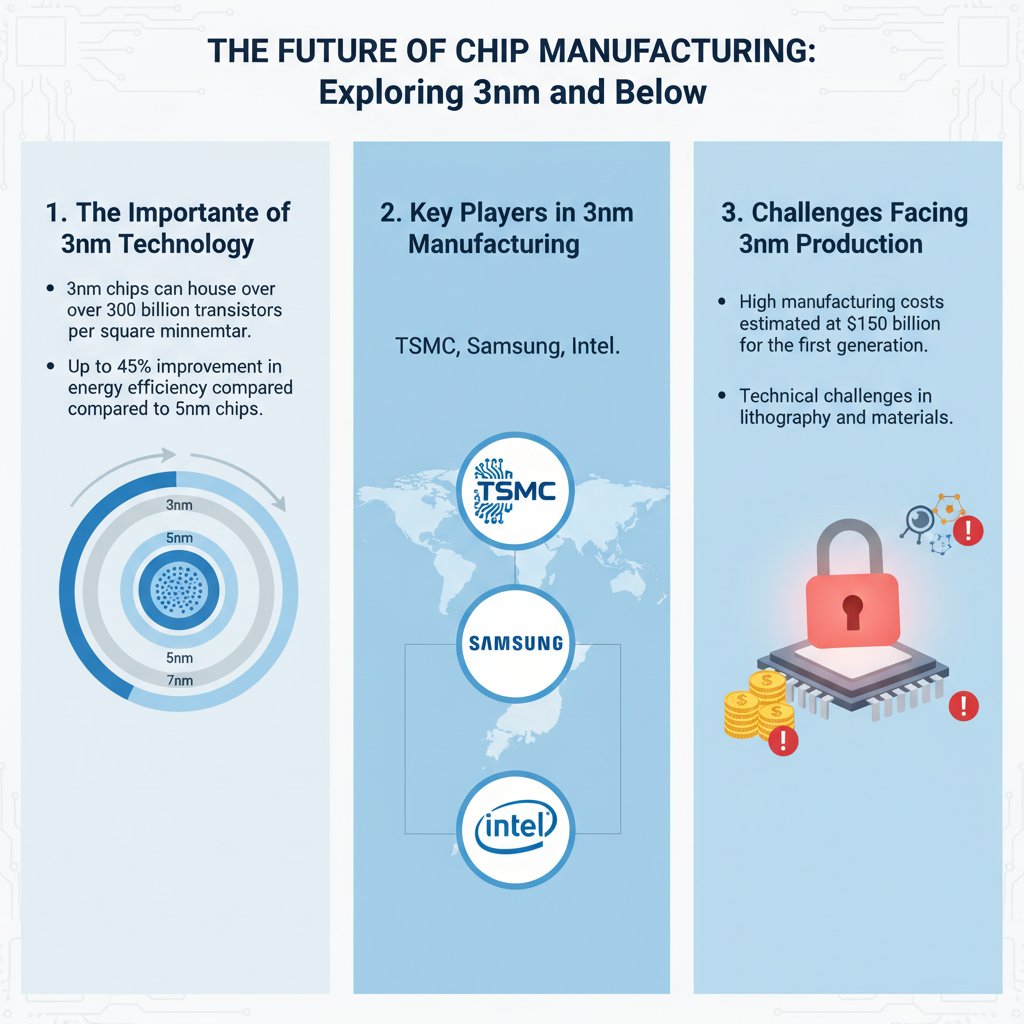
The significance of 3nm technology cannot be overstated. At this scale, chips can house an incredible density of transistors, which is essential for delivering better performance and energy efficiency. To put this in perspective, a 3nm chip can contain more than 300 billion transistors per square inch, allowing for faster data processing and reduced power consumption. This improvement is not just a matter of numbers; it directly translates to a smoother user experience in high-performance computing, artificial intelligence applications, and mobile devices.
For instance, smartphones equipped with 3nm chips can run complex applications seamlessly while maintaining excellent battery life. In the realm of AI, these chips can enhance machine learning algorithms, resulting in faster data analysis and smarter decision-making. Thus, 3nm technology is pivotal in enabling innovations that were previously thought to be unattainable, setting new benchmarks for performance across the tech landscape.
Key Players in 3nm Manufacturing

Several major companies are at the forefront of 3nm chip manufacturing, driving the industry forward. Taiwan Semiconductor Manufacturing Company (TSMC) is one of the leading players, having already started mass production of 3nm chips. Samsung is also making significant strides, with its own 3nm process technology already in development. Meanwhile, Intel, despite facing challenges, is working tirelessly to catch up and re-establish its dominance in the semiconductor market.
The collaboration between these chip manufacturers and tech giants, such as Apple and Google, is crucial for fostering rapid innovation. For example, Apple’s transition to its M1 and M2 chips, built on TSMC’s 5nm and 3nm processes, showcases how these partnerships can lead to remarkable advancements in performance and energy efficiency. As these companies continue to push the boundaries of what’s possible, we can expect a cascade of innovations that will redefine the tech landscape.
Challenges Facing 3nm Production
While the promise of 3nm technology is enticing, it comes with its own set of challenges. The complexity of manufacturing processes increases significantly at this scale. As transistors shrink, controlling heat, power leakage, and ensuring signal integrity becomes increasingly difficult. This complexity requires advanced fabrication techniques and state-of-the-art equipment, which can substantially raise production costs.
Additionally, yield rates—representing the percentage of usable chips produced from a silicon wafer—are a significant concern. As manufacturers push towards smaller nodes, achieving high yield rates becomes more challenging, directly impacting the profitability of chip production. Companies must invest heavily in research and development to optimize their manufacturing processes and mitigate these challenges, often requiring years of effort and substantial financial resources.
Applications of 3nm and Below Chips
The applications for 3nm and below chips are vast and varied, touching nearly every aspect of modern technology. These chips are essential for the latest generation of smartphones and laptops, enabling them to run sophisticated applications smoothly and efficiently. For instance, the latest Apple devices are set to benefit from the enhanced performance and battery life provided by 3nm chips, allowing users to multitask seamlessly and enjoy high-resolution graphics for gaming and video editing.
Moreover, in data centers, 3nm chips play a vital role in powering cloud computing and big data analytics. Companies like Amazon and Microsoft are leveraging these advanced chips to optimize their server performance, reduce energy consumption, and improve overall service delivery. Additionally, the rise of advanced AI systems relies heavily on the performance gains offered by 3nm technology, allowing for more complex algorithms and faster processing times. This trend will only continue as industries increasingly integrate AI into their operations.
Future Trends in Chip Manufacturing
Looking ahead, the semiconductor industry is already exploring even smaller nodes, such as 2nm and beyond. Research is ongoing into novel materials and techniques that could revolutionize production methods. For example, some companies are investigating the use of graphene and other two-dimensional materials, which may offer superior electrical properties compared to traditional silicon.
Moreover, the shift towards chiplets—smaller, modular chips that can be combined to form larger, more complex systems—could also redefine manufacturing processes. This approach allows for greater flexibility and efficiency, enabling manufacturers to mix and match chip designs to suit specific applications. As the industry continues to innovate, we can expect exciting developments that will push the boundaries of technology even further.
Environmental Impact and Sustainability
As the semiconductor industry grows, so does its environmental impact. However, there is a concerted effort among manufacturers to minimize their carbon footprint and enhance sustainability. Companies are investing in greener manufacturing processes, such as using renewable energy sources and optimizing resource management. For instance, TSMC has committed to achieving net-zero emissions by 2050, implementing initiatives to reduce water usage and improve energy efficiency across its operations.
Innovations in manufacturing processes, like reducing the energy consumption of chip fabrication, are also crucial. By focusing on sustainability, the semiconductor industry can not only reduce its environmental impact but also appeal to increasingly eco-conscious consumers. This commitment to sustainability will become a key differentiator for companies looking to lead in the future.
The expansion of 3nm and below chip manufacturing is set to reshape technology as we know it. With key players pushing boundaries, addressing challenges, and exploring new applications, the future looks promising. As we stay informed about developments in this space, we can better understand how they might impact our tech experience, from the devices we use daily to the broader technological advancements shaping our world.
Frequently Asked Questions
What are the advantages of 3nm and below chip manufacturing technology?
The advantages of 3nm and below chip manufacturing technology include enhanced performance, reduced power consumption, and increased transistor density. These advancements enable the production of smaller, faster, and more energy-efficient chips, which are crucial for powering next-generation devices such as smartphones, laptops, and high-performance computing systems. Additionally, smaller nodes allow for greater innovation in various sectors, including artificial intelligence and IoT applications.
How does the transition to 3nm and below chip manufacturing affect the semiconductor industry?
The transition to 3nm and below chip manufacturing significantly impacts the semiconductor industry by driving competition and innovation. Companies are racing to develop smaller, more efficient chips to meet the demands of emerging technologies. This evolution also necessitates substantial investments in research and development, advanced fabrication facilities, and talent acquisition, ultimately reshaping the supply chain and market dynamics within the industry.
Why is the shift to smaller chip nodes important for consumer electronics?
The shift to smaller chip nodes, such as 3nm and below, is crucial for consumer electronics because it enables devices to become more compact and capable of handling complex tasks with ease. Smaller chips can deliver higher processing power while consuming less energy, which is essential for extending battery life and improving overall user experience. As consumer demand for faster, smarter, and more efficient devices grows, manufacturers must adopt smaller nodes to remain competitive.
Which companies are leading the charge in 3nm and below chip manufacturing?
Leading companies in 3nm and below chip manufacturing include TSMC (Taiwan Semiconductor Manufacturing Company), Samsung, and Intel. TSMC has been at the forefront of advanced manufacturing technology, while Samsung is also making significant strides in this area. Intel is working to regain its competitive edge with its own 3nm processes, highlighting the industry’s competitive landscape as companies innovate to meet global demand for advanced semiconductor solutions.
What challenges does the semiconductor industry face when producing 3nm and below chips?
The semiconductor industry faces several challenges when producing 3nm and below chips, including increased complexity in manufacturing processes and the need for advanced materials. As transistors shrink, maintaining performance and reliability becomes more difficult, leading to potential issues like leakage current and heat dissipation. Additionally, the high costs associated with developing state-of-the-art fabrication facilities and the scarcity of skilled labor in this niche field further complicate the transition to smaller nodes.
References
- Semiconductor device fabrication
- https://www.reuters.com/technology/chipmakers-push-beyond-3nm-amid-global-semiconductor-shortage-2021-07-06/
- https://www.bbc.com/news/business-58593496
- https://www.sciencedirect.com/science/article/pii/S1350446721005593
- https://www.nytimes.com/2021/07/06/business/chips-semiconductors.html
- https://www.nature.com/articles/d41586-020-01770-3
- https://www.technologyreview.com/2021/04/13/1022441/3nm-chips-technology-apple-amd-intel/
- https://www.semanticscholar.org/paper/3nm-and-beyond%3A-Advancements-in-Nanoelectronics-Liu-Yu/5c9e3e0eeb8b6c5cbb4d8b2c0a1e8b4b4b3d9d6b