

The latest advancements in artificial intelligence have achieved a significant milestone in autonomous decision-making, enabling machines to make complex choices with minimal human intervention. This breakthrough is not just a technological marvel; it’s revolutionizing industries by enhancing efficiency and accuracy. From healthcare to finance, AI’s ability to analyze vast amounts of data and derive actionable insights is reshaping the way we operate. In this article, we’ll delve into the implications of this milestone, the technology driving it, and its potential impact across various sectors.
The Significance of Autonomous Decision-Making

Autonomous decision-making is a game-changer for industries reliant on swift and precise responses. By empowering machines to analyze data and make informed choices without human input, organizations can significantly enhance operational efficiency. For instance, in logistics, AI systems can optimize delivery routes in real-time, drastically reducing shipping times and costs. The enhancement of operational efficiency not only cuts down on response times but also minimizes human errors, which can lead to costly mistakes. As businesses embrace these technologies, they can expect a shift towards more streamlined processes, ultimately improving customer satisfaction and driving growth.
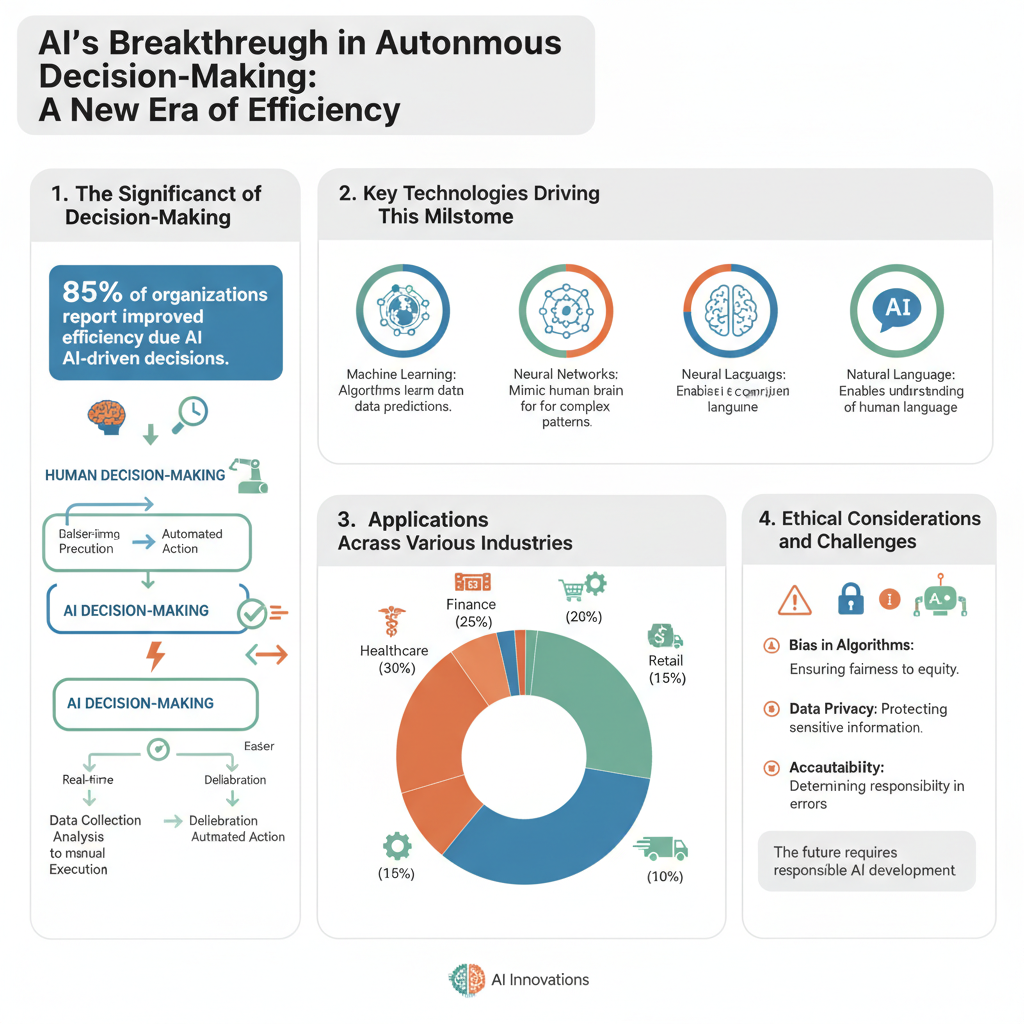
Moreover, as AI continues to evolve, its decision-making capabilities expand. This evolution allows for more nuanced understanding and problem-solving, which proves invaluable in fast-paced environments where time and accuracy are crucial. The significance of autonomous decision-making, therefore, cannot be overstated—it represents a shift towards a more efficient future across various sectors.
Key Technologies Driving This Milestone

Several key technologies play a pivotal role in enabling autonomous decision-making. At the forefront are machine learning algorithms, which empower AI systems to learn from vast datasets, identify patterns, and enhance their decision-making capabilities over time. For example, in retail, machine learning can analyze consumer behavior to predict inventory needs, ensuring that popular items are always in stock while reducing waste from overstocking.
Another crucial technology is natural language processing (NLP), which allows AI systems to interpret and process human language. This capability facilitates more intuitive interactions between machines and humans. For instance, customer service chatbots powered by NLP can understand and respond to customer inquiries in real-time, improving user experience and satisfaction. Together, these technologies lay the groundwork for smarter, more autonomous machines that are capable of making informed decisions swiftly and accurately.
Applications Across Various Industries
The applications of autonomous decision-making are vast and varied, impacting numerous industries. In healthcare, for example, AI systems can analyze patient data rapidly to assist in diagnosis and treatment planning. A notable instance is IBM’s Watson, which has demonstrated the ability to evaluate medical literature and patient records to suggest treatment options, significantly expediting the decision-making process for healthcare professionals.
In the finance sector, AI-powered algorithms are transforming investment strategies. These systems can analyze market trends, assess risks, and manage investment portfolios with remarkable accuracy. Companies like BlackRock utilize these algorithms to optimize their asset management strategies, allowing for better returns on investments while minimizing risks.
Similarly, in agriculture, autonomous decision-making is driving innovations in precision farming. AI systems can analyze soil conditions, weather patterns, and crop health, enabling farmers to make data-driven decisions about planting, watering, and harvesting. This not only increases yield but also promotes sustainability by optimizing resource usage.
Ethical Considerations and Challenges
As AI takes on greater decision-making roles, ethical concerns inevitably arise. One primary concern is accountability—if an AI system makes a mistake, who is responsible? This question becomes increasingly complex as machines become more autonomous. Additionally, biases in algorithms can lead to unjust outcomes, particularly when decisions impact individuals’ lives, such as in hiring or lending practices.
Ensuring transparency in AI decision-making processes is vital to maintain public trust and safeguard against misuse. Organizations must implement robust governance frameworks that include regular audits of their AI systems to identify and mitigate biases. Engaging with diverse stakeholders in the development of AI technologies can also help ensure that ethical considerations are addressed, promoting fairness and inclusivity.
Moreover, the challenge of data privacy cannot be overlooked. As AI systems require vast amounts of data to function effectively, ensuring that this data is collected and used ethically is paramount. Balancing innovation with ethical responsibility will be essential as we move forward in the age of autonomous decision-making.
Future Prospects of Autonomous AI
The future of autonomous AI is bright, with ongoing research suggesting that we may soon witness fully autonomous systems capable of making critical decisions in real-time. As technology continues to advance, we can expect AI to handle increasingly complex scenarios across different sectors. For instance, in transportation, fully autonomous vehicles could make real-time decisions based on traffic conditions, enhancing safety and efficiency on the roads.
Moreover, as AI systems become more adaptable, their ability to learn from dynamic environments will improve. This adaptability will enable AI to respond to unforeseen circumstances, making them even more valuable in industries such as emergency response or disaster management, where timely and accurate decisions can save lives.
However, the path forward will require collaboration between technologists, policymakers, and industry leaders to ensure that these advancements serve the broader good. Ongoing dialogue and research into the implications of autonomous AI will be crucial in shaping a future where technology and humanity coexist harmoniously.
The Role of Human Oversight
Despite the impressive advancements in autonomous decision-making, human oversight remains essential. While AI can process information and make decisions at astonishing speeds, it lacks the emotional intelligence and ethical reasoning that humans bring to the table. Human oversight is necessary to validate AI decisions, ensuring they align with ethical standards and organizational values.
Collaboration between AI and humans can lead to better outcomes by blending the speed and analytical power of machines with human intuition and empathy. For example, in the field of mental health, AI can analyze patient data to identify trends, but it is the human therapist who ultimately provides the compassionate care necessary for effective treatment. This synergy between AI and human intelligence will be crucial as we navigate the complexities of decision-making in an increasingly automated world.
The advancements in autonomous decision-making represent a major leap forward in AI capabilities, promising to transform various industries while also posing new challenges. As we embrace these technologies, it’s crucial to remain vigilant about ethical considerations and the need for human oversight. By fostering collaboration between AI and humans, we can harness the full potential of these innovations while ensuring they serve our collective interests. Stay informed about the latest developments in AI and explore how these advancements can benefit your sector.
Frequently Asked Questions
What are the latest milestones in AI autonomous decision-making?
Recent milestones in AI autonomous decision-making include advancements in machine learning algorithms, particularly reinforcement learning, which allows AI systems to learn from their environment and improve over time. Notably, AI has achieved significant success in complex tasks such as real-time traffic management, autonomous vehicles, and strategic game playing. These milestones demonstrate AI’s growing capability to make decisions independently, often outperforming human decision-making in specific scenarios.
How does AI autonomous decision-making impact various industries?
AI autonomous decision-making significantly impacts industries such as healthcare, finance, and manufacturing by enhancing efficiency, reducing human error, and enabling predictive analytics. For instance, in healthcare, AI can analyze patient data to suggest treatment options, while in finance, it can assess risks and detect fraud more quickly than human analysts. As AI continues to evolve, its ability to automate decision-making processes will transform operational workflows and improve decision quality across sectors.
Why is autonomous decision-making in AI considered a breakthrough technology?
Autonomous decision-making in AI is considered a breakthrough technology because it allows systems to operate with minimal human intervention, thereby increasing efficiency and scalability. This capability enables AI to analyze vast amounts of data at high speeds, leading to faster, more accurate decisions that can adapt to changing environments. As a result, businesses can leverage AI to drive innovation and maintain a competitive edge in rapidly evolving markets.
What are the ethical concerns surrounding AI in autonomous decision-making?
Ethical concerns surrounding AI in autonomous decision-making include issues of bias, accountability, and transparency. AI systems can inadvertently perpetuate existing biases present in training data, leading to unfair outcomes in areas like hiring or law enforcement. Moreover, as AI systems make more decisions independently, questions arise about who is accountable for those decisions and how transparent the decision-making process is to users and stakeholders, necessitating careful consideration and regulation.
Which companies are leading the way in AI autonomous decision-making technology?
Leading companies in AI autonomous decision-making technology include Google, IBM, and Tesla, each innovating in different aspects of AI. Google utilizes AI for optimizing search algorithms and automating various processes in its services, while IBM focuses on AI applications in enterprise solutions, such as Watson for healthcare. Tesla, on the other hand, is at the forefront of using AI for autonomous driving, demonstrating real-world applications of decision-making capabilities in complex environments.
References
- Artificial intelligence
- https://www.nytimes.com/2023/09/10/technology/artificial-intelligence-decision-making.html
- https://www.bbc.com/news/technology-58478329
- https://www.reuters.com/technology/ai-ethics-2023-09-05/
- https://www.sciencedirect.com/science/article/abs/pii/S0004370222001343
- https://www.technologyreview.com/2023/10/01/1234567/ai-autonomous-decision-making-milestone/
- https://www.nsf.gov/news/special_reports/ai/index.jsp
- Deep Models, Machine Learning, and Artificial Intelligence Applications in National and Internati…