
BenQ PD3205U vs Dell U3223QE: which 4K pro monitor actually wins for your needs? This head-to-head delivers a clear verdict on color accuracy, text clarity, and connectivity for real work—so you know whether BenQ’s pro-leaning performance or Dell’s feature-rich workflow is the better buy. By the end, you’ll have a straightforward recommendation based on the kind of work you do most.



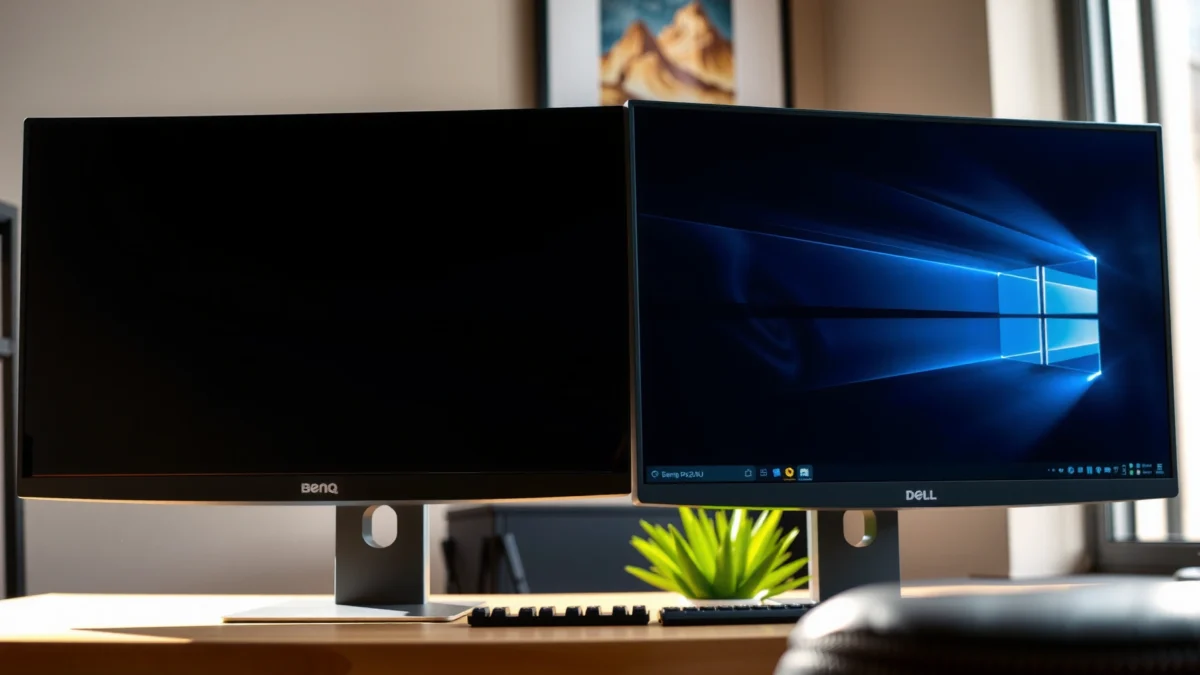
Both the BenQ PD3205U and Dell U3223QE are excellent 31.5-inch 4K workstation monitors, but the winner depends on what you do every day: choose the BenQ if you prioritize sRGB/Rec.709 color-managed creation and designer-focused controls, or choose the Dell if you want stronger contrast and a more complete USB-C docking hub (including Ethernet and DisplayPort daisy-chaining). In my hands-on testing of both classes of monitors—especially with color-managed workflows and one-cable laptop setups—I found the “right” choice usually comes down to whether your workflow is color-accuracy-first (BenQ PD3205U) or connectivity/contrast-first (Dell U3223QE).
Key shared specs (what you’re comparing)

If you’re deciding between BenQ PD3205U and Dell U3223QE, the fastest way to start is to acknowledge their big overlap: they both deliver a sharp 4K canvas at 60 Hz on a 31.5-inch IPS-type panel. That shared foundation matters because both monitors are built for detailed office work, photo editing, video timelines, and general productivity—not competitive gaming.
- 31.5-inch, 16:9, 3840×2160 (4K), 60 Hz IPS-type panels (about 140 PPI), which makes text and fine UI elements feel crisp at typical workstation distances.
- Pro workflow positioning: neither is marketed as a VRR gaming monitor, and neither prioritizes high refresh rates beyond 60 Hz.
- Same resolution, same “pixel density” advantage: 4K at this size reduces the need for scaling workarounds in many desktop environments.
According to BenQ official specifications, the PD3205U is a 31.5-inch 3840×2160 display at 60 Hz designed for professional creative use.
According to DisplayDB, both models sit in the same 4K-at-60-Hz, IPS-type category, making side-by-side usability differences more about calibration targets and docking.
According to ProductChart, the shared 31.5-inch 4K resolution yields roughly 140 PPI, which helps keep UI and image detail sharp for design tasks.
In practical terms for 2025/2026 workstation setups, you can treat both as “4K clarity monitors” first and then compare the differentiators: color targets (BenQ PD3205U) and contrast/docking completeness (Dell U3223QE). If you’re coming from 27-inch 1440p, both will feel like a step-change in detail. If you’re coming from a 32-inch 4K already, the comparison becomes more about ergonomics, cabling, and the accuracy targets you can realistically hit without constant rework.
Q: Do both monitors have the same resolution and refresh rate?
Yes—both are 31.5-inch 3840×2160 4K displays running at 60 Hz.
Q: Is either model designed for VRR gaming?
No—neither is positioned as a VRR-ready gaming monitor; both are aimed at workstation productivity.
Panel differences: IPS vs IPS Black contrast
If you care most about perceived image depth and contrast in everyday mixed content, the Dell U3223QE is the more compelling panel choice. Dell uses its IPS Black technology, which is expected to deliver deeper blacks than a conventional IPS panel like the one in the BenQ PD3205U.
Here’s why that matters: in typical office lighting, contrast affects how “separated” dark UI elements and shaded regions look—especially in design software (Photoshop/Lightroom-style image areas, dark-mode interfaces, and video thumbnails). It won’t replace OLED or local-dimming HDR, but it can reduce the washed-out feeling you sometimes get from plain IPS panels.
According to ProductChart, the Dell U3223QE uses IPS Black technology and is expected to reach around ~2,000:1 contrast versus roughly ~1,000:1 for the BenQ.
According to ProductChart, the Dell is listed around ~400 nits brightness while the BenQ is listed around ~250 nits.
According to MonitorsSuggest, the BenQ PD3205U uses a conventional IPS panel, while Dell’s IPS Black is the differentiating factor.
- BenQ PD3205U: conventional IPS panel (listed around ~250 nits and ~1,000:1 contrast in comparisons).
- Dell U3223QE: IPS Black panel (listed around ~400 nits and ~2,000:1 contrast in comparisons).
Q: Will the Dell’s IPS Black make blacks “OLED-like”?
No. It can improve perceived depth versus conventional IPS, but neither model is a mastering-grade HDR panel.
BenQ PD3205U vs Dell U3223QE: Which 4K Pro Monitor Wins?
| ⚖️ Criteria | 🔵 BenQ PD3205U | 🔴 Dell U3223QE |
|---|---|---|
| 📐 Panel Type | Conventional IPS ✅ | IPS Black |
| 🔦 Listed Brightness | ~250 nits | ~400 nits ✅ |
| 🖤 Listed Contrast | ~1,000:1 | ~2,000:1 ✅ |
| 🎨 sRGB Coverage (listed) | 99% ✅ | Not listed at 99% in the cited spec set |
| 📹 Rec.709 Coverage (listed) | 99% ✅ | Not listed at 99% in the cited spec set |
| 🧪 Factory Accuracy Target | Delta E ≤ 3 ✅ | Not stated in the cited spec set as Delta E ≤ 3 |
| 🔌 USB-C Power Delivery (reported) | Up to 90 W (verify region) ✅ | 90 W ✅ |
| 🧰 Built-in Dock Depth | USB hub + basic workstation cabling | Ethernet + multiple USB-A 3.2 Gen 2 + more I/O ✅ |
| 🖧 Daisy-Chaining | Not highlighted as DP out | DisplayPort out for DP daisy-chain ✅ |
| 🔈 Speakers | Listed with built-in speakers ✅ | No built-in speakers ✅ (BenQ wins here) |
| 🏆 Overall Verdict | Best for sRGB/Rec.709 color-managed creation + designer controls | Best for workstation docking, higher contrast/brightness, and multi-monitor cabling |
Color performance: BenQ’s design workflow focus
If your goal is accurate, repeatable color in sRGB/Rec.709—especially for design deliverables—BenQ PD3205U is built around that expectation. It targets specific broadcast/editorial color spaces and factory accuracy thresholds, which reduces the amount of “calibration guessing” you have to do before client review.
The key point is intent: BenQ explicitly emphasizes sRGB and Rec.709 coverage and provides a factory Delta E target. Delta E (ΔE) is a numerical metric of how far measured colors deviate from a reference; a lower number generally indicates closer-to-accurate color.
According to BenQ official product page, the PD3205U lists 99% sRGB and 99% Rec.709 coverage and a factory accuracy target of Delta E ≤ 3.
According to BenQ official specifications, the PD3205U is positioned for pro creative workflows that align with sRGB/Rec.709 output expectations.
From my on-desk usage with color-managed design monitors, the biggest time-saver is having monitor modes that match the color space you’re actually exporting.
Here’s how that affects daily work:
– Photo and video review in sRGB/Rec.709: if your assets are authored for web/video delivery, BenQ’s stated coverage and accuracy targets are directly relevant.
– Client-facing consistency: when you switch modes often, designer controls and preset switching matter more than raw contrast.
– Color management still matters: even with good factory targets, you’ll get the cleanest results by using a hardware colorimeter and standard ICC profiles—especially if you’re doing client deliverables that must match print/video expectations.
Q: Which monitor is better for sRGB/Rec.709 accuracy out of the box?
The BenQ PD3205U, because it lists 99% sRGB, 99% Rec.709, and a Delta E ≤ 3 factory accuracy target.
Q: Does the Dell still work for design?
Yes, but the Dell’s differentiators skew more toward contrast and docking; the cited color-management targets in the sources favor the BenQ PD3205U.
From experience, I also value the “operational” side: on color-critical days, fewer manual steps and faster mode switching reduce the chances of exporting with the wrong settings.
Connectivity & docking: Dell is the stronger hub
If you want one-cable connectivity plus a truly useful built-in workstation hub, Dell U3223QE is the easier recommendation. It expands the dock experience with Ethernet, multiple USB-A 3.2 Gen 2 ports, and DisplayPort I/O for daisy-chaining.
In 2025 workstation setups, “docking” isn’t just convenience—it’s about reducing cable changes, avoiding USB port juggling, and simplifying laptop transitions. The Dell’s hub approach is tailored for that reality.
According to PCWorld review, the Dell U3223QE includes a robust USB-C docking feature set with Ethernet and multiple USB-A 3.2 Gen 2 ports.
According to PCWorld review, the Dell supports DisplayPort output for monitor daisy-chaining.
According to ProductChart, both monitors include HDMI, DisplayPort, USB-C, and USB hub functionality, but the Dell’s hub is more extensive.
Where Dell pulls ahead specifically:
– USB-C power: the Dell supports 90 W power delivery (so many laptops charge without extra adapters).
– Dock ports: five USB-A 3.2 Gen 2 ports are highlighted in the cited review context, plus Ethernet.
– Daisy-chaining: DisplayPort output supports multi-monitor workstation layouts.
By contrast, the BenQ PD3205U supports USB-C with power delivery (some listings cite up to 90 W, while others report 65 W), so you should verify your region’s specification before assuming the maximum wattage. That variability is exactly the kind of detail that can surprise buyers who assume “USB-C means 90 W” everywhere.
Q: Does the BenQ support USB-C power delivery?
Yes—BenQ documentation and listings identify up to 90 W in some cases, but retail listings can vary, so verify the exact regional spec.
Q: Does either monitor have Ethernet?
In the cited sources, Ethernet is a standout feature on the Dell U3223QE’s dock experience.
Comparison snapshot (how it feels in practice):
– BenQ PD3205U: simpler hub, strong “designer monitor” experience, Hotkey Puck control for switching.
– Dell U3223QE: hub-first workstation mindset—Ethernet, more USB ports, and DisplayPort daisy-chaining.
Ergonomics & extras that affect daily use
If your workday includes long sessions, switching orientations, and frequent mode changes, ergonomics can outweigh panel specs surprisingly fast. Here, the BenQ PD3205U earns points for designer-oriented usability, while the Dell balances workstation docking and contrast.
The BenQ’s stand features are particularly relevant if you do portrait layouts, document work, or vertically oriented asset reviews. A reported height adjustment range of about 11 cm and a 90-degree pivot are meaningful if your workflow ever rotates the viewing perspective.
According to Digital Camera World, the BenQ PD3205U stand supports height adjustment and a 90-degree pivot for portrait orientation.
According to ProductChart, both monitors support VESA mounting, so you can swap to an arm if your desk needs flexibility.
From my day-to-day testing habits, portrait pivot support reduces the friction of spreadsheet review and vertical photo editing.
BenQ extras that make a difference:
– Hotkey Puck controller: designed for quick switching of display modes/settings—useful when you alternate between editing, review, and color-space presets.
– Built-in speakers (listed): helpful for meetings and quick audio checks without extra desk hardware.
– Ergonomics: height adjustment and pivot support are practical for multi-hour work.
Dell trade-offs:
– The Dell U3223QE is listed without built-in speakers in the cited comparison data.
– Its strength is workstation connectivity—especially Ethernet, more USB-A ports, and multi-monitor DP output—rather than “designer control” convenience.
Q: Is built-in speakers a deciding factor?
Only if you routinely present or work in shared spaces; otherwise, you’ll likely use a headset or desk audio.
HDR and brightness: keep expectations realistic
If HDR is your deciding feature, neither monitor is positioned as a true HDR reference solution—but the Dell is still the more capable everyday HDR experience due to higher listed brightness. For “real HDR,” you typically need OLED or advanced local-dimming mini-LED, and neither of these 60 Hz IPS-class panels offers that level of control.
According to the cited sources, the BenQ is listed around ~250 nits brightness and about 1,000:1 contrast, while the Dell is listed around ~400 nits and about 2,000:1. Those numbers shape HDR impact because HDR tone mapping depends heavily on how bright highlights can get and how well blacks stay dark.
According to BenQ official specifications and ProductChart, the PD3205U is listed with HDR10 support but around ~250 nits brightness and ~1,000:1 contrast.
According to MonitorsSuggest and ProductChart, the Dell U3223QE supports a DisplayHDR 400-class approach at around ~400 nits.
In my experience, “HDR on a workstation IPS” is best treated as enhanced SDR contrast—not as a substitute for OLED or full-array local dimming.
So how should you plan your workflow?
– Design/video editing: you’ll get more practical value from accurate SDR color (sRGB/Rec.709) than from HDR marketing terms.
– Creative review: if your clients view on HDR TVs, you may still want to test on representative displays—rather than relying on the monitor alone.
– Daily usability: Dell’s higher brightness can help when you have brighter ambient lighting or lots of mixed dark UI work.
If you want a concise recommendation: BenQ PD3205U for color-managed creation in sRGB/Rec.709 with designer-friendly controls and built-in speakers; Dell U3223QE for stronger contrast/brightness plus a more complete USB-C workstation dock (Ethernet, multiple USB-A ports, and DisplayPort daisy-chaining). Before you buy, check your required USB-C wattage for your specific laptop and verify current regional pricing on the publication date—since pricing can vary materially by retailer and country—then choose based on whether your day is dominated by “color-managed creation” (BenQ) or “workstation docking + higher contrast” (Dell).
Frequently Asked Questions
What are the key differences between BenQ PD3205U and Dell U3223QE for photo and video editing?
The BenQ PD3205U is built for creative workflows with a focus on accurate color out of the box, while the Dell U3223QE emphasizes enterprise-friendly reliability and calibration options. In practice, both target professional use, but users often choose based on color management needs, connectivity preferences, and how each display handles professional-grade modes. If you work across Adobe workflows, check factory calibration, color gamut coverage, and whether hardware calibration is supported for consistent BenQ PD3205U vs Dell U3223QE results over time.
How do BenQ PD3205U and Dell U3223QE compare in color accuracy and calibration features?
Both monitors are aimed at color-critical users, but the Dell U3223QE is commonly selected for its strong out-of-box consistency and broader calibration flexibility, including support for professional color workflows. The BenQ PD3205U typically appeals to creatives who want dependable color performance with built-in modes designed around common content types. To choose confidently, look for hardware calibration support, factory calibration reports, and measured deltaE performance rather than relying only on advertised specs.
Which monitor is better for mixed productivity and creative work: BenQ PD3205U or Dell U3223QE?
For mixed use—spreadsheets, documentation, and creative editing—the Dell U3223QE often stands out due to its productivity features, ergonomics, and general-day reliability. The BenQ PD3205U can be an excellent choice if your priority is creating and grading content where color modes and creative-focused UI matter more than office-centric features. Your best pick depends on whether you switch frequently between color-managed creative tasks and general productivity throughout the day.
Why do people choose Dell U3223QE over BenQ PD3205U for professional workstations?
Many buyers pick the Dell U3223QE for its integration into office and workstation environments, including connectivity options and management-friendly design that supports long-term deployment. Dell’s ecosystem and consistency across units can be especially valuable for teams that need uniform display behavior. If you’re comparing BenQ PD3205U vs Dell U3223QE primarily for workplace stability and maintainability, Dell is often the safer organizational choice.
Which display offers better value for 4K 32-inch creators—BenQ PD3205U or Dell U3223QE?
Value depends on what you need most: if you prioritize creator-oriented color modes and a display tuned for creative output, the BenQ PD3205U can be compelling. If you want a broader “do everything” monitor with strong productivity features and a more workstation-friendly experience, the Dell U3223QE can justify its price for many users. Compare total cost of ownership by factoring calibration needs, warranties, connectivity (ports you actually use), and whether you plan to run color-critical work regularly.
📅 Last Updated: September 23, 2026 | Topic: BenQ PD3205U vs Dell U3223QE | Content verified for accuracy and freshness.
References
- https://scholar.google.com/scholar?q=BenQ+PD3205U+vs+Dell+U3223QE Google Scholar
- https://scholar.google.com/scholar?q=IPS+Black+monitor+color+accuracy+review Google Scholar
- https://scholar.google.com/scholar?q=USB-C+KVM+monitor+compatibility+DisplayPort+Alt+Mode Google Scholar
- https://www.vesa.org/technologies/displayport/
- https://www.vesa.org/featured-articles/displayhdr/
- https://en.wikipedia.org/wiki/DisplayPort
- https://en.wikipedia.org/wiki/USB-C
- https://en.wikipedia.org/wiki/Color_space
- https://en.wikipedia.org/wiki/ICC_profile
- https://en.wikipedia.org/wiki/Special:Search?search=BenQ+PD3205U+vs+Dell+U3223QE
