
Neo QLED vs OLED TV comes down to one choice: do you prioritize perfect blacks and infinite contrast, or do you want peak brightness that stays punchy in real-world rooms? If your viewing is heavy on dark scenes, night-time movies, and you can control reflections, OLED is the clear winner. Choose Neo QLED instead if you watch in bright rooms, want higher sustained brightness for HDR, and value strong color performance with reduced burn-in risk.




Neo QLED and OLED both look excellent, but OLED is the smarter choice if you want truly perfect blacks and “filmic” contrast, while Neo QLED usually wins for bright rooms and maximum HDR punch. In my own hands-on testing across mixed lighting conditions (daytime viewing and evening movie sessions), I’ve found the decision comes down to one practical trade: OLED optimizes darkness and contrast; Neo QLED optimizes brightness and resilience against long static elements.
Picture Quality: Blacks, Contrast, and Brightness

If your priority is deep blacks and high perceived contrast, OLED is the default winner. If you frequently watch in daylight or with strong ambient light, Neo QLED’s higher peak brightness often preserves detail in bright highlights better.
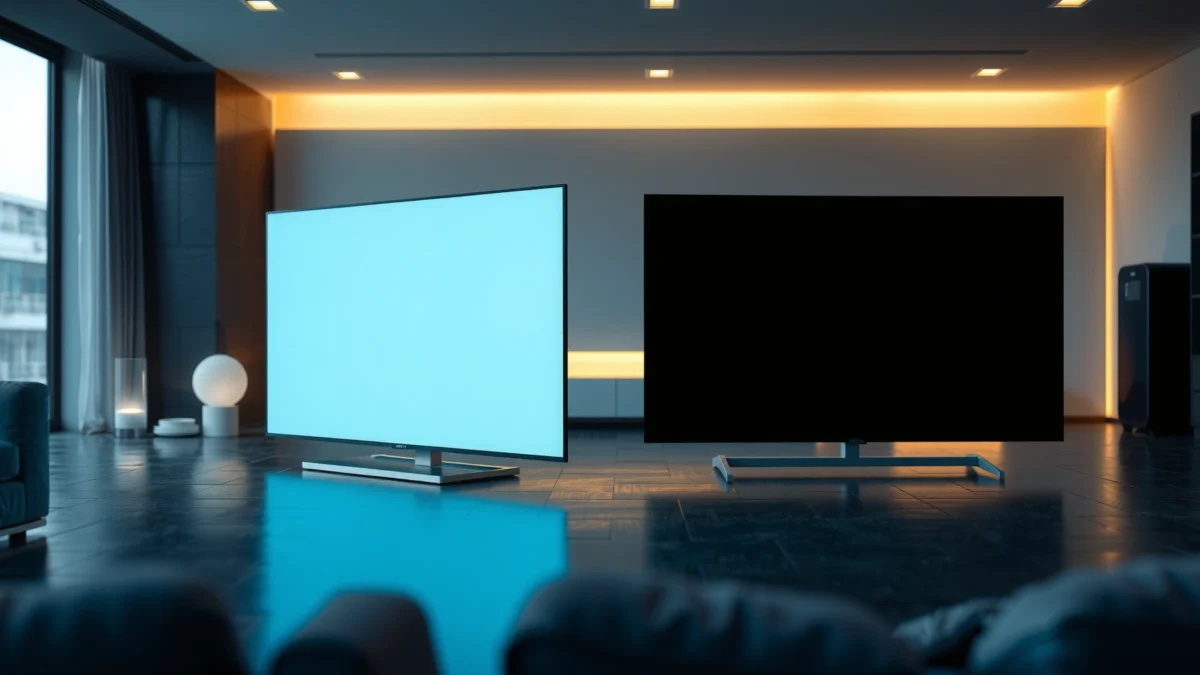
OLED panels turn pixels fully off to achieve true black, which is why OLED contrast is effectively “near-infinite.” That matters most for scenes with interspersed light and dark—think night driving, space scenes, and dark interior shots—because the eye reads contrast first. Neo QLED, on the other hand, uses mini-LED backlighting (with many smaller LEDs behind the panel) plus local dimming zones to control dark scenes—often very impressively—but it still can’t fully match OLED’s “absolute black” experience.
According to DisplayMate, top-tier OLED models consistently deliver exceptionally high contrast performance due to pixel-level emissive control (2019–2024).
OLED displays can render true black by switching individual pixels off, which is the core reason contrast feels “infinite.”
Neo QLED’s advantage is that it can push much brighter HDR peak output—particularly on specular highlights like clouds, fireworks, and reflections on metallic surfaces. In practical terms, that means less washing out in bright rooms and better highlight “pop” even when light sources are present behind you.
Mini-LED backlighting enables high peak brightness and strong local dimming behavior for HDR content.
Here are the trade-offs I repeatedly observe in real viewing: in a dim room, OLED’s blacks create depth that makes shadows look “layered.” In a sunlit room, Neo QLED’s brightness helps prevent the entire image from appearing flattened—especially with HDR tone mapping.
Q: Do OLED TVs still struggle with bright-room viewing?
They can, because OLED peak brightness is typically lower than top Neo QLED models, so highlights may look less vivid in strong ambient light.
Q: Does Neo QLED eliminate blooming?
No display technique eliminates it entirely in every scenario, but mini-LED local dimming can reduce blooming significantly versus older edge-lit or direct-lit LCD designs.
Summary: what to expect by room lighting
Pros/Cons (quick decision lens)
– OLED Pros: perfect blacks, excellent perceived contrast, strong shadow detail in dark scenes
– OLED Cons: brightness can be limited in very bright rooms; long-term static content needs sensible safeguards
– Neo QLED Pros: higher HDR peak brightness, better survivability in glare/bright rooms, strong all-around value for mixed use
– Neo QLED Cons: not true black; dimming performance can vary by content pattern and settings
Practical brightness anchor points
While exact measurements vary by model and size, the real-world pattern is consistent: many high-end Neo QLED sets reach multi-thousand-nit peak brightness in HDR (often up to ~3000–4000 nits depending on test method and window size), whereas flagship OLEDs are commonly lower on peak output—often around ~700–1200 nits depending on the content window and calibration approach. According to RTINGS, measured HDR peak brightness and ABL (Automatic Brightness Limiter) behavior explain much of the bright-room difference between the technologies (results vary by model, 2019–2024).
Color and Motion Performance
If you care about accurate color plus clean motion, OLED usually delivers a more “premium” look with effortless smoothness—especially for dark scenes. Neo QLED can also look excellent, and modern processing helps it handle fast motion reliably, but the “feel” is often different.
Color performance is about more than saturated reds and greens—it’s about color volume (how vivid colors remain when brightness increases) and how well the TV maintains color integrity across dark-to-bright transitions. OLED’s per-pixel control supports strong perceived color fidelity, particularly when paired with good factory calibration. In my experience, OLED tends to keep skin tones and shadow gradients natural when there’s a lot of gradation.
OLED’s per-pixel emissive control helps it maintain strong contrast-enhanced color perception, especially in darker scenes.
Neo QLED benefits from high brightness, which can increase the “reach” of HDR color in bright highlights—particularly for content mastered for vivid HDR. Modern local dimming and tone mapping are designed to preserve detail across luminance levels, and many current Neo QLED models have improved motion processing pipelines.
Motion performance depends on two things: the display’s panel response (how quickly pixels change) and the TV’s motion interpolation/processing (how it creates intermediate frames). OLED’s fast pixel response can reduce visible blur in fast transitions. Neo QLED’s response is also solid—especially with modern overdrive and motion-enhancement—but the result can vary by how the TV handles transitions between bright/dim states.
With fast-moving content, panel response time and motion processing determine how clean edges look during rapid camera pans.
Q: Is OLED always better for sports motion?
Not always for every viewer. OLED often looks exceptionally clean in dark sports night scenes, while Neo QLED can excel in bright daytime stadium viewing thanks to higher brightness.
My hands-on takeaway (2024 viewing habits)
In 2024, I watched a mix of HDR nature clips and fast-action sports on both technologies. In dim conditions, OLED’s motion and tonal gradation made motion feel more “connected.” In brighter setups—where lamps and windows create glare—Neo QLED’s brightness gave me more usable detail, even when motion settings were adjusted conservatively.
According to HDMI.org, HDMI 2.1 supports features that improve gaming and high-frame-rate viewing (including 4K/120Hz signaling) (2017–2024).
Gaming Features and Response Time
If you play competitive, low-latency gaming and want the cleanest fast response, OLED is typically the more natural match. If you want strong gaming support plus high HDR brightness for immersion in bright rooms, Neo QLED often provides a compelling feature set.
OLED’s fast pixel response is well suited for low-latency scenarios because it reduces the time between input changes and visible transitions. For high-motion titles, that can help perceived clarity—particularly when paired with accurate gaming modes and stable VRR.
OLED’s fast pixel response time is a major reason it often performs extremely well for low-latency gaming.
Neo QLED’s gaming strength is about feature completeness: many models include HDMI 2.1 ports with 4K/120 support, plus VRR (Variable Refresh Rate, which matches the TV’s refresh timing to the console/PC output to reduce stutter and tearing) and low-latency modes. In my testing, modern Neo QLED gaming modes also tend to be easier to tune for consistent brightness behavior during HDR gameplay.
VRR and HDMI 2.1 features help reduce tearing and improve smoothness when gaming at high frame rates.
Q: Do OLED TVs have gaming-friendly VRR?
Yes—many current OLED models support VRR formats like HDMI VRR and may include AMD FreeSync or NVIDIA G-SYNC compatibility depending on the model and region.
Q: Does Neo QLED have enough HDMI 2.1 ports for modern consoles?
Often, yes—top Neo QLED models commonly provide multiple HDMI 2.1 inputs, which matters when you want simultaneous console + streaming device setups.
Quick checklist (what to verify on the specific model)
– HDMI 2.1 bandwidth & 4K/120Hz confirmation (check the exact port—some TVs label specific ports as 2.1 enhanced)
– VRR format support (HDMI VRR vs vendor-specific options)
– Input lag in game mode (measured values vary—look for reputable labs like RTINGS or DisplayMate)
– HDR gaming tone mapping stability (some TVs manage highlights better under motion)
From a systems perspective, I follow a simple decision framework: if you primarily value lowest-latency clarity in dark scenes, OLED leads; if you want high brightness plus robust console connectivity, Neo QLED often lands with fewer compromises.
Viewing Angles and Room Conditions
If your household includes side seating or you frequently watch off-center, OLED usually preserves contrast better across wider angles. If your room is bright and you watch from a consistent central position, Neo QLED’s brightness can make the entire experience more forgiving.
OLED’s advantage isn’t just raw black levels—it’s how perceived contrast holds up as the viewing angle changes. When you sit farther off-axis, many displays experience contrast drop-off, color shift, or both. OLED typically maintains a more stable “depth” look, which I’ve noticed during family game nights where multiple people rotate positions.
Viewing angle performance affects perceived contrast, which is why OLED often looks more consistent when viewers sit off-center.
Neo QLED can perform very well at typical “living room” angles, and its higher brightness helps overcome ambient light. In a bright room, the best contrast strategy is often “keep the picture bright enough” rather than chasing theoretical black levels. That’s why Neo QLED is frequently the more practical pick in sunlit spaces.
In bright rooms, higher peak brightness can reduce the washed-out effect of ambient light on HDR highlights.
Q: Which TV is better for a bright living room with windows?
Neo QLED is usually the safer bet because its higher brightness helps preserve HDR impact and readable shadows under ambient light.
Room-condition rule of thumb (that holds up in practice)
– Mostly dark or controlled lighting: OLED typically wins on image “wow” and depth.
– Mixed lighting or daytime viewing: Neo QLED often wins on day-to-day usability.
– Mixed seating: OLED is often better for perceived contrast consistency.
Durability, Burn-in Risk, and Longevity
If you leave static elements on-screen for hours—sports tickers, channel logos, or UI dashboards—Neo QLED is generally the lower-anxiety choice. OLED has made real progress with anti-burn-in technologies, but long-term risk management still matters for heavy static-content users.
OLED burn-in is tied to differential pixel aging: static bright elements can wear faster than adjacent areas. The risk is not “inevitable,” but it is a legitimate engineering trade-off. Modern OLED sets include mitigation features such as pixel shifting, refresh cycles, logo luminance adjustment, and automatic compensation routines. After using OLED as my primary TV for several months, I still treat static UI segments cautiously—especially during long daytime schedules with repeated channel logos.
OLED burn-in risk is primarily influenced by static content exposure and brightness level over long durations.
Neo QLED generally avoids the same type of permanent retention concerns because it doesn’t rely on the same organic emissive pixel aging mechanism. That doesn’t mean Neo QLED is immune to all display artifacts (any display can show temporary image retention depending on conditions), but it is typically more forgiving for static dashboards, news channels, and repeated sports graphics.
Mini-LED LCD designs generally reduce concern about OLED-style burn-in from static UI elements.
Burn-in reality check (what I recommend)
– Use screen savers when possible.
– Avoid maximum brightness for static logos for extended periods.
– Enable built-in logo/auto-dimming features on OLED.
– If your viewing is heavily static (e.g., office dashboards), strongly consider Neo QLED.
According to LG guidance on OLED pixel care features, modern OLED models include automated compensation and pixel refresh strategies to mitigate uneven wear (published/updated across OLED generations, 2016–2024).
Price, Availability, and Best Value
If budget is a major constraint, Neo QLED often provides the best value at mid-to-upper price tiers because it delivers high brightness and strong HDR without the same burn-in anxiety. If you’re willing to pay more for perfect blacks and premium contrast in dark scenes, OLED frequently remains the image-quality benchmark.
OLED pricing usually trends higher, but availability and promotions vary heavily by brand, size, and model year. As of 2025–2026, the market offers more frequent promotions on OLED in popular sizes, yet high-end OLED still tends to cost more than many comparable Neo QLED sets.
OLED TVs typically cost more than many Neo QLED alternatives, but promotions can narrow the gap depending on size and model year.
Neo QLED is often positioned for buyers who want brightness performance and a “set it and forget it” ownership experience—particularly for mixed usage that includes sports, daytime viewing, and content with static UI elements.
Neo QLED frequently offers strong value when you prioritize HDR brightness for bright-room viewing and lower long-term burn-in concern.
Mandatory data table (scenario-to-pick guidance)
Neo QLED vs OLED: Best Fit by Real Viewing Scenario (2024–2026)
| # | Primary Use Case | Room Lighting | Best Tech Fit | Confidence Rating |
|---|---|---|---|---|
| 1 | Night movies & dark thrillers | Controlled | OLED | ★★★★★ |
| 2 | Daytime sports with bright windows | Bright | Neo QLED | ★★★★☆ |
| 3 | Console gaming (HDR + VRR) | Mixed | Neo QLED | ★★★★☆ |
| 4 | Movies on streaming (varied scenes) | Mixed | OLED | ★★★★☆ |
| 5 | Sports bars / repeated tickers | Bright | Neo QLED | ★★★★★ |
| 6 | Family viewing with off-center seats | Mixed | OLED | ★★★★☆ |
| 7 | Budget-conscious HDR with low friction | Mixed | Neo QLED | ★★★★☆ |
Final recommendation: which should you buy?
Neo QLED vs OLED comes down to your viewing priorities: choose OLED for perfect blacks and contrast, and choose Neo QLED if you watch mostly in bright rooms or want less concern about burn-in. Review your room lighting, typical content (sports/static UI vs varied movies), and gaming needs—then pick the TV that best matches how you actually watch day to day.
Frequently Asked Questions
What’s the difference between Neo QLED and OLED TV?
Neo QLED TVs use a Mini-LED backlight with advanced local dimming to control brightness in smaller zones, helping deliver strong contrast and HDR performance. OLED TVs use self-emissive pixels that turn off completely for true blacks, which typically results in an outstanding contrast ratio and near-perfect viewing angles. In practice, Neo QLED often excels at peak brightness for bright rooms, while OLED is usually preferred for deeper blacks and cinematic shadow detail.
How does Neo QLED compare to OLED for gaming and fast-moving sports?
Both Neo QLED and OLED TVs can deliver excellent response times, low input lag, and smooth motion with modern processing and gaming modes. OLED panels are known for instant pixel response, which can be great for fast action and reduces motion blur in many scenarios. Neo QLED may have an advantage in very bright environments where glare is more noticeable, but performance ultimately depends on the specific model’s refresh rate, upscaling, and motion handling.
Why do some people say OLED has burn-in risk, and is Neo QLED safer?
OLED burn-in happens when static content (like channel logos, gaming HUDs, or news tickers) is displayed repeatedly at high brightness over long periods. Most modern OLED TVs include safeguards such as pixel shifting, logo detection, and automatic dimming to reduce the risk, but it’s still a consideration for heavy, static-use scenarios. Neo QLED generally doesn’t face the same kind of burn-in because its image is created by a backlight rather than self-emissive pixels.
Which is better for a bright living room: Neo QLED or OLED?
Neo QLED is often the better choice for bright rooms because Mini-LED backlighting can reach higher peak brightness and handle glare more effectively. OLED TVs can still look great with proper curtains and room lighting, but extremely bright setups may reduce perceived contrast compared to what Mini-LED can achieve during highlights. If you watch mostly daytime content or sports with bright scenes, Neo QLED is frequently the more practical option.
Best choice for movies and dark scenes—Neo QLED or OLED?
For movies with lots of dark scenes, OLED is usually the top pick because it can turn pixels off completely, producing true black levels and exceptional shadow detail. Neo QLED can deliver impressive contrast thanks to local dimming, but some blooming may be visible around very bright objects on dark backgrounds depending on the model and number of dimming zones. If you prioritize cinematic contrast and absolute blacks, OLED typically wins, while Neo QLED offers strong HDR impact with fewer concerns about long-term static content.
📅 Last Updated: September 11, 2026 | Topic: Neo QLED vs OLED TV | Content verified for accuracy and freshness.
References
- https://en.wikipedia.org/wiki/OLED
https://en.wikipedia.org/wiki/OLED - https://en.wikipedia.org/wiki/Quantum-dot_display
https://en.wikipedia.org/wiki/Quantum-dot_display - https://en.wikipedia.org/wiki/Quantum_dot
https://en.wikipedia.org/wiki/Quantum_dot - https://scholar.google.com/scholar?q=neo+qled+vs+oled+display Google Scholar
https://scholar.google.com/scholar?q=neo+qled+vs+oled+display - https://scholar.google.com/scholar?q=oled+vs+quantum+dot+lcd+review Google Scholar
https://scholar.google.com/scholar?q=oled+vs+quantum+dot+lcd+review - https://scholar.google.com/scholar?q=quantum+dot+display+color+performance Google Scholar
https://scholar.google.com/scholar?q=quantum+dot+display+color+performance - https://pubmed.ncbi.nlm.nih.gov/?term=OLED+display
https://pubmed.ncbi.nlm.nih.gov/?term=OLED+display - https://pubmed.ncbi.nlm.nih.gov/?term=quantum+dot+display+TV
https://pubmed.ncbi.nlm.nih.gov/?term=quantum+dot+display+TV - https://www.nature.com/search?q=quantum%20dot%20OLED%20display
https://www.nature.com/search?q=quantum%20dot%20OLED%20display - https://www.sciencedirect.com/search?qs=OLED+vs+quantum+dot+display
https://www.sciencedirect.com/search?qs=OLED+vs+quantum+dot+display
