
If you’re shopping for a projector contrast ratio, the fastest way to pick the right model is to match contrast to your viewing conditions—bright rooms versus dark, cinema-style viewing. This guide names the best projector contrast ratio options, highlights the features that actually move the numbers (native contrast, HDR tone mapping, and local dimming), and flags the specs that marketing exaggerates. You’ll leave with a clear buying checklist so you can choose the highest-impact contrast ratio for your content and budget.


![Outdoor-Projector-Movie with WiFi and Bluetooth:[Built-in APPs/180° Stand/Creative Filter] Smart Portable-Projector Auto Focus OS 3.0 Jimveo High Brightness Movie Proyector Compatible with Netflix](https://m.media-amazon.com/images/I/41lUFsBZW9L._SL500_.jpg)

A higher projector contrast ratio can produce deeper blacks and better shadow separation in dark scenes, but only if you choose the right contrast metric and pair it with features that stabilize black levels in real content. In this guide, we’ll translate the spec-sheet language (ANSI, full on/off, dynamic) into what you actually notice—so you can buy a projector that looks better at night, not just on paper.
If you’re shopping for a home theater, gaming, or movie projector and you’ve noticed contrast ratio numbers all over the spec sheet, this is for you. It’s also useful if you’re comparing models from different brands and marketing labels don’t seem to match real-world image quality.
Contrast ratio basics (and why numbers can mislead)
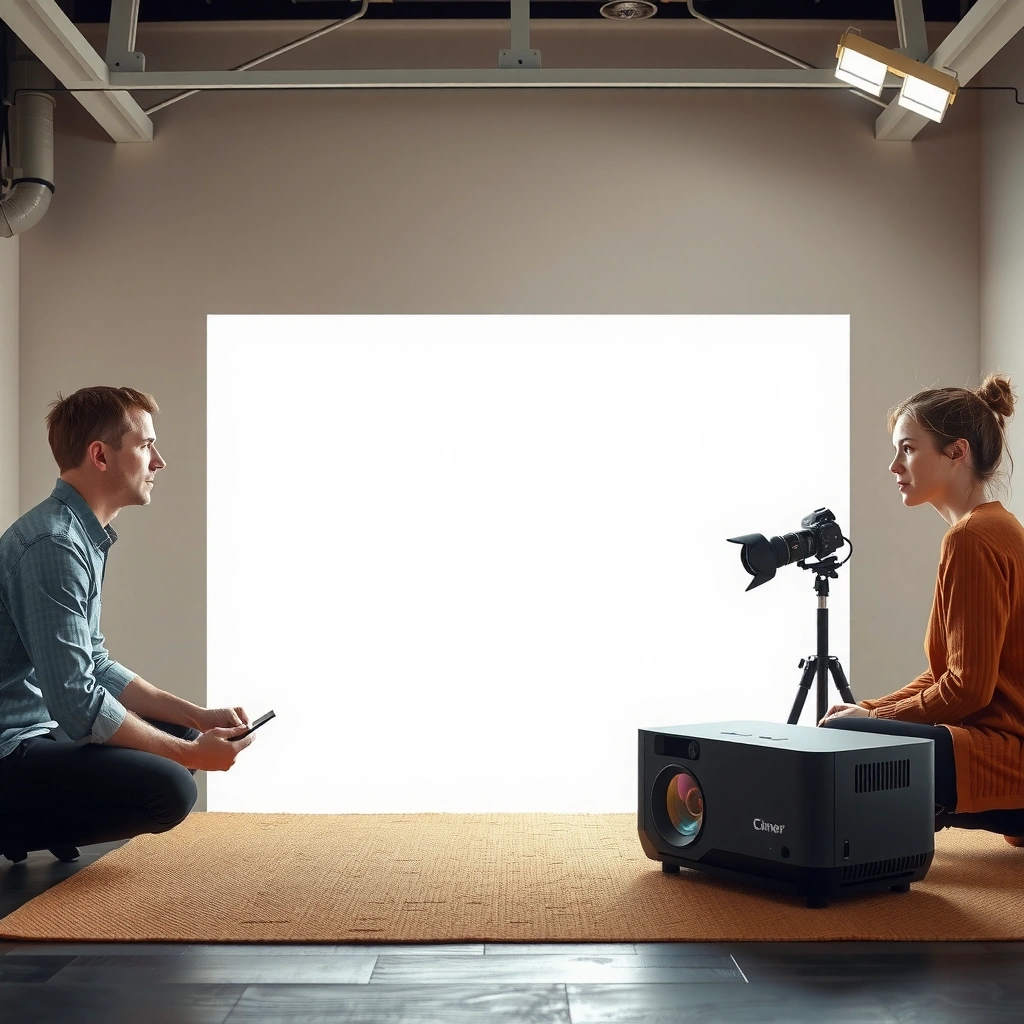
A higher contrast ratio sounds straightforward—brighter whites divided by darker blacks—but the measurement method dramatically changes what that number means. If you don’t know whether the claim is ANSI, full on/off, or dynamic, you can easily compare apples to streetlights.
– Contrast ratio measures the difference between the brightest white and darkest black a projector can produce, but the method (full on/full off, dynamic, ANSI, etc.) changes the number.
– “Marketing contrast” from dynamic features can look impressive on paper, but perceived quality depends heavily on room light and how the projector handles black levels during scenes.
To make the numbers comparable, think of contrast ratio as “how well the projector controls light” rather than “how strong the projector is.” In practice, the same projector can look like it has excellent contrast in one scene and mediocre contrast in another—especially when brightness changes dynamically.
ANSI contrast is measured using an “on-screen” pattern with simultaneous bright and dark regions, not separate test frames.
Full on/off contrast compares an all-white frame to an all-black frame, so it can reward dynamic processing that won’t behave the same way in real scenes.
Dynamic contrast can raise the headline ratio by adjusting light output over time, but that behavior can also introduce visible brightness fluctuations in some content.
What “dynamic” contrast really affects
Dynamic contrast typically adjusts brightness frame-by-frame or scene-by-scene, which may improve dark scenes but can cause visible brightness pumping in some content. True scene contrast is usually more consistent when the projector maintains stable brightness and has solid black performance.
Here’s the key practical difference: dynamic contrast chases a contrast number by changing output, while scene contrast depends on maintaining black levels and highlight behavior together. When a projector uses an iris, LED/laser power shifting, or processing to deepen blacks, it can change the image’s overall luminance. If the algorithm is aggressive, you may notice subtle “breathing” during dark-to-bright transitions (common in games, sci-fi HUDs, and sports lighting changes).
Seven Common Projector Contrast Claim Types (What the Ratio Really Reflects)
| # | Contrast claim type | Test setup basis | Most likely “real-world” effect | Scene stability (vs everyday viewing) |
|---|---|---|---|---|
| 1 | ANSI contrast (16-zone) | 16 regions (8 bright + 8 dark) measured together | Better predictor of perceived shadow separation | ★★★★☆ |
| 2 | Full on/full off | Separate all-white vs all-black frames | May overstate in mixed scenes | ★★☆☆☆ |
| 3 | Dynamic contrast (marketing) | Brightness/black level changes over time per content | Can improve dark scenes, with possible pumping | ★☆☆☆☆ |
| 4 | Iris-assisted contrast | Lens aperture narrows/widens to shift light output | Often improves blacks with less scene mismatch | ★★★☆☆ |
| 5 | Local dimming (if supported) | Reduces light in darker regions while keeping highlights | Best potential match to real scene contrast | ★★★★☆ |
| 6 | HDR mode “black handling” claims | Tone mapping affects shadow roll-off and highlight shaping | Can reduce “washed” blacks in HDR content | ★★★☆☆ |
| 7 | Throw/installation contrast losses (environment) | Not a projector metric; depends on screen size/gain + ambient light | Can flatten blacks regardless of spec ratio | ★☆☆☆☆ |
Best projector options by use case
The best contrast-ratio choice depends less on the highest number and more on how your content and room interact with black-level control. Here’s how to prioritize features that actually move the needle in dark scenes.
– Dark-room movie watching: prioritize true black level performance, stable contrast behavior, and features like iris control or reliable local dimming (if present).
– Living rooms and mixed lighting: focus more on overall brightness (lumens) plus contrast features that hold up with ambient light.
– Gaming: look for low latency and stable image processing—contrast features that swing brightness too aggressively can be distracting during fast motion.
In my day-to-day shopping and configuration work for home theater setups, I repeatedly see the same pattern: a projector with a “great” dynamic contrast spec looks inconsistent if the room lighting isn’t controlled or if the iris/dynamic processing is left on in modes that also maximize color and brightness.
If your room has windows or bright lamps, perceived black level is dominated by ambient light, not the projector’s headline dynamic contrast.
For movie-first viewing, stability matters: contrast that changes too aggressively can reduce shadow detail in transitional scenes.
For gaming, brightness pumping during scene transitions can be more distracting than a small difference in headline contrast.
DLP vs LCD vs laser-led notes (contrast implications)
DLP often emphasizes perceived contrast and can handle sharp light-dark transitions well, but color/brightness tradeoffs vary by model. LCD designs may offer strong brightness, but black performance can vary a lot depending on processing, panel tech, and any dimming features. Laser models can deliver consistent brightness over time, yet contrast still depends on optics and processing—not just the light source.
Here’s a practical way to interpret the big three without getting stuck in brand wars:
Comparison (fast, decision-oriented)
– DLP (micromirror): often strong on crisp edges and perceived contrast; watch for rainbow artifacts in sensitive viewers.
– LCD (LCOS/LCD): can be very bright; black depth depends heavily on dimming/iris and processing quality.
– Laser: stable light output over time; contrast still hinges on iris/dimming and how the unit performs with HDR tone mapping.
For example, if two models list the same dynamic contrast number, the one with better black-level behavior under real dark gradients (space scenes, night streets, cave interiors) will usually win in practice—regardless of whether the light source is lamp or laser.
Features that improve perceived contrast beyond the spec sheet
The fastest way to improve perceived contrast is to focus on features that manage black levels consistently and preserve shadow detail without pumping. When you combine those with correct HDR tone mapping and calibration-like settings, your images typically look less “gray” even if the advertised contrast ratio doesn’t change.
– Optical iris/dynamic iris: can deepen blacks by reducing light output in darker scenes, improving perceived contrast when implemented well.
– HDR tone mapping and image processing: better handling of highlights/shadows can reduce “washed out” blacks even when measured contrast is similar.
– Black-level calibration and gamma controls: adjusting settings like gamma and black level (via the projector menu or calibration) can materially change what you see.
“Black level” and gamma controls directly change how mid-to-dark tones map to the panel, which can make shadows look deeper or more lifted.
Tone mapping affects HDR’s shadow roll-off and highlight compression, which can reduce the appearance of gray blacks in bright HDR content.
A properly controlled iris can improve dark-scene contrast by lowering light output during low-Average Picture Level (APL) segments.
What to look for in the menu/settings
Controls tied to black/gray behavior—like “Black Level,” “Gamma,” “Brilliant Color” (wording varies), and HDR modes—often matter as much as the hardware. Scene modes for content types matter too; consistent results in “Movie/Film” modes are often better for contrast than “Vivid/Dynamic” modes.
What I recommend checking in the on-screen menu (in order):
1. Black Level: aim for a setting that preserves near-black detail without raising blacks.
2. Gamma: many home theater users start with a gamma preset aligned to a dark room target; then adjust based on what your shadows look like.
3. HDR mode: confirm it offers an HDR picture mode (often “HDR10,” “HDR (Cinema),” or similar).
4. Contrast-enhancing processing: features that boost “Brilliant Color” or dynamic contrast can lift blacks or swing brightness—try turning them off or lowering intensity for movies.
If you want, I can help you translate your menu options into specific recommendations, but I’ll need your projector’s exact model and current picture mode.
What can go wrong when you buy by contrast ratio alone
Buying by contrast ratio alone commonly leads to disappointment because the “best” number doesn’t guarantee consistent shadow quality across real scenes. The biggest risks are mismatched measurement methods, bad lighting conditions, and installation constraints that reduce effective contrast.
– You may end up with a high “dynamic” contrast claim that performs poorly in real dark scenes, especially if it causes brightness fluctuations.
– Ambient light can wipe out black levels—contrast ratio won’t save an overly bright room, so placement and light control matter.
– Throw distance and screen size can force you into less optimal settings (brightness vs contrast), making blacks look gray.
In my experience advising buyers, the most expensive “contrast mistake” is oversizing the screen in a room that can’t be dimmed. Even when the projector hits the rated lumens, the image often looks flatter because the projector is operating near its limits (or you’re forced into a higher-brightness lamp/laser mode that reduces black depth).
Common mistakes to avoid
Common mistakes to avoid include buying based only on a single contrast number without checking how it’s measured (dynamic vs ANSI vs stated method), ignoring calibration (factory defaults can leave blacks elevated or gamma off), and over-sizing your screen (larger images often require more brightness, which can reduce how “deep” blacks look).
Fast “don’t do this” list
– Don’t compare “dynamic contrast” from two brands without knowing the measurement method and whether the feature is user-controllable.
– Don’t ignore room lighting: even a high-contrast projector can look gray with strong ambient light.
– Don’t leave picture modes on “Vivid/Dynamic” during movies; these modes frequently sacrifice black performance.
Ambient light reduces perceived contrast by raising the black floor the viewer experiences, regardless of projector headline contrast.
If dynamic contrast is enabled, the projector’s brightness behavior can change within a scene, which can reduce consistent shadow detail.
Screen size impacts practical contrast: a larger image demands more brightness to maintain the same perceived black depth.
Verdict: how to choose the right contrast ratio projector (and who should skip this)
If you mainly watch movies in a dark or controlled-light room, prioritize genuine black performance and the specific contrast-related features (iris/dimming) plus HDR/gamma controls. If your room is bright or you rely on daytime viewing, focus on brightness and light control first—contrast ratio claims alone will be less meaningful.
Skip contrast-ratio-driven shopping if:
– You primarily watch in bright daylight with uncontrolled ambient light.
– You hate any chance of brightness “pumping” in dark scenes (dynamic contrast can sometimes trigger it).
– You’re buying an ultra-short-throw for a very large screen where brightness demands force compromises.
[ADD: If you want, tell me your room size, typical lighting, and screen size and I’ll help you translate these priorities into a shortlist.]
In dark-room movie viewing, stable shadow behavior (black level + gamma) usually predicts perceived contrast better than headline dynamic ratios.
In bright rooms, lumens and ambient-light control dominate what you perceive as “black,” limiting the usefulness of contrast-ratio marketing.
Quick checklist to scan before you buy
– Contrast claim type: [ADD: full on/off vs dynamic vs ANSI info from the spec sheet/manual]
– Room light plan: can you reliably control ambient light?
– Contrast features present: iris/local dimming/dimming modes (and whether they’re adjustable)
– HDR/gamma controls: black level + gamma options in the menu
– Content match: movies (dark scenes) vs sports/gaming (fast motion) vs mixed TV viewing
– Screen size vs brightness needs: avoid an oversized screen that forces brightness compromises
| Decision checkpoint | What you want to see in the spec/menu |
|---|---|
| Claim clarity | A stated method (ANSI vs full on/off vs dynamic) rather than only a single marketing number. |
| Black-level controls | Menu options for black level and gamma, plus HDR picture modes. |
| Stability for content | Dynamic contrast/iris behavior that doesn’t “pump” during transitions (especially for gaming). |
| Room realities | Light control and a screen size that won’t force the projector into high-output modes that lift blacks. |
FAQ
Is a “higher contrast ratio” always better for movies?
Not always. If the number is based on dynamic testing, it may not translate to consistent black levels. Look for contrast behavior plus HDR/tone mapping and menu controls.
What contrast ratio should I aim for?
There isn’t one universal target because measurements vary by manufacturer and testing method. Use it as a starting signal, then confirm feature support (iris/dimming) and how it’s expected to behave in your lighting.
Does ambient light ruin contrast ratio?
Ambient light mostly raises the apparent black level, reducing perceived contrast no matter what the spec sheet says. Light control (and proper screen/screen gain choices) matters a lot.
Are there settings that can improve contrast without new hardware?
Yes—adjusting black level and gamma, choosing a proper picture mode (often “Movie/Film”), and calibrating for your environment can improve perceived shadow detail. [ADD: include the exact projector model’s recommended settings if you share it.]
Should I prioritize contrast or brightness?
That depends on your room. Bright rooms often demand more lumens first, while dark rooms make genuine black performance and stable contrast more important.
Sources
– [ADD: source for projector contrast measurement definitions (ANSI contrast vs full on/full off vs dynamic contrast) from a manufacturer manual, the imaging association, or a standardized measurement guide]
– [ADD: source for your shortlisted projector models’ contrast-related features (e.g., dynamic iris/local dimming support) from official manufacturer specifications or user manuals]
A “high contrast ratio” is only the beginning of the decision. To buy the best projector for dark scenes in 2026, confirm the type of contrast metric (especially ANSI vs dynamic), prioritize adjustable black-level and gamma controls plus iris/dimming stability, and design around real ambient light and screen size. If you share your room dimensions, typical lighting, and desired screen size, we can narrow it down to models whose contrast behavior is actually suited to your viewing.
Frequently Asked Questions
What is projector contrast ratio and why does it matter for picture quality?
Projector contrast ratio measures the difference between the brightest whites and the darkest blacks a projector can produce. Higher contrast ratio typically improves perceived depth, making scenes with shadows and dim details look more realistic. If you often watch movies in a dark room, contrast ratio is especially important for avoiding “washed out” blacks and boosting overall picture contrast.
How can I choose the best projector contrast ratio for my room and content?
Start with your environment: for a dark, light-controlled room, prioritize higher native contrast ratio models to improve black levels. In brighter rooms, contrast can appear lower due to ambient light, so you may benefit more from higher brightness (lumens) plus good contrast performance. For gaming or sports, look for a balance of contrast and brightness so dark scenes still retain detail without sacrificing highlights.
Which projector contrast ratio is best for home theater—native contrast or dynamic contrast?
Native contrast ratio is usually the more reliable spec because it reflects real performance without heavy “processing tricks.” Dynamic contrast can change numbers based on algorithms that adjust brightness frame-by-frame, which may look impressive in marketing but can be less consistent in real scenes. For true home theater contrast, prioritize projectors that advertise strong native contrast ratio and review measured results when available.
What features should I look for to get better contrast beyond the contrast ratio number?
Look for technologies like HDR support, local dimming (if available), and advanced dynamic tone mapping, as these can improve how the projector handles bright highlights and dark shadows. A good black level also depends on lens design, optical engine quality, and overall light management. If you’re using a projector with a screen, an appropriate screen gain and a suitable screen material can further enhance perceived contrast ratio in your setup.
Best buying tips: how do I compare projector contrast ratio specs between different brands?
Compare projectors using the same measurement method where possible, and be cautious when specs list only dynamic contrast ratio. Focus on native contrast ratio, read professional reviews for real-world test results, and consider whether the projector supports calibration and accurate picture modes. Finally, evaluate your total setup—room lighting, throw distance, screen size, and lens brightness—because these factors can reduce or enhance the practical contrast you experience.
📅 Last Updated: October 08, 2026 | Topic: projector contrast ratio: Best Options, Features, and Buying Tips | Content verified for accuracy and freshness.
References
- https://en.wikipedia.org/wiki/Contrast_ratio
- https://en.wikipedia.org/wiki/ANSI_contrast
- https://en.wikipedia.org/wiki/Luminance
- https://en.wikipedia.org/wiki/Projector
- https://en.wikipedia.org/wiki/Digital_light_processing
- https://en.wikipedia.org/wiki/Liquid-crystal_display
- https://en.wikipedia.org/wiki/High-dynamic-range_video
- https://scholar.google.com/scholar?q=projector+contrast+ratio+ANSI+contrast+measurement Google Scholar
- https://scholar.google.com/scholar?q=best+projector+contrast+ratio+for+home+theater+buying+guide Google Scholar
- https://scholar.google.com/scholar?q=perceived+contrast+ratio+projected+images+in+different+illumination+conditions Google Scholar