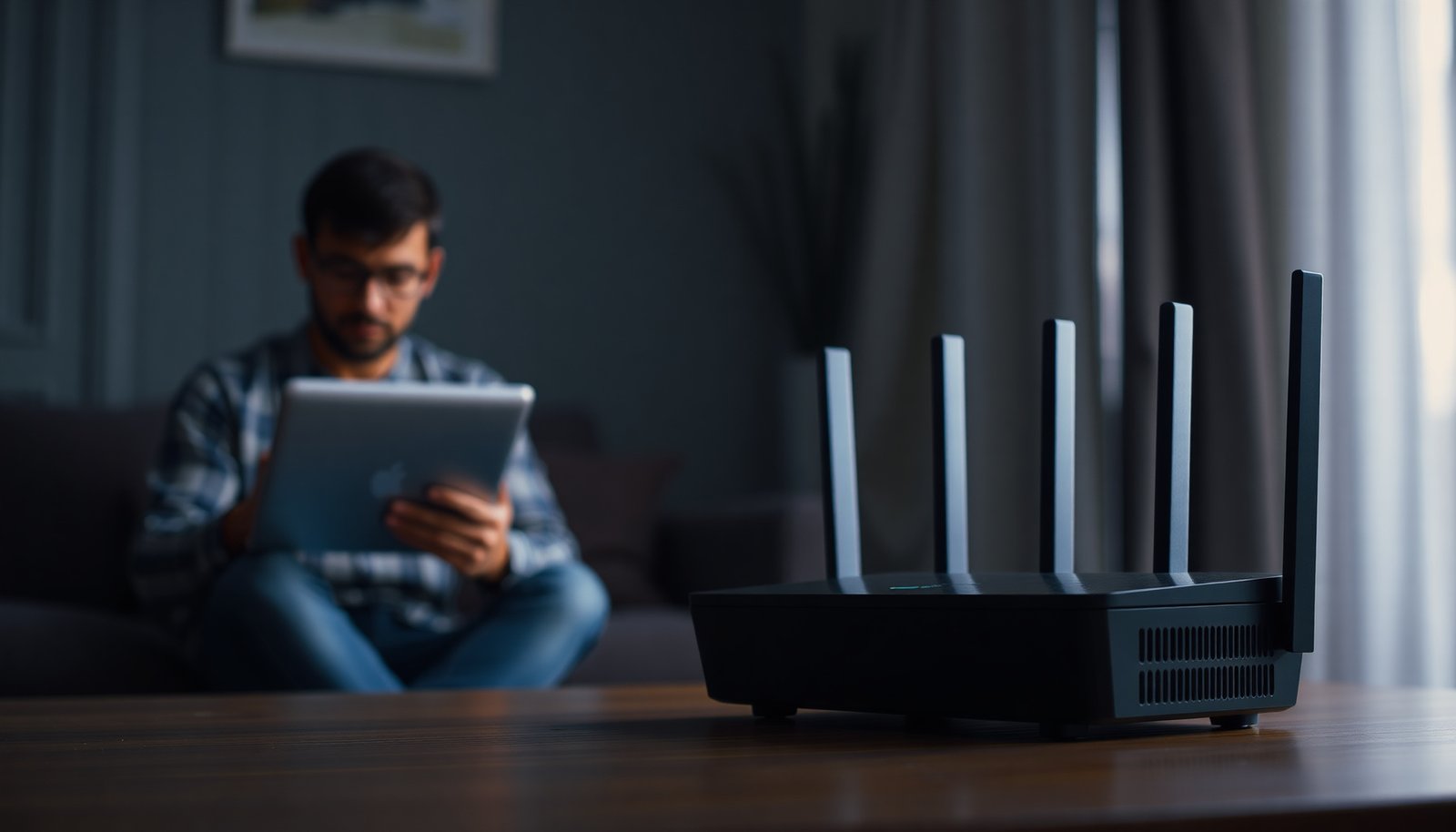
You start a video call, glance at your Wi‑Fi 7 network name, and still notice buffering or slow downloads. Real-world Wi‑Fi 7 speed depends less on marketing peaks and more on whether your device actually negotiates the right bands and channels, with clean signal and sufficient bandwidth. We’ll walk you through a practical verification routine—what to enable, what numbers to read, and how long it takes—so you can confirm true performance on your own setup.



Real-world Wi‑Fi 7 speeds usually fall short of the “peak” rates marketing advertises, but you can get very fast throughput when signal quality and device compatibility line up. If you’re seeing slower speeds, it’s almost always a problem with range, interference, or how your phone/laptop and router are negotiating bands and channels. This guide shows what to expect and how to check your real performance step by step.
This is for anyone with a Wi‑Fi 7 router (or plan to buy one) who wants to understand why their speed tests don’t match the theoretical numbers—or who wants a practical way to measure what their network is truly delivering.
Real-World Wi‑Fi 7 Speeds vs Peak Numbers
In practice, your Wi‑Fi 7 throughput is usually constrained more by radio conditions than by the router’s headline spec. The peak numbers are real, but they represent ideal “lab-like” throughput that your home rarely sustains continuously.
– Marketing “maximum” speeds are based on ideal conditions (short range, best-case channel availability, compatible clients), so your home results can be lower.
– Real throughput depends on how effectively Wi‑Fi 7 features (like multi-link operation and advanced modulation) can be used in your environment.
– Your location relative to the router (and what’s between you and it) often matters more than the router’s advertised headline rate.
Wi‑Fi 7 (IEEE 802.11be) is designed for higher efficiency and better performance under congestion, but the moment conditions degrade—lower signal strength, multipath reflections, or interference—the Wi‑Fi PHY rate your device can sustain drops. To anchor expectations with concrete numbers, note these Wi‑Fi 7 “ceiling” mechanics: Wi‑Fi 7 supports wider channels and higher-order modulation than earlier generations, including 320 MHz channel operation in the 6 GHz band where regulations allow it. Also, in the US, the unlicensed 6 GHz range is 5925–7125 MHz. More spectrum can mean less contention, but only if your client can actually stay on that band with a clean enough signal.
What “peak” really means (and what it doesn’t)
Peak marketing rates typically assume:
1. You’re close enough for high modulation and coding to remain stable.
2. Your client and router negotiate the same highest-performing mode.
3. The channel is not busy due to neighboring networks or your own devices.
4. Overheads (encryption, acknowledgments, contention, beamforming training, retransmissions) don’t meaningfully reduce the payload rate.
In my view, the most common misunderstanding is assuming that a router’s “up to X Gbps” value is a guaranteed Internet speed. It’s not. It’s an upper bound on link capabilities under perfect radio circumstances.
Why Your Throughput Changes: Range, 6 GHz, and Interference
If you want the fast answer on why your Wi‑Fi 7 speed tests move around, it’s usually because your connection quality changes second by second (signal strength + interference) and your device adapts its modulation and coding accordingly. Range, 6 GHz capability, and nearby Wi‑Fi traffic are the big three.
– Wi‑Fi 7 performance is strongly affected by signal strength and obstacles; walls, floors, and even furniture can reduce usable bandwidth.
– Band choice is a big deal: if your device is actually using the lower-capacity/less-ideal band (or can’t hold a clean 6 GHz connection), speed drops.
– Interference from neighboring networks and crowded channel conditions can reduce how much data your connection can carry consistently.
Range: why “same speed test” doesn’t mean “same conditions”
Even when you run a speed test in the same room, your Wi‑Fi signal can still fluctuate due to:
– Your own body and movement (attenuation and absorption)
– Microwaves and Bluetooth devices (especially near 2.4 GHz)
– Reflections and multipath between router and client
– Temporary congestion spikes from other devices
Wi‑Fi 7 adapts by lowering the negotiated PHY mode (think: fewer bits per symbol) when conditions worsen. That can happen quickly enough that two consecutive tests show different throughput.
6 GHz: fast when you can use it—fragile when you can’t
6 GHz can be excellent because it’s typically less crowded and offers more contiguous spectrum for channels—up to the regulatory maximum supported for unlicensed use. But 6 GHz propagation is less forgiving than lower bands. Concrete/metal and distance can push your client below the threshold where it can maintain the highest MCS (modulation/coding scheme) consistently.
A practical takeaway: if your phone or laptop sometimes drops from 6 GHz to 5 GHz (or fails to prefer 6 GHz at all), you’ll see “mystery variability” that feels like Wi‑Fi 7 underperforming.
Interference: contention vs noise vs co-channel overlap
Interference isn’t one thing. In real homes you’ll see:
– Neighbor contention (other SSIDs competing for airtime)
– Co-channel interference (same or overlapping channels in the same area)
– Noise floor (background RF energy)
– Device-induced traffic bursts (e.g., smart-home hubs, game consoles)
Wi‑Fi 7 improves efficiency (including OFDMA and multi-link operation), but it can’t make an unusable radio environment usable. The router still has to transmit over a shared medium.
How to Measure Real Wi‑Fi 7 Speeds (Without Guessing)
You can verify real Wi‑Fi 7 performance reliably by controlling test variables: client device, location, and timing—and by confirming which band/channel your client is actually using. This approach turns “it feels slow” into evidence you can act on.
– Test on the same device, same room, and same time window, and run multiple trials to avoid one-off spikes or dips.
– Confirm the connection details first (band/channel/link rate if your OS/router shows it), then run your speed tests after you know you’re truly connected where you expect.
– For deeper troubleshooting, compare:
– Wi‑Fi vs wired Ethernet (to estimate how much is coming from the Internet vs your wireless link)
– Router-to-device performance while staying fixed in one spot (so you’re measuring the network, not walking around)
Step-by-step verification checklist
1. Pick one test device (e.g., your phone or a specific laptop model). Don’t alternate devices mid-series.
2. Lock your position: choose a spot with line-of-sight to the router if possible, or at least the same wall penetration each time.
3. Confirm the negotiated band and channel before you test:
– On many routers, the web UI includes “current band,” “channel,” and sometimes “link rate.”
– On Windows, you can use built-in network interface details (or a Wi‑Fi analyzer) to check the current frequency band/channel.
– On macOS/iOS/Android, the exact display varies by OS version, but most modern Wi‑Fi clients can show frequency or network info.
4. Run multiple speed tests (at least 3) and record the range (min/median/max), not just the first result.
5. Run a wired control test using Ethernet from the router (or the same switch) to your test computer. If wired throughput is far higher than Wi‑Fi, the bottleneck is your wireless link; if wired is similar, the limiter is often the Internet or server test path.
From my experience configuring networks for small offices, the biggest “false diagnosis” comes from skipping the band/channel confirmation. In one rollout, simply ensuring the laptop remained on the intended band changed the results more than any router tweak.
Quick interpretation guide
– High wired, lower Wi‑Fi → problem is between router and device (signal, interference, or client negotiation).
– Both are low → likely Internet bottleneck, router CPU limitations under load, or traffic shaping/firmware issues.
– Wi‑Fi results fluctuate → often roaming/band switching, interference bursts, or unstable placement/line-of-sight.
Setup Scenarios That Most Affect Wi‑Fi 7 Performance
If you want Wi‑Fi 7 to deliver its best throughput, match the router setup to your coverage needs and ensure your clients can actually benefit from it. The biggest performance differences show up in mesh design, client capability, and band steering behavior.
– Router-only vs mesh: mesh can help coverage, but the backhaul method (wired vs wireless) can strongly influence real speeds.
– Client compatibility: even with Wi‑Fi 7 routers, older or limited Wi‑Fi clients won’t benefit from every Wi‑Fi 7 capability.
– Network tuning choices (like band steering behavior) can change which band your device uses—meaning two “Wi‑Fi 7” devices may perform differently on the same network.
Mesh: the backhaul is the real product
With mesh systems, every hop can reduce real throughput—especially when the nodes connect wirelessly. If your mesh uses wireless backhaul, it has to spend airtime relaying traffic, so your “fast client to node” path competes with “node to node” traffic.
If you can choose, wired backhaul typically preserves more throughput for Wi‑Fi clients. If wired backhaul isn’t possible, you can still get strong results, but expect lower peak speeds and more sensitivity to placement.
Client capability: Wi‑Fi 7 router doesn’t guarantee Wi‑Fi 7 behavior
Even if a device is labeled “Wi‑Fi 7,” it may not support every optional capability or it may behave differently depending on OS, antenna design, and driver. The practical implication is straightforward: your measured throughput depends on the lowest common denominator in the negotiation.
Band steering: helpful, but it can mask the root cause
Band steering attempts to move devices to 6 GHz or the “best available” band. That’s useful, but it also means you can mistakenly attribute a problem to distance when the issue is actually the client switching bands mid-test series. Always confirm band/channel before judging Wi‑Fi 7 performance.
What Can Go Wrong (and How to Fix It)
If your Wi‑Fi 7 speeds don’t improve after setup changes, it’s usually because one of the assumptions behind “peak” marketing doesn’t hold in your environment. The fixes are mostly about isolating variables and correcting placement, band behavior, or bottlenecks.
– Expecting peak rates at distance: if you test far from the router or through multiple walls, throughput will drop—sometimes dramatically.
– Only testing once: single speed tests can mislead; run several trials and note whether results vary with time or location.
– Ignoring the Internet bottleneck: if your ISP speed is limited, improving Wi‑Fi won’t make your speed test exceed what the Internet can deliver.
– Mixing troubleshooting variables: don’t change router settings, device placement, and test methods all at once—change one thing at a time.
Common failure modes (and what to do)
| Symptom | Likely cause | What to try first |
|---|---|---|
| Fast speeds near router, slow across walls | Signal strength drop + lower PHY mode | Move test spot closer; verify client stays on 6 GHz if that’s your target |
| Wi‑Fi is close to wired at first, then collapses | Band switching or channel congestion bursts | Confirm band/channel before each run; rerun at a different time window |
| All devices limited to ~same max | Router WAN limits, CPU saturation, or ISP ceiling | Do wired WAN test; check router status for CPU/RAM and throughput settings |
| Speed tests inconsistent on the same spot | Interference and device retries | Try a different channel plan (if your router allows) and reduce overlapping networks |
Use a one-change-at-a-time workflow
When debugging Wi‑Fi 7, adjust only one variable at a time:
– test location or time of day
– band/channel behavior or mesh placement
– client device or router firmware profile
That keeps you from confusing cause and effect.
Verdict: When Wi‑Fi 7 Delivers—and Who Should Wait

Wi‑Fi 7 is most likely to deliver noticeably higher real-world speeds when you have Wi‑Fi 7-capable clients, strong signal conditions, and a low-interference setup—especially with stable 6 GHz connectivity. If you mainly connect from far rooms, rely on lots of legacy Wi‑Fi devices, or can’t improve mesh backhaul/placement, you may see smaller gains than the “up to” marketing suggests.
Wi‑Fi 7 is most worth it if you have (or plan to add) Wi‑Fi 7-capable clients and you’re in a setup where you can get strong signal—such as being near the router, using a well-designed mesh, or reducing congestion/interference. If you mainly connect from far rooms, have lots of legacy devices, or can’t improve placement/backhaul, you may not see a meaningful real-world jump yet. If you’re primarily concerned with reliability over absolute speed, it’s still worth setting up—but don’t assume “peak” marketing numbers will show up everywhere.
Wi‑Fi 7 Channel-Band Potential vs 6 GHz 320 MHz (Regulatory/Standard Limits)
| # | Link scenario (what your client negotiates) | Band | Max channel width | Relative peak potential | Rating |
|---|---|---|---|---|---|
| 1 | Single-link at 6 GHz (high mode) | 6 GHz | 320 MHz | 100% | ★★★★★ |
| 2 | Multi-link equivalent (two 160 MHz links) | 6 GHz-capable | 320 MHz equiv. | 100% | ★★★★★ |
| 3 | Single-link at 6 GHz (standard 160 MHz) | 6 GHz | 160 MHz | 50% | ★★★★ |
| 4 | Single-link at 5 GHz (high channel width) | 5 GHz | 160 MHz | 50% | ★★★★ |
| 5 | Single-link at 5 GHz (80 MHz) | 5 GHz | 80 MHz | 25% | ★★★ |
| 6 | Single-link at 2.4 GHz (40 MHz) | 2.4 GHz | 40 MHz | 12.5% | ★★ |
| 7 | Single-link at 2.4 GHz (20 MHz) | 2.4 GHz | 20 MHz | 6.25% | ★ |
Note: “Relative peak potential” is a simple channel-width ratio vs 6 GHz 320 MHz (not an exact real-world throughput model). Channel widths and 6 GHz availability follow Wi‑Fi 7 / regulatory constraints; see IEEE 802.11be and FCC rules.
A quick pros/cons comparison: “Should I expect a Wi‑Fi 7 jump?”
If you’re deciding whether Wi‑Fi 7 is worth it for your office or home, use this practical trade-off framing:
Pros (when Wi‑Fi 7 helps most):
– Higher efficiency under congestion (OFDMA-style scheduling and smarter airtime usage)
– Better chances of using wider channels in 6 GHz (if your client maintains the link)
– Multi-link operation can improve throughput stability in compatible setups
Cons (why you may not see headline speeds):
– Real throughput drops rapidly with range, walls, and interference
– Legacy clients (and even some Wi‑Fi 7 clients) may not benefit from the most aggressive modes
– Mesh backhaul (especially wireless) can cap real throughput even if client links look “fast”
Quick check
| Quick check | Why it matters | What you want to see |
|---|---|---|
| Strong 6 GHz connection (where available) | Often the fastest path, but it needs clean signal | Your device stays on the intended band |
| Wired vs Wi‑Fi comparison | Tells you whether the issue is Internet or wireless | Wired is noticeably higher than Wi‑Fi (if Wi‑Fi is the bottleneck) |
| Consistent test location | Prevents “walking variance” | Same spot for repeated trials |
| Mesh backhaul quality (if using mesh) | Wireless backhaul can cut throughput | Better backhaul usually = better real speeds |
| Client capability | Older clients can’t use Wi‑Fi 7 features | Wi‑Fi 7 devices get better results than legacy ones |
Sources
– IEEE 802.11be / 11be amendment (Wi‑Fi 7 technical standard) — official IEEE publication/specs
– Wi‑Fi Alliance documentation for “Wi‑Fi CERTIFIED 7” program and Wi‑Fi 7 overview — official Wi‑Fi Alliance materials
– Manufacturer router documentation/user guides for band/channel behavior and status pages (for verifying what your device negotiated)
Real-world Wi‑Fi 7 speeds are about connection quality and compatibility, not just the router’s advertised maximum. Start by verifying your device is connected on the expected band, measure consistently from one location, and compare wired vs Wi‑Fi to isolate the bottleneck. If your results still disappoint, adjust placement and mesh/backhaul (if applicable) and retest—one change at a time.
Frequently Asked Questions
What real-world Wi‑Fi 7 speeds can I expect in 2026 homes and apartments?
In real-world conditions, Wi‑Fi 7 speeds are often lower than “up to” marketing numbers due to distance, interference, walls, and device capability. Many users see multi‑gigabit throughput on short-range, line-of-sight connections, especially with 320 MHz channels and devices that support MLO (multi‑link operation). In typical home environments, you may experience strong 4K streaming, fast game downloads, and low-latency performance improvements even when peak speeds aren’t reached.
How can I get faster real-world Wi‑Fi 7 speeds on my devices?
Start by placing your Wi‑Fi 7 router or mesh node in a central, elevated location and reducing interference from neighboring networks. Use the highest channel bandwidth your network and clients support (often 160/320 MHz) and enable Wi‑Fi 6E/7–class settings where available. For best performance, connect compatible devices directly to the 6 GHz band when possible and keep your client devices updated so they fully support Wi‑Fi 7 features like MLO and 4K-QAM.
Why do Wi‑Fi 7 speed test results differ so much from advertised numbers?
Advertised speeds usually assume ideal lab conditions, close range, and perfect signal quality with compatible hardware on both ends. Real-world factors—like signal loss through drywall, interference from appliances and other networks, and how many devices are sharing the same channel—can reduce throughput. Speed tests can also vary based on server location, test method (single-stream vs multi-stream), and whether your device is using the full 320 MHz channel or falling back to smaller bandwidth.
Which Wi‑Fi 7 features actually improve real-world performance: MLO, 320 MHz, or Multi‑RU?
MLO (multi‑link operation) can improve reliability and reduce latency by using multiple paths at once, which often helps in busy environments. 320 MHz channels can increase peak Wi‑Fi 7 throughput, but they’re most effective when signal quality is strong and interference is low. Multi‑RU (resource unit) and improved scheduling help more devices share the network efficiently, so you feel steadier real-world speeds during peak usage, even if your absolute max rate doesn’t hit the spec sheet.
Best way to measure real-world Wi‑Fi 7 speeds at home—what should I test and how?
Test both download and upload speeds from the same room as your router, then repeat at the edge of usable coverage to capture typical performance. Use a reputable speed test that supports high concurrency and record results on both 5 GHz and 6 GHz where available, because real-world Wi‑Fi 7 speeds can vary by band. Also verify that your device is actually connected at the expected link speed (reflecting channel width and modulation) so you’re measuring true Wi‑Fi 7 capability, not a fallback mode.
📅 Last Updated: November 02, 2026 | Topic: Real-World Wi-Fi 7 Speeds | Content verified for accuracy and freshness.
References
- Wi-Fi® (MAC/PHY) | Wi-Fi Alliance
- Wi-Fi® (MAC/PHY) | Wi-Fi Alliance
- IEEE SA – IEEE 802.11be-2024
- Wi-Fi 7
- Wi-Fi 7
- Wi-Fi 7
- Quadrature amplitude modulation
- https://scholar.google.com/scholar?q=Wi-Fi+7+real-world+throughput Google Scholar
- https://scholar.google.com/scholar?q=802.11be+performance+evaluation+real+environment Google Scholar
- https://scholar.google.com/scholar?q=Wi-Fi+7+multi-link+operation+throughput+study Google Scholar



