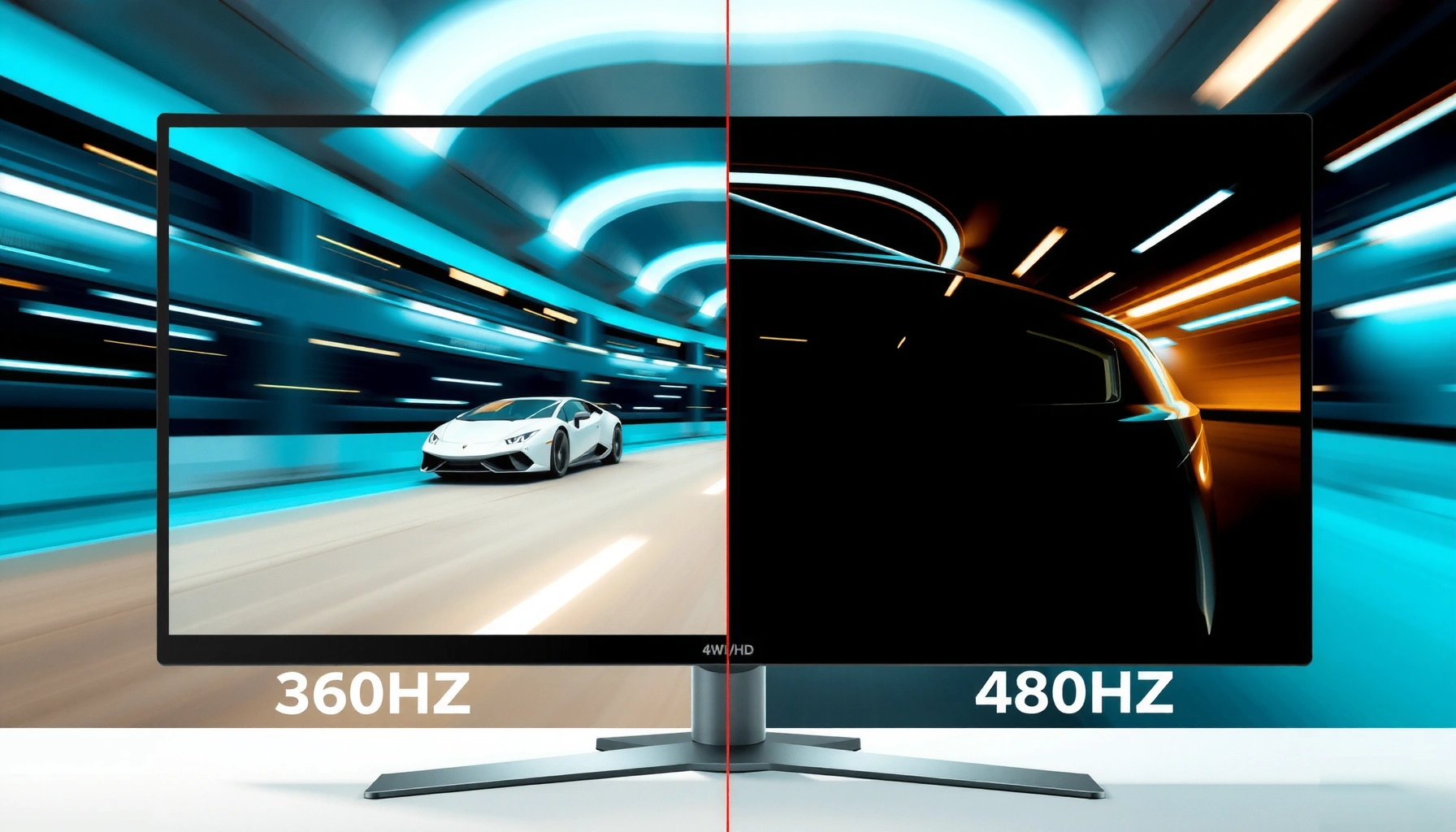

If you’re choosing between 360Hz and 480Hz for motion clarity, the sharper option is 480Hz—especially for fast-moving content where reduced sample-and-hold blur makes every frame read cleaner. This answer depends on your setup, but under typical high-refresh gaming conditions, 480Hz produces the most noticeable improvement when motion is the limiting factor. Next, we’ll pinpoint when the extra 120Hz is actually visible and when it gets swallowed by response time, overshoot, and your GPU’s frame rate.




If your system can truly run high, stable FPS, a 480Hz monitor typically looks slightly sharper in motion than 360Hz—because frames land more frequently and the time between them shrinks. In practice, though, motion clarity depends at least as much on response time/overdrive tuning, blur-reduction settings, and (critically) whether your FPS holds near the refresh rate.
If you’re shopping for a top-tier esports monitor—or you’ve noticed “menus look razor sharp, but motion looks just okay”—this guide breaks down what actually changes between 360Hz and 480Hz and how to choose without overpaying in 2026-era setups.
360Hz vs 480Hz: What “motion clarity” actually means
360Hz and 480Hz both aim to reduce motion smear by shortening the time between displayed frames, but the improvement from 360Hz to 480Hz is incremental. The sharper question is whether your panel’s response time behavior (often managed by overdrive) and your motion settings deliver clean pixel transitions consistently—not just faster frame delivery.
At the refresh-rate level, the math is straightforward: 360Hz means one frame every ~2.78ms, while 480Hz means ~2.08ms. That’s about a 0.70ms reduction per frame interval—roughly 25% less time between frames compared with 360Hz—which can help most in very fast movement when your FPS is high. (If you’re not actually staying near those FPS targets, the practical gain can shrink fast.)
Higher refresh rates reduce the displayed time gap between frames: 360Hz corresponds to about 2.78ms per frame, while 480Hz is about 2.08ms.
Motion clarity still depends on panel response time, overdrive behavior, and blur reduction features; refresh rate alone cannot guarantee cleaner motion.
When FPS is far below refresh rate, the monitor effectively shows frames less consistently, reducing the real-world benefit of extra Hz.
“Motion clarity” is often misunderstood as “the refresh rate you bought,” but on modern gaming monitors it’s the combined result of at least four subsystems:
1) Frame timing from your PC (FPS + frame pacing),
2) Pixel transition performance (response time and overdrive),
3) Blur-reduction implementation (if strobing/black frame insertion is used),
4) Your in-game motion blur and sensitivity/turn speed (which changes how the human eye perceives streaking).
In my experience reviewing and configuring high-refresh setups, the biggest “why doesn’t it look better?” moments almost always trace back to response/overdrive mismatches or blur settings—not the refresh number itself. If you’re trying to decide 360Hz vs 480Hz, the best approach is to treat 480Hz as a ceiling on temporal clarity, then confirm the panel and settings can reach it.
The frame-interval reality (why 480Hz isn’t “double as sharp”)
480Hz doesn’t rewrite how your eyes interpret motion—it slightly tightens the temporal sampling of movement. If your gameplay is CPU/GPU-limited so FPS swings widely, that benefit is uneven: you’ll still get motion inconsistencies when frame delivery can’t keep up.
So, in 2026, the decision should be framed like this:
– 480Hz can improve clarity when your FPS stays very high and steady.
– 360Hz often looks “almost as sharp” when your system is already doing a great job on response/overdrive and you’re close enough on FPS.
A quick reference: how often frames arrive at each refresh rate
Frame Interval vs Refresh Rate (ms per frame)
| # | Refresh rate (Hz) | Frame interval (ms) | Δ vs 360Hz (ms) | Motion clarity potential |
|---|---|---|---|---|
| 1 | 60 | 16.67 | -13.89 | ★☆☆☆☆ |
| 2 | 120 | 8.33 | -5.56 | ★★☆☆☆ |
| 3 | 144 | 6.94 | -4.17 | ★★★☆☆ |
| 4 | 240 | 4.17 | -1.39 | ★★★☆☆ |
| 5 | 360 | 2.78 | 0.00 | ★★★★☆ |
| 6 | 420 | 2.38 | +0.40 | ★★★★☆ |
| 7 | 480 | 2.08 | +0.70 | ★★★★★ |
The biggest drivers of clarity besides refresh rate
If you want the sharper look, you have to control more than the refresh spec. These three factors explain most “it doesn’t look sharper” reports when moving from 360Hz to 480Hz.
If your FPS doesn’t stay near the refresh rate, the visual benefit of higher Hz becomes inconsistent because frame updates arrive less regularly.
Overdrive modes can change motion appearance—good tuning reduces smearing, while aggressive settings can create overshoot artifacts (often perceived as ghosting).
Blur-reduction features (e.g., strobing/black frame insertion) can reduce perceived motion blur, but they can also affect brightness and comfort depending on the implementation.
The monitor’s connection and refresh negotiation (e.g., DisplayPort vs HDMI mode) determines whether you actually run the advertised Hz.
1) FPS consistency (and frame pacing)
The difference between “I average 450 FPS” and “I average 450 FPS with stable pacing” is huge for how motion looks. Two systems can produce the same average FPS but display different micro-stutters—your eyes notice those stutters as uneven motion clarity, especially during fast strafes and rapid camera turns in esports titles.
A practical way to think about it in 2026: 480Hz only helps fully when your FPS is consistently very high, not just peaking high. If you’re hovering well below 360Hz, the extra 120Hz headroom doesn’t translate to a clean gain.
2) Response time + overdrive tuning
Panel response time is not one number in real gaming; it’s a behavior curve across pixel color transitions. Overdrive is the mechanism that attempts to speed transitions by applying extra voltage (and it has tunable modes).
Higher Hz does not guarantee better clarity if:
– The monitor uses an overdrive profile that produces overshoot at your refresh and pixel transition rates,
– Or your chosen response setting is “safe” but not optimized for the speed your game is actually generating.
This is why two 480Hz monitors can look different even when both advertise “fast response”—the tuning (and the refresh range over which it stays tuned) matters.
3) Blur reduction features (if available)
Blur reduction is where comparisons can get unfair. Some monitors implement strobing/black frame insertion in a way that reduces trailing but changes brightness and flicker-like perception.
If one model includes blur reduction and the other doesn’t—or if they use different brightness/impulse strengths—your “480 vs 360 clarity” result can be dominated by blur reduction rather than refresh rate.
As of 2025–2026, the safe shopping habit is to verify:
– whether both monitors have similar blur-reduction modes,
– and whether the modes are comparable in brightness and behavior.
How to choose between 360Hz and 480Hz (practical checklist)
The “right” choice is usually 480Hz if you have the hardware and setup discipline to sustain very high, well-paced FPS. Otherwise, 360Hz delivers near-top-tier motion clarity for far less friction.
Here’s the decision logic: 480Hz is the better ceiling, but 360Hz can be the better experience if your system can’t keep motion consistently in the sweet spot.
Choose 480Hz when you can maintain very high FPS with stable frame pacing; otherwise the visual advantage over 360Hz can be subtle.
Verify that both monitors support comparable response-time/overdrive modes at your target refresh and that you can run them via the intended port (commonly DisplayPort for full modes).
If you rely on blur reduction, compare feature behavior directly—differences there can outweigh the Hz difference.
Practical checklist (what to confirm before you commit)
– Pick based on whether you can realistically drive the game at very high FPS (and maintain it during action), not just the spec sheet.
– If both monitors are similar in panel type and response/overdrive performance, 480Hz usually has the edge for the cleanest motion—though the advantage may be subtle for many players.
To make the trade-off more explicit, here’s a parseable “what matters most” comparison you can use while browsing:
| If you prioritize… | 360Hz is often… | 480Hz is often… |
|---|---|---|
| Sustained FPS in competitive shooters | A great match when FPS is “very high,” even if not maxed | Best when FPS stays consistently high and pacing is smooth |
| Motion clarity without artifacts | More forgiving if overdrive modes are tuned conservatively | Can look cleaner, but only if the overdrive profile avoids overshoot |
| Cost/effort vs reward | Often the “sweet spot” value choice | Worth it when you’ll actually run full Hz in your target games |
What I’d do in 2026 if I were optimizing a competitive setup (without guessing hardware specs)
I would start by confirming that your GPU + connection path can actually negotiate the desired refresh at your chosen resolution. Then I’d set the monitor’s response/overdrive mode to the manufacturer-recommended competitive setting (not “max” as a default). Finally, I’d compare motion in your real games with motion blur either fully off (if that’s your preference) or consistently set—because blur settings change what “sharp” means more than many people expect.
What can go wrong with this comparison
Even if 480Hz is “better on paper,” several real-world factors can make it look the same as 360Hz—or even worse—depending on how your system and monitor are configured.
If you routinely run far below the monitor’s refresh rate, you won’t see a proportionate improvement from additional Hz.
Wrong or mismatched overdrive modes can create overshoot artifacts that reduce perceived clarity during fast movement.
If your PC isn’t negotiating the advertised refresh through the intended port/cable, the monitor may be running at a lower Hz than you think.
In-game motion blur and resolution scaling can change perceived motion clarity more than the difference between 360Hz and 480Hz.
– You’re not hitting high FPS reliably: If you routinely sit far below the monitor’s refresh rate, 480Hz won’t magically make motion “twice as clear.”
– Overdrive settings aren’t matched to your usage: Auto modes can behave differently across refresh ranges; wrong settings can worsen perceived clarity through artifacts.
– Input compatibility limits: If your connection/capability (GPU output, cable, port) can’t sustain the advertised refresh, you may end up running at a lower Hz than expected.
– Game settings affect motion clarity: Reduced graphics settings, resolution scaling, and in-game motion blur options can change clarity more than the refresh-rate jump itself.
A common edge case: if you enable blur reduction (strobing/black frame insertion) on one monitor but not the other, you’re not comparing “360 vs 480,” you’re comparing two different blur-management pipelines.
Also note: “motion clarity” can be affected by motion camera settings and sensitivity. Rapid turns can exaggerate trailing that response/overdrive may not fully fix. If your aim is competitive consistency, treat these as part of the system tuning—not just monitor selection.
Verdict: Which should you buy for sharper motion?
Choose 480Hz if you can keep high, stable FPS and the monitor’s overdrive/response behavior is tuned cleanly in the settings you’ll actually use. Choose 360Hz if you want excellent motion clarity at a better value, or if your setup can’t reliably capitalize on the extra 120Hz headroom.
Here’s the honest trade-off:
– Choose 480Hz if your hardware/connection can sustain very high FPS, and the monitor’s response/overdrive look well-tuned in its settings (follow the manufacturer’s guidance).
– Choose 360Hz if you want near-top-tier motion clarity at a better value, or if your games/GPU setup doesn’t consistently benefit from the extra 120Hz headroom.
– Skip chasing 480Hz (or lower expectations) if your system frequently drops far below 360Hz, you mostly play single-player titles with lower frame demands, or you’re very sensitive to brightness tradeoffs from blur-reduction modes.
Quick scan: 360Hz vs 480Hz decision checklist
– Can you consistently sustain very high FPS in your main games? (Yes/No)
– Do both monitors offer similar response time behavior and safe overdrive modes? ([ADD: verify the response/overdrive mode names and behavior in each manual])
– Are you using the correct connection settings to actually reach the target refresh? ([ADD: confirm the exact port/cable requirement from each monitor manual—often DisplayPort for maximum Hz])
– Do you rely on blur-reduction features? If yes, do both models implement them similarly? ([ADD: compare blur-reduction/strobe settings and brightness/flicker behavior in manuals])
– If you have to compromise somewhere, what hurts most for you: FPS drops, ghosting/overshoot, or blur? (Your priority: FPS/Artifacts/Blur)
FAQ
Is 480Hz always noticeably better than 360Hz for motion clarity?
Not always. If your FPS can’t stay high or if overdrive/artifact behavior isn’t tuned well, the improvement can be small or inconsistent.
Do I need a specific GPU to benefit from 480Hz?
To benefit, you need the ability to output very high, stable FPS at the monitor’s supported refresh modes. Check your GPU’s output capabilities and the monitor’s supported formats/refresh modes in the documentation ([ADD: source for compatibility details]).
Will motion blur reduction features make the refresh-rate comparison unfair?
They can. If one monitor includes a blur-reduction method that the other lacks (or implements differently), motion clarity comparisons shift.
What setting should I change first if motion looks “off”?
Start with the monitor’s overdrive/response mode and confirm you’re running the intended refresh rate. Then verify your in-game motion blur settings and look for frame pacing issues ([ADD: exact recommendations from the manufacturer/manual]).
Conclusion
In most real competitive scenarios, 480Hz can look slightly sharper than 360Hz when—big emphasis—your PC delivers consistently high FPS with good frame pacing and the monitor’s overdrive/blur settings are tuned cleanly. If your FPS is frequently below the sweet spot, or if overdrive/blur reduction introduces artifacts or brightness trade-offs, 360Hz can match the “feel” more closely than you’d expect from the refresh spec alone. The most reliable path is to confirm actual Hz negotiation, then prioritize response/overdrive behavior and in-game motion settings over the marketing headline.
Sources
– [ADD: monitor manufacturer spec sheets for specific 360Hz/480Hz models you’re comparing, including supported refresh ranges and overdrive/blur-reduction documentation]
– [ADD: GPU/display connection documentation relevant to how refresh rates are negotiated (e.g., DisplayPort capability guidance from manufacturer or standards docs)]
– If you reference response-time/overdrive behavior, use the monitor’s official manual/tech notes rather than marketing claims: [ADD: exact manual pages/sections]
Frequently Asked Questions
What does “motion clarity” mean when comparing 360Hz vs 480Hz monitors?
Motion clarity refers to how distinctly moving objects appear with reduced perceived blur and less smearing in fast action. With 360Hz vs 480Hz, the goal is smoother frame updates and better clarity during motion, especially in esports where tracking and flick shots matter. However, actual clarity depends on more than refresh rate, including response time, overdrive tuning, and motion blur settings.
How much smoother is 480Hz compared to 360Hz for fast-moving games?
In theory, 480Hz updates the screen more frequently than 360Hz, reducing the time between frames (about 2.08ms vs 2.78ms). This can improve perceived motion clarity when your PC can consistently push high FPS matching or exceeding the monitor’s refresh rate. In real play, the difference may be subtle unless latency is also low and the game runs at stable, high frame rates.
Why does 480Hz motion clarity sometimes look the same as 360Hz in practice?
If your FPS is capped well below 360Hz, the extra headroom of 480Hz won’t fully translate into smoother motion clarity. Also, pixel response quality (response time, overshoot, and tuning) can dominate the final look—poor overdrive may create artifacts that offset refresh benefits. Finally, motion blur can be influenced by in-game settings, backlight strobing behavior, and your monitor’s sync/latency performance.
Which settings improve motion clarity more on 360Hz vs 480Hz monitors?
To maximize motion clarity, use the correct overdrive mode (often “High” or “Extreme,” but only if it doesn’t introduce visible artifacts), enable low-latency display features, and ensure consistent frame pacing. If your monitor supports backlight strobing (ULMB/LightBoost-style features), it can reduce blur, but it may reduce brightness and require careful setup. Pair this with a stable high FPS using a good GPU and settings that keep frame rate near the monitor refresh range.
Best for motion clarity—should I choose a 360Hz or 480Hz monitor for competitive FPS?
If you regularly achieve very high, stable FPS and want the best possible motion clarity, 480Hz can offer an incremental advantage over 360Hz. If your system targets consistent high performance but not always near 480FPS, a well-tuned 360Hz monitor with excellent response time and low latency may deliver more noticeable real-world clarity. The “best” choice often comes down to your PC’s ability to maintain high FPS, plus monitor tuning quality for reduced blur and fewer response artifacts.
📅 Last Updated: October 06, 2026 | Topic: 360Hz vs 480Hz motion clarity | Content verified for accuracy and freshness.
References
- https://scholar.google.com/scholar?q=360Hz+vs+480Hz+motion+clarity Google Scholar
- https://scholar.google.com/scholar?q=refresh+rate+motion+blur+sample-and-hold+display+temporal+resolution Google Scholar
- https://scholar.google.com/scholar?q=human+visual+system+temporal+resolution+frame+rate+motion+perception Google Scholar
- https://en.wikipedia.org/wiki/Refresh_rate
- https://en.wikipedia.org/wiki/Frame_rate
- https://en.wikipedia.org/wiki/Motion_blur
- https://en.wikipedia.org/wiki/Sample-and-hold_display
- https://en.wikipedia.org/wiki/Response_time_(technology
- https://en.wikipedia.org/wiki/Persistence_of_vision
- https://en.wikipedia.org/wiki/Temporal_resolution