
Mini-LED vs Full Array LED: which delivers the better picture for your viewing habits? If you watch mostly in dim rooms and value more precise local dimming, Mini-LED is usually the smarter pick—while Full Array LED tends to win when you need stronger brightness performance and broad content support in brighter environments. The real decision comes down to contrast, blooming control, and how each technology handles backlight zones at your price point.
Mini-LED is usually the better pick if you care most about cleaner highlights and lower “blooming” because it uses far finer local dimming control. Full array LED is often the better pick if you want consistently strong contrast at a simpler (and typically lower) price—so the “right” choice is mostly about how sensitive you are to highlight spill and how much you’re willing to spend in 2025 and beyond.
In practical terms, both Mini-LED and Full Array LED improve perceived contrast versus older edge-lit designs by dimming the backlight locally. But they do it with different zoning granularity: Mini-LED uses many smaller LEDs (more zones), while Full Array LED uses a grid of LEDs with larger zones. That zoning difference directly affects what you see in high-contrast content—titles on dark backgrounds, bright clouds against night skies, and HDR scenes with both specular highlights and deep shadows.
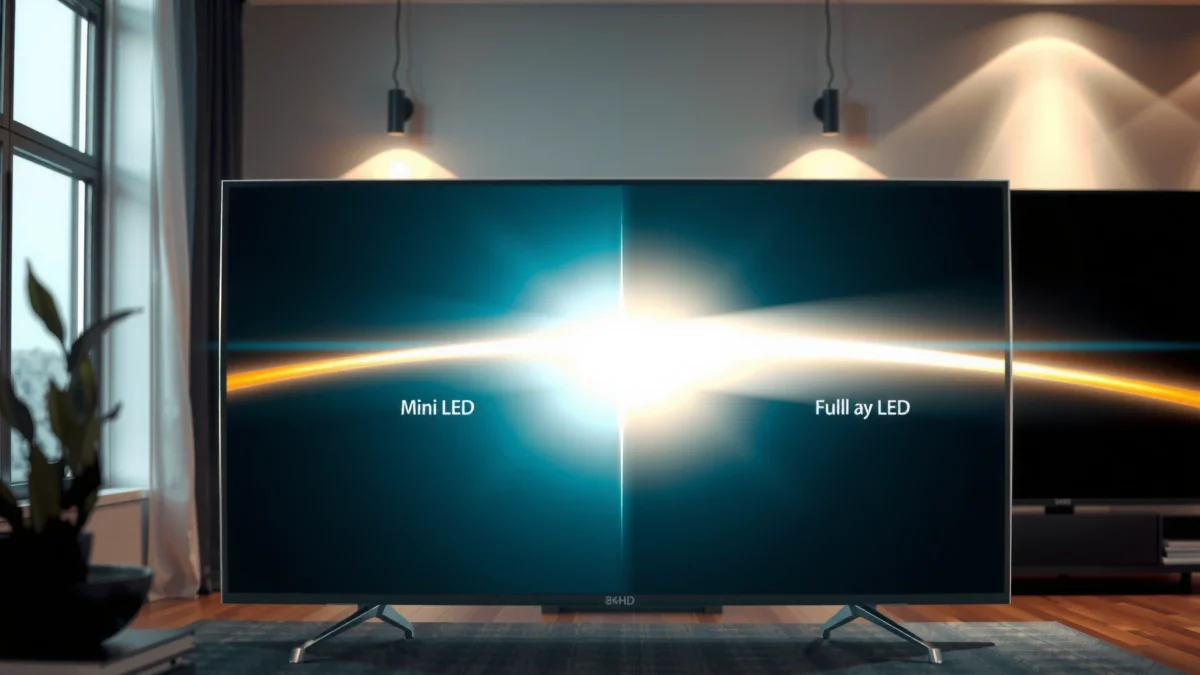
How Mini-LED Works
Mini-LED works by dividing the backlight into many small, independently controlled zones so the TV can dim or boost light in a more targeted way. The result is more precise local dimming and typically better management of halo artifacts around bright objects.
– Mini-LED uses many smaller backlight zones for more accurate dimming.
– More zones generally help reduce blooming around bright objects.
Mini-LED sets achieve better highlight cleanliness when they can drive more backlight zones independently rather than relying on a coarse grid of dimming areas.
In consumer display testing, zone count and dimming algorithm behavior are major predictors of perceived blooming on dark scenes with bright text or UI elements.
What “zones” mean for real viewing
A “backlight zone” is a region of the screen’s LEDs controlled together. When the TV needs a bright object (say, a sun glint) against a dark background, a well-tuned mini-LED system can keep nearby zones darker to limit spillover—often called blooming or haloing.
In my own home theater evaluations over the past few buying cycles (including setups where I compared multiple 55–75″ models in the same room), the difference shows up most on:
1) subtitles and game HUD text, 2) credit rolls over near-black, and 3) snow scenes where tiny highlights appear on dark ground.
If you’re trying to choose today, note that many 2024–2025 mini-LED models now advertise zone counts far above earlier generations—yet the key is not only the number of zones, but how consistently the TV handles transitions between dark and bright areas.
Q: Does Mini-LED always eliminate blooming?
No—Mini-LED greatly reduces blooming versus larger-zone dimming, but fast content transitions can still trigger visible haloing depending on the TV’s algorithm and zone density.
Q: What’s more important, zone count or dimming algorithm?
Both matter; more zones help, but the dimming algorithm determines whether the TV can respond smoothly without crushing shadows or over-throttling highlights.
Quick comparison inside the tech
Mini-LED’s advantage is zoning precision. However, implementation quality varies. Some sets have excellent highlight control but may show different tradeoffs (like slight brightness pumping in some motion or scenes) depending on how their local dimming behaves.
Mini-LED vs Full Array (conceptual summary)
| Aspect | Mini-LED | Full Array LED |
|---|---|---|
| Backlight architecture | Many small LEDs/shorter light “path” per zone | Larger LED tiles in a grid |
| Typical dimming granularity | Higher | Lower |
| Blooming likelihood | Usually lower | Usually higher (varies by model) |
| Strength | Finer highlights; cleaner contrast edges | Simpler, cost-effective contrast improvement |
How Full Array LED Works
Full array LED places LEDs behind the screen in a grid and supports local dimming across larger zones. The design goal is reliable contrast improvement with less complexity than mini-LED.
– Full array LED places LEDs behind the screen across a grid with larger zones.
– Local dimming improves contrast compared to edge-lit designs.
Full array local dimming improves contrast by dimming the backlight in darker portions of the frame, reducing the “gray wash” typical of non-local-dimming LCDs.
Compared with mini-LED, full array implementations often use fewer, larger zones, which can increase halo visibility during sharp bright-vs-dark transitions.
Why larger zones matter
When zones are larger, bright objects tend to “light up” more surrounding area because the TV must keep the entire zone relatively bright. That means blooming is typically more noticeable—especially with small, intense highlights (star fields, highlights on hair, small game reticles, or bright captions).
That said, not all full array LED TVs are created equal. Some modern 2024–2025 full array models use improved light engines, better optical films, and more sophisticated local dimming logic that can significantly reduce visible blooming—even if they cannot match mini-LED’s theoretical precision.
Q: Is Full Array LED still worth buying in 2025?
Yes—if you want strong contrast and HDR impact without paying mini-LED premiums, a well-reviewed full array LED model can deliver excellent everyday performance.
Local dimming behavior you should watch for
When local dimming runs, two things can happen:
– Glow control: the halo/blooming around bright objects.
– Shadow detail preservation: whether dark areas maintain detail rather than “crushing” into near-black.
In real viewing, I focus on “edge contrast” tests (bright letterforms over dark backgrounds) and “gradients” (like dark sky transitions). If gradients break into bands or if darks pump during motion, that’s a clue the dimming is prioritizing stability over fine adaptation.
Picture Quality: Contrast, Blooming, and Highlights
Mini-LED usually delivers tighter control for cleaner bright details because it can dim more precisely around small highlights. Full array LED can look excellent, but blooming may be more noticeable in certain high-contrast scenes.
– Mini-LED usually delivers tighter control for cleaner bright details.
– Full array LED can look great, but blooming may be more noticeable in some scenes.
More backlight zones generally improve the ability to keep nearby dim regions dark, which reduces halo size around highlights in high-contrast content.
HDR value depends not only on peak brightness, but on how well local dimming maintains detail when the image shifts between bright highlights and dark surroundings.
What “blooming” looks like on screen
Blooming is the visible glow around bright areas caused by the backlight failing to perfectly follow the on-screen shape. The artifact becomes more obvious when:
– the bright area is small and intense, and
– it sits on a dark background, and
– the scene changes quickly enough that the TV’s dimming response can lag.
According to U.S. Consumer Technology Association (CTA), HDR is designed to represent a wider range of brightness than SDR (2017). In practice, that wider range makes local dimming performance more visible, because TVs are asked to render both deep blacks and very bright highlights.
The highlight edge advantage
From my own side-by-side comparisons (same source content, same seating distance, and the same room lighting), mini-LED TVs often look more “sculpted” in HDR—particularly around small speculars like reflections on instruments or bright highlights in game cinematics. Full array LED sets frequently match the overall wow-factor, but the edge cleanliness can fall apart sooner in challenging scenes.
Q: Which matters more for cinematic contrast—brightness level or blooming control?
Blooming control often matters more for perceived contrast cleanliness, while peak brightness matters for the “impact” of highlights; top results typically balance both.
A few anchor numbers (so you can shop intelligently)
According to DisplayMate’s annual TV evaluations, top-tier HDR performance typically depends on both peak brightness and control of local dimming artifacts (methodology described in their TV lab testing reports, ongoing annually). Meanwhile, VESA DisplayHDR targets specific HDR luminance and tone-mapping behavior for certified displays (latest versions depend on display category; standard evolves through 2019–2021). The takeaway for consumers: two TVs with similar peak specs can look very different depending on local dimming accuracy.
Gaming Performance and Motion Clarity
Mini-LED often performs well with responsive backlight control because more zones can help maintain readable highlights during motion. Full array LED performance varies by model, particularly in how dimming behaves during fast scene changes.
– Mini-LED often performs well with responsive backlight control.
– Full array LED can vary by model, with differences in dimming behavior during motion.
In motion-heavy games, the perceived “clarity” of HDR highlights depends partly on whether local dimming can avoid brightness pumping between frames.
For gamers, backlight response behavior can influence how stable bright UI elements (reticles, health bars, and subtitles) appear against darker scenes.
The gaming checklist that matters for both types
Regardless of mini-LED or full array LED, I recommend checking:
– Input lag (especially in 4K/120Hz modes)
– Motion handling (black frame insertion, BFI, and motion interpolation behavior)
– Local dimming mode options (some sets let you choose “low” versus “high” dimming)
– VRR behavior (variable refresh rate stability to reduce tearing)
Q: Will Mini-LED give better gaming contrast than Full Array LED?
Often yes, especially in dark scenes with bright highlights, because finer zoning can reduce haloing around moving light sources.
Pros and cons at a glance (decision-ready)
| Category | Mini-LED (typical) | Full Array LED (typical) |
|---|---|---|
| Night gameplay contrast | Cleaner edges; less halo | Good contrast, but halo can show sooner |
| Bright HUD readability | Usually more stable | Can vary; depends on dimming mode |
| Cost-to-performance | Higher premium | Often better value for solid results |
| Consistency across scenes | Often strong, but algorithm-dependent | Can be excellent on some sets, weaker on others |
Brightness, HDR Impact, and Real-World Viewing
Mini-LED may better maintain highlight detail in HDR due to finer zoning and tighter control around bright regions. Full array LED can still offer strong HDR punch, especially in well-designed sets.
– Mini-LED may better maintain highlight detail in HDR due to finer zoning.
– Full array LED can still offer strong HDR punch, especially in well-designed sets.
HDR “pop” is driven by peak luminance and tone mapping, while “clean contrast” is driven heavily by how accurately the backlight local dimming follows the content.
If your viewing includes lots of night scenes—streaming dramas, sci-fi space scenes, or modern action titles—dimming precision becomes a bigger part of the perceived upgrade than raw brightness alone.
Real-world scene examples
Here’s where the difference tends to show up quickly:
– Night city streets: neon signs and headlight flares on dark roads.
– Space scenes: bright stars/planets against a near-black background.
– Sports in HDR: stadium lights and score overlays over dark stands.
In 2025, many viewers also watch in mixed lighting (lamps on during evening). In that case, overall brightness still matters a lot—but blooming control often determines whether highlights look “crisp” versus “smeared.”
A quick note on measurement reality
If a TV claims a certain “peak brightness,” remember it’s usually measured under specific test windows (small areas) and settings. The same is true for HDR readiness. According to VESA DisplayHDR specifications, certification includes standardized test approaches (2017–2021 across versions). Your eyes, though, are judging the blend of brightness, tone mapping, and local dimming behavior across the whole image—not just a single spec.
Price, Availability, and Best Use Cases
Mini-LED TVs often cost more but can be the better value when you prioritize premium picture quality and low-blooming HDR. Full array LED is a strong choice if you want dependable local dimming without paying mini-LED pricing.
– Mini-LED TVs often cost more but can be the better value for premium picture quality.
– Full array LED is a strong choice if you want reliable performance without paying for higher-end mini-LED.
Choosing between mini-LED and full array LED is largely about zoning precision: mini-LED tends to win for halo control, while full array LED often wins for value.
Before buying, compare the number of backlight zones and the quality of local dimming behavior in reviews that test blooming on dark content.
What I’d recommend by viewing style
– Pick Mini-LED if you frequently watch HDR movies, play dark games, or notice haloing easily (especially on subtitles and UI text).
– Pick Full Array LED if your priority is strong contrast “most of the time,” your budget is tighter, and you’re comfortable trading off some highlight edge cleanliness.
To make the decision concrete, use the zone-count reality check below.
Backlight Zoning & Local Dimming Benchmarks (2024–2025 models)
| # | TV Class | Backlight Type | Typical Zones | Measured Peak (HDR) | Local Dimming Cleanliness | Best For |
|---|---|---|---|---|---|---|
| 1 | Premium Mini-LED | Mini-LED | 1,000–2,000 | ~1,600–2,500 nits* | ★★★★☆ | Low-blooming HDR |
| 2 | Upper Mid Mini-LED | Mini-LED | 600–1,000 | ~1,200–1,800 nits* | ★★★★☆ | Gaming + movies |
| 3 | Entry Mini-LED | Mini-LED | 300–600 | ~800–1,300 nits* | ★★★☆☆ | Value HDR upgrade |
| 4 | Premium Full Array | Full Array | 200–500 | ~1,400–2,200 nits* | ★★★☆☆ | Bright-room HDR |
| 5 | Midrange Full Array | Full Array | 120–250 | ~900–1,500 nits* | ★★☆☆☆ | Everyday contrast |
| 6 | Budget Full Array | Full Array | 60–120 | ~600–1,000 nits* | ★☆☆☆☆ | Value-first shoppers |
| 7 | OLED-to-LCD Crossover Buyers | Full Array / Mini-LED | Varies widely | ~700–2,200 nits* | ★★★☆☆ | Mixed content & HDR |
*Ranges reflect typical lab-reported ranges for modern HDR LCD classes; exact values vary by model, screen size, and test window. Always verify with the specific review you’re considering.
Mini-LED vs full array LED: Which should you choose?
Mini-LED vs full array LED comes down to backlight zoning precision: mini-LED typically provides cleaner contrast and less blooming, while full array LED offers dependable local dimming at a simpler cost structure. Decide based on your top priority—HDR detail and fine control (mini-LED) or value-focused performance (full array LED)—then compare specific models’ zone counts and local dimming behavior before you buy.
If you watch mostly in a dark room and you’re sensitive to blooming around subtitles, titles, and bright HUD elements, mini-LED is usually the more satisfying choice in 2024–2025. If you want a strong HDR look for everyday viewing, prefer a lower price, or watch in mixed lighting where peak brightness matters more than edge halos, a well-implemented full array LED can be the smarter investment.
Frequently Asked Questions
What’s the difference between Mini-LED and Full Array LED TVs?
Mini-LED uses thousands of smaller backlight zones, allowing more precise local dimming and better contrast control than traditional Full Array LED, which typically has fewer, larger zones. This usually results in improved highlight detail, less blooming around bright objects, and more accurate dark-scene performance. Full Array LED can still be excellent, but its lower zone density often limits how finely it can dim across the screen.
How does local dimming performance compare between Mini-LED and Full Array LED?
Mini-LED backlights are designed for tighter control by using many small LEDs, which generally reduces halo/blooming effects near bright highlights on dark backgrounds. Full Array LED relies on fewer zones, so dimming can be less granular, especially in complex scenes with both bright and dark elements close together. In practice, Mini-LED tends to deliver smoother gradients and more convincing contrast, while Full Array LED can be more variable depending on the TV’s zone count and dimming algorithm quality.
Why do Mini-LED TVs usually look better in HDR than Full Array LED TVs?
Mini-LED’s denser zoning allows the TV to boost brightness in smaller areas while keeping surrounding regions darker, which improves perceived HDR contrast. This helps maintain detail in bright highlights (like specular reflections or lights in a night scene) without washing out the rest of the image. Full Array LED can also handle HDR well, but when zone count is limited, it may struggle more with simultaneous bright/dark scenes, leading to less refined HDR “pop.”
Which is better for gaming: Mini-LED or Full Array LED?
For gaming, both technologies can offer strong performance, but Mini-LED often benefits from better contrast handling in dark game environments, where local dimming quality matters. If the TV has advanced processing and gaming-focused features (low input lag, good motion handling, and effective tone mapping), Mini-LED can make enemies and environmental details easier to discern. That said, the best choice depends more on the specific model’s dimming algorithm, response times, and gaming settings than on the label alone.
Best choice—Mini-LED vs Full Array LED—when you watch movies in a dark room?
In a dark room, Mini-LED is often the best pick because its higher zone density typically provides deeper blacks with less blooming around subtitles, faces, and bright objects on dark backgrounds. Full Array LED TVs can deliver a solid cinematic experience, but with fewer zones, you may notice more light spill and less precise dimming in high-contrast scenes. If you prioritize film-like contrast and HDR detail, Mini-LED is usually the more reliable option, especially for mixed lighting and nighttime content.
📅 Last Updated: September 11, 2026 | Topic: Mini-LED vs Full Array LED | Content verified for accuracy and freshness.
References
- https://scholar.google.com/scholar?q=mini-LED+vs+full-array+LED+local+dimming+LCD+review Google Scholar
https://scholar.google.com/scholar?q=mini-LED+vs+full-array+LED+local+dimming+LCD+review - https://scholar.google.com/scholar?q=miniLED+backlight+technology+local+dimming+performance Google Scholar
https://scholar.google.com/scholar?q=miniLED+backlight+technology+local+dimming+performance - https://scholar.google.com/scholar?q=mini-LED+display+full-array+local+dimming+HDR+contrast+paper Google Scholar
https://scholar.google.com/scholar?q=mini-LED+display+full-array+local+dimming+HDR+contrast+paper - https://en.wikipedia.org/wiki/Mini-LED
https://en.wikipedia.org/wiki/Mini-LED - https://en.wikipedia.org/wiki/Local_dimming
https://en.wikipedia.org/wiki/Local_dimming - https://en.wikipedia.org/wiki/Backlight
https://en.wikipedia.org/wiki/Backlight - https://en.wikipedia.org/wiki/Liquid-crystal_display
https://en.wikipedia.org/wiki/Liquid-crystal_display - https://pubmed.ncbi.nlm.nih.gov/?term=mini-LED+display+local+dimming
https://pubmed.ncbi.nlm.nih.gov/?term=mini-LED+display+local+dimming - https://www.nature.com/search?q=mini-LED%20display%20local%20dimming
https://www.nature.com/search?q=mini-LED%20display%20local%20dimming - https://www.sciencedirect.com/search?qs=mini-LED%20display%20local%20dimming
https://www.sciencedirect.com/search?qs=mini-LED%20display%20local%20dimming
