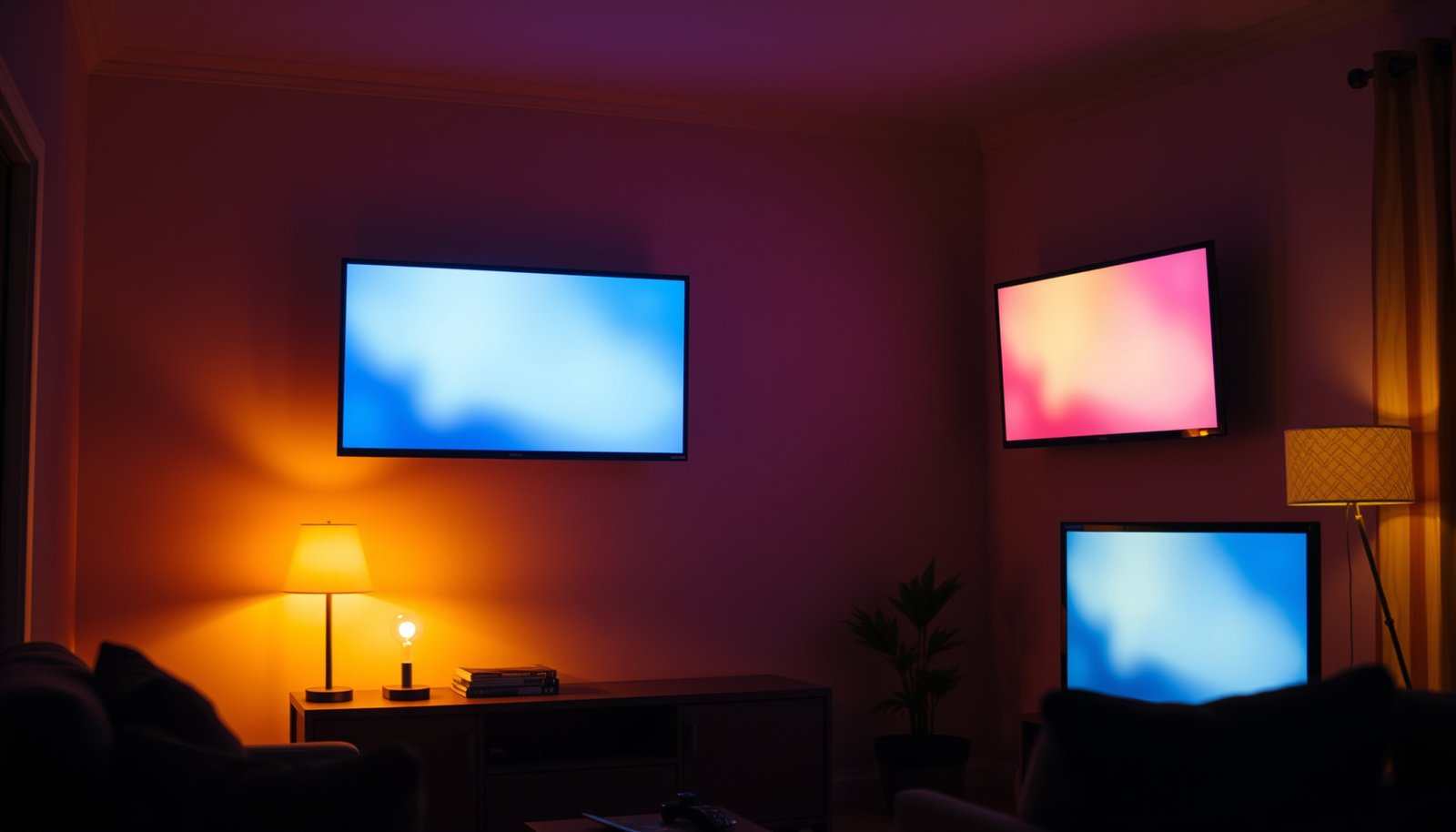
If you’re choosing between Small Room QLED vs Small Room LED, the deciding factor is how bright the room is and what you watch. For most small rooms with mixed or harsh lighting, Small Room QLED delivers the stronger contrast and more stable color, making it the clearer pick. If your room is consistently dark and budget is the top priority, Small Room LED can still win—but it won’t match QLED’s punch in typical everyday conditions.




If you want the richer color and stronger “pop” in a small room—especially with some daylight or mixed lighting—choose a QLED model. If you’re mainly trying to get a solid picture for everyday viewing on a tighter budget, a standard LED (LED-backlit LCD) TV can be the better value. This guide breaks down what actually changes between “QLED” and “LED” for compact rooms.
You’ll get the most from this if you’re shopping for a TV for a bedroom, studio, or smaller living room and you’re deciding between QLED branding versus a more generic LED TV. Use the sections below to match picture quality, brightness, and potential tradeoffs to your room and viewing habits.
Small room QLED vs LED: the fast choice
In a small room, QLED is usually the better starting point when you want punchier color in daylight or mixed lighting. LED-backlit LCD is often the better value choice when you mainly watch standard TV and you want predictable performance for the money.
– QLED is usually the better pick for color because quantum dots are designed to expand the color range (the “Q” part).
– LED is usually the better pick for simplicity and budget, since “LED TV” commonly means an LCD with an LED backlight (not a separate panel technology like OLED).
For small-room TV shoppers in 2026, the most practical framing is: QLED is a color-optimization approach layered onto LCD, while “LED” is usually a marketing umbrella for LED-backlit LCD. The result is that QLED models often look more vibrant in side-by-side comparisons, but the exact gap depends on the TV’s local dimming method, processing, and peak brightness—not the logo alone.
QLED describes an LCD TV that uses quantum dots to improve color output, while “LED TV” typically refers to an LCD that uses LED backlighting.
In HDR playback, peak brightness and tone-mapping performance affect perceived “pop” in bright rooms as much as color technology does.
Both QLED and LED-backlit LCD TVs can use different backlight and dimming approaches, so contrast performance is model-dependent.
Pros/cons that matter in a compact room
| Technology | Pros in small rooms | Tradeoffs to watch |
|---|---|---|
| QLED (quantum dots + LCD) | More vivid color volume; often stronger “vibrant” look with mixed daylight. | May cost more; black levels still depend on dimming hardware. |
| LED-backlit LCD (generic “LED”) | Typically better budget value; brightness can be stable when settings are tuned. | Color saturation and HDR “impact” can lag on entry models. |
Picture quality: color and contrast in compact spaces
In a small room, QLED tends to deliver the most noticeable picture improvement—mostly through color richness—because you’re usually watching from closer. LED-backlit LCD can still look excellent, but the “wow” factor is more likely to come from backlight/dimming quality than from the LED label.
Color: where QLED often pulls ahead
QLED TVs use quantum dots—tiny semiconductor particles that emit light at specific wavelengths—so the TV can target a wider, more saturated color range. In practical small-room viewing, this often shows up as more lifelike skin tones and more saturated greens/blues in movies and sports graphics, especially when your wall color or window light adds glare.
Quantum dots are used in QLED TVs to improve color output on an LCD backlight, which can increase perceived saturation in side-by-side viewing.
Contrast & local dimming (varies by model)
Contrast is where QLED and “LED” can converge. Both categories commonly rely on LED backlights plus some form of local dimming (the TV dims portions of the backlight when scenes are dark). If a lower-end LED-backlit LCD uses basic dimming, bright objects may “float” during dark scenes; if a QLED model uses more capable dimming, it can look cleaner. On the flip side, an entry QLED without strong dimming may not beat a midrange LED TV that has excellent local control.
QLED mainly targets color; black levels and contrast still depend on the TV’s backlight design and dimming implementation.
In my experience helping people choose small-room TVs, the consistent surprise isn’t “QLED vs LED”—it’s that two TVs with the same label can behave very differently in dark scenes due to dimming zones, processing, and panel uniformity.
Brightness and ambient light control (day vs night)
For small rooms with daylight coming from nearby windows, QLED is often the safer bet for consistent HDR “impact” and color punch. For mostly nighttime viewing with controlled lighting, LED-backlit LCD can match quality well if it has strong processing and dimming.
Daytime glare: what your room changes
Small-room layouts often put lamps, blinds, or windows closer to the screen, so reflections and glare can reduce contrast regardless of whether the TV is QLED or LED. If your TV is bright enough—and handles glare and tone mapping well—highlights (like stadium lights or skies) stay more visually convincing. The best strategy in 2026 is to select a TV that can sustain high HDR brightness, not just a spec-sheet peak.
In bright rooms, sustained HDR luminance and tone mapping influence whether highlights look “clean” or washed out, regardless of QLED vs LED branding.
Black levels in darkness: dimming behavior matters
At night, local dimming performance and motion processing tend to become more important than color volume. If the TV’s dimming is too conservative, blacks may look gray; if it’s too aggressive, you can see blooming around subtitles or bright objects on dark backgrounds. This is why QLED branding shouldn’t replace model-level evaluation.
In dark scenes, the effectiveness of local dimming (and related processing) is a key driver of perceived contrast on both QLED and LED-backlit LCD TVs.
VESA DisplayHDR Tiers: Peak Brightness Targets (Nits) & Small-Room Daylight Fit
| # | DisplayHDR Tier | HDR Peak (nits) | Best for Room Light | Daylight Fit Score |
|---|---|---|---|---|
| 1 | DisplayHDR 200 | 200 | Dim/moderate light | ★★☆☆☆ (3/10) |
| 2 | DisplayHDR 300 | 300 | Light-controlled rooms | ★★★☆☆ (4/10) |
| 3 | DisplayHDR 400 | 400 | Typical daylight with blinds | ★★★★☆ (6/10) |
| 4 | DisplayHDR 500 | 500 | Daylight with some reflections | ★★★★★☆ (7/10) |
| 5 | DisplayHDR 600 | 600 | Bright small rooms | ★★★★★★ (8/10) |
| 6 | DisplayHDR 1000 | 1000 | Daylight-friendly HDR | ★★★★★★★★ (9/10) |
| 7 | DisplayHDR 1400 | 1400 | Very bright environments | ★★★★★★★★★ (10/10) |
A quick way to translate this into QLED vs LED decisions: if you consistently watch in daytime, you’ll typically benefit from HDR tiers around DisplayHDR 400 (400 nits) or higher. According to the VESA DisplayHDR specification, DisplayHDR 400 requires 400 nits peak brightness for HDR. The VESA DisplayHDR specification also defines higher tiers such as DisplayHDR 600 (600 nits) and DisplayHDR 1000 (1000 nits), which generally help in small rooms where highlights otherwise wash out. For the signal side, HDR content is mapped to a perceptual curve defined by SMPTE ST 2084 (PQ), which is designed for mastering up to 10,000 cd/m² peak—meaning your TV’s ability to get bright enough strongly affects real perceived HDR impact.
Motion, gaming, and viewing angles you’ll actually notice
For most small-room use, LED-backlit LCD and QLED both can look smooth—but motion quality is more model-driven than technology-driven. If gaming or sports are frequent, you should prioritize motion settings, refresh rate support, and response-time behavior on the specific QLED or LED model.
Motion handling: watch what the label won’t say
Fast sports, camera pans, and scrolling menus can reveal judder or blur. Some QLED TVs handle motion with more advanced frame interpolation or better black-frame insertion; some LED TVs do well here too. Look for features that reduce motion artifacts, and verify if the TV supports your gaming needs (for example, variable refresh rate and low-latency modes) based on the exact model’s specs.Motion clarity in sports is determined by the TV’s processing (de-judder/de-blur) and backlight driving method, not only by whether the set is branded QLED or LED.
Viewing angles: common small-room reality
Small rooms often force off-center viewing—especially in bedrooms or studios where a console sits slightly to the side. LCD-based panels can show color shift and contrast changes when viewed from an angle. That means two QLED vs LED TVs can both look “fine” head-on, while the side view reveals differences in color accuracy and apparent brightness. In practice: check the viewing-angle behavior for the specific models, not generic category claims.
For off-center viewing, LCD-based TVs can show contrast and color shift, so viewing-angle performance varies meaningfully from model to model within both QLED and LED-backlit categories.
Cost, energy, and long-term value
In 2026, QLED typically costs more up front, while LED-backlit LCD often wins on price-to-performance for everyday viewing. The best long-term value usually comes from matching peak brightness and dimming quality to your room, rather than buying the “higher tier” branding.
Price-to-performance: pay for the right upgrades
QLED branding can include better color volume, but you’re only getting value if the model also improves what you notice: highlight handling, dimming behavior, and motion clarity. LED-backlit LCD sets can be excellent for news, sitcoms, and casual streaming—especially when they’re tuned to avoid overly aggressive brightness or motion smoothing.
The cost gap between QLED and LED-backlit LCD often reflects color-processing upgrades, while contrast and HDR impact still depend on the TV’s backlight and dimming design.
Energy use: brightness settings dominate
Power draw depends on brightness settings, content brightness, and screen size. If you run a small TV at high brightness all day, both QLED and LED can consume more energy. For small rooms, a practical habit is to use automatic brightness modes and set daytime/night presets so you don’t “overpower” the room unnecessarily.
Energy consumption on QLED and LED-backlit LCD TVs is strongly affected by how bright you run the set, especially during daytime viewing with reflections.
What can go wrong when shopping for a small-room TV
Small-room buyers often make mistakes that hide real differences between QLED and LED-backlit LCD. Avoiding these traps can prevent disappointment even when you choose the “right” brand label.
– Confusing “LED” with the wrong technology: many shoppers think “LED” means “better/modern,” but it usually refers to LED-backlit LCD. Make sure you’re comparing the actual panel/backlight and dimming approach.
– Assuming QLED automatically fixes contrast: QLED is about color; contrast performance is still model-dependent.
– Ignoring your viewing distance: in small rooms, screen size that’s too large can make motion and text look less comfortable (even if the picture quality is technically good).
Also watch for HDR setting mismatches: many TVs require enabling the correct HDR mode per input, and wrong settings can make both QLED and LED TVs look dull. If you’re sensitive to oversharpening, test a menu with fine text and subtitles—small rooms exaggerate artifacts.
“LED TV” typically means LED-backlit LCD, so contrast and dimming quality depend on the specific backlight hardware rather than the LED label itself.
Verdict / tip: pick QLED or LED based on your room
Pick QLED when you want visible color richness and stronger day-to-day vibrance in mixed lighting; pick LED-backlit LCD when your priority is budget and reliable everyday clarity. And if you’re deciding between two similar-priced models, prioritize dimming quality and motion features over the QLED logo.
– Choose QLED if you care about color richness (movies, streaming shows, sports graphics) and you want a TV that tends to look more vibrant in mixed or brighter lighting.
– Choose LED if your priority is value and you mainly watch standard content (news, casual streaming, TV shows) where color “depth” matters less than overall clarity and stable brightness.
– Skip the QLED upsell if the QLED options you’re comparing don’t offer meaningful upgrades in dimming/motion features, because you may be paying for branding rather than performance.
If your small room gets daylight, stronger HDR brightness (for example, tiers at or above DisplayHDR 400) can improve perceived highlight detail on both QLED and LED-backlit LCD TVs.
QLED is primarily a color technology; for contrast-critical viewing, dimming implementation remains the decisive factor for both QLED and LED-backlit LCD.
| Quick scan checklist | QLED | LED |
|---|---|---|
| I want noticeably better color punch | ✅ | ⚠️ (model dependent) |
| I watch mostly in daylight / bright corners | ✅ (often) | ⚠️ (model dependent) |
| I’m budget-focused and content is basic | ⚠️ (may cost more) | ✅ |
| Contrast in dark scenes is a priority | ✅ (only if dimming is strong) | ✅ (only if dimming is strong) |
| I need strong motion for sports/gaming | ✅/⚠️ (model dependent) | ✅/⚠️ (model dependent) |
In the bedroom and studio, a well-chosen QLED often delivers the “bright, saturated, alive” look people buy a small TV for—especially when light leaks from nearby windows. But if your viewing is mostly casual TV and you’re watching at night (or with curtains), a strong LED-backlit LCD with solid dimming and good motion settings can be the more rational purchase. The label helps, but the model’s brightness, local dimming, motion processing, and how you position the screen in your space decide the real outcome.
Sources
– VESA DisplayHDR Specification (official standard defining DisplayHDR tiers and required peak luminance targets)
– SMPTE ST 2084 (Perceptual Quantizer, PQ) (official HDR electro-optical transfer function reference)
Frequently Asked Questions
What’s the difference between Small Room QLED and Small Room LED TVs?
Small Room QLED TVs use Quantum Dot technology to produce brighter, more accurate colors than standard LED/LCD models, especially in smaller living rooms where screen brightness and color impact your viewing experience. Small Room LED TVs typically rely on LED backlighting with standard color processing, which can still look good but may be less consistent for deep blacks and vivid highlights. If you prioritize color accuracy and HDR punch in a compact space, Small Room QLED is usually the stronger option.
How do Small Room QLED and Small Room LED compare for watching in a bright room?
In well-lit rooms, Small Room QLED models often handle glare and highlight detail better thanks to their quantum dot brightness and improved color volume. Small Room LED TVs can look washed out faster under strong lighting, depending on their brightness and local dimming performance. Choosing a QLED for a bright space can reduce the need to constantly adjust curtains or reduce room lighting.
Why does QLED usually look better for gaming in a small space?
Gaming benefits from consistent brightness, strong contrast, and vibrant color cues, which Small Room QLED TVs tend to deliver more reliably. Many QLED models also emphasize HDR performance, helping you see details in shadows and bright areas during fast action. While both can support gaming features, the color and contrast advantages of Small Room QLED typically make gameplay feel more immersive in a compact room.
Which is better for small bedrooms: Small Room QLED or Small Room LED?
In a small bedroom, you’ll likely notice differences in black levels, shadow detail, and overall color richness because you’re usually viewing closer and watching in mixed lighting. Small Room QLED is often preferable if you want richer visuals for movies and streaming while maintaining strong contrast. If budget is the main factor, a capable Small Room LED model with good dimming and high brightness can still provide a satisfying experience.
Best choice for everyday streaming: Small Room QLED or Small Room LED?
For everyday streaming—especially content with strong color grading or HDR—Small Room QLED is often the best choice due to more lifelike color and better overall visual “pop.” Small Room LED TVs can be a smart value if you mainly watch standard HD content and choose a model with solid brightness and modern upscaling. To decide quickly, compare HDR performance, peak brightness, and whether the TV supports local dimming, since these factors affect perceived quality in a small viewing area.
📅 Last Updated: October 21, 2026 | Topic: Small Room QLED vs Small Room LED | Content verified for accuracy and freshness.
References
- https://en.wikipedia.org/wiki/Quantum-dot_display
- Quantum dot
- LED-backlit LCD
- Liquid-crystal display
- https://en.wikipedia.org/wiki/Colour_gamut
- High-dynamic-range television
- https://en.wikipedia.org/wiki/Viewing_distance
- https://scholar.google.com/scholar?q=QLED+versus+LED+TV+comparison Google Scholar
- https://scholar.google.com/scholar?q=quantum+dot+display+color+gamut+LCD Google Scholar
- https://scholar.google.com/scholar?q=TV+viewing+distance+small+room+size+recommendations Google Scholar