

The expansion of 6G testing in major cities worldwide is revolutionizing the telecommunications landscape. As cities like New York, Tokyo, and London become testing grounds for this next-generation technology, we can expect faster data speeds, lower latency, and a host of innovative applications. This article will explore how 6G testing is being implemented, which cities are leading the charge, the key technologies involved, the challenges faced, and the future implications for connectivity and society.
The Importance of 6G Testing

6G is not just an incremental upgrade; it promises to deliver significantly faster data speeds and near-zero latency compared to its predecessor, 5G. This advancement opens the door to numerous possibilities, such as seamless virtual reality experiences and real-time data processing for autonomous vehicles. Testing in urban areas is crucial as it allows telecom companies to refine their technologies in real-world scenarios. By implementing 6G in densely populated environments, developers can better understand the challenges of urban connectivity, optimize network performance, and ensure effective deployment when the technology becomes widely available.
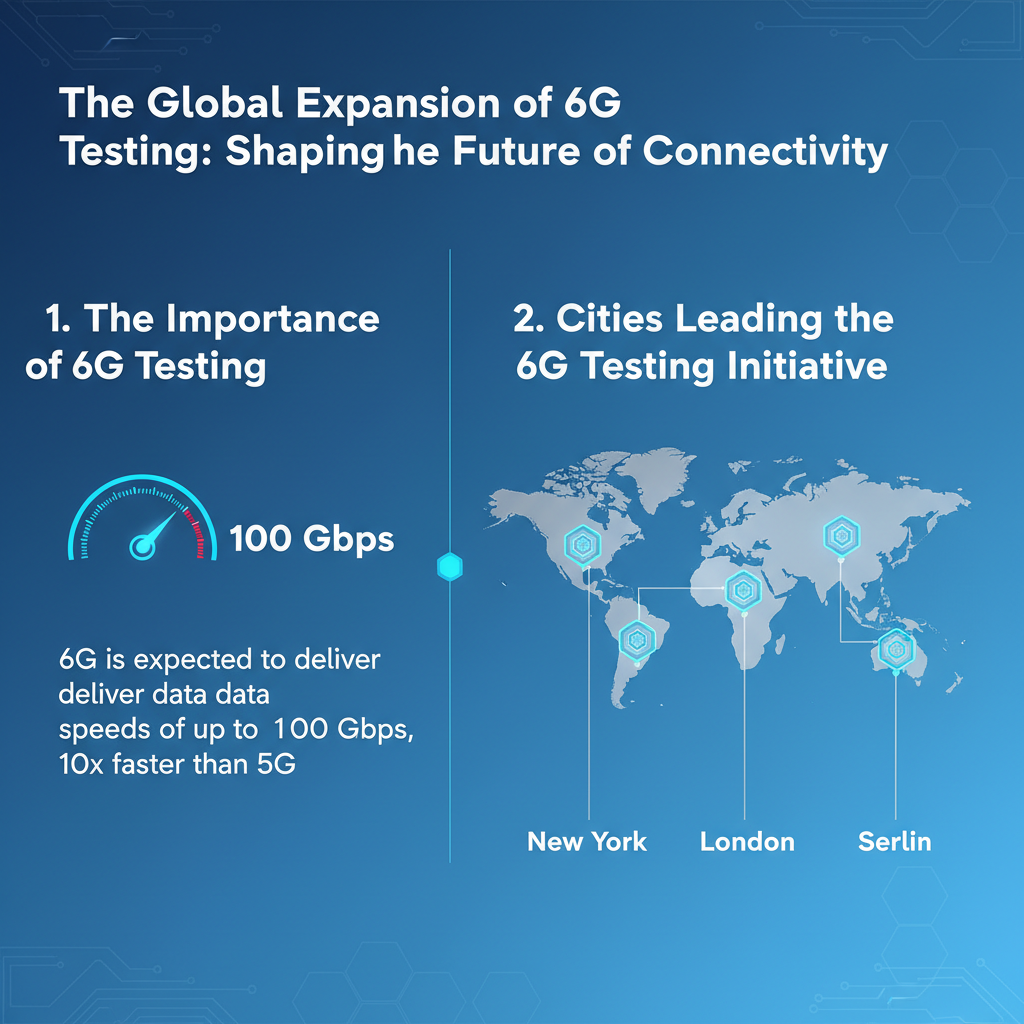
Moreover, urban centers are typically the first to adopt new technologies, making them ideal environments to push the boundaries of what is possible with 6G. The feedback gathered during these tests helps in shaping future standards and protocols, ultimately leading to a more robust and efficient network for users around the globe.
Cities Leading the 6G Testing Initiative

Several major cities are taking the lead in 6G testing, each bringing unique resources and capabilities to the initiative. New York City, for instance, has become a hotspot for innovation, with local government and telecom companies like AT&T and Verizon collaborating to establish a 6G testing framework. These partnerships focus on upgrading existing infrastructure and creating new technological ecosystems to support advanced connectivity.
Tokyo is also at the forefront, where the Japanese government has invested heavily in next-generation telecommunications. Collaborations between universities, research institutions, and telecom giants like NTT Docomo are pushing the envelope on what 6G can achieve, particularly in areas like smart city applications and enhanced public safety measures.
London is equally ambitious, facilitating trials in various boroughs to evaluate 6G’s potential in urban mobility, healthcare, and public services. The city’s commitment to innovation is evident in its partnerships with tech startups and global telecom leaders, fostering a dynamic environment for experimentation and growth.
Key Technologies Involved in 6G Testing
Several cutting-edge technologies are being utilized in 6G testing to enhance connectivity and network performance. One of the primary tools is advanced antennas, including massive MIMO (Multiple Input Multiple Output) systems that allow for improved signal processing and capacity. These antennas can communicate with multiple devices simultaneously, making them ideal for urban settings where connectivity demands are high.
Satellite communication systems also play a critical role in the development of 6G. By integrating satellite technology, telecom companies can extend coverage to rural and remote areas, ensuring that the benefits of 6G reach a broader population. This integration could lead to a more equitable distribution of technology, bridging the digital divide.
Artificial intelligence (AI) and machine learning are indispensable in optimizing network performance and reliability. These technologies can analyze vast amounts of data in real time, enabling proactive management of network traffic and resource allocation. For instance, AI algorithms can predict peak usage times and adjust bandwidth accordingly, ensuring users enjoy consistent and reliable connectivity.
Challenges Faced During 6G Testing
While the promise of 6G is exciting, several challenges hinder its testing and eventual deployment. Regulatory hurdles are among the most significant obstacles. Governments must establish new spectrum allocations to accommodate the advanced frequencies used by 6G technologies, and this process can be slow and complex. Different countries may have varying regulations, leading to inconsistent testing environments globally.
Infrastructure limitations are another critical challenge. Many urban areas lack the necessary groundwork to support 6G technology, requiring substantial investments in upgrading existing networks and installing new equipment. The high costs associated with these developments can deter smaller telecom companies from participating in the race for 6G, potentially leading to monopolization by larger players.
Additionally, the rapid pace of innovation often outstrips the establishment of safety and security protocols. As more devices connect to the network, the potential for cyber threats increases, necessitating robust security measures that must be integrated into the testing phase.
The Future of 6G and Its Impact on Society
The anticipated rollout of 6G technology is set to enable groundbreaking innovations, shaping the future of various sectors. Smart cities will emerge as a primary beneficiary, using interconnected devices to streamline traffic management, improve energy efficiency, and enhance public safety. With 6G’s ultra-reliable low-latency communication, city infrastructure can respond in real-time to changing conditions, ultimately improving the quality of life for residents.
Autonomous vehicles are another promising application of 6G technology. The near-instantaneous data exchange facilitated by 6G can help vehicles communicate with each other and their surroundings, making transportation safer and more efficient. This could lead to reduced traffic congestion and lower accident rates, revolutionizing how people commute.
Immersive virtual reality experiences will also flourish, opening new avenues for entertainment, education, and remote work. With 6G’s high data speeds, users can enjoy seamless experiences that feel incredibly lifelike, whether they are attending a virtual concert or participating in a digital classroom.
The societal impact of 6G extends beyond technology; it has the potential to drive economic growth. By fostering innovation and improving productivity across various sectors, 6G could create new job opportunities and enhance global competitiveness.
How Can You Stay Informed About 6G Developments?
Staying informed about 6G developments is easier than ever thanks to a wealth of resources available online. Following industry news outlets such as TechCrunch, Wired, and IEEE Spectrum can provide you with the latest updates on 6G testing and deployment.
Engaging with tech blogs and subscribing to newsletters focused on telecommunications will also keep you in the loop about advancements and breakthroughs in the field. Social media platforms are another valuable tool; following experts and organizations in the telecommunications sector can offer unique insights and perspectives.
Additionally, consider participating in local tech community events or webinars. These gatherings provide an excellent opportunity to engage with industry professionals and learn more about emerging technologies firsthand. Networking with like-minded individuals can also lead to valuable discussions about the future of connectivity.
The expansion of 6G testing in major cities marks a critical step towards a future of enhanced connectivity and innovation. As urban centers lead the way, they are not only paving the path for this groundbreaking technology but also tackling the challenges that accompany it. By understanding these developments, you can gain insights into how 6G might shape your life and the world around you, empowering you to be part of the conversation on this exciting journey into the future.
Frequently Asked Questions
What are the key features of 6G technology that are being tested in major cities?
6G technology is anticipated to bring significantly enhanced features compared to its predecessor, 5G. Key features under testing include extremely high data rates exceeding 100 Gbps, ultra-reliable low-latency communication (URLLC), and advanced network slicing capabilities. Additionally, 6G aims to integrate artificial intelligence to optimize network performance and enhance user experiences, making it a transformative upgrade for urban connectivity.
How is 6G testing being conducted in major cities?
6G testing in major cities involves a combination of field trials, simulations, and collaborative efforts between tech companies, universities, and government agencies. These tests use advanced equipment and infrastructure to evaluate performance metrics such as speed, latency, and device density. The results help refine technology standards and ensure that the networks are ready to support the growing demand for high-speed internet and IoT solutions in urban environments.
Why is 6G testing important for future urban development?
6G testing is crucial as it lays the groundwork for future urban development by enabling next-generation applications and services. With features like enhanced connectivity and higher bandwidth, cities can leverage 6G for smart infrastructure, autonomous vehicles, and advanced public safety systems. By ensuring robust and reliable network capabilities, urban planners can create more efficient and sustainable cities that meet the needs of a tech-savvy population.
What are the potential challenges of 6G testing in urban environments?
The potential challenges of 6G testing in urban environments include regulatory hurdles, infrastructure limitations, and the need for widespread collaboration among various stakeholders. Additionally, ensuring network security and managing electromagnetic spectrum allocation are critical concerns that need to be addressed. These challenges must be navigated to create a seamless transition from 5G to 6G while ensuring reliable service for all users.
Which major cities are currently leading the way in 6G testing initiatives?
Major cities leading the way in 6G testing initiatives include Tokyo, New York, London, and Seoul. These cities have established partnerships with telecom operators, tech firms, and academic institutions to spearhead 6G research and development. Their strategic locations and technological infrastructure make them ideal testing grounds, paving the way for advancements that will shape the future of global telecommunications.
References
- https://www.bbc.com/news/technology-63003012
- https://www.reuters.com/technology/6g-technology-testing-takes-center-stage-2022-09-22/
- https://www.sciencedirect.com/science/article/abs/pii/S1389128621000352
- https://www.nist.gov/news-events/news/2023/06/nist-research-aims-advance-6g-technology-future
- https://www.itu.int/en/ITU-T/6G/Pages/default.aspx
- https://www.wired.com/story/6g-technology/
- Nokia Corporation | Nokia
- https://www.nist.gov/6g